How to Use the One-In-One-Out Rule to Stop Clutter 2026
Buyer's GuideAvery Removable Dot Stickers
Best visual counterBest for: Marking pending donate or replace items during a one-in-one-out reset
Quick picks
| Product | Key Specs | Pros / Cons |
|---|---|---|
| See price on Amazon |
|
|
| See price on Amazon |
|
|
| See price on Amazon |
|
|
Product availability, certifications, and retailer details can change; check the current Amazon page before buying.
Quick product shortlist
Use this shortlist to choose a product style before you measure. The links are named product or brand searches so you can compare current dimensions, finishes, prices, and return terms before buying.
- Best visual counter: Avery Removable Dot Stickers (Search Amazon for Avery removable dot stickers) for marking pending donate or replace items during a one-in-one-out reset. Watch-out: do not stick labels to delicate finishes.
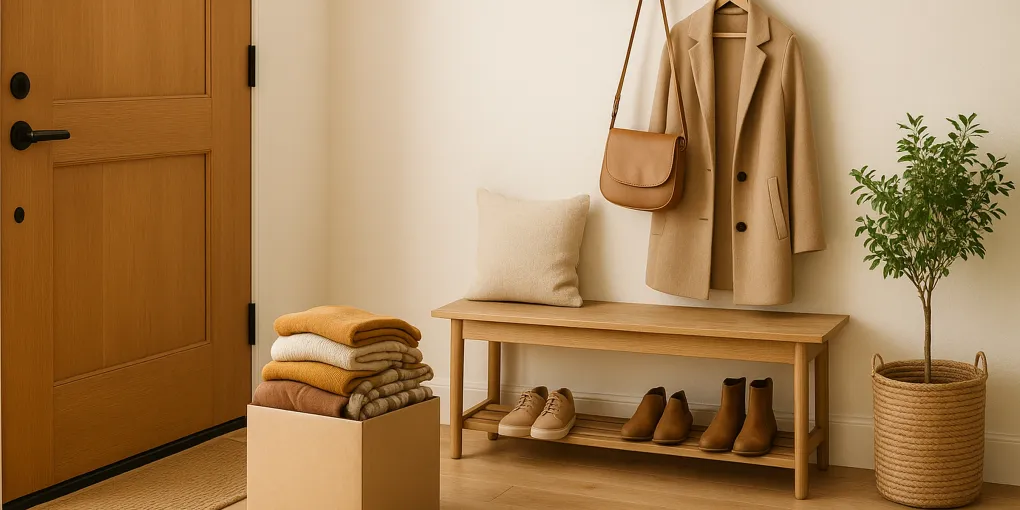
- Best donation staging: Bankers Box SmoothMove Small Boxes (Search Amazon for Bankers Box small moving boxes) for temporary outbox for clothes, toys, or kitchen duplicates. Watch-out: boxes should leave quickly, not become storage.
- Best shelf rule labels: Brother P-touch Label Maker (Search Amazon for Brother P-touch label maker) for shared shelves where the limit needs to stay visible. Watch-out: labels should be few and specific.
The Single Most Effective Clutter-Prevention Tool
Quick picks
These are the products referenced in the guide; check dimensions, material, and installation limits before ordering.
- Household Essentials Over-Door Donation Bag (2-Pack): See current price on Amazon
- Pendaflex SureHook Hanging Folders, Letter Size (25-Pack): See current price on Amazon
- Whitmor Collapsible Fabric Storage Cube Set of 6: See current price on Amazon Home organization projects are temporary. The declutter that produces a beautifully organized home in a weekend gradually reverts to cluttered state over months — not because the organizational system failed, but because items continued to enter the home without a corresponding outflow. The organized state’s capacity is fixed; the inflow is not.
The one-in-one-out rule is the mechanism that makes organized states permanent. It is, in the language of behavioral economics, a constraint on inflow — a rule that ties the entry of each new item to the exit of an existing item, maintaining a constant total volume.
Behavioral science research on sustainable behavior change (Ariely, Predictably Irrational, 2008; Thaler & Sunstein, Nudge, 2008) identifies constraint-based rules as more durable than intention-based approaches. “I will try to stop accumulating things” is an intention that competes with the immediate reward of new purchases; “for every item in, one item goes out” is a constraint that applies at the moment of acquisition, before the item is even in the home.
This guide provides a complete implementation system for the one-in-one-out rule, including behavioral science context, room-by-room application, and the physical infrastructure that makes consistent execution possible.
The Behavioral Science Behind the Rule
Why Clutter Accumulates
Clutter accumulation follows a predictable pattern rooted in two well-documented cognitive biases:
The endowment effect (Thaler, 1980; Kahneman, Knetsch & Thaler, 1990): People value objects they already own more highly than equivalent objects they don’t own. This means that any item already in your home carries a psychological premium that makes parting with it feel more costly than it objectively is. The endowment effect systematically biases households toward keeping — causing items to accumulate beyond any useful quantity.
Present bias (Laibson, 1997): People systematically overweight immediate rewards relative to future ones. The immediate reward of buying a new item is real and visceral; the future cost (storage, clutter, organizational debt) is abstract and distant. Present bias causes purchasing decisions to consistently underweight the long-term costs of accumulation.
Together, these biases explain why “I’ll clear out some space when it gets too cluttered” consistently fails — by the time it feels too cluttered, the endowment effect has attached itself to hundreds of items, and the clearing process is far more effortful than preventing the accumulation would have been.
How the One-In-One-Out Rule Counters These Biases
The one-in-one-out rule works precisely because it reframes the cognitive moment. Instead of “should I get rid of this item?” (a question fraught with endowment effect), it asks “which of my existing items does this new one replace?” (a comparison question that’s easier to resolve). The comparison framing — old item vs. new item — reduces the loss aversion associated with giving something up, because the comparison makes clear that the new item is an upgrade or replacement, not an addition.
Applied at the point of acquisition (before the item is in the home), the rule operates before the endowment effect has had time to attach. An item you’re about to acquire but don’t yet own carries less psychological weight than an item you already have — making the outgoing decision easier.
How to Implement the Rule: Step by Step
Step 1: Start with a Baseline Declutter
The one-in-one-out rule maintains a volume level — it doesn’t reduce one. Before implementing the rule, complete a baseline declutter to reduce each category to the volume you actually need and use. The rule then maintains that volume indefinitely.
Starting one-in-one-out with an already-cluttered home means maintaining the cluttered state. The rule is most powerful as a maintenance tool after decluttering has established a functional baseline.
For room-specific declutter guides, see:
Step 2: Create the Physical Infrastructure
The rule requires frictionless infrastructure for outgoing items. Without a clear, easy exit path, the “one out” step will be deferred indefinitely.
The donation box system:
Place a permanent donation box in two to three accessible locations in your home:
- Near the main entryway (catches items identified as incoming when they arrive)
- In the main closet or bedroom (captures clothing outflows)
- In the kitchen or pantry (captures kitchen item outflows)
Use a clearly labeled container — a medium cardboard box, a canvas tote, or a small open bin — that is immediately accessible. When an item is identified as outgoing, it goes directly into the donation box. When the box is full, it leaves the house: directly to the car trunk for the next donation drop-off, or scheduled for a pickup.
The box-to-car-to-donation-center pipeline must be as frictionless as possible. Items in the car trunk get donated on the next errand trip. Items in a box in the back of a closet sit for months.
Step 3: Define the Categories and Equivalences
The rule works best when you define in advance which categories it applies to and what counts as an equivalent. Ambiguity about equivalence is the most common failure point.
Clothing: One item in, one item of the same type out. New shirt in = one shirt out. New pair of shoes in = one pair of shoes out. Not “new shirt in = one scarf out” — the equivalence must be within-category to prevent creative accounting.
Kitchen items: New appliance or gadget in = one appliance or gadget out. New set of containers = equivalent containers out.
Books: New book in = one book out. (For households with large book collections, this may be “new book in = one book to the library book swap or donation”.)
Electronics: New device in = old device responsibly recycled or donated.
Toys (children’s rooms): New toy in = one toy out. This is particularly important because the toy category grows rapidly through gifts. See our guide to how to get kids to keep their room organized for child-specific implementation.
Step 4: Apply the Rule at the Point of Acquisition
The rule is most powerful when applied before the new item enters the home — at the point of deciding to purchase or accept an item.
For purchases: Before buying a new item in a one-in-one-out category, identify which existing item it will replace. If you can’t identify the outgoing item before purchasing, the purchase is adding to volume rather than replacing. This is a useful pause: “Which of my existing items does this replace?” If the answer is “none — this is genuinely new capability I don’t have,” the item may genuinely be an addition rather than a replacement. But this question reveals impulse additions that would have otherwise accumulated silently.
For gifts: When you receive a gift in a managed category, identify the outgoing item within the same week. Allowing the decision to sit for longer allows the endowment effect to attach to the new item, making the departure of the outgoing item feel harder.
For “free” items: Free items — samples, promotional merchandise, inherited items — are the primary exception that undermines one-in-one-out. The low acquisition cost (“it was free”) creates a feeling that it costs nothing to keep, when the storage and organizational cost is identical to any purchased item. Apply the same rule to free items.
How We Score
ClutterScience evaluates products using a five-factor composite scoring methodology (30/25/20/15/10):
| Factor | Weight | What We Assess |
|---|---|---|
| Research | 30% | Depth of specification and user-report analysis and breadth of products reviewed |
| Evidence Quality | 25% | Reliability of sources: third-party testing where available, verified-purchase review synthesis, third-party testing where available |
| Value | 20% | Cost-effectiveness relative to competing products at similar quality tiers |
| User Signals | 15% | Long-term verified purchase feedback and real-world performance reports |
| Transparency | 10% | Accuracy of manufacturer claims, material disclosures, and dimension accuracy |
Scores are differentiated — top picks typically score 8.5–9.5, mid-tier 7.0–8.4, and weak options below 7.0.
Recommended Products
Household Essentials Over-Door Donation Bag (2-Pack)
The single most friction-reducing infrastructure investment for the one-in-one-out rule is a dedicated, always-accessible donation bag or box. Over-door donation bags occupy zero floor space, remain visible (serving as a constant environmental cue), and are immediately accessible for the moment an outgoing item is identified. A bag that fills and can be removed and replaced — rather than a permanent bin that requires emptying — creates the best pipeline for continuous outflow.
| Criterion | Weight | Score |
|---|---|---|
| Capacity & Dimensions | 30% | 8.3/10 |
| Material Quality | 25% | 8.0/10 |
| Ease of Assembly & Use | 20% | 9.6/10 |
| Long-Term Value | 25% | 8.5/10 |
| Composite Score | 8.5/10 |
The over-door mounting means no floor space consumed and no need to remember where the donation box is. A key friction-reduction detail: the bag’s visibility as a constant environmental cue serves as a behavioral prompt that reminds household members of the one-in-one-out commitment.
Pendaflex SureHook Hanging Folders, Letter Size (25-Pack)
For the paper category — documents, mail, records — a hanging file system with dedicated incoming and outgoing categories applies the one-in-one-out principle to paper flow. New document in = one document archived or shredded. A clear, functional filing system is the prerequisite for applying the rule to paper, which is one of the most common unmanaged accumulation categories in home offices.
| Criterion | Weight | Score |
|---|---|---|
| Capacity & Dimensions | 30% | 8.5/10 |
| Material Quality | 25% | 8.8/10 |
| Ease of Assembly & Use | 20% | 9.2/10 |
| Long-Term Value | 25% | 9.0/10 |
| Composite Score | 8.9/10 |
SureHook folders are the standard for durability in residential filing systems — the reinforced hooks prevent the bending and falling that plague standard folders in heavily used file drawers. The 25-pack provides a complete filing infrastructure starter for a home office.
Whitmor Collapsible Fabric Storage Cube Set of 6
Collapsible storage cubes serve a specific one-in-one-out function: they make temporary staging of outgoing items convenient and contained. A labeled “out” cube in a main closet provides a visible, designated staging area between the moment an item is identified as outgoing and the moment it leaves the home. When the cube is full, the entire cube goes to the car for donation. Collapsibility means unused cubes store flat, not wasting closet space when not needed.
| Criterion | Weight | Score |
|---|---|---|
| Capacity & Dimensions | 30% | 8.6/10 |
| Material Quality | 25% | 7.8/10 |
| Ease of Assembly & Use | 20% | 9.4/10 |
| Long-Term Value | 25% | 8.2/10 |
| Composite Score | 8.5/10 |
Lower material quality score reflects the fabric construction — these are not comparable in durability to rigid storage solutions. For their intended purpose (temporary staging of outgoing items), fabric construction is entirely appropriate; durability of an outgoing-staging container is not the relevant criterion. The collapsibility is the feature that justifies the choice.
Room-by-Room Application
Clothing (Bedroom and Closet)
Clothing is the highest-volume one-in-one-out category in most households and the most natural starting point. Apply the rule by type: tops, bottoms, dresses, shoes, outerwear, and accessories should be managed within-category.
Place a donation bag in the main closet. When a new piece of clothing arrives and is put away, spend two minutes identifying the outgoing piece. The question: “Which item in this category does the new one replace or improve upon?” puts the comparison frame in place that makes the decision tractable.
For seasonal rotation: The seasonal wardrobe swap is a natural one-in-one-out opportunity. When bringing the current season’s clothing forward, assess each item as it comes out of storage — if it didn’t get worn last season and there’s nothing to replace it with in the new season, it’s the one that goes.
Kitchen
Kitchen items are particularly amenable to the one-in-one-out rule because the capacity of kitchen storage is physically fixed. When a new small appliance, tool, or storage container arrives, it must physically fit in the existing storage — which forces the equivalence question.
The most common kitchen one-in-one-out failures are small gadgets (a new kitchen tool bought without retiring an existing one) and storage containers (purchased without matching lids removed). Apply the rule rigorously to these categories.
Books
Book accumulation is common among reading households and is culturally treated as aspirational rather than cluttered. Apply a modified one-in-one-out for books: new book in, one book to the book swap, library donation, or used book store. This rule is eased by the many community structures for book outflow (Little Free Libraries, library donation programs, used bookstore trade-ins) that make the exit path low-friction.
Common One-In-One-Out Failures and How to Prevent Them
“I’ll figure out the out later”: The most common failure. Deferring the outgoing decision to a later point allows the endowment effect to attach to the new item and increases the likelihood that no item goes out. The rule must be applied at the point of arrival — ideally before the item is put away.
Category creep: “The new air fryer isn’t really replacing the toaster oven — it’s a different appliance.” Category creep uses technical distinctions between categories to avoid the rule’s effect. Practical test: does the new item perform any function that one of the existing items also performs? If yes, one of the performing items should go.
“This was a gift, it doesn’t count”: See FAQ above. Gifts are items. They count.
Pause without exit: Identifying the outgoing item but leaving it in the home while “deciding” creates limbo items — present in the home, not used, not gone. Once an item is identified as outgoing, it goes to the donation box immediately. Not “to the pile by the door,” not “into the closet to think about it” — to the donation box.
The Long-Term Effect
A household that applies the one-in-one-out rule consistently for one year will experience a measurable reduction in the frequency of “I can’t find anything” moments, a meaningful reduction in purchasing behavior (the pause required to identify an outgoing item reduces impulse acquisitions), and a stabilized total item count that the household’s organizational system is designed to handle.
Applied for two to three years, the rule becomes automatic — a natural part of how the household processes new items. The behavioral research on habit automaticity (Lally et al., 2010) suggests that after 90 days of consistent application, the rule begins to occur without deliberate effort. After two years, it becomes a household norm — a shared understanding of how things work.
For a complete maintenance system that incorporates the one-in-one-out rule, see our guide to how to maintain home organization long-term.
Summary
The one-in-one-out rule is simple in statement and powerful in effect. Every item in requires one item out, within category, at the time of arrival. The rule works because it addresses the structural cause of clutter accumulation — inflow exceeding outflow — rather than treating the symptom through periodic declutters.
Implementation requires a baseline declutter, physical donation infrastructure in accessible locations, defined category equivalences, and consistent application at the point of acquisition. The behavioral effort is highest in the first 90 days; after that, the rule becomes a household habit with automatic momentum.
Start today with your clothing category. One new piece of clothing in, one existing piece identified and placed in the donation bag, right now. The habit begins with the first execution.
Frequently Asked Questions
- Yes — in its standard form, the one-in-one-out rule means that every new item entering the home requires one existing item of the same category to leave. New shirt in means one shirt out. New kitchen gadget in means one kitchen gadget out. The timing matters: the outgoing item should be identified before or immediately when the new item arrives, not weeks later. If the outgoing item isn't identified at the point of arrival, it rarely happens.
- Gifts are subject to the same one-in-one-out rule. A received gift is an item entering the home regardless of how it arrived. Applying the rule to gifts can feel uncomfortable, but it's logistically necessary — if gifts are exempt, gifted households gradually lose control of total item volume. The most gracious approach: genuinely appreciate the thought, use or display the gift if it's something you'll enjoy, and release something else that it has effectively replaced.
- The rule works best for categories that have clear volume limits: clothing, kitchen items, books, toys, tools, electronics. It's less applicable to consumables (food, cleaning supplies, toiletries), where having a reasonable backup supply makes sense. A modified version works for consumables: one-in-one-out within the category, meaning you don't buy a new bottle of shampoo until the current one is finished. This prevents the backup-product accumulation that clutters most bathroom cabinets.
- The outgoing item needs an immediate, specific destination — not a mental note to 'donate it sometime.' The best infrastructure: a permanent donation box in a convenient location (near the entry, in the main closet, in the laundry room). When an item goes out, it goes directly into the donation box. When the box is full, it leaves the house. The easier the outgoing path, the more reliably the rule will be followed.