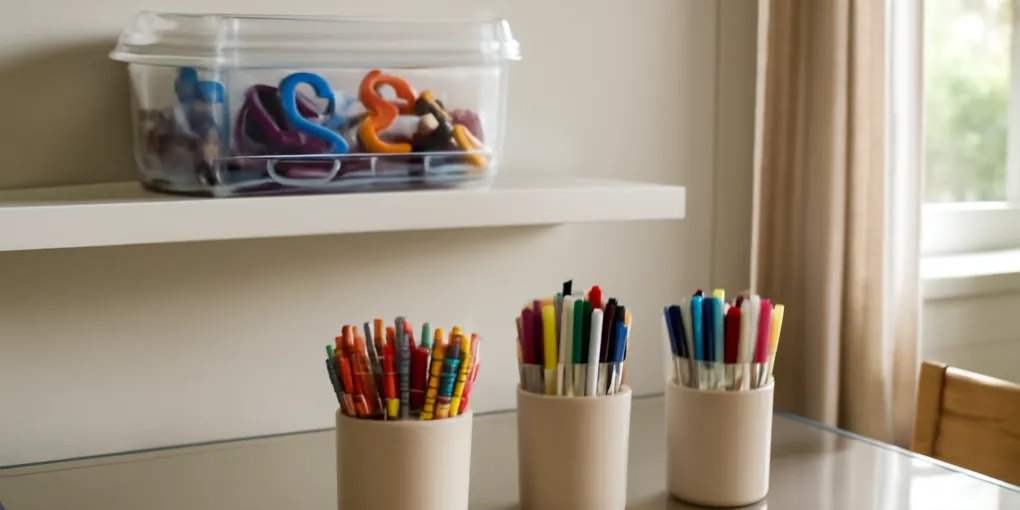
Kids Art Scissors Storage Protocol: Stop Sharp Tools From Disappearing Into Craft Bins
ProtocolQuick picks
Latching craft tool box
★ Top pick Best adult-control container- Note: Use for scissors, sharpeners, hole punches, and tools that should not live loose in a child-access bin.
Open crayon and marker caddy
Best child-access bin- Note: Keeps low-risk supplies visible so the closed sharp-tool box does not become the whole craft system.
Kids art clutter often starts as generosity: a rolling cart full of crayons, glue sticks, stickers, scissors, rulers, sharpeners, and half-finished projects. The problem is that not every craft item belongs in the same access category. A marker caddy can be open. A craft blade cannot.
This protocol separates child-access art supplies from adult-controlled sharp tools. It is for playrooms, homework stations, kitchen craft drawers, and rolling carts where scissors disappear into mixed bins. For small toy parts, see the toy small-parts quarantine bin protocol. For art supply carts generally, see best art supply carts for kids homework stations.
Quick picks for a safer craft split
- Sharp-tool container: Search Amazon for latching craft tool boxes. Pick a box that closes reliably and fits the scissors without forcing the blades against the side.
- Child-access caddy: Search Amazon for kids art supply caddies. Use this for crayons, markers, glue sticks, and paper tools appropriate for the child’s age.
- Drawer divider reset: Search Amazon for shallow drawer organizers. Use dividers only after sharp tools have been separated.
Why mixed craft bins fail
The American Academy of Pediatrics encourages home childproofing that keeps dangerous items out of children’s reach and uses locked or inaccessible storage for hazards (HealthyChildren childproofing guidance). Safe Kids Worldwide also emphasizes age-appropriate toy and small-object safety (Safe Kids toy safety).
Craft stations need the same access logic. The organizing goal is not one beautiful rainbow cart. The goal is a station where children can reach safe supplies independently and adults can find sharp tools quickly when supervision is needed.
Step 1: empty the craft bin onto a towel
Use a towel or tray so small blades, staples, and broken pencil tips do not scatter. Pull out every item from the art cart, drawer, school-supply bin, and project basket.
Sort into four groups: child-access supplies, supervised tools, trash/recycling, and project leftovers. Child-access supplies are age-dependent, but often include crayons, washable markers, glue sticks, stickers, and paper. Supervised tools include scissors, sharpeners, hole punches, craft blades, staplers, pins, needles, and metal-edged rulers.
Step 2: create an adult-controlled tool box
Put supervised tools into one latching box or high cabinet container. The box should close fully with the longest scissors inside. If you use a clear box, position it where children cannot access it casually. If older children have supervised access, make the rule explicit: the box comes out for a project and goes back when the cutting step ends.
Do not hide sharp tools in the bottom of an open cart. Hidden is not secure. It just makes the next cleanup slower.
Step 3: keep low-risk supplies easier to reach than scissors
A safety split works only if the child-access supplies are still convenient. Put crayons, markers, glue sticks, tape, and paper in open cups or a handled caddy. The child should not need to open the sharp-tool box to start a normal drawing project.
This prevents the common workaround where the whole closed box is left open because every supply is inside it. Separate access levels are the point.
Step 4: assign project cleanup jobs
At the end of a craft session, use a two-pass cleanup. First, count and return supervised tools. Second, return open supplies. Counting scissors before markers sounds fussy until the missing item is under a chair cushion.
For classrooms or multi-child households, use a small tray during the project. Scissors and punches live on the tray while in use, not scattered across the table.
What to store where
| Item | Storage level |
|---|---|
| Crayons, washable markers, stickers | Open child-access caddy |
| Glue sticks and blunt craft tools | Open or semi-open, depending on age |
| School scissors | Adult-controlled box or supervised tray |
| Pencil sharpeners with blades | Adult-controlled box |
| Craft knives, pins, needles, replacement blades | Locked or adult-only storage |
Maintenance reset
Once a month, remove dried markers, broken crayons, dried glue, scraps, and mystery project pieces. Check the sharp-tool box for rust, loose blades, broken handles, and items that no longer belong. If a tool is too sharp or specialized for the child’s current age, move it to adult craft storage.
Use this reset to reduce duplicates. Three working glue sticks are easier to manage than twelve half-dry ones. Two counted pairs of scissors are safer than a handful spread across backpacks, couch cushions, and drawers.
School-project exception rule
Some projects need a temporary table setup with scissors, staplers, skewers, or specialty blades. Treat that as a project tray, not a storage change. Put the supervised tools on one tray while the project is active, count them when the cutting step is finished, and return the tray to adult storage before the child-access caddy goes back on the shelf.
This rule prevents the common after-project slide. A tool used safely for one afternoon should not remain in the open art cart for the next week.
Kids art scissors FAQ
Are blunt-tip scissors safe enough to leave out?
Blunt-tip scissors may be appropriate for some supervised child projects, but they are still cutting tools. Store them according to the child’s age, behavior, and household rules rather than treating the shape as permission to leave them loose.
What about a rolling art cart?
Use the cart for paper, coloring tools, and project bins. Put sharp tools in a separate adult-controlled box or on a high cart tier that is not child-accessible. A cart should not make every tool equally available.
How many pairs of scissors should a craft station keep?
Keep the few pairs you actually supervise and can count back in. Extra scissors create the same problem as extra markers: they spread into backpacks, couch cushions, and junk drawers.
Bottom line
A safer kids craft station has two access levels. Open supplies invite independent creativity. Sharp tools live in a closed adult-controlled box, come out for a supervised step, and return before the rest of the table cleanup begins.
Frequently Asked Questions
- Not by default. Keep low-risk supplies open and visible, but store scissors, sharpeners, hole punches, and craft blades in a separate adult-controlled container.
- School scissors, craft scissors, pencil sharpeners with blades, hole punches, rulers with metal edges, craft knives, pins, needles, and small replacement blades.
- Split the station into open child-access supplies and a closed adult-access tool box that comes out only during supervised projects.