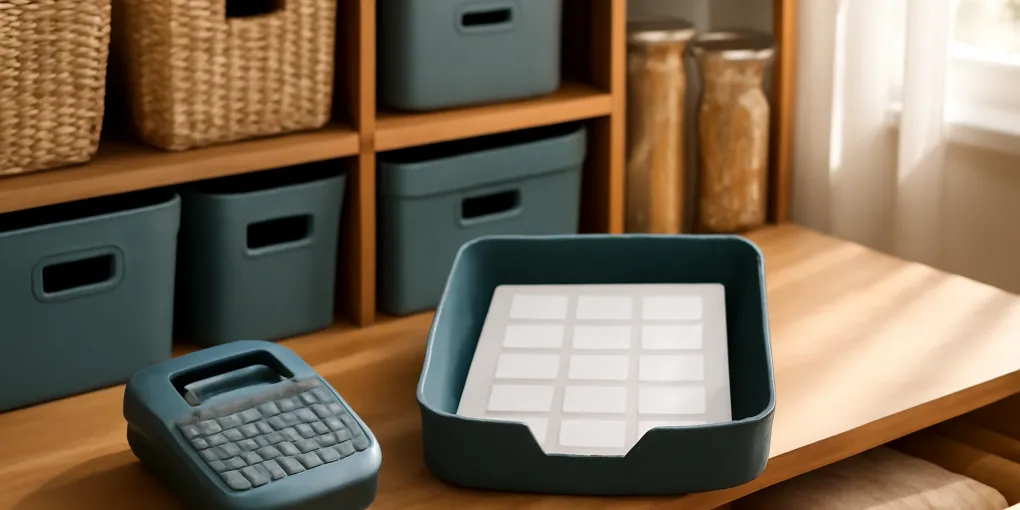
Label Maker vs Printable Labels: Which System Holds Up at Home?
ReviewBrother P-touch PT-D210 Label Maker
Best durable everyday labelsBest for: Bins, shelves, cords, and rotating categories
Quick picks
| Product | Key Specs | Pros / Cons |
|---|---|---|
| See price on Amazon |
|
|
| See price on Amazon |
|
|
| See price on Amazon |
|
|
Product availability, certifications, and retailer details can change; check the current Amazon page before buying.
Quick product shortlist
Use this shortlist to choose a product style before you measure. The links are named product or brand searches so you can compare current dimensions, finishes, prices, and return terms before buying.
- Best durable everyday labels: Brother P-touch PT-D210 Label Maker (Search Amazon for Brother P-touch PT-D210 label maker) for bins, shelves, cords, and rotating categories. Watch-out: tape refills add ongoing cost.
- Best batch printable labels: Avery 5160 Printable Labels (Search Amazon for Avery 5160 printable labels) for large pantry, moving, or classroom-style labeling projects. Watch-out: printer alignment and ink durability matter.
- Best pocket thermal option: Phomemo D30 Label Maker (Search Amazon for Phomemo D30 label maker) for small homes that want quick app-designed labels. Watch-out: thermal labels may fade in heat or sun.
Quick picks
Use this as a shortcut to the products mentioned below; verify dimensions and mounting limits against your space before buying.
- home label maker: See current price on Amazon
- water resistant label tape: See current price on Amazon
- printable pantry labels: See current price on Amazon
- clear bin label holders: See current price on Amazon
How We Score Clutter Systems
Use the checks below to compare whether the product actually fits the room, survives daily handling, and makes the next reset easier.
| Factor | Weight | What It Measures |
|---|---|---|
| Research | 30% | Fit with habit formation, retrieval friction, environmental cues, and household workflow evidence |
| Evidence Quality | 25% | Consistency with consumer-safety guidance, professional organizing practice, and product documentation |
| Value | 20% | Payoff relative to cost, setup time, durability, and space recovered |
| User Signals | 15% | Common household failure points, return complaints, repeated mess patterns, and ease of maintenance |
| Transparency | 10% | Clear tradeoffs, limitations, measurement assumptions, and when a cheaper option is enough |
The score is not a promise that one label system solves clutter. It is a way to compare whether the system reduces decisions, keeps high-use items visible, and makes the next reset easier.
The Short Answer
A label maker is best for durable, flexible, small-batch home organization. Printable labels are best for coordinated sets, large batches, decorative systems, and situations where you want icons, colors, or a specific style. The better choice depends on who will maintain the system after the first weekend.
Labels are not decoration first. They are shared memory. They tell the next person where an item goes when the original organizer is not standing there. The best label is legible, specific, easy to replace, and placed where the hand reaches.
Useful searches include home label maker (See current price on Amazon), water resistant label tape (See current price on Amazon), printable pantry labels (See current price on Amazon), and clear bin label holders (See current price on Amazon).
Comparison Table
| Criterion | Label maker | Printable labels |
|---|---|---|
| Best for | Daily household changes | Coordinated, repeated sets |
| Speed | Fast for one-off labels | Fast after template setup |
| Durability | Strong with the right tape | Depends on paper, ink, and laminate |
| Design control | Limited but clear | High |
| Replacement | Easy for one label | Easy if template is saved |
| Cost pattern | Device plus tape | Printer, sheets, ink, optional laminate |
| Best rooms | Garage, pantry, office, cables | Pantry jars, kids bins, craft rooms |
The hidden cost is not the tool. It is maintenance. A beautiful printable system fails if nobody knows where the template is saved. A label maker system fails if replacement tape is never kept in the house.
When a Label Maker Wins
Choose a label maker when categories change often. Garages, utility closets, office files, medicine bins, charging drawers, and kids’ school supplies all evolve. A label maker lets you rename a bin in thirty seconds instead of waiting for a design session.
Label makers also win when durability matters. Many tapes handle wiping, humidity, and frequent touch better than plain paper labels. They are not indestructible, but they are practical for shelves, bins, drawers, cables, and plastic totes.
The design downside can be a strength. Plain labels are readable. In a shared household, clarity usually beats charm.
When Printable Labels Win
Printable labels win when you need a full set. Pantry jars, craft drawers, classroom-style bins, toy categories, and event storage can benefit from consistent typography and icons. Printable labels also make sense when you want larger text or bilingual labels.
The risk is over-designing. If the label set includes categories your home does not actually use, the system becomes aspirational. Print only the labels you need now, and save a blank template for changes.
For damp rooms, laminate or use water-resistant sheets. For textured baskets, use tag holders instead of trying to stick labels to uneven fibers.
Placement Matters More Than Format
Put labels where eyes and hands naturally go. A shelf label belongs on the shelf lip. A bin label belongs on the front face or handle. A drawer label belongs where the drawer is opened, not on the top surface that disappears when closed.
Use action-oriented names. Returns, Batteries, Lunch Snacks, Guest Towels, Use First, Winter Gloves, and Printer Paper are better than Miscellaneous, Supplies, or Other. If a category contains unrelated items, edit the category before labeling it.
A Hybrid System
Most homes benefit from both tools. Use printable labels for stable, visible categories and a label maker for changing utility categories. Keep one small label kit in the home: label maker or printed blanks, scissors, removable adhesive, a marker, and spare holders.
Set a label review trigger. When a bin overflows twice, rename or split the category. When a label falls off twice, change the material or placement. When people ignore a label, the category may not match the real behavior.
Measurement Checklist
Measure the physical space in three ways: total opening, usable interior, and operating clearance. Total opening tells you what could theoretically fit. Usable interior accounts for hinges, trim, pipes, baseboards, shelf pegs, and uneven walls. Operating clearance is the space needed to pull a bin, open a door, lift a lid, or stand safely while using the system. Most frustrating storage purchases fail on the third measurement.
Also measure the category. Count how many items must be stored during a normal week and how many appear during peak season. A pantry may need room for holiday baking once a year, but it should not sacrifice daily breakfast access all year for that rare peak. A label system may need blank labels for new categories, but it should not print labels for imaginary future hobbies. Design for normal use, then create one small overflow rule for peaks.
What Not to Store Here
Every successful zone has a not-here list. Do not store sentimental undecided items in active storage. Do not store donation piles in a pantry, towel zone, entryway, or label station. Do not let returns, repairs, and gifts occupy the same container as daily supplies. Those categories need their own temporary homes and deadlines.
If the system keeps attracting unrelated items, the room may be missing a landing zone. Add one small tray or basket for temporary objects, but give it a reset trigger. Temporary storage without a deadline becomes permanent clutter with a nicer container.
For a paper-heavy command center where labels and categories matter, see our paperwork command center protocol.
A final buying note: do not treat the organizer as permission to increase inventory. The system should make the correct amount easier to maintain, not hide excess. If your home repeatedly outgrows the assigned space, review purchasing habits, laundry timing, grocery cadence, or return routines before adding another storage product. That review is less exciting than a new bin, but it is usually what keeps the system working after the first month.
For households with children, roommates, or guests, use plain language and visible categories. The system should not require someone to remember a private taxonomy. If a guest can understand where an item belongs in ten seconds, the label and location are probably clear enough for daily life.
Replacement and Storage Rules
Whichever label format you choose, store the replacement supplies with the system. Label maker tape should live near the label maker, not in a random office drawer. Printable label templates should be saved with a clear file name and noted in the household command center or shared drive. If the replacement path is hard to find, the first damaged or outdated label will remain wrong for months.
Use removable labels for categories that change often and stronger adhesive only for stable categories. Children’s bins, seasonal decor, and hobby supplies change more often than flour jars or battery drawers. A label that is easy to revise supports maintenance; a label that feels permanent can make people hesitate to correct the system.
Evidence Notes and Sources
This comparison uses sources that match labeling materials, legibility, and household information management. The FDA’s food-labeling resources explain why food identifiers and dates should remain understandable when items are decanted or repackaged; household pantry labels should not remove information that helps people identify contents or timing: https://www.fda.gov/food/food-labeling-nutrition. USDA FoodKeeper guidance is relevant only for food zones: it supports date labels for pantry, refrigerator, and freezer items but does not justify labeling every household container the same way: https://www.foodsafety.gov/keep-food-safe/foodkeeper-app. The CDC’s Clear Communication Index is not a storage-product standard, but its plain-language emphasis supports short, concrete label names over decorative wording that household members may interpret differently: https://www.cdc.gov/ccindex/.
Manufacturer specifications are also evidence. Brother, DYMO, Avery, and OnlineLabels all publish material guidance for tape width, adhesive type, water resistance, removable labels, printable sheet compatibility, and surface preparation. Those details determine whether a label maker, laminated printable label, tag holder, or plain handwritten temporary label is the better fit for a bin, jar, cable, shelf lip, or basket.
Labeling Failure Modes to Watch
The first failure mode is template abandonment. Printable labels look polished on setup day, but they fail when nobody can find the file, matching sheet size, font, printer, or saved category list. Store the template path with the household command center and print a few blank extras.
The second failure mode is adhesive mismatch. Paper labels curl on cold, damp, oily, or textured surfaces; some strong tapes leave residue on rental shelving or painted bins. Test one label for a week on the actual surface before labeling every container.
The third failure mode is vocabulary drift. A label called “Extras” or “Misc” becomes a permission slip for unrelated objects. If a category changes twice in a month, use removable tape or a tag holder until the household language stabilizes.
Seven-Day Label Test
Choose one high-use zone and label only the categories that already exist. During the week, note whether people return items faster, ask fewer questions, or ignore certain labels. Replace any label that requires explanation with a shorter action phrase such as “Lunch Snacks,” “Batteries,” “Returns,” or “Use First.”
At the end of the week, expand the format only if maintenance got easier. If the labels made the area prettier but harder to update, switch to a simpler label maker tape, removable tag, or handwritten temporary label for changing categories.
FAQ
How do I know if this labeling system is working?
Track the reset, not the photo. If the area can be returned to order in under five minutes by the person who uses it most, the system is probably working. If reset requires moving several unrelated objects, the storage is too complicated or too full.
Should every container be labeled for Label Maker vs Printable Labels?
Label shared, seasonal, or visually similar categories. Skip labels for obvious single-use containers. Too many labels can become visual noise, but no labels can make a shared system depend on one person’s memory.
What is the most common mistake for Label Maker vs Printable Labels?
Buying the organizer before measuring the space and defining the category. Measure width, depth, height, door swing, shelf clearance, and the largest item that must fit. Then decide what the organizer is not allowed to hold.
When should I avoid buying anything for Label Maker vs Printable Labels?
Avoid buying when the category is too large, stale, or emotionally undecided. Edit first, group like items, and test with a temporary box or basket for a week. If the temporary setup works, buy the durable version.