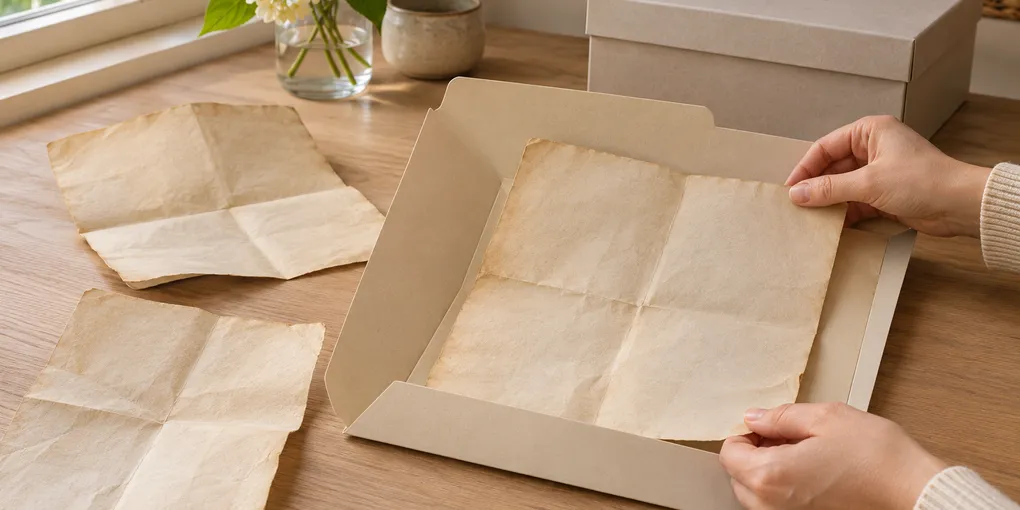
Store Family Letters Without Forcing Old Folds
ProtocolA family letter can turn into a handling problem at the moment you put it away. It has an old fold, the paper catches when you open it, and pressing it flat seems like the quickest way to fit it in a drawer. Let the fold set the pace. Open the letter only as far as it moves comfortably, then give it a clean, supported home that fits the paper as it is.
That approach makes the next visit easier, too. A folder or box that is large enough for the sheet gives you room to look for a date, a signature, or a familiar piece of handwriting without adding another crease. The National Archives specifically advises opening folded letters with care rather than back-folding them flat, while the Library of Congress emphasizes supportive enclosures for paper documents. Their family-archives guidance and the Library of Congress preservation FAQ support that small change in routine.
Let the old fold set the pace
Start on a clear table with clean, dry hands. Use both hands to lift and steady the paper so one corner is not carrying the whole sheet. Open the letter only until the fold moves freely; if it resists, leave it where it is. The goal is access, not a flatter-looking page.
Do not reverse an existing fold just to make the letter lie down. The National Archives warns that back-folding can break paper along fold lines. A letter can remain partly folded and still have a useful storage home.
| What you notice | What to do now | What not to do |
|---|---|---|
| The letter opens easily but keeps a visible crease | Let the crease remain and support the sheet in its current shape | Press it under a stack to make it flat |
| One edge catches when you lift it | Use two hands and move more slowly | Pull one corner free |
| The paper feels weak, brittle, or begins to split | Stop and get collections-care advice before more handling | Test the fold repeatedly or try to repair it yourself |
Choose a home that supports the whole letter
The housing should be bigger than the paper so every edge can rest inside it with room to spare. The National Archives recommends folders and boxes that fully enclose and support paper documents; for smaller items such as letters, it notes that upright storage in folders and boxes can work well. Pick one clean folder or document box where the edges have room around a seam, tab, or overfilled pile.
If you are choosing a dedicated paper enclosure, the Library of Congress lists acid- and lignin-free folders and document boxes among supportive options. Keep the decision small: choose a home where the letter can rest inside without curling around a too-small container or carrying the weight of unrelated household paper.
Put letters that belong together in one light group only when the group still comes out and goes back without tugging. A letter with weak paper can have its own supportive sleeve or folder rather than serving as the bottom sheet in a stack. Keep bulky albums, framed items, or boxes of mementos out of the same tight compartment.
Put the identifying note on the outside
The original letter does not need a new mark to be findable. Add one short cue to the outside of the folder, box, or shelf location: a family name, an approximate decade, a place, or a phrase such as “letters from the farm.” That gives you a way to return the group without reopening every sheet to identify it.
Use a single orientation for the group. For example, place each folder upright with its closed edge down, or lay each one flat with the same edge facing front. A consistent orientation keeps loose corners from becoming the handle you grab first.
Before the letters go back, clear unrelated items from the housing. Receipts, rubber bands, damp notes, and heavy objects turn a letter home into a mixed-paper pile. Keep the storage step small: letter into its support, support into its named spot, other household paper somewhere else.
Make the return easy after a family visit
The storage spot matters most after the letters have been shared. Choose a drawer, shelf, or cabinet that stays cool, dry, and out of the path of drinks, food, and everyday stacks. The National Archives notes that damp conditions can encourage mold and that excessive heat can make paper brittle, so an attic, basement, or garage is a poor default for an ordinary family-letter box.
Try this short reset when you are finished reading:
- Use two hands to return each letter to the position it came from, preserving the folds it already has.
- Check that every edge is inside its folder or box and that nothing heavy is pressing on the group.
- Put the housing back in its named spot with the outside cue facing where you can read it.
This is an everyday storage routine for stable household letters, not conservation treatment. If an original is brittle, torn, mold-affected, unusually valuable, or difficult to move without damage, pause before changing its handling or storage and seek qualified collections-care guidance.
Give one letter a calmer home today
Choose the letter you are most likely to refold just to make it fit. Clear a small surface, open it only as far as it will comfortably go, and place it in one fully supportive home. Label the outside of the housing. The next time you reach for it, the decision is simply where it belongs.
Sources
- National Archives: Treating Memories as Documents — Family Archives
- Library of Congress: How do I preserve my letters or paper documents?
Frequently Asked Questions
- No. Open a folded letter only as far as it moves without resistance, and do not back-fold it to make it lie flat. Give it a folder or box that supports its present shape instead.
- Label the outside housing, not the original letter. A family name, date range, or one short subject cue is enough to make the next retrieval easier.
- Stop if the paper is brittle, torn, mold-affected, or seems likely to break at a fold. That calls for collections-care advice before you change the storage or handling routine.