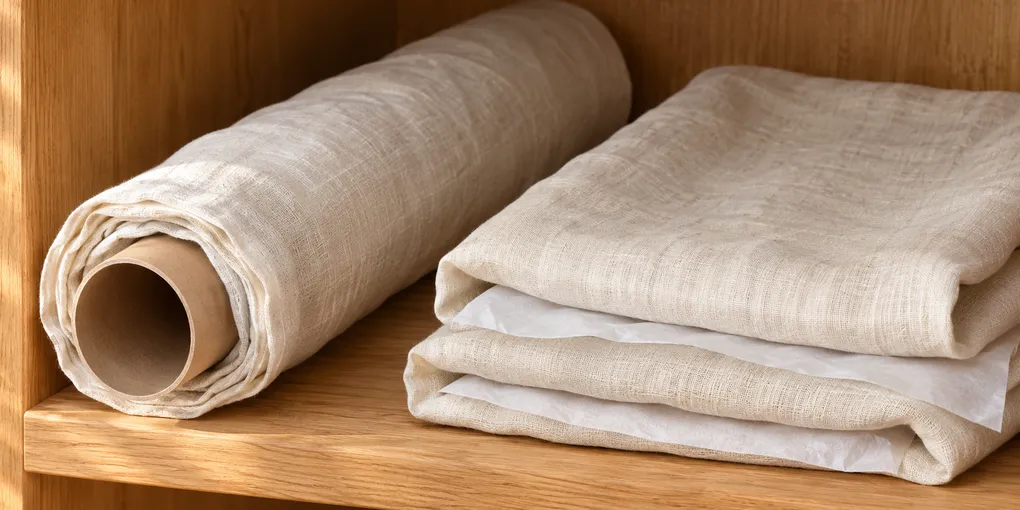
Store Linen Tablecloths Flat, Folded, or Rolled
ProtocolWhen a linen tablecloth spends most of the year in a closet, the storage choice is about avoiding the same hard crease for months. The clearest answer is to roll it around a support tube when you have the room. If a broad, fully supported drawer or shelf is already available, the cloth can lie there flat. When a roll will not fit, use broad folded storage and soften the inside of every fold.
The reason to give the cloth this little bit of attention is specific to linen. The University of Georgia’s textile guidance notes that linen wrinkles readily, that repeated creasing in the same place can weaken it, and that linen table linens should be rolled on cylinders rather than folded. George Washington University Museum and The Textile Museum’s storage guidance makes the same practical distinction: rolling is often the best option, while folding can work when rolling is not possible if the fold interiors are padded.
Start with the space you actually have
Open the drawer, shelf, or closet before you choose a method. A tablecloth that can lie across a broad, clean, supported surface can stay there instead of being squeezed into a narrow stack for the sake of tidiness. Flat storage is the low-decision choice when the cloth has a full supporting surface and you expect to reach for it again soon.
That setup is uncommon for a large tablecloth. A dining cloth can be wider than a typical linen shelf, and pushing its edges up against the sides simply creates a new bend. If the available surface is narrower than the cloth, move to a roll or a padded fold rather than forcing the cloth into a tight rectangle.
Roll when the cloth can be supported across its width
For long storage, lay the clean, dry tablecloth out as smoothly as the room allows. Start it on a clean, wide support tube, then roll at an even pace so one edge stays aligned with the other. The aim is a loose, supported roll with enough room around the fabric.
The support matters. GW Museum recommends an archival support tube for rolled textiles and specifically advises against PVC pipe because it can release damaging chemicals as it breaks down. A tube that is too narrow makes a tighter curve; one that is long enough to support the cloth’s width gives the edges somewhere to rest instead of letting them sag.
Once it is rolled, place it where other linens will not crush it. A shelf is easier to use than the floor of a crowded closet because you can lift the roll out without dragging one end. If the roll no longer fits comfortably in the space, switch to the folded method instead of reducing the roll’s diameter.
Fold only when rolling will not fit
GW Museum notes that folded storage can be a suitable alternative when rolling will not fit, with one important condition: pad the interior of each fold. The padding keeps the fold from becoming a narrow pressed line under the cloth’s own weight.
Use the fewest broad folds that let the tablecloth sit in its assigned space. Put a soft, clean layer of tissue or undyed cotton inside each fold, then settle the stack without pressing down on it. A shallow stack is easier to open, refold, and inspect than one tall pile that needs to be pushed into place.
Before putting the tablecloth away, look at the old fold lines. If the cloth has been stored in the same pattern for a long time, change the fold locations for the next storage period rather than stacking a new crease directly over the old one. That small change follows the UGA guidance’s warning about repeated creasing in the same spot.
Keep the shelf from adding its own problem
The fabric is only one half of the setup. Wood shelves and drawers can need a barrier between the textile and the wood; GW Museum suggests acid-free tissue or barrier paper for that job. If you are using a wooden linen closet, line the contact surface before putting the folded stack or supported roll in place.
Choose a spot that lets the cloth stay clean, dry, and out of direct light. An ordinary tablecloth can live in an ordinary linen closet. The useful test is simpler: can you take it out without pulling it across a rough edge, shoving it under a heavy pile, or remaking a sharp fold just to close the door?
Treat delicate or unusual cloths as a different decision
This method is for an ordinary, clean linen tablecloth. A cloth that is brittle, painted, heavily embellished, unusually fragile, or important as an heirloom calls for individualized advice from a textile conservator before you choose a storage shape.
For the everyday cloth, the choice stays practical: use flat storage when you already have a fully supported surface, roll when you have a suitable tube and the needed shelf length, and use broad padded folds when the other two options are unavailable. The best method fits the cloth and the space while limiting repeated sharp creases.
Sources
- University of Georgia Extension: Understand Your Fibers
- George Washington University Museum and The Textile Museum: Storing Textiles
Frequently Asked Questions
- Rolling is the preferred long-storage option in the cited textile guidance. If rolling will not fit, folded storage can be suitable when the inside of each fold is padded instead of left as a hard crease.
- Use a broad, fully supported shelf or drawer when one is already available and the cloth can lie there without a tight bend. It is a simple option for a cloth you will use again soon.
- Use a clean, suitably wide support tube that will not compress the fabric. The cited museum guidance specifically recommends an archival support tube and advises against PVC pipe for textile storage.