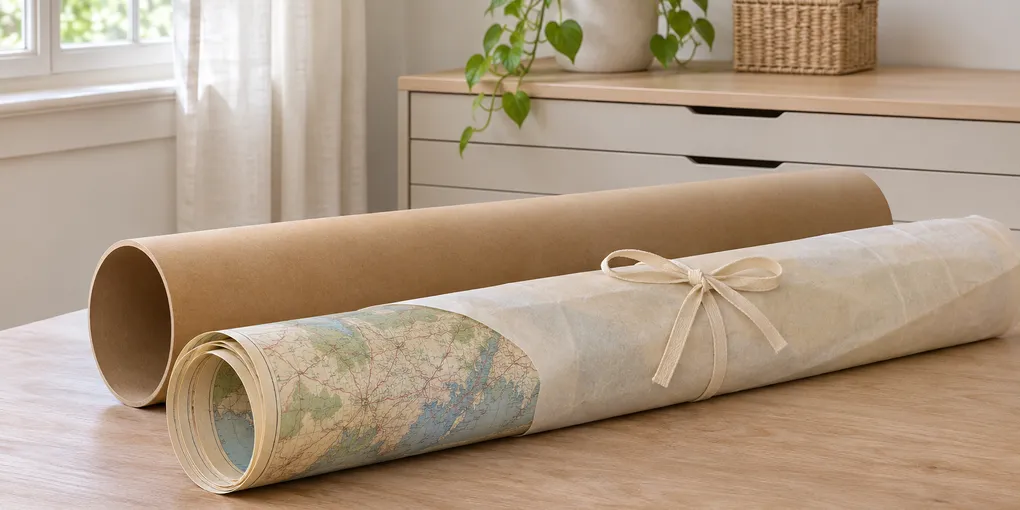
Store Oversized Paper Maps Without Adding New Folds
ProtocolAn oversized map often gets a new crease at the moment it is put away: it is too wide for the paper drawer, so it is folded one more time just to make it fit. The better choice is simple. Store it flat when you can support the whole sheet, or roll it loosely around a tube when you cannot. Then make that storage spot easy enough to use after every trip, move, or planning session.
The deciding measurement is not the map’s folded size. It is the space you can give it without forcing another bend. A clean shelf, the top of a tall cabinet, or a wide drawer may suit a flat map. A map without that footprint is usually easier to retrieve as one protected roll than as a sequence of fresh folds.
Choose the map’s resting shape before you clear a space
Start by opening the map on the largest clean surface available. If the entire sheet can lie supported with room around its edges, flat storage is the low-fuss route. Do not make a flat map into the bottom layer of a mixed paper pile; the next person looking for a receipt will lift and shift it until corners curl or crease.
If the map is wider than any reliable flat surface, plan for a roll instead. The Library of Congress lists unfolded flat or rolled storage as options for oversized paper. The National Archives adds a useful handling detail: roll documents around the outside of a tube. That gives the sheet a broad curve rather than a tight bend. Their paper-record guidance and the Library of Congress paper-care page are the sources for that distinction.
| What the map needs | Storage choice | The return rule |
|---|---|---|
| It fits fully on a clean, supported surface | Flat | Keep the full sheet clear of heavier household paper |
| It is too large for a drawer or shelf but opens regularly | Loose roll around a tube | Return it to the same horizontal or upright spot without squeezing it between other items |
| It travels with trip materials | Loose roll with an outer wrap | Label the wrap or storage spot, not the map |
Make a flat home that stays flat
Flat storage works only when the map has a defined footprint. Measure the map once while it is open, then reserve a surface at least that large. A shallow drawer is helpful when it can close without catching an edge. The top of a tall bookcase can work when it stays dry, clean, and out of the path of everyday objects. A wide under-bed space can work only if the map is protected from the dust and shifting items that tend to collect there.
Give the map a simple neighbor rule: nothing dense, wet, or scratchy gets set on it. A stack of light paper that belongs with the map is one thing; a box of spare hardware, a planter, or a basket of seasonal supplies is another. The goal is not a museum display. It is a surface you can clear and restore in one motion.
Put the location cue where your hand will reach first. A small label on the drawer front, shelf edge, or outer folder can say “road maps” or name the region. That is enough information to return the map without opening it for identification.
Roll a map for storage without making a tighter problem
For a rolled home, use a tube broad enough that the map curves gently rather than snapping into a narrow coil. Start at one short edge and let the paper travel around the outside of the tube with the printed side facing out, following the National Archives guidance. Keep the roll loose and even; a roll that is firm enough to resist being opened is too tight for an everyday retrieval system.
Once the map is rolled, use an outer paper wrap or a light tie only to keep the roll from opening by itself. The wrap is the place for a short identification note. If several rolls share a closet or shelf, use the same orientation for each one—open edge toward the front, for example—so you can read the outside cue before pulling one out.
Avoid a storage spot that turns the roll into a wedge. A map roll should not be crushed between bins, stood in a damp floor corner, or packed behind a row of items you must drag out first. Choose one horizontal shelf section or one upright holder with enough open room that the roll comes out without a tug-of-war.
Build the return routine around the last place you use the map
The storage plan fails when the map ends up on the dining table because its home is too far away or too difficult to open. Put the flat folder, drawer, or roll spot near the place where the map usually returns after use. If you spread maps on a hallway table before a trip, a nearby shelf may be more realistic than a distant attic bin. If you use maps at a desk, a flat drawer or long shelf nearby may keep the final fold from happening.
Use this two-minute reset when you are finished:
- Brush off loose papers, tickets, or notes that do not belong with the map.
- Decide whether the map returns flat or as the same loose roll; do not improvise a new fold to save a few inches.
- Put it in its named spot with nothing pressing on its edges or roll.
- Return trip notes or guidebooks to their own place, so the map’s home does not become a catchall.
That last step matters because maps tend to inherit the whole outing: brochures, receipts, route notes, and small souvenirs. Keep only the material you will actually use with the map. The rest belongs in a travel file, a memory box, or recycling—not under a sheet of paper you want to unfold again.
Keep special paper out of an everyday storage routine
This is an access-and-storage routine for ordinary household maps. It is not repair, flattening, adhesive removal, or a promise of permanent preservation. A map that is brittle, torn, historic, valuable, or difficult to unroll needs a separate collections-care decision before you change its storage or handling. The two sources below are a sensible starting point for that question.
Set up one map home today
Choose the largest map you currently avoid putting away. Open it, decide whether it genuinely has a flat footprint, and make one home for that shape. If it must be rolled, pair it with a supportive tube and label the outside wrap. If it stays flat, label the drawer or shelf instead.
The next time you put the map away, the only decision should be where it goes—not how many new folds will make it fit.
Sources
- National Archives: Paper-Based Records
- Library of Congress: Care, Handling and Storage of Works on Paper
Frequently Asked Questions
- Use flat storage when you can give the whole map a clean, supported surface. Use a loose roll when a flat surface would be too small or would turn the map into a pile; keep the roll protected from squeezing and easy to return to the same spot.
- The National Archives advises rolling documents around the outside of a tube. For a map, that means keeping the printed side outward around a supportive tube instead of forcing a tight inward curl.
- Put a short location cue on the outside wrap or on the storage spot, such as the trip, region, or room where it belongs. Avoid writing on the map itself just to make it easier to find.