Why Junk Bowls Spread Across Counters: The Clutter Science of Tiny Unassigned Objects
Evidence ExplainerQuick picks
Divided Valet Tray
★ Top pick Best replacement for one junk bowl- Best For: Keys, wallet, earbuds, coins, and pocket items
- Caveat: Still fails if every compartment becomes miscellaneous
Small Parts Drawer Organizer
Best for hardware drift- Best For: Screws, batteries, picture hooks, and repair leftovers
- Caveat: Needs labels or categories will blur again
A junk bowl feels like a solution because it catches tiny things before they scatter. Then it becomes a second problem. Keys, coins, receipts, loose screws, lip balm, rubber bands, and unidentified plastic pieces collect in one container until the bowl is full. After that, the counter around the bowl becomes the new bowl.
Junk bowls spread because they provide capture without decision. The bowl answers where can I put this down, but not what is this, when will I use it, or where does it belong after today. That missing decision is why a bowl on the kitchen counter often turns into a tray, a pile, a second bowl, and a drawer nearby.
If your main problem is daily carry rather than mystery objects, start with the more specific everyday carry drawer drop zone pattern. Junk bowls need tighter category boundaries.
Quick picks for replacing a junk bowl
- Daily-carry boundary: Search Amazon for divided valet trays. Choose this when the bowl mostly holds keys, wallet, earbuds, glasses, and coins that leave the house again.
- Hardware boundary: Search Amazon for small parts drawer organizers. Choose this when screws, batteries, hooks, and repair leftovers keep drifting onto the counter.
The mechanism: capture is easier than return
Small objects have high decision cost relative to size. A single screw, receipt, or hair tie is not worth a full organizing project in the moment. The bowl offers a low-friction place to delay the decision. That is useful for one day and harmful for one month.
The problem is visual masking. Once several small objects overlap, the eye stops seeing individual decisions and starts seeing a single clutter mass. Research on attention describes how multiple objects compete for processing in crowded visual scenes; the same principle shows up on a counter full of tiny mixed items.
Divided valet tray
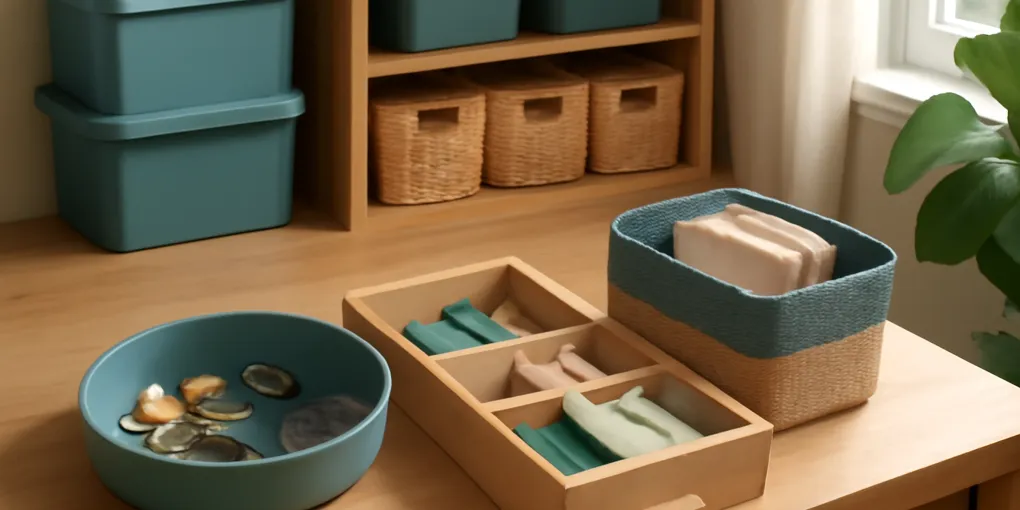
A divided valet tray is better than a bowl when the items are true daily carry. Separate sections let keys, wallet, earbuds, glasses, and coins keep their identities. The tray should be small enough that it cannot become a family archive.
Choose a tray that fits the landing surface without taking over the counter. For an entry table, a wood or leather tray may work. For a kitchen counter, a washable plastic, metal, or coated tray is easier to wipe. Avoid deep bowls for keys because they hide smaller items under larger ones.
Shopping option: Search Amazon for divided valet trays.
Small parts drawer organizer
If the bowl contains screws, picture hooks, spare batteries, furniture feet, Allen keys, and tiny repair parts, a valet tray is the wrong product. Those items need a small parts organizer or a labeled drawer tray away from the food-prep surface.
Look for shallow compartments that fit the actual categories: batteries, hooks, anchors, felt pads, and tool bits. Clear lids help if the organizer leaves the drawer. Open trays work if the organizer stays inside a drawer and gets labeled.
Shopping option: Search Amazon for small parts drawer organizers.
The five-category junk bowl reset
Empty the bowl onto a towel so small items do not roll away. Sort into five groups:
- Daily carry: keys, wallet, badge, earbuds, sunglasses.
- Paper decisions: receipts, coupons, appointment cards, school notes.
- Hardware: screws, hooks, batteries, tool bits, pads.
- Grooming and personal items: hair ties, lip balm, jewelry, medication reminders.
- Trash or unknown pieces.
Only the first group belongs near the counter long term. The others need a paperwork inbox, small-parts container, bathroom drawer, or trash decision.
Fit checks that matter
For junk-bowl fixes, the useful checks are object type, one-hand access, container size, cleanability, and whether the replacement stops mixed categories from spreading.
For junk-bowl replacements, Research rewards whether the product matches the actual object type. Evidence Quality focuses on visible categories, compartment size, cleanability, and whether the container prevents overlap. Value favors small, bounded organizers over large decorative trays that invite more clutter. User Signals focus on whether people can return keys or screws without opening a complicated system. Transparency rewards product listings that show dimensions and interior layout.
A boundary rule that prevents bowl creep
Use a one-hand rule: the daily tray should be easy to empty with one hand in less than thirty seconds. If it takes longer, the tray has stopped being a landing zone and become storage.
Use a no-mystery rule: unknown pieces get one tiny quarantine cup for seven days. If nobody identifies the piece, discard it unless it is clearly safety-related or part of an active repair.
Use a no-paper rule: receipts and school notes do not stay in the bowl. Paper spreads because it covers smaller items and makes the bowl harder to scan.
Junk-bowl counter questions
Should I eliminate the junk bowl completely?
Not always. Some households need a tiny landing tray for keys and coins. The goal is to eliminate mixed storage, not to pretend people will never put small items down.
Where should receipts go instead?
Use a paper inbox or a small receipt envelope near the place you process bills and returns. Receipts do not belong under keys because they hide both the paper decision and the pocket items.
What if my family keeps using the bowl?
Make the correct container easier. Put the divided tray exactly where the bowl was, label one small parts container, and remove the old bowl for two weeks.
Are decorative bowls ever okay?
Yes, for one category such as fruit, wrapped mints, or keys. They fail when they are asked to hold every object too small to deserve a decision.
Sources
- McMains, S. A., and Kastner, S. (2011). Interactions of top-down and bottom-up mechanisms in human visual cortex. DOI: 10.1523/JNEUROSCI.3766-10.2011.
- Saxbe, D. E., and Repetti, R. (2010). No Place Like Home: Home tours correlate with daily patterns of mood and cortisol. https://www.ncbi.nlm.nih.gov/pmc/articles/PMC3651991/. Supports the article’s point that visible household disorder can act as a recurring attention and stress cue.
Frequently Asked Questions
- A junk bowl lowers the friction of putting tiny items down but does not define when they leave. Once it fills, the counter around it becomes the overflow zone.
- A small divided drawer is usually better because it hides visual noise and can assign categories. A large undivided junk drawer repeats the same problem out of sight.
- Only items that leave the house or return daily, such as keys, wallet, badge, earbuds, and sunglasses. Repair parts, receipts, and mystery cords need separate homes.
- Sort it into leave the house, paperwork, hardware, trash, and unknown. Give the daily category a small tray and move the other categories away from the counter.