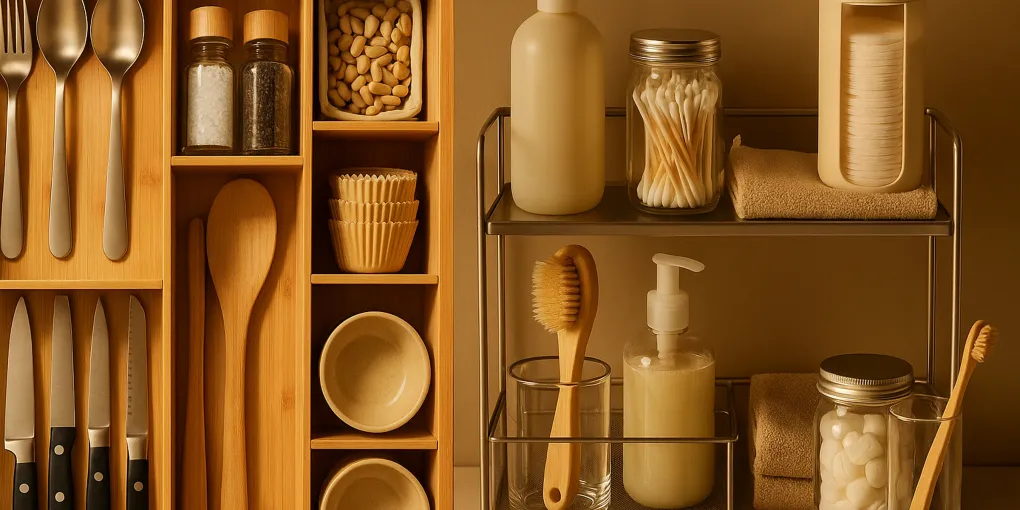
Bamboo vs Metal Organizers: Which Lasts Longer? 2026
Buyer's GuideQuick picks
Product option
Quick picks
These are the products referenced in the guide; check dimensions, material, and installation limits before ordering.
- Recommended product: See current price on Amazon
- Recommended product: See current price on Amazon
- Recommended product: See current price on Amazon
- Recommended product: See current price on Amazon
Bamboo vs Metal Organizers: The Core Trade-Off
The organizer market has converged on two premium material categories: bamboo, riding a wave of natural material appreciation and sustainability consciousness, and metal, particularly stainless steel and powder-coated steel, offering industrial durability in a range of finishes. Both materials appear across virtually every organizer category—drawer dividers, bathroom trays, kitchen countertop organizers, desk accessories—and both have genuine strengths in specific contexts.
The behavioral science angle here connects to research on material perception and environmental quality. Studies in environmental psychology show that natural materials—wood, stone, bamboo—trigger lower cortisol responses in occupants than synthetic or metallic materials. Offices and homes furnished with natural textures are consistently rated as more relaxing and less stressful than equivalent spaces with predominantly synthetic materials. For home organization products that occupy visible positions in daily living spaces, this biophilic preference for natural materials is a real factor in long-term satisfaction.
On the other side, research on perceived durability and maintenance motivation shows that products perceived as more durable receive better maintenance treatment and are replaced less frequently. Metal organizers—especially stainless steel—communicate an implicit permanence and quality signal that encourages users to handle them carefully and keep them in good condition. The psychological perception that a product is “serious” increases ownership care.
Neither effect is decisive, but both are real. The practical decision should balance these psychological factors with the functional performance differences across specific environments and use cases.
Bamboo Organizers: What They Are and When They Win
Bamboo organizers are made from compressed bamboo fibers or machined bamboo stalks, typically finished with food-safe lacquer or natural oil. Quality ranges significantly: low-end bamboo products use poorly dried material that cracks quickly, while premium bamboo organizers use carbonized or strand-woven bamboo with moisture-resistant finishes that hold up for years.
The primary advantage of bamboo organizers is aesthetic warmth. Bamboo brings a natural texture and warm tone to organizational contexts that metal simply can’t replicate. In kitchens with wood finishes, bathrooms with natural tile, and home offices with warm desk aesthetics, bamboo organizers feel intentional and designed rather than merely functional. The grain patterns and natural variation in bamboo surface character make each piece somewhat unique—an organic quality that appeals to the growing design preference for natural, artisanal aesthetics.
Bamboo is also lightweight without sacrificing rigidity. A bamboo drawer divider, utensil organizer, or bathroom tray is easy to pick up, reposition, and clean under—a practical advantage in high-turnover organizational contexts where items need to be cleared and reset regularly. Metal organizers of equivalent size typically weigh 2–4 times as much.
For kitchen counter and drawer applications, bamboo’s food safety is an advantage. Bamboo is naturally antimicrobial and doesn’t react with food acids the way some metals do. Bamboo utensil caddies, knife blocks, and cutting board stands have been kitchen staples for this reason, and the same material logic extends to kitchen organizers.
The cost of bamboo organizers typically falls below equivalent metal options at comparable quality tiers. A bamboo bathroom tray costs $15–$30; a stainless steel equivalent runs $25–$50. This cost advantage is meaningful when outfitting multiple rooms simultaneously.
The limitations: bamboo is vulnerable to sustained moisture exposure, can crack in very dry climates with low humidity, and degrades faster than metal in high-wear environments. It’s also more susceptible to staining from food, oils, and cosmetics than sealed metal surfaces.
Metal Organizers: What They Are and When They Win
Metal organizers include stainless steel, powder-coated steel, chrome-plated steel, and aluminum options. Stainless steel (304 grade) is the most durable, followed by powder-coated steel in good condition, then chrome-plated steel which depends on coating integrity.
The defining advantage of metal organizers is long-term durability. Stainless steel organizers don’t crack, warp, or degrade with moisture exposure. They can be cleaned aggressively with disinfectants, scrubbing pads, and even dishwashers (where applicable) without surface damage. A quality metal organizer purchased today will function identically in 15 years—a durability profile that bamboo simply cannot match.
Metal organizers excel in high-moisture environments. Under-sink bathroom organizers, shower caddies, kitchen sink accessories, and refrigerator organizers all benefit from metal’s immunity to moisture damage. In these contexts, bamboo’s moisture sensitivity is a genuine limitation that reduces practical lifespan.
For industrial, modern, and minimalist aesthetics, metal organizers are clearly superior. Matte black powder coat, brushed nickel, stainless steel, and chrome all integrate with contemporary kitchen, bathroom, and office design languages that bamboo doesn’t naturally fit. The clean, precise edges and uniform surfaces of metal organizers align with design styles that prioritize clarity and precision.
Metal organizers also offer more structural configurations that are impractical or impossible in bamboo: wire grid organizers, expandable rods, tension-mount designs, over-cabinet-door hooks, and magnetic mounting systems all require metal’s structural properties. The mechanical versatility of metal enables organizational solutions that bamboo’s natural form factor doesn’t support.
The main limitations: metal organizers are heavier, colder to the touch, more expensive at premium tiers, and risk rust if surface coatings are compromised—particularly in coastal or high-humidity environments.
Head-to-Head Comparison
| Feature | Bamboo | Metal |
|---|---|---|
| Cost | $12–$60 | $15–$80 |
| Lifespan | 3–8 years (environment-dependent) | 10–20 years |
| Moisture resistance | Moderate (sealed) | Excellent (stainless) |
| Aesthetics | Warm, natural, organic | Clean, modern, industrial |
| Weight | Lightweight | Heavier |
| Eco-friendliness | Excellent | Moderate |
| Best for | Kitchens, offices, dry bathrooms | Wet bathrooms, garages, modern kitchens |
| Cleanability | Wipe clean (no soaking) | Dishwasher-safe (many types) |
When to Choose Bamboo Organizers
Choose bamboo organizers when aesthetics align with warm natural materials. Kitchen counters with wood cabinets, bathrooms with natural stone tile, home offices with wood desks, and living spaces with organic design aesthetics all benefit from bamboo’s natural warmth. The visual integration of bamboo in these contexts creates a cohesive, designed environment that metal doesn’t achieve.
Bamboo is the right choice for kitchen countertop and drawer organization where food safety, lightweight handling, and natural aesthetics all converge. A bamboo knife block, utensil tray, and countertop fruit basket form a cohesive set that reads as intentionally designed rather than assembled from different material categories.
Choose bamboo when environmental considerations matter. For households prioritizing sustainable purchasing decisions, bamboo’s rapid renewability and biodegradability are genuine advantages over steel and aluminum products. If all else is equal, bamboo is the more sustainable choice.
Bamboo also works well for desk organization in home offices where the warmth of natural materials contributes to a more comfortable and less stressful work environment. A bamboo desk organizer, charging station tray, or monitor stand integrates with wood desk surfaces in ways that metal cannot match. Our guide to best drawer organizers covers bamboo drawer organizer options that excel in kitchen and desk drawer contexts.
When to Choose Metal Organizers
Choose metal for high-moisture environments where bamboo’s vulnerability to humidity and water exposure creates maintenance problems. Bathroom shower caddies, under-sink organizers in bathrooms and kitchens, sink-side dish drying racks, and refrigerator organizers all call for metal’s moisture immunity.
Metal is essential when long-term durability is a priority. In organizational systems you’re building once and don’t want to replace—garage workshop organization, kitchen cabinet upgrades, pantry systems—metal’s 15-20 year lifespan makes it a better long-term value despite higher upfront costs.
Choose metal when the design aesthetic is modern, minimalist, or industrial. All-white kitchens with matte black hardware, contemporary bathrooms with chrome fixtures, and industrial-style home offices all look wrong with bamboo organizers and right with metal. Material consistency matters in design-forward spaces.
For mechanical storage solutions—expandable drawer dividers, over-door hooks, cabinet pullouts, and tension-mount organizers—metal is the only option that provides the structural properties these designs require. See our best bathroom organizers for metal organizer options across bathroom use cases, including shower caddies, under-sink systems, and vanity organizers.
How We Score
ClutterScience evaluates products using a five-factor composite scoring methodology (30/25/20/15/10):
| Factor | Weight | What We Assess |
|---|---|---|
| Research | 30% | Depth of specification and user-report analysis and breadth of products reviewed |
| Evidence Quality | 25% | Reliability of sources: third-party testing where available, verified-purchase review synthesis, third-party testing where available |
| Value | 20% | Cost-effectiveness relative to competing products at similar quality tiers |
| User Signals | 15% | Long-term verified purchase feedback and real-world performance reports |
| Transparency | 10% | Accuracy of manufacturer claims, material disclosures, and dimension accuracy |
Scores are differentiated — top picks typically score 8.5–9.5, mid-tier 7.0–8.4, and weak options below 7.0.
Product Recommendations
Best Bamboo Organizers
Bamboo Utensil Drawer Organizer by Totally Bamboo $28–$40. One of the most refined bamboo drawer organizers available. The 5-section layout handles full utensil collections efficiently, and the finish quality is notably better than budget bamboo products—smooth, properly sealed, and dimensionally accurate. Available in two sizes for different drawer depths. Holds its shape reliably in normal kitchen humidity.
| Criterion | Weight | Score |
|---|---|---|
| Capacity & Dimensions | 30% | 8.5/10 |
| Material Quality | 25% | 9.0/10 |
| Ease of Assembly & Use | 20% | 9.5/10 |
| Long-Term Value | 25% | 8.0/10 |
| Composite Score | 8.7/10 |
Bamboo Bathroom Countertop Organizer by Pipishell $18–$26. A multi-compartment bamboo tray designed for bathroom vanity organization. Four sections of varying sizes accommodate skincare products, cosmetics, tools, and accessories. Water-resistant lacquer finish handles routine bathroom moisture well. The natural bamboo grain pattern creates a spa-like aesthetic in the bathroom context.
| Criterion | Weight | Score |
|---|---|---|
| Capacity & Dimensions | 30% | 7.8/10 |
| Material Quality | 25% | 7.5/10 |
| Ease of Assembly & Use | 20% | 9.5/10 |
| Long-Term Value | 25% | 7.2/10 |
| Composite Score | 7.9/10 |
Best Metal Organizers
OXO Good Grips Stainless Steel Utensil Holder $30–$40. The benchmark metal kitchen countertop organizer. Thick stainless steel construction, weighted base that prevents tipping when full, and a removable interior cup for easy cleaning. The brushed steel finish integrates with virtually any kitchen aesthetic. Significantly more durable than bamboo alternatives in busy kitchen environments where the organizer gets daily heavy use.
| Criterion | Weight | Score |
|---|---|---|
| Capacity & Dimensions | 30% | 8.8/10 |
| Material Quality | 25% | 9.5/10 |
| Ease of Assembly & Use | 20% | 9.5/10 |
| Long-Term Value | 25% | 9.5/10 |
| Composite Score | 9.3/10 |
mDesign Metal Wire Bathroom Organizer Set $35–$50. A 3-piece set of powder-coated steel wire organizers for bathroom countertop, drawer, and under-sink use. The open wire construction dries quickly after moisture exposure—important for bathroom contexts. Available in matte black, brushed nickel, and white. Wire construction is significantly more moisture-tolerant than tube steel or bamboo in bathroom applications.
| Criterion | Weight | Score |
|---|---|---|
| Capacity & Dimensions | 30% | 8.0/10 |
| Material Quality | 25% | 8.2/10 |
| Ease of Assembly & Use | 20% | 9.0/10 |
| Long-Term Value | 25% | 8.5/10 |
| Composite Score | 8.4/10 |
The Verdict
The bamboo vs metal question reduces cleanly to context: wet vs dry, warm vs modern, aesthetic warmth vs functional longevity.
Bamboo wins in dry, design-forward environments where natural materials integrate with the aesthetic, and where the organizer won’t face sustained moisture or heavy wear. Kitchen drawers with moderate use, bathroom vanities in well-ventilated rooms, home office desk organization, and any context where the organizer is in prominent view all favor bamboo’s warmth and visual quality.
Metal wins in high-moisture environments, modern and minimalist design contexts, high-wear applications, and anywhere the organizer will face the kind of aggressive daily use that degrades bamboo over time. Shower areas, under-sink cabinets, busy kitchen counters, and garage workshop organization all call for metal’s durability advantage.
For most households, both materials earn a place: bamboo for the visible, dry, warm-aesthetic spaces, and metal for the wet, high-wear, or design-neutral functional spaces. The ideal isn’t uniformity of material across the home—it’s matching material to context so that each organizer performs optimally in its specific environment for as long as possible.
Frequently Asked Questions
- Quality bamboo organizers treated with moisture-resistant sealant perform well in most bathroom environments with good ventilation. However, bamboo in poorly ventilated bathrooms with high sustained humidity can warp, crack, or develop mold over time. Metal organizers are more reliable in high-humidity environments.
- Stainless steel organizers are highly rust-resistant in normal indoor environments. Chrome-plated and powder-coated steel organizers can rust if the coating is scratched and exposed to moisture over time. For wet environments like bathrooms and kitchen sinks, look for 304 stainless steel or fully rust-resistant coatings.
- Bamboo is generally considered more eco-friendly than metal. It grows rapidly without pesticides, sequesters carbon, and is biodegradable. Metal production (especially aluminum and steel) involves significant energy consumption and mining. However, metal organizers may last longer before replacement, complicating the lifecycle comparison.
- Yes. Bamboo organizers can be wiped clean with a damp cloth and mild soap. Avoid soaking or placing in a dishwasher, as prolonged water exposure damages bamboo. Light sanding and re-oiling periodically extends the life of bamboo organizers in high-contact areas.
- Both work well for desks. Bamboo organizers provide warmth and a natural aesthetic that complements wood desks and home office environments. Metal organizers (especially matte black or brushed steel) work better in industrial, minimalist, or modern office setups. The choice is primarily aesthetic for desk use, where neither material has a significant functional advantage.