Best Recipe and Cookbook Organizers 2026
Buyer's GuideCooks Standard Bamboo Recipe Box with Cards
Best OverallCapacity: 400+ recipe cards
$28–42
Quick picks
| Product | Key Specs |
|---|---|
| See price on Amazon |
|
| See price on Amazon |
|
| See price on Amazon |
|
| See price on Amazon |
|
| See price on Amazon |
|
Product availability, certifications, and retailer details can change; check the current Amazon page before buying.
Why Recipe Organization Affects How and What You Cook
There is a well-documented relationship between kitchen organization and cooking behavior that goes beyond simple convenience. Behavioral economists studying meal preparation habits have found that the accessibility of recipes — how easy they are to locate and reference during active cooking — directly influences meal variety, nutritional quality, and cooking frequency. Households with organized recipe systems cook a wider variety of meals, rely less on takeout and convenience food, and report higher satisfaction with their eating habits than households with the same number of recipes stored in disorganized fashion.
The mechanism is the same friction-reduction principle that applies to any habit: when the right recipe is one easy reach away, you are more likely to try something new or return to a favorite. When finding a recipe requires scrolling through 300 phone photos of handwritten cards, flipping through three different unindexed binders, and ultimately Googling because you cannot locate the original, the cognitive cost exceeds the perceived benefit of cooking and you order delivery instead.
Recipe and cookbook organization is also a preservation task. Handwritten recipes from family members carry irreplaceable sentimental value — the handwriting itself, the stains from actual cooking, the marginal notes about adjustments made for specific occasions. These artifacts deserve the same archival consideration as photographs, and the right storage system protects them from the kitchen’s hostile environment of heat, steam, grease, and spills.
This guide evaluates the best recipe and cookbook organizers for 2026, addressing both recipe card systems and cookbook storage solutions for kitchens of different sizes and cooking styles.
How We Evaluated Recipe and Cookbook Organizers
Capacity and Dimensions (30%) — Recipe card capacity, cookbook shelf depth and height compatibility, and counter footprint. A recipe box that holds 50 cards is functionally useless for a household with 300 tested recipes; a cookbook stand that only works for paperbacks fails for the heavy hardcover cookbooks that dominate professional collections.
Material Quality (25%) — Resistance to the kitchen environment: humidity from steam, grease splatter from nearby cooking, and the inevitable liquid spill. Also material durability under daily use and the chemical safety of materials in close proximity to food preparation.
Ease of Assembly and Use (20%) — How quickly can you locate a specific recipe? Can you browse by category? Does the system allow quick insertion of new recipes without disturbing the existing organization? Is the cookbook stand stable with a heavy book open in cooking position?
Long-Term Value (25%) — Price per recipe stored, whether the system grows with a recipe collection, and preservation quality for handwritten heirloom recipes that should last decades.
The Best Recipe and Cookbook Organizers for 2026
How We Score
ClutterScience evaluates products using a five-factor composite scoring methodology (30/25/20/15/10):
| Factor | Weight | What We Assess |
|---|---|---|
| Research | 30% | Depth of specification and user-report analysis and breadth of products reviewed |
| Evidence Quality | 25% | Reliability of sources: third-party testing where available, verified-purchase review synthesis, third-party testing where available |
| Value | 20% | Cost-effectiveness relative to competing products at similar quality tiers |
| User Signals | 15% | Long-term verified purchase feedback and real-world performance reports |
| Transparency | 10% | Accuracy of manufacturer claims, material disclosures, and dimension accuracy |
Scores are differentiated — top picks typically score 8.5–9.5, mid-tier 7.0–8.4, and weak options below 7.0.
1. Cooks Standard Bamboo Recipe Box with Cards — Best Overall
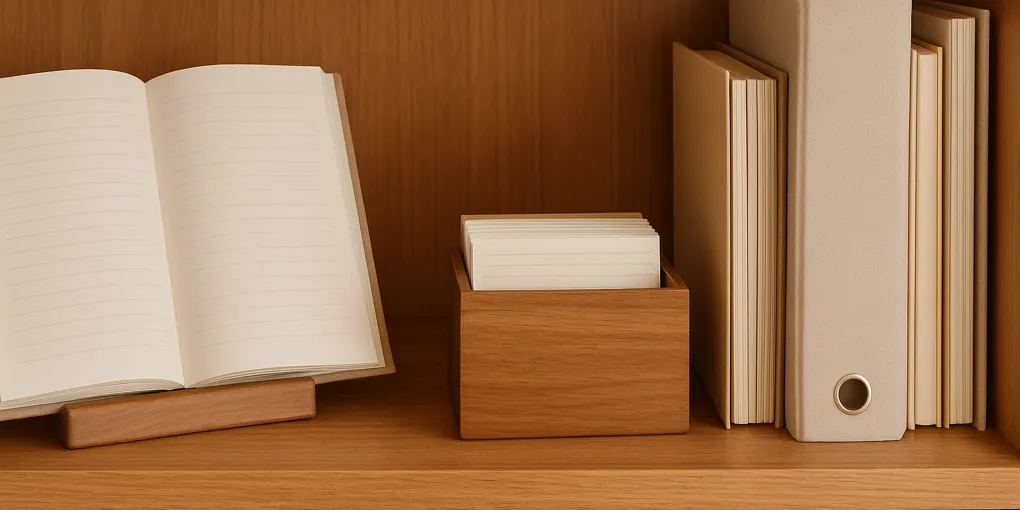
The Cooks Standard Bamboo Recipe Box achieves the ideal balance between traditional recipe card organization and modern design quality. The bamboo construction is both aesthetically appropriate for kitchen counters and genuinely practical — bamboo’s natural resistance to moisture and bacteria makes it significantly more kitchen-appropriate than most alternative materials, and the smooth finish wipes clean easily from cooking-environment contaminants.
The 30 tabbed category dividers are pre-printed with standard culinary categories (Appetizers, Soups, Salads, Breads, Main Dishes by protein, Desserts, Beverages, and blank custom tabs) that cover most home cooking collections without requiring any setup. The 100 included blank recipe cards are the correct 4×6 size and thick enough to write on with either pen or marker without bleed-through.
At 400+ card capacity, the box handles substantial recipe collections with room to grow, and the bamboo lid closes securely to protect contents from kitchen steam and casual spills. The overall design is handsome enough to leave on a kitchen counter as a functional decorative object — a significant advantage over utilitarian metal or plastic alternatives.
| Criterion | Weight | Score |
|---|---|---|
| Capacity & Dimensions | 30% | 8.8/10 |
| Material Quality | 25% | 9.2/10 |
| Ease of Assembly & Use | 20% | 9.0/10 |
| Long-Term Value | 25% | 8.8/10 |
| Composite Score | 9.0/10 |
2. Avery Recipe Binder Kit — Best Binder System
Modern recipe collections rarely arrive entirely on index cards. More commonly, a household’s recipe inventory is a mix of handwritten cards, magazine clippings of varying sizes, printed web recipes, and photos of dishes as served. The recipe card box format handles only the card component of this mix; the Avery Recipe Binder Kit accommodates all of it through the universal compatibility of clear sheet protectors in a three-ring binder.
The 50 included sheet protectors hold letter-size (8.5” × 11”) content that accommodates full-page magazine spreads, printed recipes, and multiple cards per page in an arrangement of the user’s choosing. The 8 category divider tabs create the same organizational framework as a tabbed recipe box, and additional sheet protectors can be added indefinitely.
The heavy-duty binder material is kitchen-appropriate — the plastic cover wipes clean and the ring mechanism is robust enough for the repeated opening and closing of active cooking use. The sheet protectors provide a genuine splash-protection layer for recipes referenced while cooking, which is the most common point of recipe damage.
| Criterion | Weight | Score |
|---|---|---|
| Capacity & Dimensions | 30% | 9.0/10 |
| Material Quality | 25% | 8.3/10 |
| Ease of Assembly & Use | 20% | 8.5/10 |
| Long-Term Value | 25% | 8.8/10 |
| Composite Score | 8.7/10 |
3. Artisan Kitchen Stand with Book Rest — Best Cookbook Stand
When actively cooking from a cookbook, the book itself needs to be open, visible, and positioned to be read without bending over a counter. Most home cooks manage this by opening a heavy cookbook on a counter, where it closes itself repeatedly, requires a hand to hold open, and risks steam and splash damage to pages and binding. A dedicated cookbook stand eliminates all of these problems.
The Artisan acrylic cookbook stand holds books up to 3” thick at a reading angle adjustable from 20 to 70 degrees, with a lip at the bottom that prevents the book from sliding down. The clear acrylic construction allows the stand to visually recede on any counter and is completely waterproof and grease-resistant — wipes clean with a damp cloth.
The stand works equally well for tablets and phones displaying digital recipes, which makes it a versatile kitchen tool for households with mixed recipe formats. For cookbook users who cook frequently from specific books, the stand pays for itself in binding preservation alone — repeated forced-open handling is the primary cause of cookbook spine failure.
| Criterion | Weight | Score |
|---|---|---|
| Capacity & Dimensions | 30% | 8.5/10 |
| Material Quality | 25% | 9.0/10 |
| Ease of Assembly & Use | 20% | 9.5/10 |
| Long-Term Value | 25% | 8.5/10 |
| Composite Score | 8.9/10 |
4. Better Homes Metal Recipe Card Box — Best Budget Box
For households that want a traditional recipe box without the bamboo premium, the Better Homes Metal Recipe Card Box delivers the same fundamental organizational capability at significantly lower cost. The metal tin construction is durable, wipe-clean, and kitchen-appropriate, and the 24 tabbed dividers create organized recipe categories from the start.
The 300-card capacity handles most home collections, and the included blank index cards match standard 4×6 format. The lid closes with a simple snap fit that keeps contents contained during counter handling but does not create a weathertight seal — adequate for counter storage but not ideal for areas with significant steam exposure.
For families organizing a first recipe collection or teaching younger household members to start their own recipe files, the lower price point makes the Better Homes box an appropriate starting system.
| Criterion | Weight | Score |
|---|---|---|
| Capacity & Dimensions | 30% | 7.8/10 |
| Material Quality | 25% | 7.5/10 |
| Ease of Assembly & Use | 20% | 8.8/10 |
| Long-Term Value | 25% | 8.2/10 |
| Composite Score | 8.0/10 |
5. Umbra Trigg Floating Shelf Cookbook Display — Best Counter-Free Storage
Small kitchens face a storage paradox: they most need organizational tools, but they have the least counter and cabinet space for those tools. The Umbra Trigg Floating Shelf addresses this by moving cookbook storage to wall space — a resource that most small kitchens have in abundance — while creating a display that is visually appealing enough to be intentional interior design rather than a storage workaround.
Two wall-mounted shelves hold up to 5 lbs each, accommodating three to four standard cookbooks per shelf in a spine-out display accessible with a single reach. The metal construction (available in copper or white) coordinates with most kitchen hardware and is grease and steam resistant.
Installation requires two anchor points per shelf into drywall studs or with appropriate wall anchors, which takes about 30 minutes but results in a permanent solution that frees the equivalent counter space permanently. For small kitchens where counter space is genuinely scarce, the value of recaptured counter space exceeds the value of the shelf itself many times over.
| Criterion | Weight | Score |
|---|---|---|
| Capacity & Dimensions | 30% | 7.5/10 |
| Material Quality | 25% | 8.5/10 |
| Ease of Assembly & Use | 20% | 8.0/10 |
| Long-Term Value | 25% | 8.3/10 |
| Composite Score | 8.0/10 |
Organizing a Recipe Collection from Scratch
Most households approach recipe organization as a reactive project — triggered by a specific frustration, usually the inability to locate a specific recipe when needed. This reactive approach makes the organizing project feel larger and more difficult than it actually is. A systematic approach that treats it as a one-time investment produces results that remain organized with minimal ongoing maintenance.
Step 1: Gather all recipes. Locate every recipe card, magazine clipping, printed page, notebook, and saved digital recipe in one physical or digital location. This is often revealing — most households discover they have been storing recipes in four to eight different locations.
Step 2: Eliminate. Work through the gathered collection and remove any recipe that you have never made, do not intend to make, or have made and found unsatisfactory. For a typical household recipe collection, elimination reduces volume by 30–50%.
Step 3: Categorize. Sort the remaining recipes into categories that reflect how you actually cook — by protein, by cuisine type, by occasion, or by course. The categories should match how you search for recipes, not a theoretical ideal.
Step 4: Transfer. For handwritten cards or clippings that are not already on a standard-size card, transcribe the recipe to a card or sheet protector format that fits the chosen storage system. This is the time-intensive step, but it is also an opportunity to add notes about modifications and serving experiences.
Step 5: Index. For boxes with alphabetical or categorical dividers, place each recipe in its correct location. For binders, arrange pages in the established category order. Create a simple index card at the front of the system listing the categories and the types of recipes in each.
Protecting Heirloom Handwritten Recipes
Handwritten recipes from family members deserve the same archival care as photographs. The ink, paper, and handwriting are irreplaceable, and the kitchen environment is particularly hostile to paper — steam causes waviness, grease causes staining, and handling with wet or greasy hands causes progressive edge damage.
For heirloom recipes, the recommended approach is to:
- Scan or photograph the original card or page in high resolution before any further handling
- Store the original in an acid-free sleeve or envelope (never in a plastic pocket that creates condensation)
- Create a clean transcription copy for kitchen use, keeping the original in archival storage away from active cooking
- Note the original author and any family context on both the transcription and the archived original
This two-copy system allows the recipe to remain alive in kitchen use while protecting the original document for future generations.
Digital Recipe Integration
Many contemporary home cooks use digital recipe management alongside physical collections — apps like Paprika, Whisk, or AnyList allow recipe saving, scaling, and grocery list integration that physical systems cannot replicate. The most practical approach treats physical and digital systems as complementary rather than competing.
Physical recipe boxes or binders work best for handwritten family recipes, frequently-used standard recipes that are referenced during cooking, and recipes that benefit from handwritten notation. Digital systems work best for new recipe discovery, scaling calculations, and grocery integration. Build the physical system as the archival and active-cooking reference, and use digital tools for discovery and planning.
For kitchen organizational systems beyond recipe storage, see our guide to the best storage bins for closets for adjacent storage solutions that complement kitchen organization.
Final Recommendations
The Cooks Standard Bamboo Recipe Box is the best all-around choice for most households — its design quality, material appropriateness for the kitchen, and organizational capacity make it worth the slight premium over basic metal alternatives. It functions both as a practical organizational tool and as a counter presence that reinforces the habit of cooking from recipes.
For mixed-format collections, the Avery Recipe Binder handles the variety of sources that modern recipe collections include. Most serious home cooks benefit from having both — the binder for clipped and printed recipes, the box for handwritten cards — as a complete dual-format recipe library.
Add the Artisan Cookbook Stand for any cookbook used regularly during cooking, and consider the Umbra Floating Shelves if counter space scarcity is limiting your ability to keep cookbooks accessible. For broader kitchen organization context, see the best mudroom organizers for organizational approaches that extend kitchen efficiency into adjacent spaces.