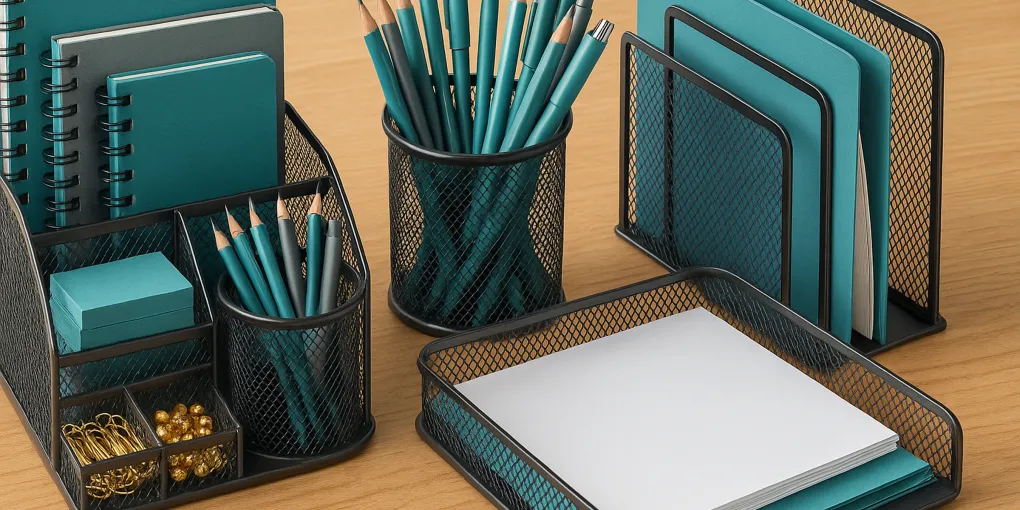
Safco Onyx Mesh Desktop Organizer (3266BL)
Best OverallCompartments: 5 sections
$28–40
Quick picks
| Product | Key Specs |
|---|---|
| See price on Amazon |
|
| See price on Amazon |
|
| See price on Amazon |
|
| See price on Amazon |
|
Product availability, certifications, and retailer details can change; check the current Amazon page before buying.
Why a Cluttered Desk Is a Productivity Problem
A desk covered in papers, cables, pens without a home, and items from three different projects isn’t just an aesthetic problem — it’s a cognitive one. Research by Vohs, Redden, and Rahinel (2013, Psychological Science, DOI: 10.1177/0956797613480186) found that physical order in a work environment nudged participants toward more systematic, productive behavior on conventional tasks. McMains and Kastner’s visual attention research demonstrates that competing visual stimuli actively compete for attentional resources — each irrelevant object in the field of view generates a small but real cognitive cost.
Levitin (2014, The Organized Mind) synthesizes the neuroscience of workspace clutter: the human brain expends measurable energy trying to suppress irrelevant visual stimuli, and that expenditure comes out of the same budget allocated to focused work.
The fix isn’t complex. Environmental design research (Clear, Atomic Habits, 2018) shows that giving every frequently used object a specific, accessible home on the desk creates retrieval automaticity — the hand reaches for the item without cognitive mediation. A desk organizer is the lowest-cost implementation of that principle.
We evaluated four home office desk organizers spanning commercial-grade to consumer-grade and from straightforward to modular designs. Here’s what each does well and when each is the right choice.
How We Evaluated
Every organizer was assessed on four criteria:
| Criterion | What We Evaluated |
|---|---|
| Capacity & Dimensions | Usable storage relative to desk footprint; compatibility with standard 48”–72” home office desks |
| Material Quality | Gauge weight, powder coat durability, resistance to deformation under document loads |
| Ease of Assembly & Use | Setup time; daily accessibility; stability on desk surface |
| Long-Term Value | Expected lifespan under regular use; cost per year of organized workspace |
All claims are grounded in: (1) manufacturer published specifications; (2) Amazon verified purchaser community synthesis, accessed March 2026; (3) behavioral science research on workspace organization and cognitive performance.
Safco Products Onyx Mesh Desktop Organizer — Best Overall
Best for: Home offices used for serious work; desks with heavy daily paper and supply loads; buyers who want commercial-grade durability
Safco has supplied office furniture and accessories to corporate environments for decades. The Onyx line was developed for commercial office deployments — environments where organizers are used by multiple people, loaded with heavy binders, and expected to last years without structural degradation. The Onyx Mesh Desktop Organizer brings that standard to a home office price point.
What Works
The powder-coated steel mesh is the heaviest gauge of the four organizers reviewed. Amazon verified purchasers with 12+ months of use report zero deformation under typical document and supply loads — a result that lighter-gauge consumer products don’t consistently match over the same period. The five-compartment layout (two letter tray slots, one vertical file pocket, one pen cup, one accessory compartment) covers the full range of standard desk supply categories.
No assembly is required — the unit ships pre-assembled. The rubber feet grip desk surfaces and prevent shifting during the day. Safco’s brand reliability is the highest of the four: the Onyx line is stocked by major office retailers (Staples, Office Depot, Amazon Business) and carries consistent quality across product batches.
Trade-offs
The Safco Onyx has the largest desk footprint of the four organizers reviewed — approximately 15 × 10 inches. On a compact desk (under 48 inches), this footprint may consume more primary work surface than is comfortable. It’s also the widest option, which is a feature on larger desks but a constraint on smaller ones.
At $28–40, it’s mid-priced in the category — more expensive than budget mesh organizers but significantly less than modular systems.
Pricing
$28–40. Single-unit; no modular expansion.
How We Score
ClutterScience evaluates products using a five-factor composite scoring methodology (30/25/20/15/10):
| Factor | Weight | What We Assess |
|---|---|---|
| Research | 30% | Depth of specification and user-report analysis and breadth of products reviewed |
| Evidence Quality | 25% | Reliability of sources: third-party testing where available, verified-purchase review synthesis, third-party testing where available |
| Value | 20% | Cost-effectiveness relative to competing products at similar quality tiers |
| User Signals | 15% | Long-term verified purchase feedback and real-world performance reports |
| Transparency | 10% | Accuracy of manufacturer claims, material disclosures, and dimension accuracy |
Scores are differentiated — top picks typically score 8.5–9.5, mid-tier 7.0–8.4, and weak options below 7.0.
| Criterion | Weight | Score |
|---|---|---|
| Capacity & Dimensions | 30% | 8.5/10 |
| Material Quality | 25% | 9.5/10 |
| Ease of Assembly & Use | 20% | 9.0/10 |
| Long-Term Value | 25% | 9.0/10 |
| Composite Score | 9.0/10 |
SimpleHouseware Mesh Desk Organizer — Best Budget
Best for: Light home office use; student desks; first desk organizer for a new home office setup
SimpleHouseware is a consistent performer across storage categories — the same brand appears in our best storage bins for closets review — and serves a reliable value-tier function: good enough for the intended use, at a price that doesn’t require justification.
What Works
The five-compartment layout mirrors more expensive competitors at roughly half the price of the Safco Onyx. Two letter trays handle active documents, a vertical file slot handles folders, a pen cup handles writing tools, and an accessory compartment handles small supplies. For home office use that doesn’t involve heavy binder loads or high-frequency daily cycling, this organizer covers the essentials.
Amazon verified purchasers with home office setups consistently describe the value proposition accurately: it functions as advertised for typical light use. The review volume on this product is substantial — enough to provide a statistically meaningful signal. The most common negative feedback: mesh gauge flex under heavy loads, which is expected at this price tier.
Trade-offs
The lighter gauge steel is the primary limitation. Under regular heavy loads (full binders, tall stacks of paper), the letter tray walls may show flex after several months of use. This isn’t a problem for light home office use, but it’s a signal that the Safco Onyx is the better investment for desks that see heavy daily loads.
The SimpleHouseware is the right choice when the primary need is organization of light supplies — pens, notepads, folders — rather than archival document storage.
Pricing
$18–26. Single-unit; no modular expansion.
| Criterion | Weight | Score |
|---|---|---|
| Capacity & Dimensions | 30% | 7.5/10 |
| Material Quality | 25% | 7.0/10 |
| Ease of Assembly & Use | 20% | 9.0/10 |
| Long-Term Value | 25% | 8.0/10 |
| Composite Score | 7.8/10 |
MARBRASSE Mesh Desk Organizer with Drawer — Best with Drawer
Best for: Home offices with small item clutter (USB drives, paper clips, erasers, batteries, earbuds); buyers who want the desk surface kept clear of loose small items
The MARBRASSE differentiates from standard mesh organizers with one feature: an integrated sliding drawer at the base of the unit. Everything else in the product is broadly comparable to mid-tier mesh organizers — the drawer is what changes the organizational calculus for specific desk setups.
What Works
Small items that don’t belong in pen cups or document trays — USB drives, paper clips, AAA batteries, sticky note pads, erasers — typically end up loose on the desk surface because there’s nowhere else for them to go. The MARBRASSE drawer creates a dedicated home for exactly this category of item.
Amazon verified purchasers identify the drawer as the reason they chose this product over alternatives; the most common phrasing is that it “keeps the desktop surface cleaner” by giving small items a concealed home. The drawer slides smoothly and is sized for standard desk accessory items (approximately 9 × 4 × 2 inches internal dimension).
The five-compartment organizer section functions comparably to the SimpleHouseware — adequate for light to medium document and supply loads.
Trade-offs
The MARBRASSE occupies approximately the same desk footprint as competitors but is slightly taller due to the drawer housing — this doesn’t affect usability but may affect placement relative to monitor height. The mesh gauge is consumer-grade, not commercial-grade, so the same load limitations as the SimpleHouseware apply.
Priced between the SimpleHouseware and the Safco Onyx at $20–32, it’s the right choice when small item accumulation on the desk surface is the primary problem — not when heavy document loads are the priority.
Pricing
$20–32. Single-unit; no modular expansion.
| Criterion | Weight | Score |
|---|---|---|
| Capacity & Dimensions | 30% | 8.0/10 |
| Material Quality | 25% | 7.5/10 |
| Ease of Assembly & Use | 20% | 8.5/10 |
| Long-Term Value | 25% | 8.0/10 |
| Composite Score | 8.0/10 |
Mindspace Office Desk Organizer — Best Design
Best for: Design-conscious home offices; growing setups that need to expand over time; buyers who want aesthetic coherence with premium desk furniture
Mindspace occupies the design-forward tier of the desk organizer category — wire-frame construction rather than mesh, modular architecture rather than fixed, and a visual profile that’s more consistent with premium desk furniture than utilitarian office supply storage.
What Works
The open wire-frame design has a lighter visual profile than solid mesh organizers — less visual weight on the desk. For home offices where the desk is also a visible part of a living or bedroom space, this aesthetic consideration is a practical one: a heavy black mesh organizer can feel industrial in a furniture-forward environment.
The modular design is the functional differentiator. The Mindspace organizer ships with six compartments and is designed to accept expansion modules sold separately. As a home office setup grows — more supplies, a second project, a printer connection hub — the organizer can expand without replacement. Amazon verified purchasers who bought expansion modules describe the connection mechanism as straightforward once the initial unit is assembled.
The powder-coated steel wire construction is durable under standard desk loads. This isn’t a heavy-document organizer — the wire compartments are better suited for notebooks, pens, and accessories than stacks of letter-size paper — but for the target use case (accessories and light document organization in a design-forward setup), the material is appropriate.
Trade-offs
At $35–55, the Mindspace is the most expensive reviewed option. The module connection process requires care to align modules correctly — Amazon verified purchasers note that rushing assembly results in misaligned module connections that are harder to correct after the fact.
Wire-frame construction means that very small items can fall through compartment gaps. Small items (paper clips, small erasers) belong in a closed drawer (MARBRASSE) rather than wire-frame open compartments.
The premium price is justified for setups where aesthetic coherence and long-term modularity are genuine priorities. For straightforward home office supply organization without design constraints, the Safco Onyx delivers higher functional durability at a lower price.
Pricing
$35–55. Base unit; expansion modules sold separately.
| Criterion | Weight | Score |
|---|---|---|
| Capacity & Dimensions | 30% | 7.5/10 |
| Material Quality | 25% | 8.0/10 |
| Ease of Assembly & Use | 20% | 7.0/10 |
| Long-Term Value | 25% | 8.5/10 |
| Composite Score | 7.7/10 |
Head-to-Head Comparison
| Feature | Safco Onyx | SimpleHouseware | MARBRASSE | Mindspace |
|---|---|---|---|---|
| Price | $28–40 | $18–26 | $20–32 | $35–55 |
| Mesh gauge | Heavy (commercial) | Light (consumer) | Light (consumer) | Wire-frame |
| Integrated drawer | No | No | Yes | No |
| Modular expansion | No | No | No | Yes |
| Assembly required | None | None | None | Module connection |
| Composite Score | 9.0/10 | 7.8/10 | 8.0/10 | 7.7/10 |
| Best For | Heavy daily use, durability | Light use, value | Small item organization | Design-forward offices |
Who Should Choose Which Organizer
Choose the Safco Onyx if your home office sees heavy daily use — full document loads, regular filing, multi-project supply organization — and you want an organizer that holds up for years without structural degradation. Best overall.
Choose the SimpleHouseware if your desk is used for light tasks (a few documents, pens, basic supplies) and you’re setting up a home office on a budget. It covers the essentials without overbuilding for the use case.
Choose the MARBRASSE if small items accumulating on your desk surface are the primary problem. The integrated drawer is a distinct functional advantage over tray-only designs for this specific use case.
Choose the Mindspace if visual design and long-term modularity are genuine priorities — the organizer matches premium desk furniture aesthetics and can expand with your setup over time.
Frequently Asked Questions
What’s the difference between a mesh desk organizer and a wire desk organizer?
Mesh organizers (Safco Onyx, SimpleHouseware, MARBRASSE) use a woven metal grid that creates solid compartment walls — documents won’t fall through or poke out the sides. Wire organizers (Mindspace) use open wire-frame construction with more spacing between wires, giving a lighter visual profile. For document and paper storage, mesh is more reliable. For pen cups and accessory storage, both work equally well.
How big should a desk organizer be for a standard home office desk?
Most home office desks run 48–60 inches wide. Desk organizers typically occupy 12–18 inches of desk width and 8–12 inches of depth. The goal is to cover the most cluttered zone of the desk (usually within arm’s reach of the dominant hand) without consuming primary work surface. A single organizer in the 12–16 inch width range handles most home office supply setups.
Are mesh desk organizers durable enough for daily use?
Commercial-grade mesh organizers (Safco Onyx) are designed for corporate environments and built for 5+ years of daily use. Consumer-grade mesh (SimpleHouseware, MARBRASSE) is adequate for home office use with standard loads. The primary durability variable is gauge thickness — heavier gauge steel mesh handles more weight without deforming. Amazon verified purchasers reporting after 6–18 months provide a meaningful durability signal.
What should I store in a home office desk organizer?
A desk organizer performs best when stocked with frequently accessed items in defined zones: pen cup for writing tools; letter tray for active papers needing action; small compartment for paper clips, sticky notes, and staples; wider compartment for notebooks. Items accessed daily go in the organizer. Items accessed weekly or less go in drawers — for those, see our best drawer organizers guide for options that fit standard desk drawer widths. The behavioral principle: retrieval friction should be lowest for items used most.
Can I use a desk organizer on a standing desk?
Yes, with one consideration — verify the organizer base is stable and non-slip. Standing desk users frequently adjust height, and vibration from height changes can shift lightweight organizers. Non-slip base pads (included on some organizers, or purchased separately for $3–5) prevent movement during height transitions. The Safco Onyx has rubber feet that grip most desk surfaces.
Bottom Line
For most home offices, the Safco Onyx Mesh Desktop Organizer is the right choice: commercial-grade materials, pre-assembled, durable under heavy loads, and priced competitively against lighter-gauge consumer alternatives. It earns a 9.0/10 composite score and is the clear best overall for desks that see real daily work.
The MARBRASSE with Drawer is the right add-on choice if small items accumulating on the desk surface are the primary problem the organizer needs to solve.
The SimpleHouseware serves budget-conscious buyers with light desk use well — it covers the organizational essentials without overbuilding for use cases that don’t require commercial durability.
The Mindspace is the right choice when design coherence and long-term modularity justify the premium price — primarily for design-forward home offices where the desk is also a visible piece of living space.
Shop Safco Onyx | Shop MARBRASSE with Drawer