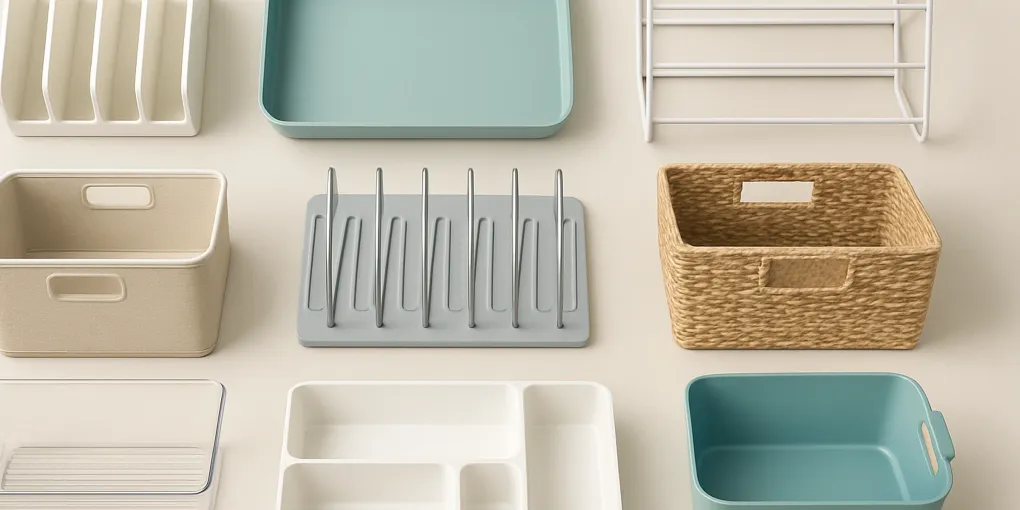
Best Bakeware Organizers for Sheet Pans, Cutting Boards, Muffin Tins, and Cooling Racks
Buyer's GuideHow We Evaluate Bakeware Organizers
ClutterScience scores kitchen organizers using a five-factor composite methodology (30/25/20/15/10). Composite weights: Research 30%, Evidence Quality 25%, Value 20%, User Signals 15%, Transparency 10%.
| Factor | Weight | What It Measures |
|---|---|---|
| Research | 30% | Fit with reach, retrieval, visibility, and ergonomic handling principles |
| Evidence Quality | 25% | Quality of product information, owner feedback patterns, and practical design logic |
| Value | 20% | Storage improvement relative to cost, installation burden, and cabinet compatibility |
| User Signals | 15% | Common feedback: wobble, divider spacing, pull-out smoothness, coating durability |
| Transparency | 10% | Clear notes on when a cheaper or simpler storage method is better |
Recommended starting searches:
- vertical bakeware organizerAffiliate link: we may earn a commission. This does not affect scoring.
- sheet pan organizer rackAffiliate link: we may earn a commission. This does not affect scoring.
- pull out bakeware organizerAffiliate link: we may earn a commission. This does not affect scoring.
- cutting board and bakeware organizerAffiliate link: we may earn a commission. This does not affect scoring.
Why Bakeware Is So Awkward to Store
Bakeware creates a different storage problem than pots, plates, or pantry containers. Sheet pans, muffin tins, cooling racks, cutting boards, pizza stones, and roasting racks are wide, flat, and often slightly different sizes. When stacked, the piece you want is usually under three other pieces. When leaned loose against a cabinet wall, the whole group slides forward like a metal avalanche.
The best bakeware organizers solve two problems at once: they separate flat pieces and they hold them upright. Upright storage turns a lifting task into a sliding task. Instead of removing every pan to reach the half sheet, you pull the half sheet from its slot. That is faster, quieter, and less likely to scratch coatings.
This matters because bakeware is often used during time-sensitive cooking. If the oven is preheating and dough is ready, digging through a stack adds friction at exactly the wrong moment. A good organizer turns the bakeware cabinet into a file drawer for kitchen tools.
Best Overall Type: Adjustable Vertical Divider Rack
An adjustable vertical divider rack is the best first choice for most kitchens. It sits inside a cabinet and creates lanes for sheet pans, cooling racks, cutting boards, muffin tins, and trays. Adjustable dividers matter because bakeware thickness varies. A cooling rack needs a narrow slot; a muffin tin needs a wider one.
Look for a rack with a stable base, coated metal construction, and dividers that lock firmly into place. If dividers pop out whenever a pan is removed, the organizer becomes more annoying than the stack it replaced.
Best fit: base cabinets, deep shelves, renters, and households with mixed bakeware.
Weakness: it uses a fixed cabinet footprint and may not hold very heavy stoneware or cast-iron griddles safely.
Search option: adjustable vertical bakeware rackAffiliate link: we may earn a commission. This does not affect scoring..
Best for Deep Cabinets: Pull-Out Bakeware Organizer
A pull-out organizer is useful when bakeware lives in a deep base cabinet and the back half is hard to reach. The sliding mechanism brings the entire category forward, so you can access pans without crouching and reaching blindly.
The tradeoff is installation. Many pull-out systems require screws, careful measuring, and enough side clearance for the slide hardware. They also cost more than freestanding racks. The payoff is highest in kitchens where bakeware is used often and the current cabinet wastes depth.
Before buying, measure cabinet opening width, interior depth, hinge intrusion, and door clearance. A pull-out rack that fits inside the cabinet but cannot clear the door frame is a failed purchase.
Best fit: homeowners, serious bakers, deep lower cabinets, and people who struggle with low reaching.
Weakness: higher cost, installation effort, and less flexibility if your bakeware collection changes.
Search option: pull out sheet pan organizer cabinetAffiliate link: we may earn a commission. This does not affect scoring..
Best Budget Option: Sturdy Wire Pan and Lid Organizer
A pot-lid organizer can double as bakeware storage if it is sturdy and wide enough. This is a good budget option for small sheet pans, cutting boards, cooling racks, and lightweight trays. The same design principle applies: create vertical slots so items can slide out independently.
The risk is scale. Many lid organizers are too narrow or too lightweight for full-size sheet pans. Check the listed dimensions and compare them with your largest pan before buying. Also check the direction of the slots; some lid racks are designed for round lids and do not support rectangular pans well.
Best fit: small kitchens, renters, light bakeware collections, and cabinet shelves with limited height.
Weakness: may wobble with heavy pans and may not fit large half-sheet pans.
Search option: wire pan lid organizer rackAffiliate link: we may earn a commission. This does not affect scoring..
Best for Cutting Boards and Thin Trays: Countertop or Cabinet File Rack
If your main problem is cutting boards rather than pans, a file-style rack can work well. Choose metal or bamboo rather than flimsy plastic, and make sure the slots are wide enough for thicker boards. This type can live inside a cabinet, on a pantry shelf, or on a counter if the boards are attractive and used daily.
Countertop visibility is a tradeoff. Keeping boards visible can improve use and drying, but it adds visual density. If your kitchen already feels busy, place the rack inside a cabinet or pantry instead.
Best fit: households with several cutting boards, serving boards, or thin trays.
Weakness: poor for muffin tins, roasting pans, and heavy bakeware.
Search option: cutting board file organizerAffiliate link: we may earn a commission. This does not affect scoring..
Best for Above-the-Oven or Tall Cabinets: Shelf Divider System
Some kitchens have a tall cabinet above the oven or refrigerator where flat pans can stand upright. Shelf dividers can convert that tall zone into bakeware storage without using a separate rack. This works best when the cabinet is high but not too deep and when the household can safely reach the items.
Use this only for lightweight pieces. Pulling a heavy stoneware pan from above shoulder height is not ergonomic and can be unsafe. Ergonomics guidance generally favors keeping heavier, awkward items closer to the body and avoiding unnecessary high or extended reaches. Store heavy pieces low, preferably in a base cabinet.
Best fit: lightweight trays, cooling racks, pizza screens, and occasional-use pans.
Weakness: poor for heavy items and for users who cannot comfortably reach the shelf.
Search option: cabinet shelf dividers for pansAffiliate link: we may earn a commission. This does not affect scoring..
What to Measure Before Buying
Measure the cabinet opening, not just the interior. Hinges, face frames, and door swing can reduce usable access. Then measure the largest pan in the category, including handles or raised edges. Many sheet pans are larger than people remember.
Check vertical clearance. A pan stored upright needs enough height for the pan plus finger clearance. If the cabinet shelf is too low, the pan will scrape every time it comes out.
Check depth. If a rack is too deep, it may block the door. If it is too shallow, large pans may lean unstable. For pull-out systems, measure twice and read the installation diagram before ordering.
Finally, count the category. A family with two sheet pans, one muffin tin, and two cutting boards needs a different organizer than a baker with cooling racks, cake pans, silicone mats, pizza stones, and roasting pans.
Setup Protocol
- Remove every flat kitchen item from the cabinet.
- Separate true bakeware from cutting boards, serving trays, appliance accessories, and rarely used holiday pans.
- Donate or relocate duplicates that no longer match your cooking habits.
- Choose the cabinet nearest the oven if possible.
- Put heavy pans low and lightweight racks or boards higher.
- Place the most-used sheet pan in the easiest slot.
- Test removal with one hand while the cabinet door is fully open.
- Label the shelf edge if multiple people unload dishes.
The one-hand test is useful as a household usability screen. If you need two hands and a balancing maneuver to remove a pan, the organizer is probably not reducing retrieval friction enough to justify its footprint.
Materials and Stability
Most bakeware organizers are coated steel, stainless steel, bamboo, plastic, or a mixed-material frame. Coated steel is usually the best balance of price, strength, and easy cleaning. Stainless steel can be more durable but may cost more. Bamboo looks warmer on open shelving, but it can stain or warp if stored near damp cutting boards. Plastic is acceptable for lightweight trays, but it is rarely the best choice for heavy metal pans.
Stability matters more than appearance. A rack with a wide base, rubber feet, and rigid dividers will feel better every day than a narrow rack that looks cleaner in product photos. If you store pans in a lower cabinet, the organizer should stay still while you slide one pan out. If the whole rack moves, add a grippy shelf liner underneath or choose a heavier model.
Spacing also matters. Tight slots maximize count but can scratch finishes and make muffin tins difficult to remove. Wide slots reduce capacity but improve retrieval. For most homes, retrieval quality is more valuable than squeezing in one more rarely used pan.
When Stacking Is Still Better
Vertical storage is not always best. Stack matched cake pans that nest cleanly. Stack seasonal roasting pans if they are used twice a year. Stack silicone baking mats flat if vertical storage causes curling. Store heavy pizza stones horizontally on a low shelf.
The principle is frequency plus shape. Frequently used flat items deserve vertical access. Rarely used nested sets can stack because retrieval friction is occasional.
Common Mistakes
Do not buy a rack before editing the category. Organizers are sized for the collection you keep, not the collection you wish you used.
Do not mix bakeware with random appliance parts. Stand mixer attachments, food processor discs, and air-fryer accessories need their own containment or the bakeware rack becomes chaotic.
Do not store nonstick pans where metal edges scrape them every time one item slides out. Add spacing or use protectors if coatings matter.
Do not put heavy stoneware in a lightweight divider rack. Weight belongs low and stable.
Sources and Safety Notes
This buyer’s guide is based on storage ergonomics and retrieval logic rather than a claim that one organizer type is medically required. Source-backed cautions include:
- NIOSH’s lifting guidance, including Applications Manual for the Revised NIOSH Lifting Equation, supports the general principle that awkward reaches and heavier loads increase handling strain. In a kitchen, that translates to storing heavy stoneware and awkward pans low rather than overhead.
- Product recommendations here use Amazon search links rather than fabricated ASINs. Before buying, verify current dimensions, weight limits, installation requirements, and return terms on the live listing.
- The vertical-storage recommendation is a practical retrieval heuristic for frequently used flat items; stacking can still be better for nested sets, heavy stones, or rarely used seasonal pans.
Bottom Line
The best bakeware organizer is usually an adjustable vertical divider rack: simple, affordable, renter-friendly, and effective for the flat items that make kitchen cabinets frustrating. Choose a pull-out rack for deep base cabinets, a wire lid organizer for budget setups, a file rack for cutting boards, and shelf dividers for tall lightweight storage.
The goal is not to store more bakeware. The goal is to make the pans you actually use easy to retrieve without lifting a noisy stack. If the organizer makes baking easier, reduces cabinet noise, and prevents duplicate buying because every pan is visible, it is doing its job. If it simply hides the same overgrown collection in a new rack, edit again before adding more hardware. Measure first, edit duplicates, and let each pan slide out like a file instead of hiding under the pile.
Frequently Asked Questions
- Vertical dividers are usually the best option because they let each sheet pan, cutting board, cooling rack, and muffin tin slide out independently without lifting a heavy stack.
- Pull-out organizers are worth it for deep base cabinets where reaching the back is difficult. A simple freestanding divider is usually better for shallow cabinets or renters.
- A sturdy metal file sorter can work for lightweight cutting boards and small sheet pans, but purpose-built bakeware racks are usually wider, stronger, and more stable.
- Store bakeware vertically when pieces are flat and frequently used. Stack only low-frequency items or matched sets that are easy to lift together.