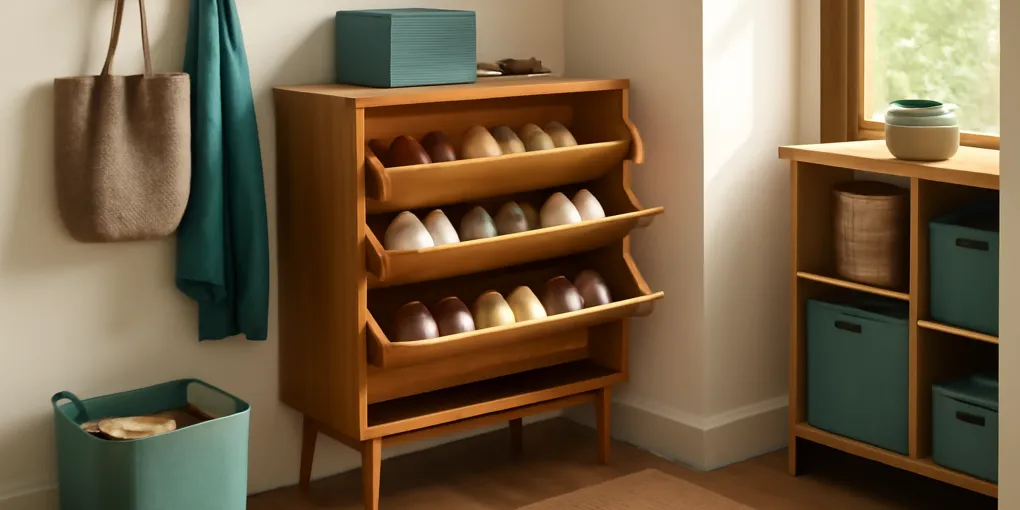
Best Entryway Shoe Cabinets for Small Apartments
Buyer's GuideIKEA HEMNES Shoe Cabinet
Best closed cabinetBest for: Apartments where shoes face a living room or hallway
Quick picks
| Product | Key Specs | Pros / Cons |
|---|---|---|
| See price on Amazon |
|
|
| See price on Amazon |
|
|
| See price on Amazon |
|
|
Product availability, certifications, and retailer details can change; check the current Amazon page before buying.
Quick product shortlist
Use this shortlist to choose a product style before you measure. The links are named product or brand searches so you can compare current dimensions, finishes, prices, and return terms before buying.
- Best closed cabinet: IKEA HEMNES Shoe Cabinet (Search Amazon for IKEA HEMNES shoe cabinet) for apartments where shoes face a living room or hallway. Watch-out: wall fastening and tilt clearance matter.
- Best budget tilt-out: VASAGLE Slim Shoe Cabinet (Search Amazon for VASAGLE slim shoe cabinet) for small entries that need a lower-cost closed shoe cabinet. Watch-out: check depth with shoes inside and doors open.
- Best open backup: SONGMICS Stackable Shoe Rack (Search Amazon for SONGMICS stackable shoe rack narrow entryway) for renters who prefer visible daily shoes and no wall mounting. Watch-out: open shoes need a strict pair limit.
How We Score Clutter Systems
Use the checks below to compare whether the product actually fits the room, survives daily handling, and makes the next reset easier.
| Factor | Weight | What It Measures |
|---|---|---|
| Research | 30% | Fit with habit formation, retrieval friction, environmental cues, and household workflow evidence |
| Evidence Quality | 25% | Consistency with consumer-safety guidance, professional organizing practice, and product documentation |
| Value | 20% | Payoff relative to cost, setup time, durability, and space recovered |
| User Signals | 15% | Common household failure points, return complaints, repeated mess patterns, and ease of maintenance |
| Transparency | 10% | Clear tradeoffs, limitations, measurement assumptions, and when a cheaper option is enough |
The score is not a promise that one cabinet solves entryway clutter. It is a way to compare whether the system reduces decisions, keeps high-use shoes visible, and makes the next reset easier.
The Problem This Guide Solves
Best Entryway Shoe Cabinets for Small Apartments is really a guide to protecting a small, busy room from daily drift. Clutter usually does not appear because a household lacks containers. It appears because the easiest place to put an item is not the place where the item belongs. A good organizer changes that path. It makes the right action easier than the wrong one, while still respecting the limits of the room.
Before shopping for best entryway shoe cabinets small apartments, write down the failure pattern you are trying to stop. Are items landing on the floor because the shelf is too high? Are clean and used items mixing because the categories are vague? Is the door blocked because storage projects into the walking path? The best choice depends less on the prettiest product photo and more on the exact friction point.
Good product categories to compare include entryway shoe storage (See current price on Amazon); small apartment shoe cabinet (See current price on Amazon); narrow shoe organizer (See current price on Amazon); closed shoe cabinet (See current price on Amazon). Use your exact measurements, door swing, and baseboard clearance before buying.
Quick Picks by Household Type
| Household need | Best direction | Why it works | Watch-out |
|---|---|---|---|
| Tiny apartment | Narrow closed cabinet | Hides visual noise without widening the footprint | Measure door swing and baseboards |
| Family bathroom or entry | Open hooks plus one closed bin | Fast for children and guests | Open storage needs a weekly reset |
| Rental home | Freestanding or over-door solution | Avoids drilling and patching | Can wobble if overloaded |
| Design-sensitive room | Matching baskets or cabinet fronts | Reduces visual clutter | Pretty containers can hide overbuying |
| Accessibility priority | Waist-height pull access | Less bending and reaching | Requires stricter category limits |
A product earns a higher score when it supports the household’s normal behavior. If everyone drops items near the door, a perfect closet system down the hall will fail. If towels are used by guests, a hidden linen closet may be less useful than a labeled basket near the shower.
Selection Criteria
Start with measurements. Record the usable width, depth, height, and clearance around doors, drawers, toilets, vents, and baseboards. Many returns happen because a product technically fits the wall but blocks a handle, outlet, switch, or walking route. For narrow rooms, also measure the open position: cabinet doors, pull-out bins, and lids need operating space.
Next, choose the storage style. Closed storage is better for visual calm and dust control. Open storage is better when items must be grabbed quickly or returned by children and guests. Pull-out storage helps deep spaces because it brings the back forward. Hooks are high-value when the item is used daily and does not need folding.
Finally, limit the category. A towel shelf should not become a backup toiletries shelf. A shoe cabinet should not become a returns pile. A pantry bin should not become a mystery box for expired food. Every organizer needs a boundary statement: this holds only one category, and overflow triggers editing rather than expansion.
Best Overall Setup
The best overall setup combines one primary storage piece with one reset surface. The primary piece holds the category. The reset surface catches the temporary item that would otherwise land on the floor. For example, a shoe cabinet works better with a small tray for keys and returns; towel shelves work better with hooks for damp towels; pantry bins work better with a front basket for food that should be used this week.
Look for stable construction, smooth edges, and surfaces that can be wiped clean. In damp rooms, avoid unfinished materials that swell. In entryways, avoid delicate finishes that scratch from grit. In kitchens, choose bins that can be cleaned after spills. If the unit is tall or top-heavy, follow anchoring guidance and manufacturer instructions.
The best version is rarely the largest version. Oversized storage invites delayed decisions. Choose enough capacity for normal use plus a small buffer, not enough to store every possible future item.
Budget Option
A budget setup can work well if it uses fewer categories. Choose one sturdy container, one label, and one weekly reset habit. For many homes, a basic basket, shelf divider, or over-door hook solves more than an elaborate modular system because everyone can understand it instantly.
The tradeoff is visibility and durability. Cheap fabric bins can slump. Thin wire shelves can wobble. Adhesive hooks can fail in humidity or under weight. Budget products should be tested with the heaviest realistic load before becoming the permanent system.
Use temporary containers for one week before buying multiples. If the temporary version is ignored, the expensive version will probably be ignored too.
Upgrade Option
An upgrade is worth considering when the area is used many times a day, when the room is small enough that visual noise affects comfort, or when the product prevents repeated replacement. For cabinets, upgrades usually mean better hinges, a shallower profile, adjustable shelves, and easier cleaning. For shelves and bins, upgrades mean stronger materials, clearer labels, and better pull access.
Do not upgrade for capacity alone. More capacity often delays editing and makes the next reset harder. Upgrade for fit, access, safety, and maintenance.
Setup Protocol
Empty the target category and sort it where you can see all of it. Remove broken, expired, duplicate, or disliked items before measuring capacity. Group by use case rather than by vague type. Daily items deserve the easiest reach. Backup items can live higher, lower, or farther back.
Install or place the organizer, then load it to about 80 percent. Leave air space so hands can retrieve items without dragging out the whole category. Add one plain label per category. If the label needs a sentence, the category is too complicated.
Test the setup for seven days. Watch where items still land. Adjust the system to the behavior instead of scolding the behavior. The goal is a repeatable reset, not a perfect first arrangement.
Maintenance Plan
Schedule a five-minute weekly reset. Return stray items, wipe surfaces, and check whether overflow has started. Monthly, remove anything that no longer belongs in the category. Seasonally, reconsider whether the category still deserves the same location.
A good maintenance plan has a visible trigger: trash night, laundry day, grocery day, or the day before guests arrive. Without a trigger, even the best organizer becomes background furniture.
For a related routine that keeps footwear from spreading beyond the door, see our guide to how to organize shoes.
A final buying note: do not treat the organizer as permission to increase inventory. The system should make the correct amount easier to maintain, not hide excess. If your home repeatedly outgrows the assigned space, review purchasing habits, laundry timing, grocery cadence, or return routines before adding another storage product. That review is less exciting than a new bin, but it is usually what keeps the system working after the first month.
For households with children, roommates, or guests, use plain language and visible categories. The system should not require someone to remember a private taxonomy. If a guest can understand where an item belongs in ten seconds, the label and location are probably clear enough for daily life.
Evidence Notes and Sources
This entryway guide uses sources that are specific to walkway safety, furniture stability, and small-apartment storage limits. The National Fire Protection Association explains that every household escape plan depends on clear, usable exits and routes; that makes cabinet depth, door swing, and shoe overflow safety issues rather than just aesthetics: https://www.nfpa.org/education-and-research/home-fire-safety/escape-planning. The CDC’s fall-prevention guidance emphasizes removing tripping hazards and improving lighting, which supports closed or contained shoe storage that keeps footwear out of the walking path: https://www.cdc.gov/falls/. The U.S. Consumer Product Safety Commission tip-over guidance is relevant when a narrow cabinet is tall, top-heavy, or placed where children may pull drawers open: https://www.cpsc.gov/Safety-Education/Safety-Education-Centers/Tipover-Information-Center.
Product documentation also matters here. IKEA’s STÄLL and HEMNES shoe-cabinet instructions, for example, specify wall anchoring and clearance assumptions; those manufacturer limits are why renters should verify anchor permissions and why freestanding units need stability checks before loading. The organizing claim is deliberately narrow: a shoe cabinet is successful when it keeps the everyday pair count within a measured footprint and leaves the apartment entry route unobstructed.
Entryway Failure Modes to Watch
The first failure mode is the door-swing surprise. A cabinet can fit the wall and still fail when its drawer front, tilt-out compartment, closet door, or apartment door needs the same space. Tape the footprint on the floor and mimic the open position before ordering.
The second failure mode is shoe math. Many slim cabinets hold fewer adult shoes than product photos imply, especially boots, high-tops, and wide sizes. Count pairs by height and season, then decide which shoes live at the door and which move to a closet or under-bed backup zone.
The third failure mode is unstable loading. Narrow cabinets can become front-heavy when several compartments are open or when children use them for balance. Follow the manufacturer’s anchoring instructions where allowed; if you cannot anchor in a rental, choose a lower, heavier, wider unit or an open bench-style rack.
Seven-Day Entryway Test
For one week, let only current-season daily shoes live in the cabinet. Put a small tray beside it for keys, returns, or wet items so those do not occupy shoe compartments. Each night, check whether shoes are inside the cabinet or forming a second pile beside it.
At the end of the week, keep the cabinet only if the walking path stayed clear without a heroic reset. If guests, kids, or roommates repeatedly miss the compartments, switch one daily category to open access and reserve the closed cabinet for less frequent pairs.
FAQ
How do I know if this storage system is working?
Track the reset, not the photo. If the area can be returned to order in under five minutes by the person who uses it most, the system is probably working. If reset requires moving several unrelated objects, the storage is too complicated or too full.
Should every container be labeled for Entryway Shoe Cabinets for Small Apartments?
Label shared, seasonal, or visually similar categories. Skip labels for obvious single-use containers. Too many labels can become visual noise, but no labels can make a shared system depend on one person’s memory.
What is the most common mistake for Entryway Shoe Cabinets for Small Apartments?
Buying the organizer before measuring the space and defining the category. Measure width, depth, height, door swing, shelf clearance, and the largest item that must fit. Then decide what the organizer is not allowed to hold.
When should I avoid buying anything for Entryway Shoe Cabinets for Small Apartments?
Avoid buying when the category is too large, stale, or emotionally undecided. Edit first, group like items, and test with a temporary box or basket for a week. If the temporary setup works, buy the durable version.