Best Eyeglass and Sunglasses Organizers for Entryways, Nightstands, and Cars
Buyer's GuideYamazaki Rin Accessory Tray
Quick picks
| Product | Key Specs |
|---|---|
| See price on Amazon | — |
| See price on Amazon | — |
| See price on Amazon | — |
| See price on Amazon | — |
Product availability, certifications, and retailer details can change; check the current Amazon page before buying.
Eyeglasses and sunglasses disappear because they are used in transitions. A pair leaves the car, lands on the kitchen island, moves to a bedside table, then hides under mail. Buying a large sunglasses organizer does not solve that if the real problem is three different drop zones with no rules.
This guide is for choosing the right organizer by location: entryway, nightstand, desk, drawer, or car. If your entryway already catches keys and mail, pair this with the entryway landing zone reset so glasses do not become another object in the bowl.
Quick picks
- Best by the door: Yamazaki Rin Accessory Tray or a similar shallow divided tray with one slot for the daily sunglasses pair.
- Best for readers: Umbra Tesora Jewelry Stand or a similar smooth stand on the desk or nightstand where glasses are removed.
- Best for multiple pairs: mDesign Clear Stackable Sunglasses Organizer Box or another clear compartment drawer with separated slots.
- Best for the car: EletecPro Car Visor Sunglasses Holder or a similar low-profile holder only for a dedicated driving pair.
- Skip if: the organizer mixes lenses with keys, coins, grit, or loose charging cables.
The four organizer jobs
Eyewear storage fails when one product is asked to do every job. The entryway pair needs a tray shallow enough that sunglasses do not slide under mail. Readers need a stand beside the desk, sofa, or nightstand where they come off. A multi-pair collection needs compartments wide enough for frames and cases. A driving pair needs a car-safe holder that does not block the visor, mirror, or sight line.
Use capacity only after choosing the job. A twelve-slot sunglasses drawer is overkill for one daily pair, while a single ceramic dish is risky for prescription lenses that share space with keys. The products below represent the four jobs, not a reason to collect more frames.
Best entryway tray: divided glasses tray
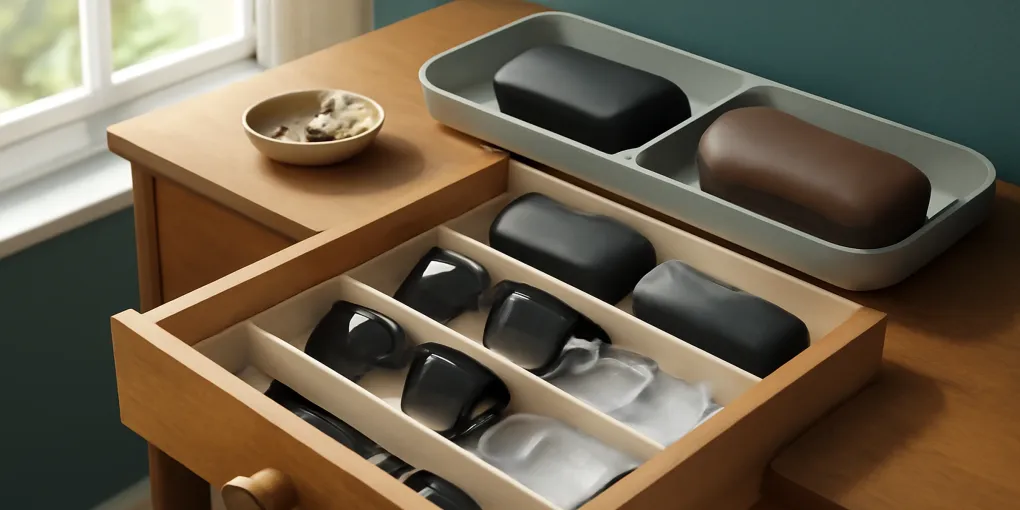
A divided tray works when the problem is sunglasses landing with keys, receipts, and mail. Search for Yamazaki Rin accessory tray (check current options on Amazon) if you want a low-profile tray that can sit on a console without looking like a shop display.
Choose a tray with at least two separated zones: one for glasses and one for pocket items. Avoid rough wicker, deep bowls, and anything that lets keys scrape lenses. If the tray has no divider, it is just a prettier junk bowl.
Best desk or nightstand holder: vertical glasses stand
Readers and blue-light glasses usually fail because they are removed mid-task. A vertical stand beside the computer or bed keeps the pair visible without requiring a hard case every time. Search for Umbra Tesora jewelry stand glasses (compare current options on Amazon) and choose a weighted stand with a smooth surface.
This is not the best option for expensive prescription glasses in a house with pets or small children. In that case, use a hard case in the same spot and make the case itself the habit.
Best multiple-pair storage: stackable clear drawer
If the household owns fashion sunglasses, reading glasses, computer glasses, and backup pairs, a single tray becomes a pile. Search for mDesign clear stackable sunglasses organizer box (browse current options on Amazon) and look for individual compartments deep enough for cases or frames.
Clear drawers are useful only if they stay shallow. A tall tower in a closet can hide the everyday pair and push the household back to counter clutter. Put daily pairs at eye level and backup pairs lower.
Best car holder: visor or console glasses holder
A car holder should be for one driving pair, not for every pair the household loses. Search for EletecPro car visor sunglasses holder (check current options on Amazon) and choose a clip that holds firmly without scratching lenses or blocking the driver’s view.
If a visor clip annoys you or interferes with sun visor use, put the glasses in a hard case in the console instead. Do not leave loose frames sliding in a cup holder with coins, pens, and crumbs.
Buyer checklist
| Need | Better choice | Avoid |
|---|---|---|
| One daily sunglasses pair | Shallow divided entryway tray | Deep bowl with keys |
| Bedside readers | Smooth vertical stand | Open shelf where frames get knocked down |
| Prescription backup pair | Hard case in a labeled drawer | Soft pouch under mail |
| Many fashion sunglasses | Clear compartment drawer | One overfilled basket |
| Driving pair | Stable car holder or console case | Loose glasses in cup holder |
Lens-protection details that matter
Look for smooth compartments, washable liners, and enough space that arms do not bend when the organizer is full. Avoid rough seagrass, metal edges, gritty entryway trays, and compartments so narrow that frames rub each other.
If you keep cleaning cloths with the glasses, give cloths their own small slot. A dusty cloth thrown into a tray with keys does not protect lenses. The American Academy of Ophthalmology recommends gentle lens cleaning and avoiding abrasive materials, which is a good reminder that storage surfaces matter too.
Match the organizer to the pair value
Not every pair deserves the same storage. Cheap readers can live in a fast-access stand because the cost of friction is higher than the cost of a soft case. Prescription glasses, progressive lenses, and expensive polarized sunglasses need more protection. Put those in a hard case or a lined drawer slot where keys, pens, and coins cannot touch the lenses.
For kids’ glasses, choose fewer locations rather than more containers. One school-bag hard case and one home landing spot are easier to teach than a bedroom tray, kitchen tray, backpack pouch, car case, and bathroom shelf. If the pair is always lost after homework, the organizer belongs near the homework spot, not near the front door.
Where not to put glasses
Do not store glasses in the same bowl as keys. The shape looks convenient, but the contents move like a tumbler every time someone drops keys, lip balm, or a garage remote into the bowl. That is how lenses get small scratches and frames bend.
Do not use a bathroom tray for daily glasses unless the pair is actually removed there. Bathroom counters collect toothpaste, hair products, and damp cloths. A washable tray is better than a wooden dish, but a bedside or entryway location usually matches the habit better.
Do not make the car the backup storage spot for every extra pair. Heat, vibration, and loose console clutter are rough on frames. Keep one driving pair in the car if needed, then store backups in a closet or drawer organizer inside the house.
Small-home setup examples
For a studio apartment, use one entryway tray with two slots: daily sunglasses and keys. Put readers on a desk stand. Keep backup cases in a closet drawer so the public surface does not become a glasses display.
For a family entryway, use individual tray compartments or a narrow drawer with labels by person. The important part is not the label style. The important part is that one child’s sports sunglasses do not bury another adult’s prescription pair.
For a bedroom dressing area, use a clear compartment drawer for style pairs and hard cases for prescription pairs. Put the daily pair at the front, not under the special-occasion sunglasses. If the organizer has twelve slots and you use only three pairs, leave the extra slots empty instead of filling them with watches, cords, and receipts.
Buying mistakes to avoid
The most common mistake is buying too much capacity. A 12-pair organizer looks orderly when empty, but it invites every broken case, scratched novelty pair, and out-of-date prescription into the same system. Buy for the pairs you actually use plus one backup slot.
The second mistake is choosing a pretty material that scratches. Rough baskets and metal mesh can work for cases, not bare lenses. If frames will touch the organizer directly, run a finger along the surface before trusting it.
The third mistake is hiding the active pair. A lidded drawer is excellent for a collection, but it is too slow for the pair that comes on and off several times a day. Put the active pair in the fastest safe holder, then put extras in slower protected storage.
Eyeglass organizer FAQ
Is a glasses stand better than a case?
A stand is faster for daily readers. A case is better for prescription glasses, travel, and any pair that shares space with keys or tools.
Where should sunglasses live in a small entryway?
Use one shallow tray or wall pocket near the door, then limit it to the active pair. Store backups somewhere else.
Do clear sunglasses drawers look cluttered?
They can if they sit in a public entryway. Use clear drawers inside a closet, bedroom, or dressing area where visibility is more useful than decor.
Sources
- American Academy of Ophthalmology eyeglass care guidance supports smooth, non-abrasive handling and cleaning habits for lenses.
- CDC falls prevention at home supports keeping home pathways and surfaces free of trip hazards, which is relevant when entryway catchalls overflow onto floors and benches.
Reader test
A reader can choose a tray for one daily pair, a stand for readers, a clear drawer for many pairs, or a car holder for a driving pair. This article is specific to eyewear because it covers lens abrasion, frame bending, prescription cases, visor clips, cleaning cloths, and the transition points where glasses are removed.
Frequently Asked Questions
- A shallow divided tray works best by the door because it keeps one daily pair visible without creating a deep catchall.
- Use hard cases for prescription pairs, travel, or bags. A soft tray can work for daily readers only if lenses are protected from keys and grit.
- Usually one entryway tray, one bedside or desk holder, and one car-specific holder if a driving pair actually lives in the vehicle.