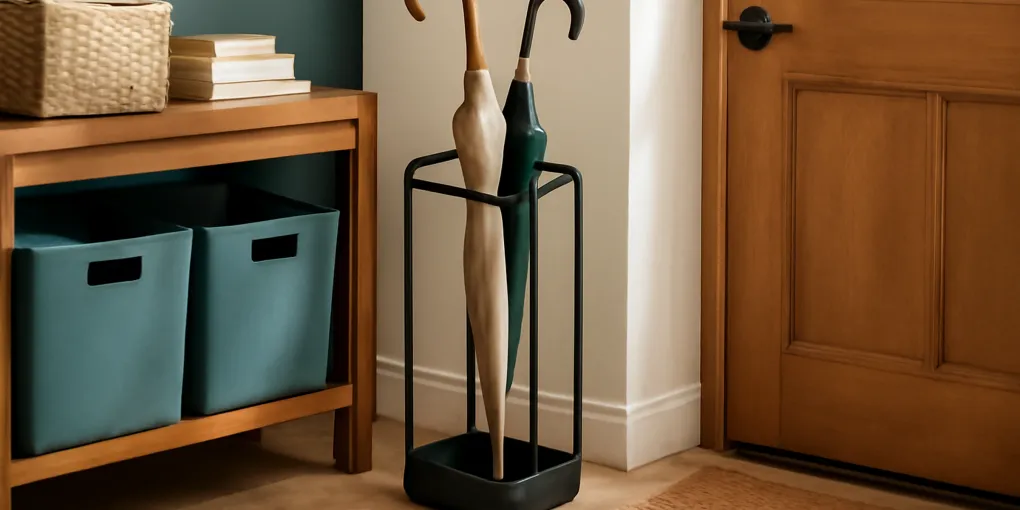
Best Umbrella Stands for Entryways: Drip Control, Tip Resistance, and Small-Space Fit
Buyer's GuideSONGMICS metal umbrella stand with drip tray
Quick picks
| Product | Key Specs |
|---|---|
| See price on Amazon | — |
| See price on Amazon | — |
| See price on Amazon | — |
Product availability, certifications, and retailer details can change; check the current Amazon page before buying.
A wet umbrella is small until it leans across the entryway, drips onto shoes, and turns the first step inside the door into a puddle. The right umbrella stand is not just a decorative tube. It is a drip-control and trip-control tool for the exact place where people enter with wet hands, bags, pets, groceries, and poor visibility.
If the entry already has shoes and backpacks in the walking path, start with hallway drop zone protocol. If the larger project is a full entry reset, pair this guide with drop zone bench vs wall hooks.
Quick picks
- Best everyday choice: Search Amazon for SONGMICS umbrella stands. Choose a removable tray and a base that does not wobble when one umbrella is pulled out.
- Best narrow-hall choice: Search Amazon for Yamazaki umbrella stands. Check width against the door swing and shoe mat.
- Best no-floor-space choice: Search Amazon for mDesign wall umbrella holders. Use only when it can be mounted securely and water has a catch point below.
What an umbrella stand has to solve
An umbrella stand needs to solve four entryway problems at once: water, tipping, reach, and walking clearance. Water matters because a wet umbrella without a tray leaves the floor slippery. Tipping matters because tall umbrellas act like levers. Reach matters because people will not cross the room to store something wet. Walking clearance matters because the front door is already a high-traffic transition.
CDC falls-prevention guidance lists removing trip hazards and improving home safety as part of reducing fall risk (CDC falls prevention). An umbrella stand is not medical equipment, but the entryway logic is the same: keep objects and wet spots out of the path where feet land.
Best overall: weighted stand with removable drip tray
A weighted stand with a removable drip tray is the best default for most homes. The weight keeps the stand from sliding when someone grabs one umbrella. The tray collects water so it can be emptied and cleaned. Tall sides keep compact umbrellas from spilling out.
Best fit: family entryways, mudrooms, covered porches, and apartments where umbrellas are used often.
Avoid if: the only available spot is directly behind the door or in the narrowest part of a hallway.
Before buying, measure the open-door arc. A stand that fits when the door is closed may get knocked every time the door opens. Also measure your tallest umbrella. A stand that is too short lets golf umbrellas lean so far that they become a trip hazard.
Best for tight halls: narrow metal stand
A narrow stand is useful when floor space is limited but umbrellas need a visible home. Metal tends to handle dampness better than woven baskets, especially if the bottom has a removable insert. Look for a base that is wider or heavier than the top, because slim stands can tip when loaded unevenly.
Best fit: small apartments, side entries, and hallways with one or two regular umbrellas.
Avoid if: your household has several large umbrellas, walking sticks, shoehorns, and sports gear competing for the same narrow column. A slim stand can become a packed spear bucket.
A narrow stand should sit beside the mat, not on the mat if that makes people step around it. If the stand forces a sideways step while carrying groceries, it is too large for that entry.
Best for no floor space: wall-mounted holder
A wall-mounted holder can work when the entry has no safe floor footprint. The advantage is clear floor space. The tradeoff is installation. A wet umbrella has weight, and people pull at odd angles. Use proper anchors for the wall type and follow the holder instructions.
A wall holder still needs a drip plan. That might be a small tray, a washable mat, or a location where water lands on an existing boot tray. Do not mount umbrellas over wood flooring, electrical outlets, mail bins, or a shoe pile that should stay dry.
What to avoid
Avoid open woven baskets for wet umbrellas unless there is a waterproof insert. They look warm, but trapped moisture and drips can damage the basket or floor. Avoid ceramic stands in busy family entries if they are easy to chip or tip. Avoid stands with tiny decorative feet that catch on mats.
Avoid using the coat closet floor as umbrella storage. Wet umbrellas make the closet damp, hide behind shoes, and are harder to grab before leaving. If umbrellas are stored in a closet, use a drip tray and keep them at the front edge.
Skip umbrella stands that are mostly decorative cylinders with no visible base weight, no tray, and no way to clean the bottom. A tall open tube can look organized on a product page while still letting compact umbrellas disappear, tips poke through side openings, and dirty rainwater pool where nobody can reach it. If the listing photos never show the bottom or the tray removed, assume cleaning will be annoying.
How to choose by entryway layout
For a front door that opens directly into a narrow hall, choose the stand only after measuring the door swing, mat width, and the clear walking strip people actually use. The safest narrow choice is not always the thinnest stand; it is the one that can sit fully beside the walking line without being clipped by the door or kicked by shoes.
For a mudroom or side entry, capacity matters more. A wider weighted stand with separated compartments can keep wet stick umbrellas from pinning small folding umbrellas at the bottom. If the stand will live near backpacks or sports gear, choose a shape that clearly says “umbrellas only” instead of a generic catchall bin.
For renters, a floor stand is usually easier than a wall holder unless the wall product uses damage-free hardware that the manufacturer rates for damp loads. Adhesive hooks and rails can fail faster in humid entries or on textured paint. If you cannot mount into a secure surface, use a low floor stand with a tray rather than a high wall rack that may peel loose.
Fit checklist
| Check | Why it matters |
|---|---|
| Door swing | The stand should not be hit by the door |
| Walking path | People should not step around the stand |
| Base stability | Tall umbrellas need weight or width at the bottom |
| Drip control | A removable tray is easier to empty and clean |
| Umbrella mix | Compact, stick, and golf umbrellas need different heights |
Setup protocol
Place the stand where a wet person naturally pauses: just inside the door, beside the shoe mat, or at the mudroom edge. Put only umbrellas in it for the first week. If canes, sports sticks, wrapping paper, and dog leashes appear, the container is being misunderstood. Move those categories to their own hooks or bins.
After rain, empty the tray and let the stand dry. Wipe the floor under it. If water routinely escapes the tray, use a larger mat or move the stand farther from the walkway. If the stand tips twice, replace it or reduce the load.
Do one wet-weather audit before deciding the stand is right. Come home with the largest umbrella you actually use, place it in the stand with one hand, then open the door again and walk past with a bag. If your hip, bag, or shoe clips the umbrella handle, the stand belongs farther from the path or the home needs a wall hook plus tray instead. This check catches the failures that dimensions alone miss.
Product material notes
Powder-coated metal is usually the safest all-purpose material because it is rigid, easy to wipe, and less absorbent than woven fiber. Plastic can work in casual entries, but very light plastic stands need weight at the base. Ceramic looks finished in a formal entry, but it is less forgiving in a tight hall with kids, bags, or pets.
Color matters less than visibility. A black stand in a dark hallway can disappear at night. If the entry has low light, choose a stand that contrasts with the floor or place it fully outside the walking path.
Five-minute reader test
The stand is doing its job if a person can enter with a wet umbrella, place it without bending over, and walk away without leaving a puddle in the footpath. It is failing if umbrellas still land on the floor, lean behind the door, or drip into shoes.
Umbrella Stand FAQ
Can a boot tray replace an umbrella stand?
A boot tray can catch drips, but it does not keep tall umbrellas upright. Use both if umbrellas currently fall across the tray.
How many umbrellas should stay by the door?
Keep the active household umbrellas and one guest backup. Store extras elsewhere or donate usable duplicates.
Where should compact umbrellas go?
Compact umbrellas can go in a small divided bin, wall pocket, or the same stand if they do not fall to the bottom. If they vanish inside a tall stand, use a separate shallow container.
Sources
- CDC falls prevention: https://www.cdc.gov/falls/prevention/index.html
- Safe Kids Worldwide, home fall-risk prevention: https://www.safekids.org/safetytips/field_risks/falls
Frequently Asked Questions
- A stable base, a drip tray, and placement outside the walking path matter more than decorative shape.
- Only if umbrellas routinely land on the floor, radiator, closet floor, or shoe pile. A narrow stand or wall holder can be enough.
- Follow the umbrella care instructions when available. In small entries, the practical goal is to let water drip into a controlled tray without blocking the walkway.