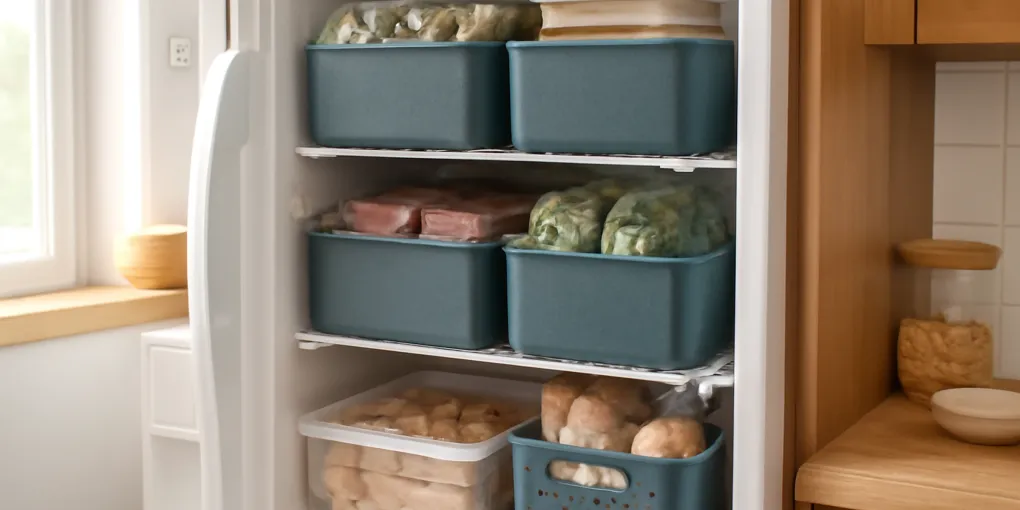
Best Freezer Inventory Bin System for Chest and Upright Freezers
Buyer's GuideiDesign Linus Deep Plastic Storage Bins
Best clear freezer zonesBest fit: Upright freezers and chest-freezer baskets where visibility matters
$12-30 per bin
Quick picks
| Product | Key Specs |
|---|---|
| See price on Amazon |
|
| See price on Amazon |
|
| See price on Amazon |
|
| See price on Amazon |
|
Product availability, certifications, and retailer details can change; check the current Amazon page before buying.
Freezer clutter is not just annoying. It hides food until quality drops, turns duplicate shopping into a habit, and can make it harder to notice a temperature problem. The best freezer inventory bin system combines three things: physical zones, date labels, and a simple temperature check.
For most homes, the first buy is not a giant matching set. It is two or three clear or wire bins sized to the freezer you actually own, plus freezer tape or dissolvable labels and a thermometer. If you use a chest freezer, add an outside inventory board so frozen items do not vanish under the top layer.
If your problem is dry pantry sprawl rather than frozen-food rotation, start with best pantry shelf risers for deep cabinets. If you are trying to reset the whole kitchen counter routine, pair this with how to build a nightly kitchen counter reset.
Quick picks for different freezer layouts
- Best clear zone bin: Search Amazon for iDesign Linus freezer bins. Use these when packaged food disappears behind older packages in an upright freezer.
- Best flat-food lane: Search Amazon for YouCopia FreezeUp freezer bins. Good for bags of vegetables, breakfast items, breast-milk storage bags, and meal-prep packets that need to stand like files.
- Best safety add-on: Search Amazon for AcuRite freezer thermometers. A bin cannot tell you whether the freezer is holding temperature.
- Best chest-freezer memory aid: Search Amazon for Quartet magnetic inventory boards. Use a board when the freezer is deep enough that the bottom layer is invisible.
What a freezer bin system has to solve
A useful freezer system reduces four specific problems.
First, it keeps raw meat, cooked meals, vegetables, bread, and small packets from mixing into one frozen brick. Second, it makes the oldest food visible enough to use first. Third, it lets a tired person put groceries away without redesigning the freezer. Fourth, it keeps packages away from the door seal and vents.
The National Center for Home Food Preservation notes that good freezing practice depends on packaging, freezer temperature, and limiting quality loss during storage. The FDA refrigerator and freezer storage chart also treats freezer storage as a temperature-and-time issue, not simply a space issue. That means the organizer should support rotation and temperature awareness, not hide food in prettier piles.
Product fit matrix
| Freezer problem | Best first product | Why it helps | What to avoid |
|---|---|---|---|
| Meat packages slide into one heap | Handled basket or sturdy clear bin | Creates a liftable protein zone | Oversized tubs that become too heavy |
| Small vegetable bags vanish | Narrow clear bin or divided freezer bin | Keeps bags upright like files | Deep bins where small bags sink |
| Chest-freezer bottom layer is forgotten | Inventory board plus two liftable baskets | Connects the outside list to physical zones | A list with no matching bin labels |
| Freezer door is hard to close | Fewer bins and flatter package stacking | Protects the gasket and airflow | Forcing bins against the door |
| Nobody knows whether food stayed cold | Freezer thermometer | Makes temperature visible during routine use | Treating tidy bins as a safety check |
Use the table as a buying filter. If a product does not fix the specific freezer failure you have, it is probably just a new container for the same confusion.
How to choose bins without blocking airflow
Measure the usable interior width, depth, and height with the freezer door closed. Leave space around vents and do not buy bins that force packages against the gasket. If a bin makes the door harder to close, it is the wrong bin.
For upright freezers, clear rectangular bins usually beat round containers because they waste less shelf space. For chest freezers, handled bins or wire baskets are often easier to lift than smooth plastic boxes, especially when frozen meat makes a bin heavy.
Avoid a full wall of identical bins unless your food categories are also identical. A freezer with one bread bin, one cooked-meal bin, one vegetable bin, and one raw-meat bin is easier to maintain than eight blank boxes.
Upright freezer buying notes
An upright freezer usually needs shallow-to-medium bins that slide forward without scraping the shelf above. Prioritize straight sides, front handles, and clear walls. Deep bins can work on the lowest shelf, but they often hide small bags when used at eye level.
Do not buy tall open bins for door shelves unless the shelf rail is designed to carry that load. Door storage is better for small, quick-turn items because it warms slightly more often when the door opens. Keep expensive proteins and long-storage meals deeper inside the freezer body.
Chest freezer buying notes
A chest freezer needs liftable zones. Before buying, load a laundry basket or cardboard box with the same amount of frozen food you expect one bin to hold. If lifting that weight from the bottom of the freezer feels awkward, choose smaller baskets.
Handled wire baskets can be better than clear plastic tubs for heavy packages because they are easier to grab with cold hands. Clear plastic still helps for small bags, but a smooth heavy tub at the bottom of a chest freezer can become a frozen drawer with no handle.
Labeling choices that survive cold storage
Use freezer tape, freezer-safe labels, or marker directly on bags. Ordinary paper labels can loosen when frost forms or when packages sweat during loading. If you use reusable bins, label the bin category rather than the exact food. The package label should carry the food name and freeze date.
The most useful label is not decorative. It answers, “What is this, when did it enter the freezer, and where does it belong?” A plain white freezer-tape label beats a beautiful label that falls off or hides the date.
The inventory board that actually gets updated
A freezer inventory should be short enough to update in ten seconds. Use columns for zone, item, date, and quantity. Do not track brand names, recipes, or every detail of a package unless that detail changes whether you will use it.
A good chest-freezer board might read: “Red bin: chicken thighs, 2 packs, June 18” or “Top basket: chopped spinach, 3 bags, July 1.” That tells a shopper what is available and tells the cook where to reach.
If the freezer is shared, put the marker directly beside the board. A missing marker turns inventory into wishful thinking.
Food-safety details to keep in the system
A freezer thermometer belongs in the system because organization can hide failure. Place it where you can read it without emptying a shelf during an ordinary kitchen check before shopping or meal prep. If the freezer stores high-value food or medical/infant feeding supplies, consider a second thermometer or an alarm model.
Label with the freezing date, not just the food name. Food can remain safe while quality declines, but old unlabeled packages become much less likely to be used. Freezer tape, dissolvable labels, or a marker on freezer bags is enough.
Do not use baskets as an excuse to keep mystery packages. If no one can identify it, date it, or remember why it was saved, it should not occupy prime space.
Setup protocol
- Empty one shelf, drawer, or chest-freezer layer at a time so food stays cold.
- Discard leaking, unidentifiable, or freezer-burned packages that the household will not realistically use.
- Group by cooking decision: raw protein, vegetables, bread, prepared meals, breakfast, and small ingredients.
- Measure the grouped piles before buying bins.
- Put heavy or infrequently used food in lower or rear zones.
- Put quick-use food in the easiest front or top zone.
- Add a thermometer where it remains visible.
- Write the first inventory list only after the bins are loaded.
- Review the list before grocery shopping, not after.
FAQ
How many freezer bins should I buy first?
Start with two or three labeled bins. One bin for raw proteins, one for vegetables or sides, and one for prepared meals will reveal whether you need more. Overbuying bins creates another organizing project.
Should I use baskets or solid plastic bins?
Use baskets when airflow and lifting weight matter. Use solid clear bins when small packages fall through wire or when upright-freezer visibility is the main problem. The bin should make retrieval easier without blocking cold air movement.
What labels work in a freezer?
Freezer tape, freezer-safe labels, and direct marker labels on freezer bags are usually more reliable than ordinary paper labels. Test one label before committing the whole freezer.
Can a freezer inventory reduce food waste?
Yes, if it changes shopping and cooking behavior. A list that shows two bags of peas and three packs of chicken can prevent duplicate purchases and push older food into this week meal plan.
Sources
- National Center for Home Food Preservation, General Information for Freezing: https://nchfp.uga.edu/how/freeze/general-information-freezing/
- U.S. Food and Drug Administration, Refrigerator and Freezer Storage Chart: https://www.fda.gov/media/74435/download
- Michigan State University Extension, Freezing Foods for Storage: https://www.canr.msu.edu/news/freezing_foods_for_storage