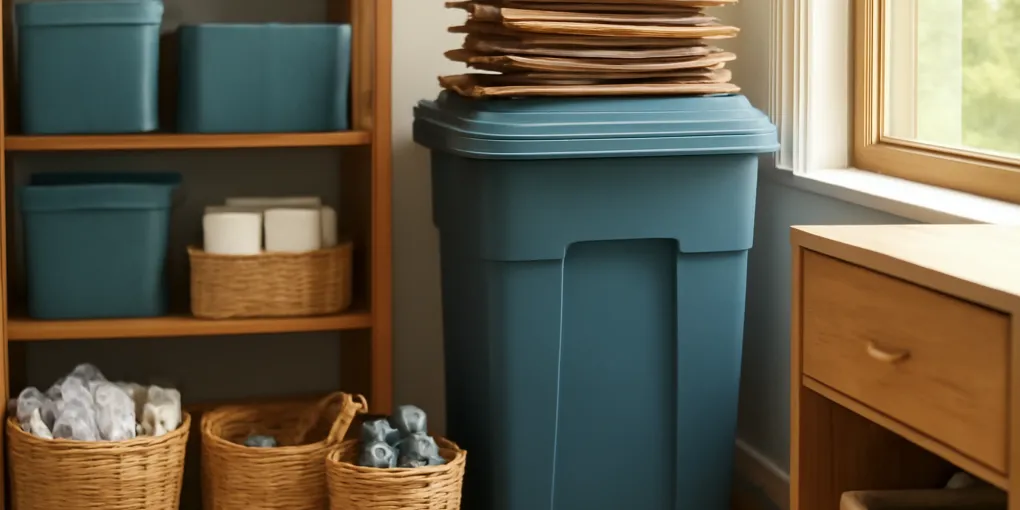
Recycling Overflow Bin Protocol: Stop Bottles, Boxes, and Returns From Taking Over the Kitchen Floor
ProtocolQuick picks
| Product | Key Specs |
|---|---|
| See price on Amazon |
|
| See price on Amazon |
|
| See price on Amazon |
|
Product availability, certifications, and retailer details can change; check the current Amazon page before buying.
Recycling clutter usually starts with good intentions. One box waits by the back door. A few bottles sit beside the bin because the liner is full. A return bag hangs from a cabinet knob. By trash day, the kitchen floor is a sorting project and the walking path has narrowed.
This protocol gives overflow a temporary, washable landing zone and a fixed exit habit. It is not a lecture about recycling perfectly. It is a way to stop clean containers, flattened cardboard, and return items from becoming floor clutter. For nearby systems, see our simplehuman rectangular step trash can review and reusable grocery bag storage protocol.
Product starting point
- Overflow tote: Search Amazon for slim recycling totes with handles
- Return-bag holder: Search Amazon for wall-mounted recycling bag holders
- Cardboard reset tool: Search Amazon for guarded box cutters
Pick products after checking the local rules for what can go together. A beautiful three-bin station is not useful if the city wants cardboard bundled separately or deposit containers returned elsewhere.
Step 1: Separate the three overflow jobs
Most recycling piles mix three different jobs:
- Daily containers that should fit the normal bin.
- Bulky cardboard that needs flattening.
- Deposit, return, or special items that leave by a different route.
Do not force all three jobs into one kitchen bin. The normal bin handles daily clean recyclables. A slim tote handles short-term overflow. A separate bag or crate handles returns. Cardboard gets flattened before it is allowed to wait.
The EPA’s recycling basics guidance emphasizes knowing what is accepted locally and keeping recyclables clean and dry enough to be processed. In the home, that means an overflow system should make contamination less likely, not hide sticky containers in a pretty basket.
Step 2: Make the overflow tote smaller than you want
The overflow tote should be deliberately modest. If it is huge, it becomes a second recycling bin with no deadline. Choose a tote or handled bin that holds roughly one busy day of clean overflow, not a week of boxes.
Good features:
- Smooth plastic or metal that wipes clean.
- Handles that make the tote easy to carry outside.
- A footprint narrow enough to avoid the main walking path.
- A shape that does not invite everyone to toss trash from across the room.
Avoid open woven baskets for cans and bottles. They trap moisture, hide spills, and make the system look more permanent than it should be. Overflow is temporary by design.
Step 3: Flatten cardboard at the decision point
Shipping boxes are the fastest way to overwhelm a recycling station. Set a rule: empty boxes are flattened before they enter the overflow zone. If a box still holds returns, packing slips, or donation items, it is not recycling yet. It belongs in the returns or donation system.
Use a guarded box cutter only if it can be stored safely. A cutter left on top of a pile creates a different household hazard. If children use the kitchen, store the cutter in a high utility drawer or locked cabinet and use scissors or tear strips when that is safer.
For thick boxes, flatten near the door or garage rather than in the kitchen. The goal is to keep the kitchen station from becoming the packaging workbench.
Step 4: Build a weekly exit route
A recycling overflow bin needs a scheduled exit. Pick one trigger:
- The evening before curb pickup.
- After grocery unloading.
- When the tote reaches the top line.
- Before the weekend kitchen reset.
Tie the trigger to an existing route. If someone already walks to the garage after dinner, the overflow tote can leave then. If deposit bottles go to the store, keep the return bag near the shopping bags rather than in the main cooking zone.
The exit route should be easier than stepping around the pile. That is why handles matter. If the tote is awkward to lift, people will keep adding to it instead of emptying it.
Product fit matrix
| Item | Best use | What to avoid |
|---|---|---|
| Slim handled tote | Clean overflow that leaves within a day or two | Oversized bins that become permanent storage |
| Wall-mounted bag holder | Deposit cans, bottles, and store-return items | Hanging bags where they block doors or attract kids |
| Guarded box cutter | Flattening shipping boxes safely during adult reset | Loose blades in the recycling pile |
| Small rinse tray | Drying containers before the bin | Letting wet containers sit until they smell |
How to evaluate the station
| Factor | Weight | What matters |
|---|---|---|
| Local-rule fit | 30% | Materials are sorted according to the rules where you live. |
| Floor control | 25% | Overflow no longer spreads into the walking path. |
| Exit friction | 20% | The tote is easy to carry and empty on schedule. |
| Cleanability | 15% | Sticky containers and damp cardboard do not hide in fabric or wicker. |
| Tool safety | 10% | Box-cutting tools are stored away from children and casual reach. |
FAQ
Can I store recycling overflow in the garage instead?
Yes, if the route is easy and local weather, pests, and household layout make it practical. Keep food residue and wet containers out of long-term garage storage.
What if cardboard pickup is every other week?
Use a larger garage or utility-zone cardboard spot, not a bigger kitchen pile. Flatten boxes immediately and set a pickup-week reminder so the overflow leaves before it spreads.
Should I buy a multi-compartment recycling cabinet?
Only if it matches your local rules and the compartments are large enough for real use. Many households do better with one normal bin, one temporary overflow tote, and one separate return bag.
Sources
- EPA recycling basics and benefits: https://www.epa.gov/recycle/recycling-basics-and-benefits
- HealthyChildren.org childproofing guidance for household hazards and sharp tools: https://www.healthychildren.org/English/safety-prevention/at-home/Pages/Childproofing-Your-Home.aspx