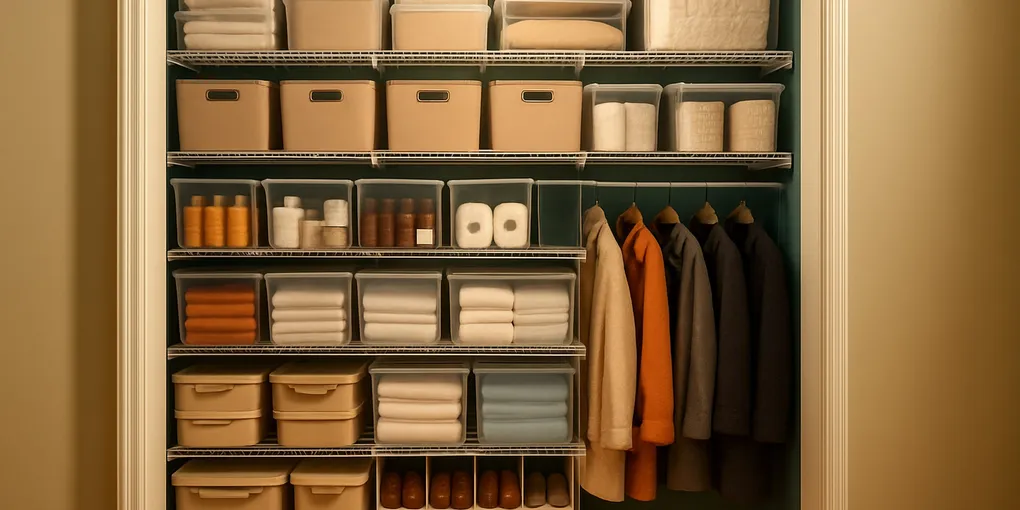
Best Hall Closet Organizers (2026): Coat Closets, Linen, and Catch-All Storage
Buyer's GuideWhitmor 5-Tier Closet Organizer
Best OverallDimensions: ~31.5 x 14 x 63 inches
$35–50
Quick picks
| Product | Key Specs |
|---|---|
| See price on Amazon |
|
| See price on Amazon |
|
| See price on Amazon |
|
| See price on Amazon |
|
Product availability, certifications, and retailer details can change; check the current Amazon page before buying.
Best Hall Closet Organizers (2026)
The hall closet is one of the most abused spaces in the home — a default landing zone for coats, extra linens, cleaning supplies, sports gear, seasonal items, and everything else that doesn’t have a dedicated space elsewhere. Without intentional organization, hall closets become the first space to overflow and the last to get organized.
The good news is that hall closets are typically the same depth as standard clothes closets (18–24 inches), making them fully compatible with standard shelf units, hanging organizers, and door systems designed for bedroom closets. The best hall closet organizer for most homes is the Whitmor 5-Tier Closet Organizer — a 63-inch tall steel frame unit that fits in most hall closets and immediately adds five adjustable shelves without installation. For a modular system that can grow, the ClosetMaid 3-Tier Stackable Organizer allows expansion over time.
TL;DR
- Top Pick: Whitmor 5-Tier Closet Organizer — 63-inch tall, fits most hall closets, no installation
- Best Modular: ClosetMaid 3-Tier Stackable — expands as needs change, clean look
- No-Install Hanging: SimpleHouseware 8-Compartment — clips to existing rod, zero installation
- Best Permanent: Rubbermaid FastTrack System — rail-and-bracket system, maximum capacity
- Key Principle: Use vertical space — the average hall closet has 6–7 feet of unused vertical height
Hall closet organization benefits from a behavioral science insight: a designated place for each category of item reduces decision fatigue and the time cost of returning things to storage. Research on environmental design and habit formation suggests that the harder it is to put something away, the more likely it is to be left out. The goal of a hall closet system is to make the “put away” action nearly as easy as the “dump it at the door” action.
How We Score
ClutterScience evaluates products using a five-factor composite scoring methodology (30/25/20/15/10):
| Factor | Weight | What We Assess |
|---|---|---|
| Research | 30% | Breadth of products evaluated and depth of specification and dimension review |
| Evidence Quality | 25% | Reliability of sources: verified purchaser synthesis, manufacturer specs, specification-led assessment |
| Value | 20% | Cost-effectiveness relative to competing products at similar quality tiers |
| User Signals | 15% | Long-term verified purchase feedback and real-world performance in hall closet applications |
| Transparency | 10% | Accuracy of manufacturer dimension and load capacity claims |
Scores are differentiated — top picks typically score 8.5–9.5, mid-tier 7.5–8.4, weaker options below 7.5.
Individual product scores are assessed on four specification-led criteria: Capacity & Dimensions (30%), Material Quality (25%), Ease of Assembly & Use (20%), Long-Term Value (25%).
Whitmor 5-Tier Closet Organizer Review: Best Overall
The Whitmor 5-Tier Closet Organizer is a 63-inch tall chrome steel shelving unit that fits in the floor space of a hall closet and immediately adds five full shelves of organized storage. At 31.5 inches wide, it fills most single-door hall closets without wasted space.
What makes it work for hall closets: The 14-inch depth fits comfortably within an 18-inch deep hall closet with room to access items. The five shelves can be configured for bins (top shelves), folded linens (middle), and heavier items like cleaning supplies or shoe boxes (bottom). Chrome steel construction handles household loads without flex. Assembly takes approximately 15–20 minutes with no tools required — frame components snap together.
Practical configuration for a mixed hall closet:
- Top shelf: seasonal/rarely used items in labeled bins
- Upper-mid shelf: extra linens, towels, toilet paper stock
- Mid shelf: daily-use items (household supplies, umbrella, small cleaning tools)
- Lower-mid shelf: shoes or heavy items
- Bottom shelf: floor items (cleaning bucket, extra bags)
Pros:
- Fits standard hall closet widths (31.5 inches)
- 14-inch depth compatible with 18-inch deep closets
- 5 shelves immediately add significant vertical storage
- No tools required for assembly
- Competitive price point
Cons:
- Chrome steel susceptible to rust if exposed to prolonged moisture (not ideal for bathrooms)
- Shelf edges may mark painted walls if unit shifts
- Fixed shelf spacing — less adjustable than wire shelf systems
Score Breakdown:
| Criterion | Weight | Score |
|---|---|---|
| Capacity & Dimensions | 30% | 9.2/10 |
| Material Quality | 25% | 8.3/10 |
| Ease of Assembly & Use | 20% | 9.5/10 |
| Long-Term Value | 25% | 8.8/10 |
| Composite Score | 9.0/10 |
Score notes: High capacity score for fitting standard hall closets and providing immediate vertical storage. Material quality moderate due to chrome susceptibility to surface rust. Ease of assembly highest in comparison.
ClosetMaid 3-Tier Stackable Organizer Review: Best Modular
ClosetMaid’s resin-frame 3-tier organizer is stackable — two units can be stacked to create a 6-shelf system, or a single unit can be used freestanding. The epoxy-coated resin resists moisture better than chrome steel, making it a better choice for hall closets adjacent to exterior walls.
Why modular matters: Starting with one 3-tier unit and adding a second when more storage is needed is a pragmatic approach for renters or those unsure of long-term storage needs. The stacking connectors keep units aligned and stable.
Pros:
- Modular — stack two units for 6-shelf configuration
- Resin/epoxy more moisture-resistant than chrome steel
- Open shelf design is compatible with various bin types
- Adjustable feet for uneven floors
Cons:
- Wider individual unit (32 inches) — may be tight in narrow closets
- Assembly requires some attention to shelf slot alignment
- More expensive per shelf than single-unit alternatives
Score Breakdown:
| Criterion | Weight | Score |
|---|---|---|
| Capacity & Dimensions | 30% | 8.8/10 |
| Material Quality | 25% | 8.8/10 |
| Ease of Assembly & Use | 20% | 8.5/10 |
| Long-Term Value | 25% | 9.2/10 |
| Composite Score | 8.9/10 |
Score notes: Long-term value elevated by modular expansion capability. Material quality reflects resin’s moisture resistance advantage. Slightly lower ease score due to snap-stacking alignment requirements.
SimpleHouseware Hanging Closet Organizer Review: Best No-Install
For hall closets that already have a hanging rod, SimpleHouseware’s 8-shelf hanging organizer clips directly to the rod and hangs vertically, creating 8 horizontal storage compartments without any floor footprint. Each compartment is approximately 12×12×5 inches.
Ideal for: Rental properties with no-drill restrictions, very shallow hall closets where floor space is critical, or coat closets that need folded item storage added alongside hanging coats.
Pros:
- Zero installation — clips to existing rod in under 30 seconds
- 8 compartments across 45 inches of vertical hanging space
- No floor footprint — preserves existing floor storage
- Easily removed and relocated or taken when moving
Cons:
- Fabric construction less durable than steel/resin alternatives
- Weight capacity limited by the structural integrity of the rod it hangs from
- Compartment dimensions may not fit larger folded items (bulky sweaters, blankets)
Score Breakdown:
| Criterion | Weight | Score |
|---|---|---|
| Capacity & Dimensions | 30% | 7.8/10 |
| Material Quality | 25% | 7.5/10 |
| Ease of Assembly & Use | 20% | 9.8/10 |
| Long-Term Value | 25% | 8.0/10 |
| Composite Score | 8.2/10 |
Score notes: Ease of assembly highest in comparison for zero-install clip setup. Capacity slightly lower due to smaller individual compartment dimensions. Material quality reflects fabric construction limitations.
Rubbermaid FastTrack Closet System Review: Best Permanent System
Rubbermaid’s FastTrack system uses a wall-mounted horizontal rail from which shelves and accessories are hung via adjustable brackets. Unlike freestanding systems, the rail is anchored into wall studs, allowing significantly higher load ratings and the ability to reposition components without disassembling the system.
Why choose a wall-mounted system: For a hall closet that will remain in place long-term (homeowners rather than renters), a rail system creates a more finished, permanent look and handles substantially higher loads than freestanding alternatives. The Rubbermaid FastTrack rail accepts a variety of bracket types, allowing custom configurations of shelves, hooks, baskets, and hanging rods.
Pros:
- Wall-anchored — significantly higher load capacity than freestanding
- Modular — add components without reinstalling the rail
- Handles both hanging and shelf storage from one mounting point
- Professional finished appearance
Cons:
- Requires drilling into studs — not suitable for renters or those avoiding wall damage
- Higher installation complexity (finding studs, proper leveling)
- Higher upfront cost vs. freestanding options
Score Breakdown:
| Criterion | Weight | Score |
|---|---|---|
| Capacity & Dimensions | 30% | 9.5/10 |
| Material Quality | 25% | 9.5/10 |
| Ease of Assembly & Use | 20% | 7.0/10 |
| Long-Term Value | 25% | 9.2/10 |
| Composite Score | 9.0/10 |
Score notes: Highest capacity and material quality in comparison for wall-mounted, high-load design. Ease of assembly reflects drilling and stud-finding requirements.
Hall Closet Organizer Comparison Table
| Feature | Whitmor 5-Tier | ClosetMaid Stackable | SimpleHouseware Hanging | Rubbermaid FastTrack |
|---|---|---|---|---|
| Type | Freestanding | Freestanding modular | Hanging from rod | Wall-mounted |
| Installation | No tools | No tools | Clip to rod | Drill required |
| Shelves/sections | 5 | 3 (stackable to 6) | 8 compartments | Configurable |
| Width | 31.5 in | 32 in | 12 in | Rail covers full width |
| Depth | 14 in | 15 in | 12 in | 12–16 in |
| Material | Chrome steel | Resin/epoxy | Oxford fabric | Steel rail + wire |
| Price range | $35–50 | $40–60 | $18–28 | $45–70 |
| Score | 9.0 | 8.9 | 8.2 | 9.0 |
| Best for | Most hall closets | Modular expansion | No-install rental | Permanent installation |
Who Should Use Which System?
Renters or temporary spaces: SimpleHouseware Hanging (zero installation) or Whitmor 5-Tier (freestanding, no wall anchors required)
Homeowners making a permanent upgrade: Rubbermaid FastTrack — the wall-mounted rail system provides the highest load capacity and cleanest finished look
Mixed-use hall closets (coats + linens + supplies): Whitmor 5-Tier for the main shelving, plus a ClosetMaid unit if additional capacity is needed
Linen closets specifically: ClosetMaid Stackable — the wider shelves handle folded towels and bedding sets more naturally than wire alternatives
Frequently Asked Questions
How do I organize a small hall closet?
Small hall closets (30–48 inches wide) benefit most from vertical stack thinking: hanging organizer on the rod, a slim freestanding shelf unit on one side for bins and linens, and over-door organizer for flat items. The most common mistake is using the closet floor as flat storage — use a shelf unit to stack storage bins vertically instead.
What is the best hall closet organizer for coats?
For a coat-primary hall closet, the priority is maximizing linear hanging rod space. Double-hang rod extenders create extra hanging for shorter coats. Above the main rod, labeled bins handle hats, scarves, and accessories. The Rubbermaid FastTrack system offers the most flexible configuration for coat closets.
Do I need to anchor a closet organizer to the wall?
Freestanding shelf units do not require wall anchors under normal loads. Wall-mounted systems (Rubbermaid FastTrack) require drilling into studs. For tall freestanding units, anti-tip straps are a good safety precaution in households with children.
How do I organize a hall closet with no shelves?
A hall closet with only a hanging rod can be transformed with three additions: (1) a freestanding shelf unit on the floor below the rod, (2) a hanging closet organizer clipped to the rod, and (3) an over-door organizer. This three-component system adds shelving, hanging compartments, and door storage without drilling — total cost under $80.
Can I use kitchen shelving in a hall closet?
Yes — wire shelving units sold as kitchen or pantry organizers work equally well in hall closets. Standard hall closets are 18–24 inches deep and most kitchen shelf systems share these dimensions. Verify depth specifications before purchasing.
Final Verdict
The best hall closet organizer depends on whether you need a no-install solution (Whitmor 5-Tier or SimpleHouseware Hanging) or a permanent system (Rubbermaid FastTrack). For most renters and first-time hall closet organizers, the Whitmor 5-Tier is the clearest starting point — it fits, it’s fast to assemble, and it immediately transforms a pile into organized vertical storage. For homeowners wanting a more permanent, load-bearing solution, Rubbermaid FastTrack is worth the installation effort.
The behavioral principle behind any hall closet system is the same: lower the friction of putting things away. A labeled shelf for each category reduces the decision load each time someone returns from the store, takes off a coat, or grabs cleaning supplies. Systems fail when finding the right place is harder than leaving things on the floor.