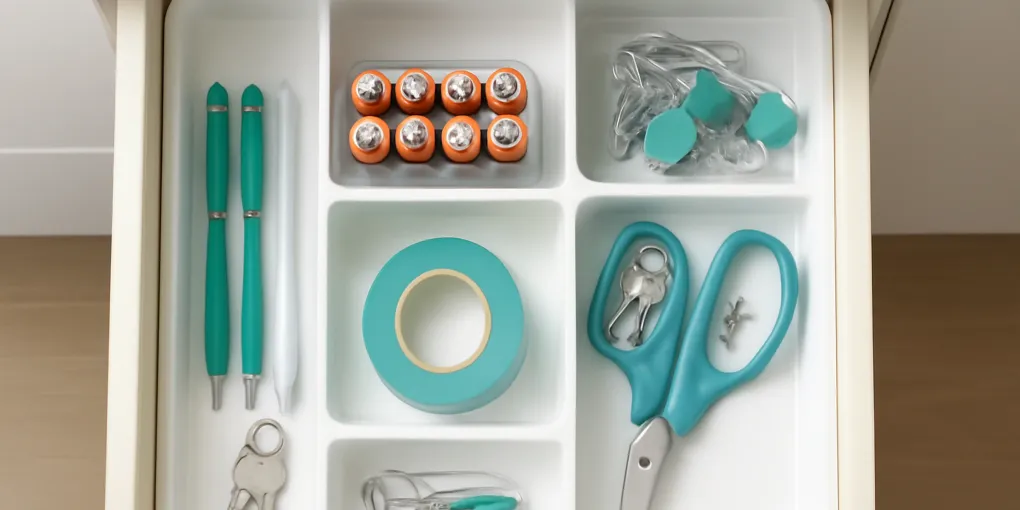
Best Junk Drawer Dividers for a Reset That Actually Stays Organized
Buyer's GuideThe best junk drawer divider is not the prettiest tray. It is the one that turns mixed small objects into a few readable categories: writing tools, fasteners, tape, batteries, keys, measuring items, and everyday repair supplies.
Editorial Transparency
ClutterScience uses AI tools during drafting support, outline organization, and source review. Human editors review every article for accuracy, clarity, product-link policy, and source quality. We do not fabricate reviewers, credentials, test results, ASINs, or citations.
Quick Picks
| Organizer type | Best for | Watch out for | Search link |
|---|---|---|---|
| Adjustable bamboo dividers | Long utensils, tape, scissors | Can waste space in narrow drawers | adjustable bamboo drawer dividersAffiliate link: we may earn a commission. This does not affect scoring. |
| Clear modular trays | Batteries, clips, keys, small hardware | Tiny trays can become too fussy | clear modular drawer organizer traysAffiliate link: we may earn a commission. This does not affect scoring. |
| Expandable cutlery-style tray | Simple one-piece reset | Fixed compartments may not fit odd items | expandable drawer organizer trayAffiliate link: we may earn a commission. This does not affect scoring. |
| Silicone or plastic bins | Kids’ supplies and messy categories | Can slide unless the drawer has a liner | small plastic drawer binsAffiliate link: we may earn a commission. This does not affect scoring. |
| Nonslip liner plus trays | Shallow drawers | Adds a setup step | nonslip drawer linerAffiliate link: we may earn a commission. This does not affect scoring. |
We use search links rather than direct ASIN links in this guide because drawer dimensions, colors, multipacks, and sellers change often. Do not buy until you measure your drawer.
Why Junk Drawers Fail
Junk drawers fail because they store objects by absence, not by function. The item has no obvious home, so it goes in the drawer. Over time, the drawer becomes a mixed database with no search function.
Human-factors research has long shown that visual search gets harder as the number of competing items increases. In a drawer, the practical version is simple: if every object is loose, your eyes have to inspect everything. Dividers reduce the search field.
How to Measure Before Buying
Measure inside width, depth, and height. Then subtract a little room for drawer movement and human error. A divider that technically fits but scrapes the drawer sides will become annoying.
Also measure your longest recurring objects. Common long items include scissors, a tape roll, a small flashlight, a ruler, and a pen. If your organizer only has tiny squares, those items will end up on top of everything.
The Best Layout for Most Homes
Use a three-zone layout:
- Long tools: scissors, pens, marker, small screwdriver, flashlight.
- Small utilities: batteries, clips, rubber bands, keys, tape tabs.
- Temporary items: coupons, receipts, loose notes, and objects that need to leave the drawer soon.
The temporary zone matters. Without it, the whole drawer becomes temporary.
Adjustable Bamboo Dividers
Adjustable bamboo dividers are best when the drawer is wide and you own several long objects. They create lanes rather than tiny compartments, which makes resets faster.
Choose this type if you want the drawer to feel calm and you mostly store tools, writing supplies, tape, and household basics. Avoid it if most of your items are very small. Loose batteries and clips need smaller trays inside the lanes.
Clear Modular Trays
Clear trays are best for small, mixed items. They let you build categories around what you actually own instead of forcing everything into a fixed insert.
The risk is over-sorting. A tray for every micro-category looks satisfying on day one but can become exhausting. Combine categories where possible: “fasteners” can hold clips, rubber bands, and twist ties.
Expandable One-Piece Inserts
Expandable inserts are the easiest purchase when you want one product and a fast reset. They are especially useful in kitchens because they borrow the logic of a cutlery tray: long channels plus side compartments.
The downside is fit. Fixed compartments can leave awkward dead space. They also struggle with bulky objects such as a tape dispenser or charger brick.
Small Plastic Bins
Small plastic bins are useful for families because categories can be removed from the drawer and reset on a counter. They are also easier to wash if the drawer holds glue sticks, crayons, or snack clips.
Use a nonslip liner underneath if the bins slide. Sliding bins undo the visual order every time the drawer opens.
What to Remove First
Before installing any organizer, remove:
- Dead batteries.
- Duplicate pens that do not write.
- Expired coupons.
- Mystery keys you cannot identify.
- Loose screws with no known project.
- Product manuals available online.
- Anything sharp that needs safer storage.
The U.S. Environmental Protection Agency recommends recycling batteries through appropriate household hazardous waste or battery recycling programs rather than tossing all battery types into ordinary trash. Check local rules before disposal.
How This Buyer’s Guide Is Scored
Composite score breakdown: Research 30%, Evidence Quality 25%, Value 20%, User Signals 15%, Transparency 10%. Research weighs drawer-fit logic and visual-search principles. Evidence Quality favors credible search and disposal sources. Value rewards organizers that work across drawer sizes without overbuying. User Signals weighs retrieval speed, reset speed, and broad category maintenance. Transparency covers drawer-size variation and disposal limits. Fit flexibility is still a practical priority because drawers vary widely. Visibility is 20% and favors light or clear organizers that reduce search time. Reset speed is 20% and rewards broad categories. Durability is 15% and considers materials, cleanability, and sliding. Value is 15% and penalizes systems that require buying many specialized pieces before the drawer works.
Build the Drawer Around Retrieval Speed
A junk drawer is successful when you can find the common item in under ten seconds and reset the drawer in under one minute. That means the layout should be obvious, forgiving, and slightly underfilled. A drawer packed edge to edge looks efficient in a photo but fails when you try to put tape back quickly.
Start with the items you reach for most often. In many kitchens, those are pens, scissors, tape, batteries, clips, rubber bands, a flashlight, a measuring tape, and a few small tools. Give those items the best spaces. Rare items should not control the layout. If you design around the weird adapter used twice a year, the daily pen and scissors will float loose.
Use Broad Categories
The drawer should not need a museum catalog. Five broad categories are usually enough: writing, fasteners, small tools, power, and temporary. Writing includes pens, markers, and pencils. Fasteners include clips, rubber bands, twist ties, and tape tabs. Small tools include scissors, screwdriver, flashlight, and measuring tape. Power includes batteries and a small charger. Temporary holds receipts, coupons, and items leaving the drawer soon.
Broad categories make the drawer resilient. When someone is unloading groceries or helping a child with homework, they can still put the item in the right general area. Overly precise categories collapse because they require too much attention during cleanup.
Add a Temporary Compartment
Most junk drawers become junk again because they have no legal place for short-term objects. A receipt you need tomorrow, a mystery screw from a current repair, or a school coupon will enter the drawer. If there is no temporary compartment, it lands on top of a real category.
Give temporary items a small, shallow tray. Empty it weekly. If an item survives three weekly resets, it needs a real home, a calendar task, or disposal. The temporary tray is a pressure valve, not a second junk drawer.
Fit Problems to Watch Before Buying
Measure the drawer height with the drawer closed, not just the open side wall. Some drawers have a lip or face frame that catches tall inserts. Also check the back corners. Older cabinets can be slightly out of square, and rigid bamboo trays may fit in the middle but stick at the edge.
If the drawer is very shallow, choose low trays and a liner. If the drawer is deep, stackable small bins may work, but only if the top layer lifts out easily. Avoid stacking daily items under other daily items. Hidden layers are for backups, not primary tools.
Reset Script
Use this script once a month: remove trash, test pens, check batteries, return tools, clear temporary papers, and wipe crumbs. Then stop. A drawer reset should not become a two-hour decluttering project. The smaller the maintenance promise, the more likely the drawer stays usable.
Buying and Setup Mistakes to Avoid
The most common mistake is buying a product before defining the behavior it needs to support. Containers do not create habits by themselves. They make a chosen habit easier or harder. Before buying, write one sentence that explains what the item must do: hold outgoing returns by the door, separate cables by connector, divide small drawer tools, or cue mail processing. If the product does not support that sentence, skip it.
The second mistake is filling every available inch. Empty space is part of the system because it gives your hands room to reset the area quickly. A container that is 100% full on day one is already failing. Aim for about 70% full so new items can enter briefly without destroying the layout.
The third mistake is hiding active tasks too well. Closed bins, opaque boxes, and deep drawers can make a space look calmer while making the next action less visible. Use closed storage for completed categories and visible, bounded storage for tasks that still need action.
Finally, do not judge the setup by the first hour. Judge it after two normal weeks. A good system survives groceries, tired evenings, rushed mornings, and other people using it. If the system fails, adjust distance, label clarity, or category size before buying a larger version of the same problem.
Two-Week Review Questions
After two weeks, review the setup with five questions. Did the pile or tangle shrink? Can someone else understand the categories? Is the next action visible without searching? Are the containers easy to reset when tired? Did the system create a new pile nearby?
If the answer is mostly yes, keep the system and schedule a light monthly reset. If the answer is no, remove one layer of complexity. Most home systems improve when categories become broader, containers become easier to reach, and labels describe actions rather than ideals.
Simple Low-Buy Version
If you are not ready to buy anything, test the system with supplies you already own. Use a shoebox lid, a spare basket, painter’s tape labels, or clean food containers for two weeks. A temporary version reveals the right size and location before money is spent. If the temporary version works, upgrade only the weakest part. If it does not work, the problem is probably placement or category design rather than product quality.
Sources
- Wolfe, J. M. “Visual Search.” Scholarpedia. http://www.scholarpedia.org/article/Visual_search
- U.S. Environmental Protection Agency. “Used Household Batteries.” https://www.epa.gov/recycle/used-household-batteries
Bottom Line
For most junk drawers, start with clear modular trays plus one long divider lane. Measure first, keep categories broad, and leave one temporary zone so the organizer does not become another clutter trap.
Frequently Asked Questions
- The best organizer is usually a mix of shallow trays and adjustable dividers. The trays contain small objects, while dividers create zones for longer items such as tape, scissors, and pens.
- Clear or light-colored organizers are usually better because the drawer is already a hidden space. Visibility helps you find small items quickly.
- Aim for five to seven broad categories. Too many tiny categories make the drawer harder to reset when you are in a hurry.