How to Organize a Junk Drawer Once and For All 2026
Buyer's GuideOXO Good Grips Expandable Drawer Organizer
Best adjustable trayBest for: Kitchen or office junk drawers with mixed small items
Quick picks
| Product | Key Specs | Pros / Cons |
|---|---|---|
| See price on Amazon |
|
|
| See price on Amazon |
|
|
| See price on Amazon |
|
|
Product availability, certifications, and retailer details can change; check the current Amazon page before buying.
Quick product shortlist
Use this shortlist to choose a product style before you measure. The links are named product or brand searches so you can compare current dimensions, finishes, prices, and return terms before buying.
- Best adjustable tray: OXO Good Grips Expandable Drawer Organizer (Search Amazon for OXO Good Grips expandable drawer organizer) for kitchen or office junk drawers with mixed small items. Watch-out: measure drawer width before expanding.
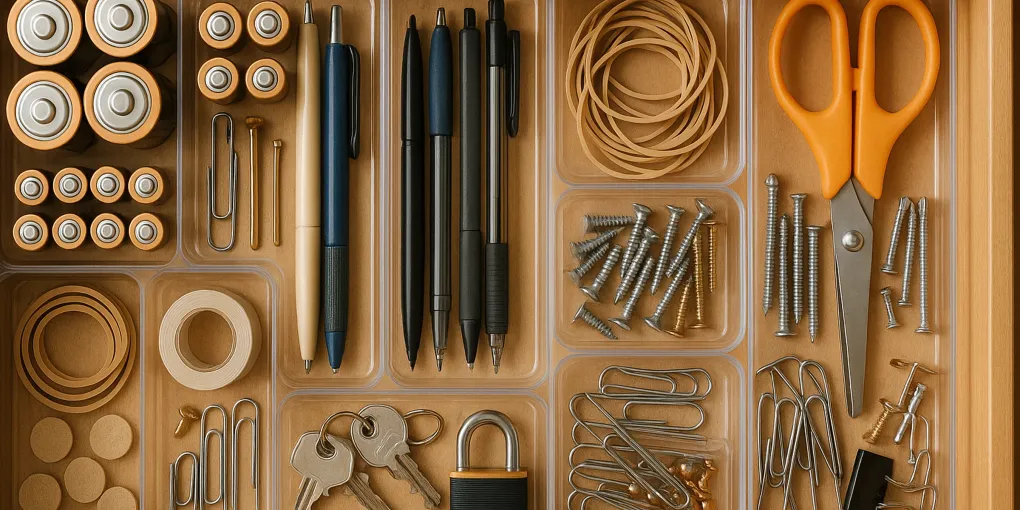
- Best modular bins: STORi Clear Plastic Drawer Organizers (Search Amazon for STORi clear plastic drawer organizers) for batteries, clips, keys, and small repair items. Watch-out: tiny bins need labels if shared.
- Best reset labels: Avery Removable Labels (Search Amazon for Avery removable labels drawer organizer) for shared drawers where categories drift. Watch-out: labels should match real categories, not wishful ones.
Quick picks
These are the products referenced in the guide; check dimensions, material, and installation limits before ordering.
- Recommended product: See current price on Amazon
- Recommended product: See current price on Amazon
- Recommended product: See current price on Amazon
The Junk Drawer Is Not the Problem — Your System Is
Every home has a junk drawer. Even the most meticulously organized households maintain one — that single drawer where batteries, takeout menus, expired coupons, mystery keys, dried-up pens, and an inexplicable collection of rubber bands have made their home. The junk drawer is not a moral failure. It is a predictable consequence of how households actually function.
The problem is not that the drawer exists. The problem is that without structure, it becomes a black hole. Things go in and rarely come out, because finding anything requires excavation through layers of accumulated miscellany. The solution is to transform the drawer from an undifferentiated dump zone into a curated tool — a drawer where every item has a category and every category has a home, and where the 30-second retrieval of a AA battery or a pair of scissors is guaranteed.
This guide walks through the complete process: the initial declutter, the categorization system, the right products for maintaining the system, and the behavioral habits that prevent reversion to chaos. For broader kitchen organization, see our guide on how to organize kitchen cabinets and our roundup of best drawer organizers.
Step 1: The Complete Drawer Dump
The first step is also the most satisfying: remove everything from the drawer and place it on a flat surface where you can see the full contents at once. Do not start organizing inside the drawer. The physical act of seeing everything together breaks the psychological invisibility that allows clutter to accumulate — when things are in a drawer, they are out of sight and therefore out of mind. Spreading them out forces conscious engagement with each item.
Spread the contents across a table or countertop. Give yourself permission to be surprised by what you find. Most household junk drawers contain three to five items that are genuinely useful and need to stay, a handful of items that have a better home elsewhere in the house, and a large majority of items that have no reason to remain in the household at all.
Before you start sorting, wipe the empty drawer with a damp cloth. If the drawer has a liner, this is the time to replace it. A clean starting surface psychologically reinforces the commitment to a new system — a small environmental cue that signals a behavioral change is underway.
Take a photo of the full spread. This is useful later for two reasons: it gives you a complete record of what existed before (which prevents the “I could have sworn I had a…” problem), and it serves as a before photo that makes the finished result more satisfying.
Step 2: Apply the Keep-Toss-Relocate Method
With everything on the table, work through each item and assign it to one of three categories: Keep, Toss, or Relocate. Move quickly — hesitation leads to keeping things that should go. If you have not touched an item in six months and cannot name a specific upcoming use for it, it goes.
Keep: Items that genuinely belong in the junk drawer because they are used occasionally, do not have a more logical home, and serve a household function. Batteries, tape, scissors, a small screwdriver, pens and markers, matches or a lighter, rubber bands, a notepad, and one or two takeout menus are the canonical junk drawer items. Most households keep 15 to 25 items maximum.
Toss: Dead batteries (immediately), dried-up pens (test each one), expired coupons, takeout menus for restaurants that have closed, mystery hardware with no identifiable purpose, duplicate items you do not need (how many tape dispensers does one household need?), and anything broken beyond use. Be ruthless. Every item you keep is an item that takes up space in the finished, organized drawer.
Relocate: Items that have a better home elsewhere in the house. Phone charging cables belong near the charging station. Menus for restaurants you order from regularly belong on the refrigerator or in a kitchen command center. Tools that are used regularly belong in a proper tool kit. Instruction manuals belong in a home filing system. Medications belong in the medicine cabinet. The relocate pile is often the largest of the three, and moving these items to their proper homes before organizing the drawer is critical — otherwise they drift back.
Most households reduce their junk drawer contents by 50 to 70 percent during this step. That reduction is not loss — it is the foundation of a functional system.
Step 3: Define Categories for What Remains
After the keep-toss-relocate sort, count your remaining items and group them by function. This is the categorization step that determines how many divider compartments you need and what size they should be.
Common junk drawer categories and their typical space requirements:
Writing instruments (pens, markers, pencils): 2-3 inch wide compartment, 6-8 inches deep. Group these together with a small cup insert or a narrow divider cell.
Office and paper supplies (tape, scissors, sticky notes, rubber bands, paper clips): Medium compartment, roughly 3-4 inches wide. Scissors are usually the largest item and set the depth requirement.
Batteries: A dedicated compartment is worth it. Batteries stored loose get mixed — used and unused become indistinguishable. A small battery organizer that holds specific sizes upright prevents this and allows quick identification of what you have and what you need.
Small tools (screwdrivers, box cutter, Allen wrenches): A longer, narrower compartment works best. These items are used infrequently but are critical when needed.
Miscellaneous/emergency (matches, flashlight, local emergency contacts, takeout menus): One larger compartment for the things that do not fit neatly into other categories.
The goal of this categorization step is to end up with a list of compartment sizes that, when combined, fill the drawer efficiently. This list is what you take with you when shopping for organizers.
Step 4: Measure and Select Organizers
Measure the interior of the drawer: width, depth, and height. Most standard kitchen drawers are 12 to 20 inches wide, 18 to 24 inches deep, and 3 to 5 inches tall. Write down exact measurements before shopping — a product that looks perfect online may not fit your specific drawer.
There are two main categories of drawer organizers. Pre-configured organizer sets come in fixed sizes and configurations. They are easy to set up but may not fit your drawer precisely, leaving wasted space at the edges. Adjustable interlocking divider systems allow you to customize compartment sizes and fill the drawer completely, but require more setup time.
For most junk drawers, the adjustable interlocking approach is worth the extra ten minutes of setup. A perfect fit means no items shift or migrate between compartments during use, which is the primary mechanism by which organization breaks down over time. When there is unused space in a drawer, items migrate into it and compartments lose their definition.
Bamboo or acrylic organizers are the most popular materials. Bamboo provides a warm, natural aesthetic and is durable. Acrylic allows visibility from above, which helps with quick identification. Both are easy to clean.
Install the organizers before placing any items in them. This forces you to commit to the category layout rather than arranging items and trying to fit the dividers around them.
Step 5: Load, Label, and Lock In the System
With organizers in place, load each compartment with its assigned category. Do not overfill. Each compartment should be full enough that items do not slide around, but loose enough that you can retrieve a specific item without disturbing everything else. Two-thirds full is the practical maximum.
For categories where items look similar — batteries especially — add a small label. A strip of masking tape with a handwritten label on the front of each compartment takes 90 seconds and makes the drawer instantly understandable to every member of the household.
The label is a behavioral design element as much as a practical one. Research on shared spaces shows that explicit visual cues about where things belong dramatically improve compliance by other household members. When a compartment is clearly labeled “Batteries,” people return batteries to that compartment rather than dropping them anywhere in the drawer.
Take a photo of the organized drawer. Store it on your phone. This is your reset reference — the image you consult when the drawer needs to be restored to its organized state. Having a visual target reduces the cognitive load of maintenance and makes the weekly two-minute reset genuinely quick.
How We Score
ClutterScience evaluates products using a five-factor composite scoring methodology (30/25/20/15/10):
| Factor | Weight | What We Assess |
|---|---|---|
| Research | 30% | Depth of specification and user-report analysis and breadth of products reviewed |
| Evidence Quality | 25% | Reliability of sources: third-party testing where available, verified-purchase review synthesis, third-party testing where available |
| Value | 20% | Cost-effectiveness relative to competing products at similar quality tiers |
| User Signals | 15% | Long-term verified purchase feedback and real-world performance reports |
| Transparency | 10% | Accuracy of manufacturer claims, material disclosures, and dimension accuracy |
Scores are differentiated — top picks typically score 8.5–9.5, mid-tier 7.0–8.4, and weak options below 7.0.
Product Recommendations
For junk drawer organization, these products deliver the best results:
SimpleHouseware Kitchen Drawer Organizer with Adjustable Dividers
Best for: Custom-fit drawer organization in non-standard drawer sizes $18–24. Amazon verified purchasers highlight that the expandable design fits drawers from 13 to 21 inches wide without cutting or tools, and the interlocking grid system allows any compartment configuration.
| Criterion | Weight | Score |
|---|---|---|
| Capacity & Dimensions | 30% | 9.0/10 |
| Material Quality | 25% | 8.3/10 |
| Ease of Assembly & Use | 20% | 9.2/10 |
| Long-Term Value | 25% | 8.6/10 |
| Composite Score | 8.8/10 |
Bambüsi Bamboo Kitchen Drawer Organizer
Best for: Households prioritizing natural materials and aesthetics $22–30. Purchasers note that the bamboo construction is significantly more rigid than plastic alternatives, preventing flexing and compartment migration that plagues cheaper organizers over time.
| Criterion | Weight | Score |
|---|---|---|
| Capacity & Dimensions | 30% | 8.5/10 |
| Material Quality | 25% | 9.2/10 |
| Ease of Assembly & Use | 20% | 8.7/10 |
| Long-Term Value | 25% | 9.0/10 |
| Composite Score | 8.8/10 |
Storagebud Battery Organizer Storage Box
Best for: Dedicated battery management within a junk drawer $14–18. Verified buyers report it holds AA, AAA, C, D, and 9V batteries in upright sorted rows, eliminating the dead-battery confusion problem. A built-in battery tester is included in the premium version.
| Criterion | Weight | Score |
|---|---|---|
| Capacity & Dimensions | 30% | 8.8/10 |
| Material Quality | 25% | 8.4/10 |
| Ease of Assembly & Use | 20% | 9.5/10 |
| Long-Term Value | 25% | 8.7/10 |
| Composite Score | 8.8/10 |
Maintenance: Keeping the Junk Drawer Functional
The organized junk drawer is one of the easier organizational systems to maintain, because its purpose is inherently low-stakes and quick-access. The most effective maintenance approach is the two-minute weekly reset — a quick scan during which you return any items that have migrated to the wrong compartment and discard anything that has accumulated since the last check.
Tying this reset to another weekly habit — Sunday meal prep, or taking out the trash — prevents it from requiring independent motivational effort. Behavioral research consistently shows that pairing a small maintenance task with an established routine dramatically increases compliance over time compared to treating it as a standalone task.
The deeper clean-out should happen every three to six months. At that point, run through the full keep-toss-relocate process again, but it should take about ten minutes rather than the 45 to 60 minutes the initial sort required. The main thing to watch for at the quarterly clean-out is category creep — items that do not belong in the junk drawer but have gradually migrated there because they had nowhere else to go. If the same category of items keeps appearing (takeout receipts, for example, or miscellaneous cables), that is a signal that those items need a dedicated home somewhere else in the house rather than defaulting to the junk drawer.
The ultimate measure of a successful junk drawer system is this: can every member of your household find a AA battery or a roll of tape in under 15 seconds? If yes, the system is working. If not, it is time for a reset.
Frequently Asked Questions
- Not necessarily. Research on household friction points shows that people need a low-barrier landing zone for miscellaneous items. A well-organized junk drawer with defined categories serves this function intentionally. The goal is not elimination but intentional curation.
- The most functional junk drawers contain batteries, basic tools (tape, scissors, small screwdrivers), writing instruments, matches or a lighter, rubber bands, and one or two takeout menus or local reference cards. Everything else belongs in a more specific location.
- With a good divider system, a junk drawer should only need a proper clean-out every three to six months. A two-minute weekly scan to return stray items to their compartments is sufficient ongoing maintenance.
- Adjustable interlocking divider trays work best because they can be reconfigured to match the drawer dimensions exactly. Pre-sized rigid organizers often leave awkward gaps or do not fit at all. Measure your drawer before purchasing.
- Most junk drawers revert because the organizational system is too rigid for how the space actually gets used. Items are shoved in quickly under time pressure. The fix is ensuring every category has a clearly defined, easy-to-access compartment so returning items requires no more effort than tossing them in randomly.