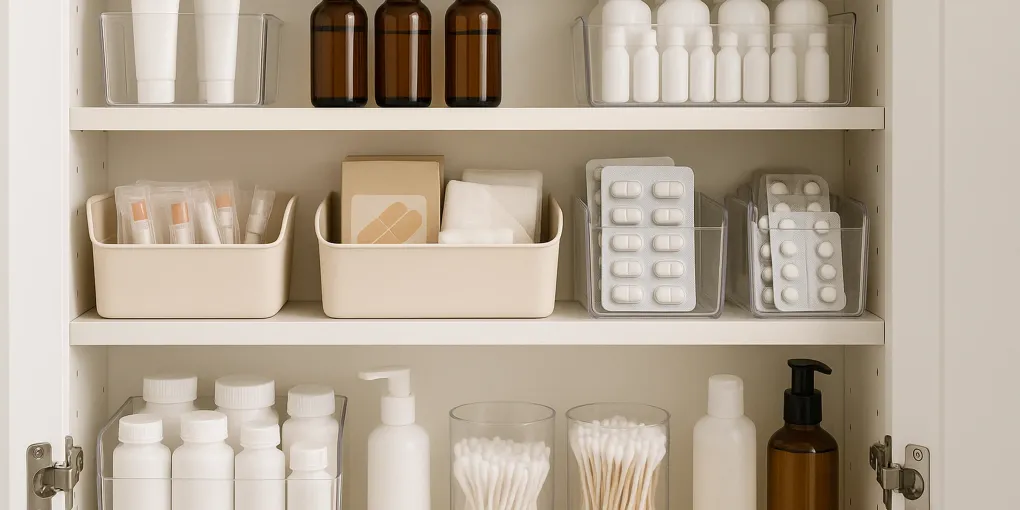
iDesign Linus Medicine Cabinet Bin
Best small categoriesBest for: Dental, first-aid, and skincare categories in shallow cabinets
Quick picks
| Product | Key Specs | Pros / Cons |
|---|---|---|
| See price on Amazon |
|
|
| See price on Amazon |
|
|
| See price on Amazon |
|
|
Product availability, certifications, and retailer details can change; check the current Amazon page before buying.
Quick product shortlist
Use this shortlist to choose a product style before you measure. The links are named product or brand searches so you can compare current dimensions, finishes, prices, and return terms before buying.
- Best small categories: iDesign Linus Medicine Cabinet Bin (Search Amazon for iDesign Linus medicine cabinet organizer bin) for dental, first-aid, and skincare categories in shallow cabinets. Watch-out: clear bins still need child-safe placement.
- Best weekly pill sorting: Ezy Dose Pill Organizer (Search Amazon for Ezy Dose weekly pill organizer) for adults managing daily vitamins or medications. Watch-out: medication safety rules still apply.
- Best lockable backup: SentrySafe Locking Medicine Box (Search Amazon for locking medicine storage box SentrySafe) for homes needing medicines away from children or guests. Watch-out: lockbox must be stored in a safe location.
Quick picks
These are the products referenced in the guide; check dimensions, material, and installation limits before ordering.
- Recommended product: See current price on Amazon
- Recommended product: See current price on Amazon
- Recommended product: See current price on Amazon
Why Medicine Cabinet Organization Is a Safety Issue, Not Just an Aesthetic One
Most people think of medicine cabinet organization as a tidiness project. In reality, it is a safety and health issue. A disorganized medicine cabinet creates three distinct risks that go far beyond aesthetic frustration.
First, expired medications. When a medicine cabinet is cluttered and hard to navigate, expired items persist indefinitely. Expired medications may be less effective at a critical moment — a fever reducer that has lost potency during a late-night emergency is a real problem. Some medications, such as certain antibiotics and liquid formulations, can actually become harmful past their expiration date.
Second, dangerous mix-ups. In a disorganized cabinet, medications that look similar can be confused — an especially serious risk if the cabinet is accessed in the middle of the night, by elderly family members, or by caregivers who are unfamiliar with the contents. A system where every category has a clearly designated location and every medication is clearly labeled reduces this risk dramatically.
Third, decision fatigue compounding health habits. Research on behavioral health shows that when people face friction in accessing medications they are supposed to take regularly, adherence drops. A prescription vitamin or blood pressure medication buried behind three rows of half-empty bottles creates a small but real barrier to consistent use. Environmental design that makes the right behavior easy directly supports better health outcomes.
This guide walks through the complete process of organizing a medicine cabinet, from the initial audit through zone design, product selection, and long-term maintenance. For related bathroom organization, see our guide on how to organize your bathroom counter and our roundup of the best medicine cabinet organizers.
Step 1: Full Cabinet Audit and Expiration Check
Remove every item from the medicine cabinet and place it on a flat surface. This is the step most people skip when they “organize” a cabinet — they work around the existing contents instead of starting fresh. That approach preserves the underlying chaos and produces organization that lasts a few weeks at best.
With everything on the counter, group items into categories: medications and supplements, first aid supplies, personal care items, dental care, and miscellaneous. This grouping is the first step toward the zone system you will implement in the next step.
For every medication and supplement, check the expiration date. Any item past its expiration date should be removed from the cabinet. Set it aside in a separate pile for proper disposal — do not simply throw expired medications in the trash (see FAQ for disposal guidance). Be thorough: expired items often include vitamins that have been in the cabinet for years, half-used antibiotic courses that should have been discarded after the prescription was completed, and OTC medications that were purchased for a specific illness and never used up.
For first aid supplies, check bandage packaging for integrity, check antiseptic products for expiration dates, and discard any item that is visibly degraded, contaminated, or incomplete. A half-used tube of antibiotic ointment that has been open for three years should go.
For personal care items, apply a simple rule: if you have not used it in the past three months, it belongs in a different location — or discarded. Medicine cabinets are premium space. Every item occupying a shelf should earn its place through regular use.
Most households remove 30 to 50 percent of their medicine cabinet contents during this audit. That reduction is the foundation of an organized, navigable cabinet.
Step 2: Design Your Zone System
Medicine cabinet shelves are typically shallow — 3 to 5 inches deep — and tall — 6 to 9 inches between shelves. This combination creates specific constraints that should drive your zone design.
Top shelf (hardest to reach): Infrequently accessed items. Long-term supplies, backup stock, and items that are kept for emergencies rather than daily use. First aid supplies that rarely need to be accessed quickly are appropriate here, as are backup quantities of items in use on lower shelves.
Eye-level shelf (most accessible): Daily use items. Current prescriptions, daily vitamins, items used as part of the morning routine. The eye-level shelf is the highest-value real estate in the cabinet, and it should be reserved for the items that are opened most frequently. Behavioral research on accessibility and habit formation is clear: the more accessible a healthy behavior is, the more consistently it is performed.
Middle shelf (easy reach): Commonly used but not daily items. Pain relievers, antihistamines, antacids, and the other OTC medications you reach for several times per month.
Bottom shelf (lean forward to access): First aid items that need to be accessed quickly but are not used daily. Bandages, antiseptic, thermometer, and basic wound care supplies work well here.
Door shelves (if applicable): Toothpaste, toothbrushes, dental floss, and other dental care items work well in door shelves if the dimensions fit. Smaller items like hair ties, cotton swabs, and travel-size products also work on door shelves.
Write out your zone assignment before restocking. Having a clear plan prevents the default behavior of putting items back wherever there is space.
Step 3: Implement Small Bin Organizers
The defining challenge of medicine cabinet organization is the shallow shelf depth. Most organizational bins are designed for pantry or drawer widths that exceed the typical medicine cabinet shelf depth of 3 to 5 inches. The solution is to use purpose-designed small cabinet organizers or acrylic bins that fit within these constraints.
Small acrylic drawer organizers repurposed for shelf use work excellently in medicine cabinets. They create category boundaries on a single shelf, keep small items from tipping over, and allow the transparent-front visibility that makes quick identification possible. For a standard two or three shelf medicine cabinet, four to six small bins is typically sufficient.
Tiered shelf risers are another highly effective product for medicine cabinet organization. A two-tier riser on a single shelf effectively doubles the visible storage space by elevating the back row, allowing both front and back items to be seen simultaneously. This is particularly useful for the middle shelf where you store multiple OTC medications that would otherwise require moving front items to access the back.
Magnetic organizers that attach to the inside of metal medicine cabinet doors are worth considering for small items: hair ties, bobby pins, travel-size products, and items that would otherwise take up shelf space. Not all medicine cabinet doors are magnetic, but many are.
When selecting organizers, prioritize clear or translucent materials. In a space as small and high-traffic as a medicine cabinet, being able to see the contents at a glance without moving items is critical for both daily use and the expiration audits that keep the cabinet safe.
Step 4: Label and Assign Household Member Sections
For multi-person households, labeling is not optional — it is the difference between a system that works for one person and a system that works for everyone. The most effective approach for households with children or multiple adults is to assign each person a designated shelf section or bin, clearly labeled with their name.
This solves two problems simultaneously. First, it eliminates the “I can’t find my stuff” problem that causes people to give up on the organizational system. Second, it clarifies responsibility: each person is responsible for maintaining their own section.
For medications specifically, labels should include more than just a category name. A label that reads “Pain/Fever — Check exp. dates” does more than one that just reads “Pain.” The embedded reminder to check expiration dates, while small, builds the maintenance habit into the daily interaction with the cabinet rather than relying on a separate quarterly audit.
For households with young children, consider a lock for the medicine cabinet or storing medications in a locked cabinet elsewhere. Easy access to medications is a safety risk. The organizational convenience of the medicine cabinet is outweighed by the safety requirement for child-resistant storage.
Step 5: Build the Twice-Annual Audit Habit
The medicine cabinet requires more rigorous periodic maintenance than most organizational systems because the stakes of expired or degraded contents are higher. Twice per year — coinciding with daylight saving time changes is a common anchor — conduct a complete expiration audit.
The twice-annual audit follows the same process as the initial setup: remove all items, check expiration dates, remove expired items for proper disposal, and restore the system. With an organized cabinet, this should take about 15 to 20 minutes rather than the hour the initial setup required.
Between audits, a monthly two-minute scan is sufficient. Open the cabinet, look for anything visibly out of order, return any items that have drifted from their zones, and check whether any commonly used items are running low. This scan is so brief that it can be integrated into any existing bathroom routine — done while waiting for the shower to warm up, for example.
Stocking a small backup of critical items — pain relievers, fever reducers, bandages — prevents the frustrating scenario of discovering an empty bottle during an illness. A dedicated “backup” section on the top shelf keeps these reserves visible without cluttering the active-use shelves.
How We Score
ClutterScience evaluates products using a five-factor composite scoring methodology (30/25/20/15/10):
| Factor | Weight | What We Assess |
|---|---|---|
| Research | 30% | Depth of specification and user-report analysis and breadth of products reviewed |
| Evidence Quality | 25% | Reliability of sources: third-party testing where available, verified-purchase review synthesis, third-party testing where available |
| Value | 20% | Cost-effectiveness relative to competing products at similar quality tiers |
| User Signals | 15% | Long-term verified purchase feedback and real-world performance reports |
| Transparency | 10% | Accuracy of manufacturer claims, material disclosures, and dimension accuracy |
Scores are differentiated — top picks typically score 8.5–9.5, mid-tier 7.0–8.4, and weak options below 7.0.
Product Recommendations
For medicine cabinet organization, these products deliver the best results:
mDesign Plastic Stackable Small Bathroom Cabinet Organizer
Best for: Shallow medicine cabinet shelf organization by category $16–22. Amazon verified purchasers praise the exact fit for standard medicine cabinet shelves and the stackable design that allows two tiers of storage without adding permanent hardware.
| Criterion | Weight | Score |
|---|---|---|
| Capacity & Dimensions | 30% | 8.7/10 |
| Material Quality | 25% | 8.5/10 |
| Ease of Assembly & Use | 20% | 9.3/10 |
| Long-Term Value | 25% | 8.6/10 |
| Composite Score | 8.8/10 |
Sorbus Acrylic Medicine Cabinet Organizer with Tiered Shelves
Best for: Maximizing visibility on a single medicine cabinet shelf $20–26. Purchasers highlight the two-tier design that keeps all items visible simultaneously, eliminating the problem of front items blocking back items on shallow shelves.
| Criterion | Weight | Score |
|---|---|---|
| Capacity & Dimensions | 30% | 9.1/10 |
| Material Quality | 25% | 8.8/10 |
| Ease of Assembly & Use | 20% | 9.0/10 |
| Long-Term Value | 25% | 8.7/10 |
| Composite Score | 8.9/10 |
Conair Wall Cabinet Door Organizer with Adhesive Mount
Best for: Adding storage to the inside of medicine cabinet doors $12–16. Verified buyers note that the adhesive mount is strong enough for normal cabinet door weight but removable without wall damage, making it a good option for renters and for testing the concept before committing.
| Criterion | Weight | Score |
|---|---|---|
| Capacity & Dimensions | 30% | 7.8/10 |
| Material Quality | 25% | 8.2/10 |
| Ease of Assembly & Use | 20% | 9.1/10 |
| Long-Term Value | 25% | 8.0/10 |
| Composite Score | 8.2/10 |
Maintenance: Keeping Your Medicine Cabinet Safe and Organized
The medicine cabinet is unique among household organizational systems because maintenance is not just about tidiness — it is about safety. A medicine cabinet that contains expired, degraded, or incorrectly stored medications presents a real health risk. The maintenance habits you build should reflect this.
The twice-annual expiration audit is non-negotiable. Set calendar reminders now — the first Sunday in March and the first Sunday in November, for example. When the reminder fires, it takes 15 minutes to audit the full cabinet. Those 15 minutes twice a year are the most important maintenance task in this space.
For daily use, the two-second rule applies. Every item in the cabinet should be reachable and identifiable in under two seconds. If you find yourself regularly moving items to access others, the zone organization needs to be revised. The purpose of the zone system is to eliminate friction, not add it.
Stock a small medicine bag or kit for travel, separate from the main cabinet, rather than depleting the cabinet supplies whenever someone travels. This prevents the common problem of returning home from a trip to discover that the Tylenol, antiseptic, and bandages are all packed in a suitcase.
Photograph the organized cabinet after setup and keep the photo accessible. When the cabinet gets disrupted during a busy period — illness, household visitors, a chaotic week — the photo provides a quick reference for restoration without requiring you to remember the system from scratch.
Frequently Asked Questions
- Twice a year is the standard recommendation — many people align this with the spring and fall clock changes as a built-in reminder. Any medication past its expiration date should be removed promptly, as potency and safety can be affected.
- The FDA recommends using designated medication take-back programs at pharmacies or police stations. If no program is available, mix medications with an undesirable substance like dirt or coffee grounds, seal in a bag, and dispose in household trash. Never flush medications unless the label explicitly permits it.
- Humidity and heat from showers can degrade medications faster than storage in a cool, dry location. For medications you use daily (vitamins, prescriptions), the medicine cabinet is fine. For long-term storage, a cool dry drawer or dedicated medicine organizer outside the bathroom is better.
- Assign each household member their own shelf or section. Use labeled bins to mark each person's area. This prevents medication mix-ups and ensures everyone knows where their items are without searching through other people's supplies.
- The core medicine cabinet should include basic first aid supplies (adhesive bandages, gauze, antiseptic), fever and pain relievers, antihistamines, antacids, thermometer, and any current prescriptions. Duplicate or expired items should be removed regularly.