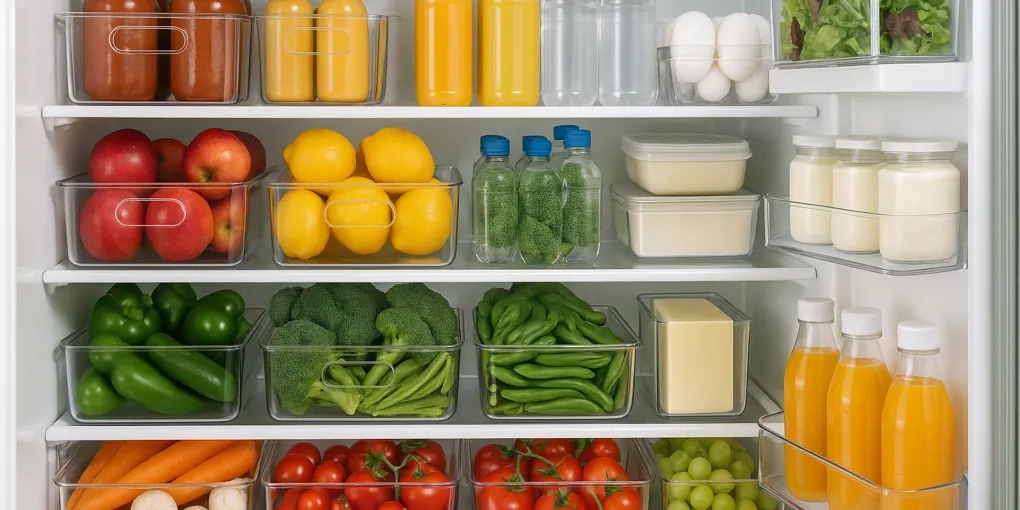
How to Organize Your Refrigerator 2026
Buyer's GuideQuick picks
mDesign Plastic Refrigerator Drawer Organizer Bin
Vtopmart Clear Refrigerator Organizer Bins (Set of 8)
OXO Good Grips GreenSaver Produce Keeper
Quick picks
These are the products referenced in the guide; check dimensions, material, and installation limits before ordering.
- Recommended product: Check current options on Amazon
- Recommended product: Check current options on Amazon
- Recommended product: Check current options on Amazon
Why Most Refrigerators Become Chaos Machines — and How to Fix Yours
The average American household throws away roughly $1,500 worth of food per year, and a disorganized refrigerator is one of the biggest contributors. Items get pushed to the back. Leftovers disappear behind a fortress of condiment bottles. Produce wilts in drawers while duplicates sit forgotten on upper shelves. It is not a willpower problem — it is an environmental design problem.
Behavioral scientists who study kitchen habits have documented a consistent pattern: when food requires more than two seconds to locate, people skip it in favor of something more visible. That $6 bunch of kale bought on a Tuesday gets forgotten by Saturday because it is hidden behind a pitcher of water and a bag of shredded cheese. The solution is not to try harder — it is to redesign the environment so that good choices require the least effort.
A well-organized refrigerator does three things simultaneously. First, it groups foods by zone so that the right items are stored at the right temperatures, which directly affects food safety and shelf life. Second, it uses visual clarity — clear bins, transparent containers, pulled-forward items — to eliminate the cognitive work of finding what you need. Third, it creates a system simple enough to maintain, so that Sunday’s grocery run does not undo Monday’s careful organization.
This guide walks through the complete process of organizing your refrigerator from empty to fully optimized, including which zones to create, how to handle produce, and which products actually deliver on their promise of maintaining order long-term. For complementary kitchen organization, see our guide on how to organize kitchen cabinets and our roundup of the best refrigerator organizers.
Step 1: Empty, Audit, and Deep Clean
The single biggest mistake people make when organizing a refrigerator is organizing around the existing contents. Before any system can be built, you need to start from a blank slate.
Remove everything from the refrigerator and place it on the counter. Work quickly if you are concerned about temperature — the process should take about 20 minutes total, well within the safe window for most items.
As you remove items, sort them into three groups: keep, discard, and relocate. Discard anything past its expiration date, anything with visible mold, and anything you honestly cannot remember putting in there. Be ruthless. The point of this step is not just cleanliness — it is audit. You need to know what you actually have before you can design a system around it.
The “relocate” pile is often surprisingly large. Items that belong in the pantry but migrated into the fridge (hot sauce that does not need refrigeration, backup peanut butter, dry goods that someone stashed), duplicates of the same condiment, and items that belong in the freezer all need to be moved out before the fridge organization begins.
Once the shelves are empty, remove all drawers and bins and wash them in warm soapy water. Wipe down the interior walls, the door bins, and the shelf surfaces with a solution of one tablespoon baking soda per quart of warm water. This neutralizes odors without leaving behind a chemical smell. Dry thoroughly before reassembling.
This step typically takes 30 to 45 minutes but it pays dividends for months. A clean, empty refrigerator is also far easier to measure if you plan to add organizational bins or pull-out drawers.
Step 2: Establish Your Zone Map
A refrigerator is not a uniform storage space. Temperature varies meaningfully by location, and the right zone system leverages those variations to extend food life and reduce spoilage.
Upper shelves (warmest interior zone): This is where ready-to-eat foods, leftovers, prepared meals, and beverages live. These items are consumed quickly and benefit from being at eye level. Keeping leftovers here with clear containers and a simple two-day rule (if it has been in there more than two days, it leaves) prevents the leftover graveyard problem.
Middle shelves (consistent moderate temperature): Dairy products, eggs, and deli meats belong here. These items need consistent cold but not the extreme cold of the bottom shelf. Eggs specifically should never be stored in the door — the temperature fluctuations from opening and closing shorten their shelf life significantly.
Bottom shelf (coldest zone): Raw proteins — meat, poultry, seafood — belong on the bottom shelf, in sealed containers or on a dedicated tray. This is both the coldest location and the safest from a cross-contamination standpoint. Juices from raw proteins cannot drip onto other foods.
Crisper drawers (humidity-controlled zones): Most modern refrigerators have two crisper drawers: one high-humidity for leafy greens, herbs, and vegetables that wilt, and one low-humidity for fruits and vegetables that do better with drier conditions. Check your refrigerator’s manual for the correct setting — most have a slider on the drawer itself. Mixing produce types in the same drawer is one of the most common causes of premature spoilage.
Door bins (warmest zone overall): Condiments, juices, salad dressings, and items you reach for constantly belong in the door. This is the highest-traffic, least-cold location. Butter, which does not need to be extremely cold, can also live here.
Write down your zone map before you start putting food back. The physical act of planning prevents the reflexive habit of putting items back wherever they were before.
Step 3: Install Organizational Products Before Restocking
This step is where most organization attempts fail. People buy bins, then fill the refrigerator, then try to fit the bins around the food. That approach rarely works. Install your organizational products first, then load food into the system.
Measure your refrigerator shelves before purchasing anything. Standard full-size refrigerators have shelves roughly 20 to 22 inches wide and 12 to 15 inches deep, but measurements vary considerably by brand and model. Write down the dimensions of each shelf, each drawer, and each door bin before you shop.
The most impactful products for refrigerator organization fall into three categories. Pull-out bins or drawers, which allow you to reach items stored at the back without moving everything in front. Stackable clear containers, which standardize the visual field and eliminate the confusion caused by mismatched original packaging. And lazy Susans or turntables, which are particularly effective for condiment-heavy households or for storing sauces and jars in the door.
For the upper shelf, two to three medium-sized clear pull-out bins work well — one for leftovers, one for beverages, one for grab-and-go snacks. For the bottom shelf, a dedicated raw-protein tray or bin with a small lip prevents leaks. For the crisper drawers, adding a produce-specific liner can absorb excess moisture and extend vegetable life. For the door, bin organizers that subdivide large door pockets into smaller sections prevent the door from becoming a disorganized jumble of bottles.
Label each zone. You do not need a label maker — a small strip of masking tape with a handwritten category is sufficient. The label is not for you; it is for everyone else in your household. When the system is visible and explicit, other people follow it more reliably.
Step 4: Load the Refrigerator Using the Two-Second Rule
The two-second rule from behavioral economics holds that any habit you want to maintain should require two seconds or fewer to initiate. Applied to refrigerator organization: every food item should be reachable and identifiable within two seconds of opening the door.
When loading the refrigerator, apply four principles. First, bring everything to the front edge of the shelf. Items pushed to the back get forgotten. Make a habit of always pulling new items to the front when restocking.
Second, store like with like. Keep all condiments together, all dairy together, all leftovers together. This sounds obvious but most refrigerators end up with condiments scattered across three shelves and two door bins because items get returned wherever there is space.
Third, use the first-in, first-out (FIFO) principle from commercial kitchens. When you buy new items, put older items in front and new items behind them. This is especially important for dairy, deli meats, and produce.
Fourth, never fill a bin more than two-thirds full. Overfilled bins are difficult to pull out, obscure items at the bottom, and cause people to give up on the system entirely after a few weeks of frustration.
Step 5: Build the Weekly Maintenance Habit
An organized refrigerator is maintained not through annual deep cleans but through a five-minute weekly routine. The best time to do it is immediately before grocery shopping — the fridge is at its emptiest, which makes the task less overwhelming, and you can identify what you actually need before buying more.
The weekly routine has three steps: scan for anything expiring or past its prime and discard it; wipe down any spills or sticky spots before they solidify; and verify that items are in their correct zones, returning anything that has drifted to the wrong shelf.
This five-minute habit prevents the gradual entropy that causes organized refrigerators to revert to chaos within weeks. Behavioral research on habit formation consistently shows that small, frequent maintenance behaviors outperform infrequent large interventions. The brain treats a five-minute weekly task as a normal routine rather than a project, which means it requires far less motivational energy to sustain.
Refrigerator organizer buying criteria
Use these factors to compare options before ordering:
| Factor | Weight | What to check |
|---|---|---|
| Research | 30% | Depth of specification and user-report analysis and breadth of products reviewed |
| Evidence Quality | 25% | Reliability of specs, product documentation, and repeated owner-reported fit patterns |
| Value | 20% | Cost-effectiveness relative to competing products at similar quality tiers |
| User Signals | 15% | Long-term owner feedback and fit-related complaints |
| Transparency | 10% | Accuracy of manufacturer claims, material disclosures, and dimension accuracy |
Scores are differentiated — top picks typically score 8.5–9.5, mid-tier 7.0–8.4, and weak options below 7.0.
Product Recommendations
For refrigerator organization, these products deliver the best results:
mDesign Plastic Refrigerator Drawer Organizer Bin
Best for: Upper and middle shelf pull-out organization $22–28. Owner reviews often highlight the smooth-gliding pull handles and the fact that the open-front design makes contents visible without removing the bin. Ideal for leftovers, beverages, and deli items.
| Criterion | Weight | Score |
|---|---|---|
| Capacity & Dimensions | 30% | 8.8/10 |
| Material Quality | 25% | 8.5/10 |
| Ease of Assembly & Use | 20% | 9.2/10 |
| Long-Term Value | 25% | 8.7/10 |
| Composite Score | 8.8/10 |
Check current options on Amazon
Vtopmart Clear Refrigerator Organizer Bins (Set of 8)
Best for: Full-fridge organization across all shelf zones $28–34. Purchasers report that the stackable design allows two tiers of storage on a single shelf, effectively doubling capacity. The set includes multiple sizes suited to different shelf depths.
| Criterion | Weight | Score |
|---|---|---|
| Capacity & Dimensions | 30% | 9.1/10 |
| Material Quality | 25% | 8.4/10 |
| Ease of Assembly & Use | 20% | 9.0/10 |
| Long-Term Value | 25% | 8.6/10 |
| Composite Score | 8.8/10 |
Check current options on Amazon
OXO Good Grips GreenSaver Produce Keeper
Best for: Crisper drawer produce freshness extension $16–20. Verified buyers note that produce stored in the GreenSaver lasts two to three times longer than in standard crisper drawers, thanks to the activated carbon filter and vented lid system that manages ethylene gas.
| Criterion | Weight | Score |
|---|---|---|
| Capacity & Dimensions | 30% | 7.9/10 |
| Material Quality | 25% | 9.0/10 |
| Ease of Assembly & Use | 20% | 8.5/10 |
| Long-Term Value | 25% | 8.8/10 |
| Composite Score | 8.6/10 |
Check current options on Amazon
Maintenance: Keeping Your Refrigerator Organized
The most common reason refrigerator organization fails is not the initial setup — it is what happens the third or fourth week after the initial enthusiasm fades. Life gets busy, groceries get shoved in wherever there is space, and within a month the system has reverted to its previous state.
The antidote is to make the maintenance routine frictionless enough that it happens automatically. Tying your weekly fridge check to an existing habit — brewing Saturday morning coffee, for example — is a classic implementation intention technique from behavioral science. When behavior B (fridge check) immediately follows behavior A (morning coffee), it requires no extra decision-making to initiate.
Seasonal deep cleans every three months are also worth scheduling. Quarterly, remove all bins, wash them, and reassess whether the zone system still matches your household’s actual eating patterns. Families with young children have different refrigerator habits than empty nesters. A system that worked perfectly two years ago may need to be reconfigured as household needs shift.
Involving everyone in the household in the initial setup significantly improves long-term follow-through. When people help design a system, they are more likely to follow it. Show children where their snacks live. Explain the zone logic to a partner. The more shared the mental model, the more durable the organization.
One additional technique: photograph your organized refrigerator after setup and keep the photo on your phone. After grocery shopping, reference the photo to restore the system rather than trying to remember it from memory. This single habit reduces setup drift dramatically and takes about 30 seconds per week.
Frequently Asked Questions
- Divide your fridge into four zones — upper shelves for ready-to-eat foods and leftovers, middle shelves for dairy and eggs, lower shelves for raw proteins, and the crisper drawers for produce. The door is best for condiments and shelf-stable items.
- A quick weekly purge of expiring items takes about five minutes. A deep clean and full reorganization every three months is sufficient for most households.
- Yes. Studies on visual cues and decision-making show that when food is visible and accessible, people consume it before it spoils. Clear bins that pull out completely are especially effective at eliminating the "out of sight, out of mind" problem.
- The bottom shelf, which sits closest to the cooling unit, is the coldest zone. Raw meat, poultry, and seafood should always be stored here in sealed containers to prevent cross-contamination.
- Yes, but selectively. Door temperatures fluctuate more than the interior. Use door bins for condiments, juices, and shelf-stable items. Avoid storing eggs, milk, or leftovers in the door.