Best Vertical Cleaning Storage for a Small Apartment: Keep Supplies Reachable Without a Floor Pile
Buyer's GuideHapiRm Over The Door Organizer with 4 Metal Baskets
Best for a closet doorBest For: Renter-friendly vertical storage for cloths, refills, and light supplies
Quick picks
| Product | Key Specs |
|---|---|
| See price on Amazon |
|
| See price on Amazon |
|
Product availability, certifications, and retailer details can change; check the current Amazon page before buying.
Small apartments create a specific cleaning-storage problem: supplies are needed in several rooms, but the floor space that could hold a cart or utility cabinet is also a walking path. The answer is not to stack every bottle under the kitchen sink. It is to give daily tools a narrow vertical home and keep bulk refills elsewhere.
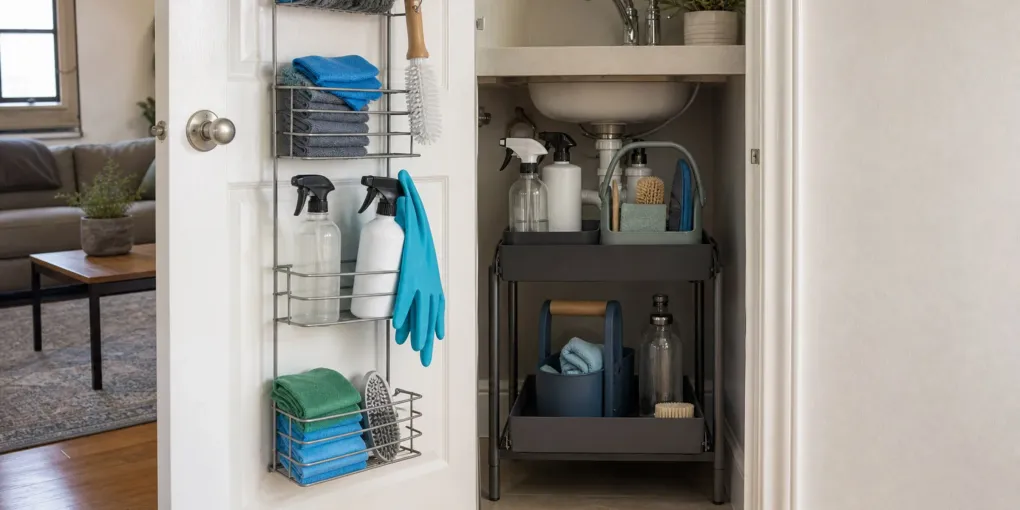
Two setups solve different problems. An over-door basket organizer keeps lightweight, dry tools visible without taking shelf space. A slide-out under-sink organizer makes a shallow cabinet usable when the plumbing leaves awkward gaps. Neither is a good place for every product you own.
Quick picks for different apartment layouts
- Closet-door setup: The HapiRm Over The Door Organizer with 4 Metal Baskets is best for microfiber cloths, gloves, dusting tools, and unopened light refills. Confirm the door’s clearance and hinge movement before ordering, then see price on Amazon.
- Single-cabinet setup: The Kitstorack 2-Tier Slide Out Under Sink Organizer (2-Pack) is a better fit when you need to see a modest daily set under one sink. Measure the cabinet around drainpipes first, then see price on Amazon.
Use the product card as a starting point, not a reason to fill every basket. The apartment-specific question is whether the setup shortens the trip between a common mess and the supplies needed to handle it.
Choose the location before buying an organizer
Start by observing where cleaning actually happens. Bathroom residue is easiest to handle when the cloths and approved bathroom cleaner are nearby. Kitchen spills need a different location from laundry supplies. If the only available cupboard is far from both rooms, a small carry caddy can bridge the gap, while bulk stock stays in the cupboard.
Avoid storing products on the floor beside a toilet, heater, or entry path. That turns a cleaning system into a trip hazard and makes leaks harder to notice. Keep containers upright with labels visible, and never transfer chemical products into food or drink containers.
Poison Control warns that transferring cleaners into unlabeled beverage or other containers can lead to accidental poisoning and advises keeping products in their original containers (Poison Control container-transfer guidance). If young children or pets can access the location, choose a latchable cabinet or a higher storage point rather than an open basket.
Measure the storage envelope, not just the organizer
For an over-door setup, measure the door thickness, the gap above the door, and the distance between the door face and the nearest shelf or wall when it swings. Then tape a paper rectangle to the door at the proposed basket depth. Open the door fully, close it, and stand in the normal walkway. If the paper catches a shelf, brushes your shoulder, or prevents the latch from engaging, the location is too tight even if the organizer technically fits the door.
Also check the hardware’s effect on the top edge. A metal hook that looks thin can still rub a painted jamb or make a closet door spring back open. Test with the door’s normal contents nearby; an empty closet can hide the collision that happens when a coat sleeve or mop handle occupies the same space.
For an under-sink setup, measure three different rectangles: the clear floor area, the usable area above the drain trap, and the path the sliding shelf needs when pulled forward. Note hinges, disposal housings, shutoff valves, supply lines, and any pipe that sweats. The organizer should be removable without disconnecting plumbing, and a shutoff valve must remain reachable by hand. A setup that fits only when bottles lean against a pipe is not a workable fit.
Compare the two useful vertical setups
Over-door baskets: best for dry, lightweight tools
An over-door organizer is most useful for items that do not leak: microfiber cloths, scrub brushes, spare sponges, gloves, a dustpan, and a small lint roller. It works well in a hall or utility closet where the door can close without crushing the baskets.
Skip it for heavy glass bottles, large liquid refills, or anything that makes the door swing awkwardly. Check that the basket hooks do not damage painted rental doors and that the door still latches. If the hooks change the door gap, use the cabinet instead.
The four-basket HapiRm configuration is most useful when each level has a stable material type. One basket can hold folded cloths, one can hold gloves and spare sponges, one can hold lightweight hand brushes, and the lowest reachable basket can hold the small caddy that travels to the room being cleaned. That layout makes missing supplies visible without putting liquids on every level.
Before loading it, install the empty organizer and operate the door ten times. Listen for scraping, watch whether the hooks walk sideways, and confirm that the knob and latch still work normally. Add items one basket at a time and stop if the door begins to drift, flex, or strike the wall. The product’s current listing and instructions—not the number of empty baskets—set the load limit.
Slide-out under-sink shelves: best for a limited daily set
A slide-out organizer can prevent the back of a cabinet from becoming a graveyard of half-used bottles. It is best for the small group of products used weekly and for cloths or gloves kept in a separate dry basket.
Measure width, depth, and drainpipe clearance before buying. Keep bleach products, ammonia products, and acids in their original containers and follow their labels; do not assume an organizer makes incompatible products safe to store together. The American Cleaning Institute emphasizes reading and following label directions for cleaning products (ACI cleaning product safety).
Because the Kitstorack option is sold as a two-pack, decide whether the apartment actually has two safe locations before treating both units as one cabinet solution. One unit may fit beneath the bathroom sink while the other serves a dry utility shelf. Forcing both around one drain trap can block the pullout path and hide leaks. A two-pack is useful only when the second organizer has a defined location and job.
Load the lower tier with the taller daily-use bottles that can stand upright without touching plumbing. Use the upper tier for a separate dry basket of cloths or gloves. Pull the shelf fully forward with the cabinet door at its normal opening angle; if a spray trigger catches the frame or a bottle tips, reduce the inventory instead of turning the product sideways. Place an absorbent leak mat beneath the organizer only if it does not conceal an active plumbing leak.
Separate products before you optimize the shelf
Vertical space does not override product-label storage directions. Read every label before grouping supplies. Keep products in their original containers, close caps and triggers, and do not place a leaking bottle above cloths that will later touch skin or food-contact surfaces. If two labels call for different storage conditions, they belong in different zones even when they are both described casually as cleaners.
Create a small quarantine step for damaged containers. Put the suspect product upright in a compatible temporary tray, keep people and pets away, ventilate only as its label directs, and contact the manufacturer or local household-hazardous-waste program for disposal guidance. Do not decant it into an unmarked bottle to save shelf space.
Open over-door baskets are a poor choice for any liquid that a child or pet could reach or that could fall when the door moves. In that household, use the door rack only for dry tools and reserve chemicals for a latched cabinet or another location that meets the label’s directions.
Run a one-week fit test
Photograph the empty zone, install the organizer, and stock only the supplies used during an ordinary week. Put a removable date note inside the cabinet or closet. After seven days, check four things: whether the door still closes, whether any bottle has tipped or leaked, whether plumbing remains accessible, and whether household members return tools to the same place.
If a product never left the shelf, move it to the refill zone rather than buying a larger rack. If a needed cloth still lands on the floor, lower its basket or move the whole setup closer to the mess. The successful organizer is the smallest stable setup that makes the next cleaning action easier; unused capacity is not a failure.
A small-apartment capacity rule
Give each vertical zone one job. A door organizer holds dry tools. An under-sink shelf holds the daily products for that room. A high cabinet or separate locked space holds refills. When a zone is full, use up or discard products according to local guidance before buying a larger organizer.
This matters in a small apartment because excess refills create the same access problem as clutter: the product you need is behind three products you forgot you owned.
Review the zone monthly when you replace a refill. Wipe the shelves, check caps and triggers, look for moisture below the sink, and remove tools that migrated from another job. This five-minute inspection catches a slow leak or overloaded door before it becomes a larger cleanup.
What to avoid
- A rolling cart parked in a narrow exit route.
- Heavy bottles hanging from a thin over-door rack.
- Products decanted into unmarked jars or drink bottles.
- A cabinet so full that spray triggers or caps catch on plumbing.
- One mixed bin for laundry chemicals, dishwasher products, and bathroom cleaners.
Vertical cleaning storage FAQ
Is an over-door organizer safe in a rental?
It can be if it fits the door, does not prevent latching, and holds only light items. Check lease requirements and use a removable solution where possible. Do not overload a hollow-core door.
Should I store disinfectant wipes in the bathroom?
Only if the package directions allow the temperature and humidity of that location, and the container can stay closed. Keep wipes and chemicals out of reach of children and pets.
How do I keep a cleaning cart from becoming clutter?
Stock it for one reset, then return extras to the refill zone. A cart should carry active tools, not every unopened bottle in the apartment.
Sources
- Poison Control, Container Transfers: https://www.poison.org/articles/container-transfers
- American Cleaning Institute, Cleaning Product Safety: https://www.cleaninginstitute.org/understanding-products/cleaning-product-safety
- U.S. Environmental Protection Agency, Safer Choice: https://www.epa.gov/saferchoice
Frequently Asked Questions
- Store them near their main point of use, in one stable location that is out of reach of children and pets. A closet door, utility cabinet, or under-sink zone can work when it has a clear capacity limit.
- Only if the cabinet stays dry, ventilated enough for the product labels, and has room to keep products upright and separated. Do not crowd the plumbing or mix products in the same unmarked container.
- Keep only the tools used in the current room: cloths, gloves, one all-purpose product used as directed, and a small brush. Bulky refills and rarely used products belong in a separate storage zone.