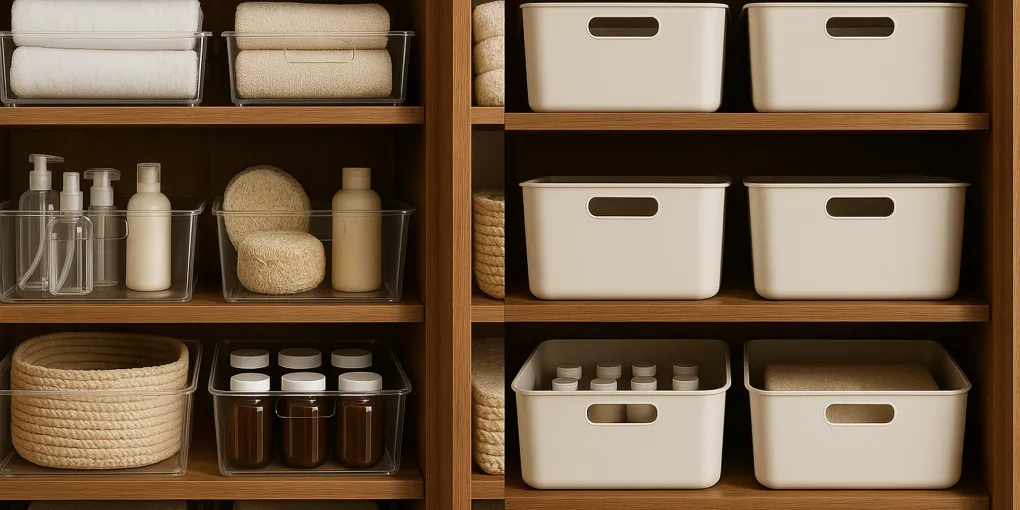
Clear Bins vs Opaque Bins: Which Is Better for Storage? 2026
Buyer's GuideQuick picks
Product option
Quick picks
These are the products referenced in the guide; check dimensions, material, and installation limits before ordering.
- Recommended product: Check current options on Amazon
- Recommended product: Check current options on Amazon
- Recommended product: Check current options on Amazon
- Recommended product: Check current options on Amazon
Clear Bins vs Opaque Bins: The Core Trade-Off
When it comes to storage bins, the choice between clear and opaque is one of those decisions that seems trivial but has real consequences for how effectively you maintain an organized home. At its core, you are trading visibility against aesthetics—and neither side wins unconditionally.
Behavioral science has a useful lens here: the principle of friction reduction. Research in habit formation, including work cited in BJ Fogg’s Tiny Habits framework, shows that reducing the steps required to complete a routine dramatically increases follow-through. In the context of home organization, clear bins reduce the cognitive load of locating items. You see the contents, you grab what you need, you move on. Opaque bins introduce one extra step—either memory recall or physical opening—which seems minor until you multiply it across dozens of interactions per week.
On the other hand, visual clutter is itself a source of cognitive stress. Studies on environmental psychology consistently show that cluttered visual fields elevate cortisol. If your bins are filled with a chaotic mix of items that aren’t perfectly organized inside, clear bins broadcast that disorder to the room. Opaque bins provide a visual reset, signaling “contained and resolved” even when the interior is imperfect.
The practical upshot: clear bins win in utility-first environments—pantries, garages, craft rooms, utility closets. Opaque bins win in display-forward spaces—living rooms, bedroom shelves, children’s rooms, entryways. Understanding which environment you’re organizing changes which bin type delivers better long-term results.
Clear Bins: What They Are and When They Win
Clear storage bins are made from transparent or semi-transparent polypropylene, HDPE, acrylic, or PET plastic. At a glance, you can identify contents without opening, moving, or labeling the container—though labels remain useful for quick scanning at a distance.
The primary advantage of clear bins is instant visual inventory. When you open a pantry and scan the shelves, clear bins let you identify what needs restocking, what’s nearly empty, and what’s been overlooked in the back row. This is especially valuable in high-turnover storage areas where contents change frequently.
Clear bins also excel at accountability. Because contents are visible, clutter inside the bin is immediately obvious. This sounds like a disadvantage, but it actually encourages people to maintain organization more consistently. Studies on “commitment devices” in behavioral economics show that making behavior visible increases adherence to intended routines. When your bins show mess, the visual discomfort motivates correction.
In garages and utility spaces, clear bins prevent the common problem of “mystery boxes”—containers whose contents you’ve forgotten and won’t rediscover until a full reorganization. With clear bins, the garage becomes readable at a glance, even from across the room.
For craft rooms and hobby spaces, clear bins are nearly indispensable. Thread colors, paint tubes, beads, and small tools need to be identifiable without physical handling. The tactile-first alternative—rifling through opaque bins until you find the right item—consumes creative energy before the actual project begins.
The main challenge with clear bins is that they demand interior organization discipline. Partial loads, mixed categories, or items in non-standard orientations look messier in a clear bin than an opaque one. For many households, this is a feature, not a bug. For households where organizational consistency is already a struggle, it can increase visual stress.
Clear bins also tend to yellow and cloud over time with UV exposure, particularly in garage settings with natural light. High-quality clear bins use UV-stabilized polymers, so checking material specs before buying matters more for this type than opaque alternatives.
Opaque Bins: What They Are and When They Win
Opaque storage bins come in every color and finish imaginable—white, natural linen, navy, terracotta, matte black, and beyond. They conceal contents completely, presenting a uniform face to the room regardless of what’s stored inside.
The most significant advantage of opaque bins is visual cohesion. A shelf lined with matching opaque bins looks intentional and calm, regardless of what’s inside. This matters enormously in living spaces, bedrooms, and entryways where storage is in view of guests or family members and contributes to the room’s overall aesthetic.
Interior designers consistently favor opaque bins in open-shelf situations for exactly this reason. A set of matching woven baskets or matte white bins transforms a chaotic living room shelf into a composed vignette. The same shelf with clear bins, even neatly packed, reads as more utilitarian.
Opaque bins also protect contents from light degradation. Items stored in direct or indirect sunlight—including food, medications, dyed fabrics, and certain craft supplies—fare better without UV exposure. For seasonal closets near windows or sun-exposed garage spaces, opaque bins extend the life of stored items.
For children’s rooms, opaque bins reduce visual stimulation overload. When toys and craft supplies are visually “closed,” the room reads as more restful—a meaningful benefit at bedtime or during focused homework time. The behavioral principle of choice reduction also applies: opaque bins limit the visual temptation of the contents, which can help children move past the play area without distraction.
The primary limitation is labeling dependency. Opaque bins require clear, accurate labels to maintain usability. Without labels, the organizational benefit collapses into a guessing game. This is a manageable tradeoff if labeling is part of your setup process, but it adds an upfront time cost that clear bins eliminate.
Head-to-Head Comparison
| Feature | Clear Bins | Opaque Bins |
|---|---|---|
| Cost | $8–$45 per bin | $6–$50 per bin |
| Visibility | Instant, no label required | Requires labeling |
| Aesthetics | Utilitarian, clinical | Cohesive, design-friendly |
| Durability | May yellow with UV exposure | Colorfast with most materials |
| Best for | Pantries, garages, craft rooms | Living rooms, bedrooms, entryways |
| Organization visibility | Shows interior disorder | Conceals interior state |
| Light protection | Minimal | Good to excellent |
When to Choose Clear Bins
Choose clear bins when speed and accuracy of access is the priority. Pantries are the clearest win: being able to see rice, pasta, and snacks without opening containers saves real time during meal prep. The same logic applies to garage workshops, where tool visibility keeps projects moving.
Clear bins are also the right call in spaces where you track inventory—laundry rooms with cleaning supply stock, craft rooms with consumable materials, offices with paper and supply reserves. Visual depletion cues are built into the container itself.
If you store items that rotate frequently—seasonal decorations swapped mid-year, holiday supplies, athletic gear—clear bins let you audit contents quickly when you pull them from storage. Labeling still helps, but even unlabeled clear bins give you enough information to find what you need in a stack.
Clear bins also pair well with uniform storage systems that prioritize function over form. If your garage or utility room will never be photographed for a design blog, the utilitarian look of clear bins is irrelevant. What matters is efficiency, and clear bins deliver it reliably.
For households managing ADHD or other executive function challenges, clear bins significantly reduce the mental overhead of organization maintenance. The system stays legible even after months without active maintenance—a major practical advantage. See our guide to best storage bins for closets for specific product recommendations suited to visibility-first organization.
When to Choose Opaque Bins
Choose opaque bins when visual consistency and room aesthetics are important. Open living room shelves, bedroom bookcases, and entryway cubbies are all spaces where guests will see your storage and where the overall look of the room matters to daily quality of life.
Opaque bins also make sense when your household’s organizational habits are inconsistent. If bins regularly end up with mixed contents, partial loads, or items stored in disarray, opaque bins contain the visual chaos. The room looks organized even when individual bins are imperfect—which is the organizational reality in most homes with children or multiple adults sharing spaces.
For seasonal storage—holiday decorations, winter gear, summer toys—opaque bins protect contents better during long dormancy periods. When bins sit in a basement or storage unit for six months, light-sealing opaque walls help preserve colors, fabrics, and packaging.
If you’re building a color-coordinated organization system, opaque bins give you palette control that clear bins can’t match. Matching bins across a closet in a single color creates visual order that’s deeply satisfying and motivates ongoing maintenance—a well-documented effect in environmental design research.
Renters and people who move frequently often prefer opaque bins because they transport without revealing contents to movers, adapt to new room aesthetics easily, and don’t show the scuffs and scratches that make clear bins look worn. Browse our recommendations for best closet organization systems for opaque bin sets that work across multiple spaces.
Bin choice criteria
Use these factors to compare options before ordering:
| Factor | Weight | What to check |
|---|---|---|
| Research | 30% | Depth of specification and user-report analysis and breadth of products reviewed |
| Evidence Quality | 25% | Reliability of specs, product documentation, and repeated owner-reported fit patterns |
| Value | 20% | Cost-effectiveness relative to competing products at similar quality tiers |
| User Signals | 15% | Long-term owner feedback and fit-related complaints |
| Transparency | 10% | Accuracy of manufacturer claims, material disclosures, and dimension accuracy |
Scores are differentiated — top picks typically score 8.5–9.5, mid-tier 7.0–8.4, and weak options below 7.0.
Product Recommendations
Best Clear Bins
IRIS USA Weathertight Storage Boxes (Set of 4) $28–$40. These IRIS bins are the gold standard for clear storage: thick polypropylene walls, gasket-sealed lids for moisture resistance, and stackable form factor. The clarity is exceptional even after years of use—UV-stabilized material prevents the yellowing that plagues cheaper clear bins. Available in 6-quart to 62-quart sizes.
| Criterion | Weight | Score |
|---|---|---|
| Capacity & Dimensions | 30% | 9.0/10 |
| Material Quality | 25% | 9.2/10 |
| Ease of Assembly & Use | 20% | 8.8/10 |
| Long-Term Value | 25% | 9.0/10 |
| Composite Score | 9.0/10 |
Check current options on Amazon
Sterilite 6-Quart Stacking Shelf Organizer Bins $12–$18 for a 6-pack. A budget-friendly option for pantry and closet use. These smaller bins stack reliably without a dedicated lid, making them ideal for shelf-front labeling systems. Clarity is good out of the box; moderate UV resistance means they’re better suited to indoor use.
| Criterion | Weight | Score |
|---|---|---|
| Capacity & Dimensions | 30% | 7.5/10 |
| Material Quality | 25% | 7.0/10 |
| Ease of Assembly & Use | 20% | 9.0/10 |
| Long-Term Value | 25% | 7.2/10 |
| Composite Score | 7.6/10 |
Check current options on Amazon
Best Opaque Bins
Rubbermaid Roughneck Totes (18-Gallon) $14–$22 each. Rubbermaid’s Roughneck line is the benchmark for opaque utility storage. Heavy-gauge polyethylene walls resist cracking even in temperature-fluctuating garages and attics. Secure-snap lids stack well. Available in multiple sizes and colors—the classic dark gray/black colorway reads as neutral in any utility space.
| Criterion | Weight | Score |
|---|---|---|
| Capacity & Dimensions | 30% | 9.2/10 |
| Material Quality | 25% | 9.5/10 |
| Ease of Assembly & Use | 20% | 8.5/10 |
| Long-Term Value | 25% | 9.3/10 |
| Composite Score | 9.2/10 |
Check current options on Amazon
mDesign Fabric Storage Bins with Labels (Set of 4) $24–$32. For open-shelf display spaces, these fabric bins in neutral tones offer excellent visual cohesion. The built-in label window solves the opaque bin’s main limitation without compromising aesthetics. Collapsible design stores flat when not in use—a practical advantage for seasonal rotation.
| Criterion | Weight | Score |
|---|---|---|
| Capacity & Dimensions | 30% | 7.8/10 |
| Material Quality | 25% | 8.0/10 |
| Ease of Assembly & Use | 20% | 9.2/10 |
| Long-Term Value | 25% | 7.5/10 |
| Composite Score | 8.0/10 |
Check current options on Amazon
The Verdict
Neither clear nor opaque bins are universally superior—the right choice depends entirely on where you’re using them and what you need to accomplish.
Default to clear bins for any space where speed of access matters: pantries, garages, craft rooms, utility closets, and anywhere you track consumable inventory. The visibility dividend compounds over time—every time you grab the right item on the first try instead of opening three containers, you’re recovering time and mental energy.
Default to opaque bins for any space that’s part of your home’s visual environment: living rooms, bedrooms, hallways, children’s rooms, and entryways. The aesthetic coherence that opaque bins provide contributes to a calmer environment, which has documented effects on mood and stress levels.
For many households, the optimal solution is a hybrid: clear bins in the pantry and garage, opaque bins in the living room and bedrooms. The mental model is simple—clear bins where you need to find things, opaque bins where others need to see things.
Whatever type you choose, prioritize consistency within each zone. A uniform row of clear bins reads as intentional. A random mix of clear and opaque creates visual noise that defeats the purpose of either type.
Frequently Asked Questions
- Clear bins are generally better for frequent-use areas where you need to identify contents quickly, like pantries and craft rooms. Opaque bins work better in living spaces where visual tidiness matters more than instant visibility.
- Yes. Clear bins reveal dust, crumbs, and grime inside the bin that opaque versions would hide. If aesthetics are a priority, opaque bins require less visual maintenance.
- You can, but labeling becomes essential. Without labels, opaque pantry bins force you to open every container to find what you need, which slows down cooking routines and increases frustration.
- Both clear and opaque bins come in similar materials—polypropylene, HDPE, or ABS plastic. Durability depends more on wall thickness and lid quality than transparency, so compare specs rather than assuming one type outlasts the other.
- Not necessarily. Both types span a wide price range. Clear bins can be slightly more expensive in premium brands due to the added manufacturing precision needed for true transparency, but budget options exist for both.