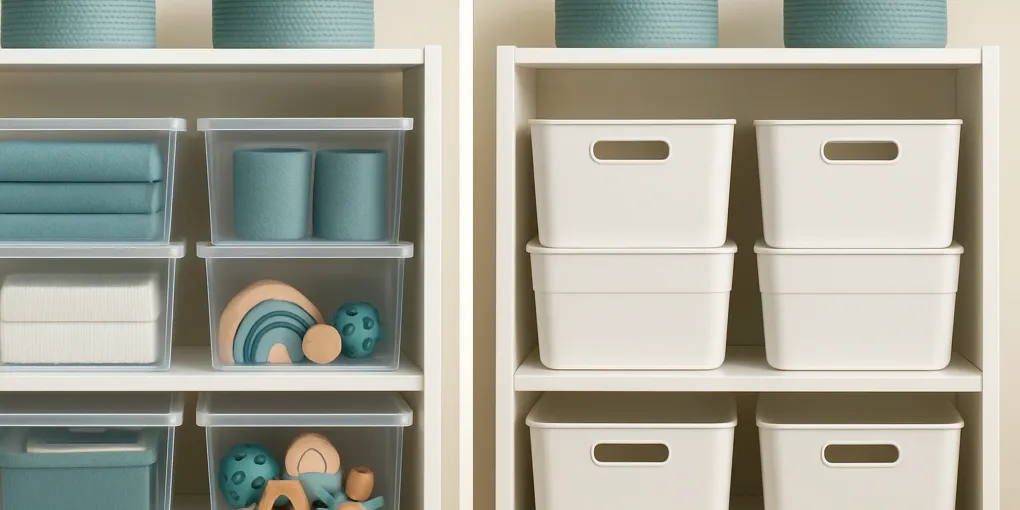
Do Clear Storage Bins Reduce Clutter or Just Make It Visible?
Evidence ExplainerQuick picks
Use this as a shortcut to the products mentioned below; verify dimensions and mounting limits against your space before buying.
- clear storage bins with lids: See current price on Amazon
- opaque storage bins: See current price on Amazon
- storage bin labels: See current price on Amazon
- clear pantry bins: See current price on Amazon
The Short Answer
Clear storage bins reduce clutter when the main problem is forgetting, searching, or buying duplicates. They can make clutter feel worse when the main problem is visual noise.
That distinction matters. Organization is not only about where things go. It is also about how much information a space asks your brain to process. A transparent bin full of multicolored cords, half-used craft supplies, and random small parts may be functionally organized, but it still broadcasts visual complexity.
Use clear bins when seeing the contents creates better behavior. Use opaque bins when hiding the contents creates more calm.
Search for clear storage bins with lids (See current price on Amazon), opaque storage bins (See current price on Amazon), or storage bin labels (See current price on Amazon). Compare current labels, prices, sellers, dimensions, and return policies before buying.
The Science: Visibility Has Two Effects
Visibility helps retrieval. If you can see the batteries, you are less likely to buy another pack. If you can see the winter gloves, you are more likely to use them before buying replacements. Clear storage improves external memory: the container itself reminds you what exists.
Visibility also increases visual load. McMains and Kastner (2011, DOI: 10.1523/JNEUROSCI.3766-10.2011) describe competition between objects in visual attention. A shelf of transparent bins still presents many objects to the visual system because the contents remain visible. The bin creates a boundary, but it does not remove the information.
This helps explain why clear pantry bins often feel useful, while clear living-room toy bins can feel chaotic. In a pantry, the purpose is inventory. In a living room, the purpose may be calm.
Saxbe and Repetti (2010, PMID: 19934011) found that perceptions of cluttered home environments were associated with stress-related cortisol patterns in adults. The study does not test clear bins specifically, but it supports the broader point: perceived clutter matters, not just the number of objects owned.
When Clear Bins Are the Right Choice
Clear bins are strongest when you need a fast inventory cue.
Pantry backstock
Clear bins help reveal pasta, snacks, baking supplies, and unopened staples before you buy duplicates. They also make partial categories easier to consolidate.
Search for clear pantry bins (See current price on Amazon).
Craft supplies
Craft materials are often small, colorful, and category-specific. Clear bins help you see ribbon, markers, beads, yarn, fabric, stickers, and specialty tools. The visibility prevents the classic craft-room problem: buying a replacement because the original disappeared.
Search for clear craft storage bins (See current price on Amazon).
Toy rotation sets
Clear bins work well in storage closets where adults need to see what is in each toy set. For the active play area, opaque or partially hidden storage may be calmer.
Hardware and utility supplies
Batteries, light bulbs, hooks, tape, felt pads, small tools, and repair parts benefit from visibility. These are categories where duplicates happen because people cannot find the item at the moment of need.
Seasonal categories
Holiday lights, gift wrap, winter accessories, and party supplies are used infrequently. Clear bins help re-identify them after months in storage.
When Opaque Bins Are Better
Opaque bins are better when the goal is visual quiet.
Living rooms
Open shelving with clear bins often looks busier than the original clutter because everything is visible through plastic. Opaque fabric, seagrass, or solid bins create a calmer visual boundary.
Search for opaque storage baskets for shelves (See current price on Amazon).
Bedrooms
Bedrooms benefit from low visual stimulation, especially at night. Opaque bins for accessories, chargers, extra toiletries, and bedside clutter keep the room visually quieter.
Cords and electronics
Cords are visually chaotic even when coiled. Clear bins show the tangle. Opaque bins hide it while labels preserve retrieval.
Sentimental or mixed categories
Memory boxes, miscellaneous keepsakes, and mixed household categories rarely need instant visual scanning. Opaque bins reduce the emotional and visual noise of half-sorted items.
The Decision Rule
Ask two questions before buying bins:
- Would seeing the contents help me use, remember, or avoid rebuying this category?
- Will this bin live in a visible space where the contents will add visual noise?
Choose clear if the answer to question 1 is yes and question 2 is no.
Choose opaque if the answer to question 2 is yes.
If both are yes, choose a hybrid: frosted bins, opaque bins with large labels, or clear bins stored behind doors.
Clear Bin Setup Protocol
Step 1: Sort before buying
Do not buy bins for unsorted clutter. Sort the category first, then measure the actual volume. Buying containers first often locks you into the wrong sizes.
Step 2: Use one category per bin
Clear bins become less useful when categories mix. A transparent bin labeled “miscellaneous” is just a visible junk drawer.
Better labels:
- Batteries.
- Tape and adhesives.
- Holiday lights.
- Pasta backstock.
- Kids craft paint.
- Travel toiletries.
Step 3: Avoid overfilling
A clear bin loses its scanning advantage when it is packed to the lid. Leave enough space to see and remove items without dumping the bin.
Step 4: Label anyway
Clear does not mean self-explanatory. Labels help other household members return items correctly, and they reduce the need to inspect every bin.
Search for removable bin labels (See current price on Amazon) or label maker tape (See current price on Amazon).
Common Clear Bin Mistakes
Mistake 1: Clear bins on every open shelf
This makes a room look like a stockroom. Use clear bins behind doors or in utility areas. Use opaque bins in visually important spaces.
Mistake 2: Too many tiny bins
Small bins create more categories to maintain. Use the fewest bins that preserve useful separation.
Mistake 3: No lid plan
Lids help stacking and dust control, but they add friction. Use lids for long-term storage. Skip lids for daily-use categories.
Mistake 4: Ignoring dimensions
Measure shelf depth, height, and width before buying. A bin that fits online may not fit your actual cabinet or closet.
Bottom Line
Clear storage bins are not automatically better. They are tools for visibility. Use them when the cost of forgetting is high: pantry waste, duplicate buying, lost craft supplies, and seasonal search problems. Use opaque bins when the cost of seeing is high: bedrooms, living rooms, cords, toys, and mixed clutter.
The best system balances memory and calm. Clear where you need inventory. Opaque where you need rest.
How We Score Storage Bin Recommendations
ClutterScience uses a 30/25/20/15/10 weighted framework for storage recommendations:
| Factor | Weight | What we assess |
|---|---|---|
| Research | 30% | Whether the recommendation reflects visual attention, affordance, and household-behavior evidence |
| Evidence Quality | 25% | Whether claims are supported by peer-reviewed research, design principles, and realistic use cases |
| Value | 20% | Whether the bin choice prevents duplicate buying, search time, or wasted space without over-containerizing |
| User Signals | 15% | Whether other household members can understand and maintain the category |
| Transparency | 10% | Whether limitations, product-link assumptions, and cases where no purchase is needed are clear |
Clear bins score highest in utility zones where visual inventory matters. Opaque bins score highest in visible rooms where reducing visual stimulation matters. A bin that looks good but makes retrieval harder scores poorly, even if it photographs well.
Use-Case Matrix
| Category | Better bin | Why |
|---|---|---|
| Pantry backstock | Clear | Prevents duplicate buying and expired extras |
| Living-room toys | Opaque | Reduces visual noise in shared space |
| Craft supplies | Clear | Speeds inventory and project setup |
| Bedroom accessories | Opaque | Supports a calmer room at rest |
| Hardware | Clear | Helps identify small parts quickly |
| Cords | Opaque | Hides visual tangles while labels preserve retrieval |
| Holiday decor | Clear or labeled opaque | Clear helps in storage rooms; opaque looks better on visible shelves |
| Medicine overflow | Clear with caution | Visibility helps, but safety and child access matter more |
The Hybrid Solution: Clear Inside, Opaque Outside
Many homes need both. Use clear bins behind cabinet doors, in closets, in pantries, and in garages. Use opaque bins on open shelves, in bedrooms, and in living rooms. This gives you inventory where it helps and calm where it matters.
A hybrid system can also work within one room. For example, a playroom may use opaque baskets for active toys and clear lidded bins in a closet for rotated toys. A craft room may use clear drawers for supplies but opaque baskets for unfinished projects that look messy.
Before Buying: Measure and Sort
Container purchases fail when size decisions happen before category decisions. First, sort the category. Second, discard or relocate items that do not belong. Third, measure the shelf. Fourth, buy the smallest number of containers that hold the edited category with room to retrieve items.
Measure:
- Shelf width.
- Shelf depth.
- Shelf height.
- Door clearance.
- Handle clearance.
- Space needed to pull the bin out.
A bin that fits when empty may be annoying when full. Handles matter if the shelf is high. A lid matters if the item is stored long-term. An open top matters if the item is used daily.
Labeling Rules
Labels are not only for opaque bins. Clear bins need labels when multiple people share the system or when similar categories sit together.
Bad labels:
- Misc.
- Stuff.
- Extras.
- Things.
Better labels:
- AA and AAA batteries.
- School lunch backstock.
- Gift wrap tape and tags.
- Winter gloves.
- Printer ink.
Specific labels reduce decision fatigue. They also expose when a category has become too broad and needs to be split or edited.
Cost Control: Do Not Containerize Everything
The fastest way to overspend on bins is to treat every shelf as a container problem. Some categories need editing, not bins. If a closet contains broken parts, expired supplies, duplicate tools, or objects no one can identify, a clear bin only preserves the clutter in a more expensive form.
Use the one-month test for uncertain categories. Put the category in a temporary box with a handwritten label. If the household uses it and returns items correctly for a month, buy a durable container. If no one uses it, rethink the category before buying plastic.
This test is especially useful for hobby supplies, seasonal decor, kids’ toys, and pantry extras. These categories expand quietly. A temporary container slows the purchase decision and reveals whether the storage need is real or imagined.
Sources
- McMains, S. and Kastner, S. (2011). Interactions of top-down and bottom-up mechanisms in human visual cortex. Journal of Neuroscience. DOI: 10.1523/JNEUROSCI.3766-10.2011.
- Saxbe, D. E. and Repetti, R. (2010). No place like home: Home tours correlate with daily patterns of mood and cortisol. Personality and Social Psychology Bulletin. PMID: 19934011.
- Norman, D. A. (2013). The Design of Everyday Things. Basic Books. Used here for affordance and visibility principles in storage design.
Frequently Asked Questions
- Clear bins are better when you need fast visual inventory, such as pantry, craft, toy rotation, and seasonal categories. Opaque bins are better when visual calm matters more than instant scanning, such as open living-room shelves or bedrooms.
- They can. Clear bins reduce search friction but show every color, shape, and partial package inside. In visible rooms, that visual information can increase perceived clutter even when the items are technically contained.
- Use clear bins for categories where forgetting causes waste, duplicates, or missed use: pantry backstock, craft supplies, toy sets, holiday lights, hardware, and under-sink supplies.
- Use opaque bins for visually busy categories in living spaces: cords, mixed toys, sentimental papers, mismatched accessories, and anything stored on open shelving where calm appearance matters.
- This article links to Amazon search pages for clear storage bins, opaque bins, and labels so readers can compare current labels, prices, sellers, and return policies before buying.