Clear vs Opaque Storage Bins: Which Reduces Clutter Better?
Evidence ExplainerQuick picks
| Product | Key Specs | Pros / Cons |
|---|---|---|
| See price on Amazon |
|
|
| See price on Amazon |
|
|
| See price on Amazon |
|
|
Product availability, certifications, and retailer details can change; check the current Amazon page before buying.
Quick product shortlist
Use this shortlist to choose a product style before you measure. The links are named product or brand searches so you can compare current dimensions, finishes, prices, and return terms before buying.
- Best clear lidded bin: IRIS USA Clear Latching Box (Search Amazon for IRIS USA clear latching storage box) for closets, craft supplies, and backup household goods. Watch-out: clear boxes still need category limits.
- Best opaque utility bin: Sterilite ShelfTote Opaque Bin (Search Amazon for Sterilite opaque storage tote) for garage-adjacent overflow, seasonal decor, and less attractive supplies. Watch-out: opaque bins need large labels.
- Best visible-room opaque bin: Open Spaces Medium Bins (Search Amazon for Open Spaces storage bins) for living spaces where a calmer look matters more than instant visibility. Watch-out: higher cost per bin.
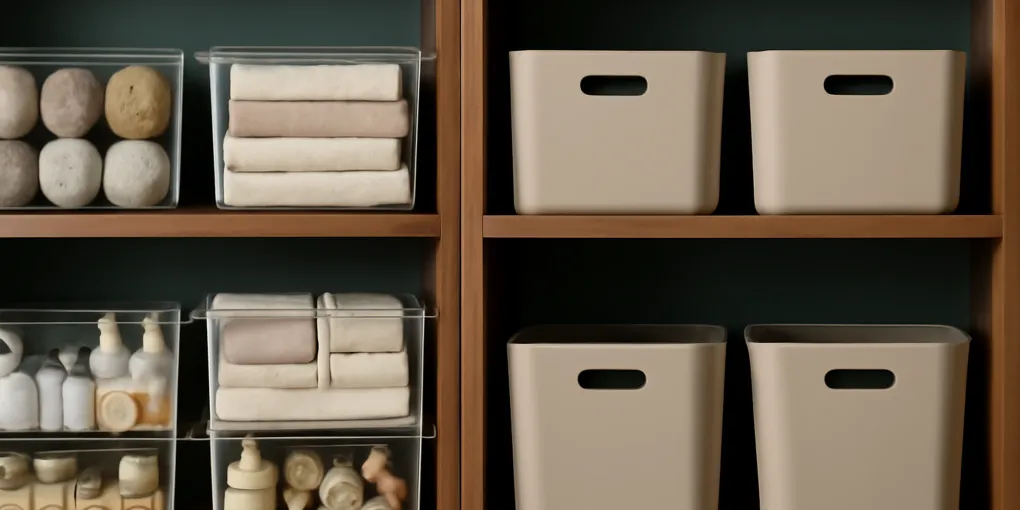
Clear vs opaque storage bins is not a style question; it is a retrieval question. Clear bins reduce search time when contents change often, while opaque bins reduce visual noise when categories are stable and labeled. The best home systems usually mix both: clear for inventory, opaque for calm.
Quick picks
Use this as a shortcut to the products mentioned below; verify dimensions and mounting limits against your space before buying.
- clear storage bins with lids: See current price on Amazon
- opaque storage bins with lids: See current price on Amazon
- label maker for storage bins: See current price on Amazon
- shelf bins with handles: See current price on Amazon
The Real Tradeoff: Visibility Versus Visual Load
A clear bin gives information instantly. You can see spare batteries, craft paint, wrapping paper, or the missing holiday lights without opening five lids. That visibility is helpful when the category changes often or when multiple people share the storage area.
The downside is that clear bins display every color, label, cable, and half-used package inside. In an open shelf, that can turn storage into visual clutter. McMains and Kastner, 2011 (doi:10.1523/JNEUROSCI.3766-10.2011) found that competing visual stimuli interact with attentional control in human visual cortex. A shelf of transparent bins can therefore be functionally organized and still feel visually busy.
Opaque bins reverse the tradeoff. They hide the contents, which can make a room calmer. But they require better labeling and more discipline. If labels are vague or missing, opaque bins create mystery storage. That is how “miscellaneous” becomes a long-term archive of decisions nobody wants to make.
Product searches: clear storage bins with lids (See current price on Amazon), opaque storage bins with lids (See current price on Amazon), label maker for storage bins (See current price on Amazon), and shelf bins with handles (See current price on Amazon). Compare current listings by dimensions, materials, recent buyer feedback, and return policy before buying.
When Clear Bins Work Better
Choose clear bins when the main job is finding things quickly. This includes seasonal inventory, pantry overflow, craft supplies, small toy systems, guest linens, appliance parts, cables that must be matched to devices, and garage consumables. Clear bins are also useful in deep shelves where labels face only one direction but the bin may be viewed from the side.
Clear storage is especially helpful during a transition period. If a household is building a new system, visibility reduces the chance that people forget where categories moved. It also reduces duplicate buying. When you can see six rolls of painter’s tape, you are less likely to buy a seventh.
For kids’ categories, clear bins can support independence. A child who cannot read labels can still identify blocks, train tracks, or art supplies. For shared adult storage, clear bins reduce the “where did you put it?” problem because the answer is visible.
The weakness is display quality. Clear bins work best inside closets, cabinets, garages, pantries, and utility rooms. In living areas, they can make shelves feel busier unless contents are uniform.
When Opaque Bins Work Better
Choose opaque bins when the storage area is visible and the category is stable. Living-room toys, media accessories, entryway winter gear, gift wrap, keepsakes, and cables in an open office often look calmer behind a solid surface.
Opaque bins also help when contents are visually noisy but not frequently searched. A basket of gloves, charging bricks, or dog accessories may function perfectly without showing every object. The container becomes the visual object, not the contents.
The key is labeling. Do not label bins with broad categories like “stuff,” “extra,” or “misc.” Use action-oriented or inventory labels: “printer ink and labels,” “winter hats and gloves,” “gift bags and tissue,” “router cables,” or “school art archive 2025.” A good label helps future you make the next decision.
Opaque storage fails when the label is too pretty to update. Use removable labels or label tape so categories can evolve. If relabeling feels like damaging the container, the system will lag behind reality.
The Hybrid Rule by Room
In a pantry, clear usually wins for food-adjacent categories because inventory matters. For unopened bulk snacks, baking supplies, and tea boxes, visibility reduces duplicate buying. For ugly overflow packaging, opaque bins can work if labels are precise.
In closets, use clear bins for seasonal clothing if the bins are on high shelves or in secondary storage. Use opaque bins for open closet shelves where visual calm matters. If you already use a protocol like how to store seasonal clothing, clear bins make rotation easier because you can confirm contents quickly.
In kids’ rooms, clear bins work for parts-based play and opaque bins work for broad categories like stuffed animals or dress-up accessories. In garages, clear bins are useful for light-duty categories but heavy-duty opaque totes may be better for durability.
In home offices, opaque bins are usually better for cables and tech accessories because the contents look messy even when sorted. Add a label and a small internal divider.
Labeling Matters More Than Color
The container type helps, but labels decide whether the system survives. Every bin should answer three questions:
- What category is inside?
- Who uses it?
- When should it be reviewed?
For example, “summer pool gear - kids - review August” is more useful than “summer.” “USB-C chargers and adapters - office” is better than “cords.” If the category contains many small objects, add a quick inventory list inside the lid.
Label placement matters too. Put labels where people naturally look. For shelf bins, label the front. For stackable totes, label two adjacent sides so the bin remains identifiable when turned. For high shelves, use large labels or color-coded tape.
Evidence-Informed Decision Framework
Saxbe and Repetti, 2010 (doi:10.1177/0146167209352864) linked stressful home descriptions with daily mood and cortisol patterns among dual-income families. That does not mean a clear bin causes stress, but it supports a practical point: how a home looks and functions can affect how it feels.
Vohs, Redden, and Rahinel, 2013 (doi:10.1177/0956797613480186) found that physical order and disorder can shape behavior in different ways. ClutterScience interprets that cautiously. Order is not morally superior, and creative work sometimes uses mess. But storage should make intentional behavior easier, not accidental piles easier.
Use this decision rule:
- If you need inventory accuracy, choose clear.
- If you need visual calm, choose opaque.
- If the category changes often, choose clear or add a very good label.
- If the category is stable and public-facing, choose opaque.
- If the bin is high, deep, or shared, favor visibility.
Buying Notes
Measure shelf depth before buying bins. A bin that is too deep becomes a drawer without slides. A bin that is too tall wastes vertical space. Handles matter more than decorative texture if the bin will be pulled down from a high shelf.
For clear bins, look for straight sides, lids that stack securely, and plastic that does not flex too much when full. For opaque bins, prioritize labels, handles, and a consistent size family. Mixed bin sizes can be useful, but too many shapes waste shelf space.
Avoid buying a full-house matching set before sorting. Sort categories first, estimate container sizes, then buy. Otherwise you may end up organizing around the bins instead of the household’s real inventory.
Mistakes to Avoid
The first mistake is buying bins before sorting. Containers feel like progress, but unsorted categories create the wrong shopping list. Sort first, measure second, buy third. If you reverse the order, the household may inherit a beautiful set of containers that does not fit the actual shelves or objects.
The second mistake is using clear bins for shame storage. A clear bin full of random delayed decisions will not become easier just because it is visible. If the contents are emotionally or administratively hard, label the next action rather than the object category. “Review tax papers by Sunday” is more useful than “papers.”
The third mistake is using opaque bins without review dates. Hidden storage can calm a room while quietly accumulating stale inventory. Add a small review cue for categories that expire, rotate, or change size: kids’ clothes, school papers, holiday supplies, pantry overflow, craft materials, and cables.
A Simple Audit Before You Buy
Pick one storage area and count how many categories need inventory visibility. Then count how many categories only need visual containment. If more categories need inventory, clear bins should dominate. If more categories need calm and stable storage, opaque bins should dominate.
Next, measure the shelf. Record width, depth, height, and the clearance needed to pull a bin out. Many people measure the empty shelf but forget the door frame, hinge, closet lip, or overhead clearance. A bin that technically fits but cannot be removed easily will not be used.
Finally, choose one size family. A shelf with four compatible sizes usually works better than a shelf with twelve unrelated bins. Standardization helps stacking, but the sizes still need to match the categories.
Maintenance Schedule
Clear bins need dusting and quick inventory checks. Opaque bins need label checks and category reviews. Once per season, pull down the top two or three bins in a closet and ask whether each still deserves its space. If the answer is unclear, the bin needs a sharper label or a smaller boundary.
Storage is not finished when the bin is purchased. It is finished when a tired person can put the item back correctly without solving the whole category again.
Quick Decision Examples
Use clear bins for a high shelf of holiday lights because you need to confirm the contents before pulling the bin down. Use opaque bins for living-room toy rotation because the room benefits from a calmer visual field. Use clear bins for pantry overflow because inventory prevents duplicate buying. Use opaque bins for memory items because the category is stable and does not need daily visibility.
Use clear bins for shared craft supplies when several people need to find tape, glue, markers, and paper without asking. Use opaque bins for a work-from-home shelf that holds cables, adapters, and office backstock. The cables are still organized, but the room does not need to display every black cord.
These examples show why there is no universal winner. The right bin is the one that removes the next point of friction: search time, duplicate buying, visual stress, or category drift.
Decision Framework: Visibility vs Calm
Use clear bins when retrieval speed matters more than visual quiet. Use opaque bins when the category is emotionally noisy, visually mismatched, or rarely needed. The best system often mixes both: clear containers inside cabinets and closets, opaque containers on open shelves, and labels everywhere.
| Storage situation | Better bin | Why |
|---|---|---|
| Pantry overflow | Clear | Inventory is the main problem |
| Kids’ building toys | Clear or translucent | Children need to see choices quickly |
| Sentimental keepsakes | Opaque | Contents do not need daily visual attention |
| Cables and adapters | Opaque with labels | The category looks messy even when sorted |
| Seasonal decor | Clear if stored high, opaque if displayed | Retrieval and visual calm compete |
| Linen closet | Opaque baskets or clear lidded bins | Choose based on shelf visibility |
This framework connects to attention research. McMains and Kastner, 2011 (doi:10.1523/JNEUROSCI.3766-10.2011) describes how competing visual stimuli affect attention. In a storage context, clear bins can either reduce search or create more stimuli. The outcome depends on where the bin lives and how often the contents are used.
Saxbe and Repetti, 2010 (doi:10.1177/0146167209352864) linked cluttered home descriptions with daily mood and cortisol patterns. That does not mean every visible object is harmful, and it does not prove a specific bin type improves health. It does support a practical point: visual load at home matters enough to treat storage visibility as a design choice, not just an aesthetic preference.
How We Score Storage Bin Choices
Compare storage products on capacity and dimensions, material quality, ease of assembly and use, and long-term value. For clear versus opaque bins, the product category matters less than the fit between visibility and behavior.
For under-sink storage, judge each option by plumbing access, leak visibility, chemical separation, cleaning clearance, and whether the product can be removed without unpacking the whole cabinet.
| Bin type | Capacity & dimensions | Material quality | Ease of use | Long-term value | Best fit signal |
|---|---|---|---|---|---|
| Clear lidded bins | 9 | 8 | 9 | 9 | 8.8/10 |
| Opaque lidded bins | 8 | 8 | 8 | 9 | 8.3/10 |
| Open opaque baskets | 7 | 7 | 9 | 7 | 7.5/10 |
| Translucent bins | 8 | 7 | 8 | 8 | 7.8/10 |
| Decorative boxes | 5 | 7 | 6 | 6 | 6.0/10 |
Clear lidded bins score highest for hidden storage because they make inventory easy. Opaque lidded bins score highest for visible shelves because they reduce visual noise while still protecting contents. Decorative boxes score lower because their dimensions are often inefficient and their lids can slow retrieval.
Labeling Rules That Make Either Choice Work
A clear bin still needs a label. The label is not only for guests or children; it creates a rule for what belongs inside. Without the rule, clear bins become mixed-content boxes where every visible item competes for attention. Use category labels such as “printer ink,” “gift wrap,” “winter gloves,” or “USB cables,” not vague labels such as “misc.”
Opaque bins need more specific labels because the contents are hidden. If the category contains several subtypes, add a second line: “cables: USB-C, HDMI, adapters” or “holiday: lights, hooks, extension cords.” This prevents the common opaque-bin failure where the container looks calm but becomes functionally invisible.
For shared households, place the label where the user approaches the bin. A beautiful top label fails on a high shelf. A side label fails in a deep drawer. Labels should be readable during retrieval, not only when the bin is staged for a photo.
Frequently Asked Questions
Do clear bins make clutter worse?
Clear bins can make visual clutter worse when they are displayed in living areas and filled with mixed-color objects. They usually make functional clutter better because contents are easy to identify. Put clear bins behind doors or in utility spaces when the contents look busy.
Should storage bins all match?
Matching bins can make shelves look calmer, but function matters first. A perfect matching set is not useful if the sizes do not fit the categories. Standardize within one area, not necessarily across the whole home.
How do you label clear bins?
Label clear bins anyway. Visibility helps, but labels prevent category drift. Use a label that describes the category and the boundary, such as “holiday lights only” or “school papers to review.” The label tells people what does not belong.
Bottom Line
Clear bins and opaque bins solve different problems. Clear bins are best for inventory, changing categories, and shared storage. Opaque bins are best for visual calm, stable categories, and open shelves. The strongest storage systems use both, then rely on specific labels to keep the categories honest.