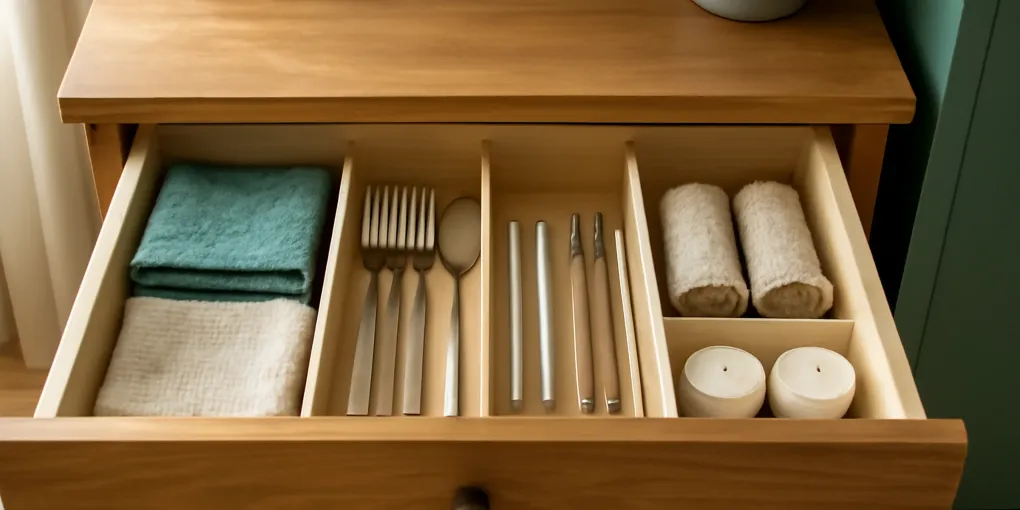
Do Drawer Dividers Actually Help? The Science of Small-Item Clutter
Evidence ExplainerDrawer dividers look like an obvious solution. Buy an insert, sort the small objects, and the junk drawer becomes a tidy grid. Sometimes that works. Other times the drawer looks organized for a week, then slowly fills with cords, receipts, batteries, keys, rubber bands, spare screws, and mystery parts.
Quick picks
Use this as a shortcut to the products mentioned below; verify dimensions and mounting limits against your space before buying.
- adjustable drawer dividers: See current price on Amazon
- bamboo drawer organizer: See current price on Amazon
- junk drawer organizer tray: See current price on Amazon
- modular drawer bins: See current price on Amazon
The difference is not the divider itself. The difference is whether the divider reduces search, creates limits, and matches the real purpose of the drawer.
This evidence explainer looks at when drawer dividers help, when they fail, and how to design a drawer system that stays usable after the first organizing session. Compare current labels, prices, sellers, and return policies before buying.
G6 Composite Score
| Drawer strategy | Research 30% | Evidence Quality 25% | Value 20% | User Signals 15% | Transparency 10% | Composite |
|---|---|---|---|---|---|---|
| Adjustable drawer dividers | 8.5 | 7.5 | 8.5 | 8.5 | 9.0 | 8.3 |
| Small modular trays | 8.0 | 7.5 | 8.0 | 8.0 | 9.0 | 8.0 |
| One open junk drawer | 5.5 | 6.0 | 7.0 | 5.5 | 8.0 | 6.2 |
| Over-segmented tiny compartments | 6.0 | 6.5 | 5.5 | 6.0 | 8.0 | 6.3 |
Drawer dividers help most when they reduce visual search, make capacity obvious, and stop categories from sliding back together during normal daily use.
The Real Problem: Search Cost
A messy drawer is not only unattractive. It increases search cost. When every object overlaps every other object, you have to rummage, move items, and remember whether the thing you want is even in that drawer.
Visual search research has long shown that cluttered displays make target detection harder. A review by Rosenholtz, Li, and Nakano describes how visual clutter affects perception and search efficiency: https://doi.org/10.1167/7.2.17. A kitchen drawer is not a lab display, but the principle carries over: when objects are visually crowded and poorly grouped, finding the target takes more effort.
Drawer dividers can help because they reduce the search field. Instead of looking through the entire drawer for scissors, you check the tool compartment. Instead of dumping a drawer for a battery, you check the battery tray.
Why Dividers Work
Dividers work through three mechanisms:
- Category boundaries.
- Capacity limits.
- Faster reset.
Category boundaries tell you where an item belongs. Capacity limits show when the category is full. Faster reset makes cleanup easier because every item has a short path home.
This is similar to the concept in [[why-label-systems-fail|why label systems fail]]. A divider is a physical label. It only works if the category is meaningful and maintained.
When Dividers Fail
Dividers fail when the drawer has no clear job. If a drawer holds office supplies, takeout menus, sunglasses, cords, batteries, coupons, tape, medicine, and pet supplies, dividers can only make chaos look grid-shaped.
They also fail when compartments are too small. A tiny square for paper clips may look satisfying on day one, but if you rarely use paper clips, it wastes prime space. Meanwhile the category you actually use, such as charging cables, overflows.
Another failure is hidden overflow. If you buy deep trays and stack objects vertically, you may still have to dig. Dividers are most useful when items remain visible from above.
Best Use Cases
Drawer dividers are especially useful for:
- Kitchen tools that are used daily.
- Desk supplies such as pens, clips, sticky notes, and chargers.
- Bathroom grooming items.
- Batteries and small household hardware.
- Craft tools with distinct categories.
- Kids’ art supplies.
- Entryway drawers for keys, wallets, sunglasses, and dog-walk items.
Search options include adjustable drawer dividers (See current price on Amazon), bamboo drawer organizer (See current price on Amazon), junk drawer organizer tray (See current price on Amazon), and modular drawer bins (See current price on Amazon).
Adjustable Dividers vs Trays
Adjustable dividers are best when item sizes vary. They work well for utensils, tools, wraps, and categories that may change over time. Trays are best when the drawer contains many small, stable categories.
| Feature | Adjustable dividers | Modular trays |
|---|---|---|
| Best for | Larger changing categories | Small stable categories |
| Flexibility | High | Medium |
| Cleaning | Easy if removable | Easy if trays lift out |
| Risk | Compartments become too broad | Too many tiny compartments |
| Best drawer | Kitchen, utility, craft | Desk, bathroom, junk drawer |
A hybrid works well: use two or three dividers to create big lanes, then use small trays inside one lane for tiny objects.
The Seven-Category Limit
Most household drawers work best with three to seven categories. More than seven categories usually means the drawer is trying to serve too many purposes.
This is not a strict scientific law. It is a practical design heuristic based on scanability. If you have to read twelve tiny labels to find a rubber band, the drawer is no longer low-friction.
A good kitchen utility drawer might have:
- Tape.
- Scissors.
- Pens and marker.
- Batteries.
- Small tools.
- Measuring tape.
- Spare keys.
If you need more categories, split the drawer by function. Office supplies should live in a desk drawer, not the kitchen utility drawer, unless that is where they are actually used.
How to Set Up a Divider System
Start by emptying the drawer completely. Do not buy dividers first. Sort items into categories and count what is actually worth keeping.
Then ask:
- What is this drawer for?
- Which items are used weekly?
- Which items belong somewhere else?
- Which category needs the largest compartment?
- Which category should have a hard limit?
Measure the drawer interior before buying anything. Include depth, width, height, and any obstruction. Many organizers waste space because they do not match the drawer dimensions.
The One-Layer Rule
A drawer divider works best when items remain in one visible layer. Stacking can be fine for identical items, such as batteries in a battery case, but mixed stacking brings back the search problem.
Use shallow compartments for frequently used objects. Use deeper storage elsewhere for backups. For example, keep two rolls of tape in the drawer and store the extra six rolls in a supply bin.
The one-layer rule also makes resets faster. If the pen slot is full, you can see it immediately and remove extras.
Capacity Limits Matter More Than Labels
A label says what belongs. Capacity says when to stop. A drawer without limits will slowly absorb extras even if each category is labeled.
Use physical limits:
- One tray for batteries.
- One lane for charging cables.
- Five pens, not forty.
- One small cup for rubber bands.
- One compartment for spare keys.
When a category overflows, do not immediately buy another organizer. First remove duplicates, dead items, expired items, and things that belong elsewhere.
Maintenance: The Two-Minute Drawer Reset
Once a week, open the drawer and reset visible drift. Throw away dead pens, move receipts, return tools, and remove duplicates. This should take two minutes if the categories are clear.
Our [[two-minute-rule-clutter-science|two-minute rule guide]] explains why tiny maintenance actions can keep clutter from becoming a bigger project. The drawer reset is a perfect example because small-item clutter compounds quickly.
What the Evidence Can and Cannot Say
There is strong evidence that cluttered visual environments can make search harder and increase cognitive load. There is also good behavior-design logic behind reducing friction and making categories visible.
There is not, however, a clinical trial proving that a specific bamboo drawer divider will improve your life. Treat dividers as tools for reducing search and supporting habits, not magic objects.
FAQ
Do drawer dividers really make drawers more organized?
Yes, when they create clear categories, visible limits, and an easy reset path. They do not help much if the drawer contains too many unrelated items.
Are adjustable dividers better than trays?
Adjustable dividers are better for larger or changing categories. Trays are better for small stable categories. Many drawers benefit from a mix of both.
How many categories should one drawer have?
Three to seven categories is a useful target. If you need more, the drawer may need a narrower purpose or a second location.
A Practical Drawer Audit
Run a drawer audit before buying an organizer. Empty the drawer onto a table and sort the contents into four piles: use weekly, use monthly, backup supply, and unknown. The weekly pile deserves the easiest compartments. The monthly pile can use side or rear compartments. Backup supplies often belong somewhere else. Unknown items should not get prime drawer space until you know what they are for.
Next, count duplicates. Most homes do not need thirty pens in the kitchen drawer, six tape measures in one utility drawer, or twelve charging cables of uncertain origin. Keep a useful number and move extras to a labeled backup box. The divider should organize the active set, not the full inventory.
Finally, test retrieval. Close the drawer, ask another person to find scissors or batteries, and watch where they look first. If they hesitate, the category boundary is not obvious enough. If they find the item quickly but cannot put it back quickly, the compartment may be too tight. A good drawer system supports retrieval and return with the same clarity.
This audit pairs well with the capacity approach in stackable bins vs drawer units. Small storage succeeds when each category has a visible limit and an obvious reset path.
Product Fit Notes
Choose bamboo or wood inserts when the drawer is dry and the look matters, such as a kitchen utensil drawer that guests may see. Choose plastic trays when leaks, cosmetics, craft paint, or battery corrosion are possible because they are easier to wash. Choose spring-loaded dividers when you need broad lanes rather than many tiny slots.
Avoid organizers that leave awkward unused strips along the side of the drawer unless those strips have a job, such as storing a ruler or rolls of tape. Empty gaps become places for receipts and loose parts. Also avoid novelty organizers with fixed compartments that match neither your drawer nor your inventory. The best divider is boring, adjustable, washable, and sized to the categories you actually use.
A final test is replacement behavior. If something breaks, would you buy the same organizer again for the same drawer? If not, the first purchase may have solved the photo of clutter rather than the workflow of the drawer.
Bottom Line
Drawer dividers help when the problem is search and category drift. They fail when the real problem is too much inventory or an undefined drawer purpose.
Before buying dividers, decide the drawer’s job, reduce duplicates, and measure the space. Then choose adjustable dividers, modular trays, or a hybrid system that keeps items visible in one layer. The best drawer is not the most segmented one. It is the one that makes the next use and the next reset obvious.