Joseph Joseph DrawerStore Review: Does the Compact Cutlery Tray Work?
ReviewJoseph Joseph DrawerStore Compact Cutlery Organizer
Top pick for narrow drawersType: Tiered compact cutlery tray
$10-25
Quick picks
| Product | Key Specs |
|---|---|
| See price on Amazon |
|
| See price on Amazon |
|
| See price on Amazon |
|
Product availability, certifications, and retailer details can change; check the current Amazon page before buying.
Bottom line
The Joseph Joseph DrawerStore compact cutlery organizer is a smart product when the problem is specifically a narrow cutlery drawer. It uses a tiered layout to stack forks, spoons, knives, and teaspoons into a much smaller footprint than a conventional flat tray. In the right drawer, that frees up enough side space for a utensil lane, a small wrap organizer, or simply less jamming every time the drawer opens.
It is not the best universal kitchen drawer organizer. The same tiered design that saves width also hides part of each category, requires enough drawer height, and works best when the flatware set is edited. If your drawer is wide but chaotic, a flat expandable tray may be easier. If the drawer contains peelers, clips, thermometers, measuring spoons, and cooking tools, modular bins are usually more adaptable.
Our verdict: DrawerStore earns a 4.3 out of 5 for small kitchens, apartment kitchens, galley kitchens, and any drawer where a standard cutlery tray wastes too much width. It is a compact-space specialist, not a cure-all.
Why Joseph Joseph DrawerStore Compact Cutlery Organizer is the top pick
Best for narrow kitchen drawers, small apartments, edited flatware sets, and households that want to reclaim side space without installing permanent dividers. Not best for shallow drawers, oversized flatware handles, very large place settings, children who need fully visible categories, or drawers that also need to hold bulky cooking utensils.
Fit checks before buying: measure the inside drawer width, depth, and height; count how many forks, knives, spoons, and teaspoons you actually use; and confirm that the organizer leaves enough clearance under the counter frame when the drawer closes.
Shopping option: See current Amazon options for Joseph Joseph DrawerStore compact cutlery organizers.
What DrawerStore is trying to solve
Most cutlery trays are designed as if drawer width is free. They spread five or six long compartments across the full drawer floor, which is fine in a generous kitchen but frustrating in a small one. A narrow apartment drawer can lose almost all usable width to a basic flatware tray, leaving no space for a can opener, chopsticks, kitchen shears, or the few prep tools that genuinely belong nearby.
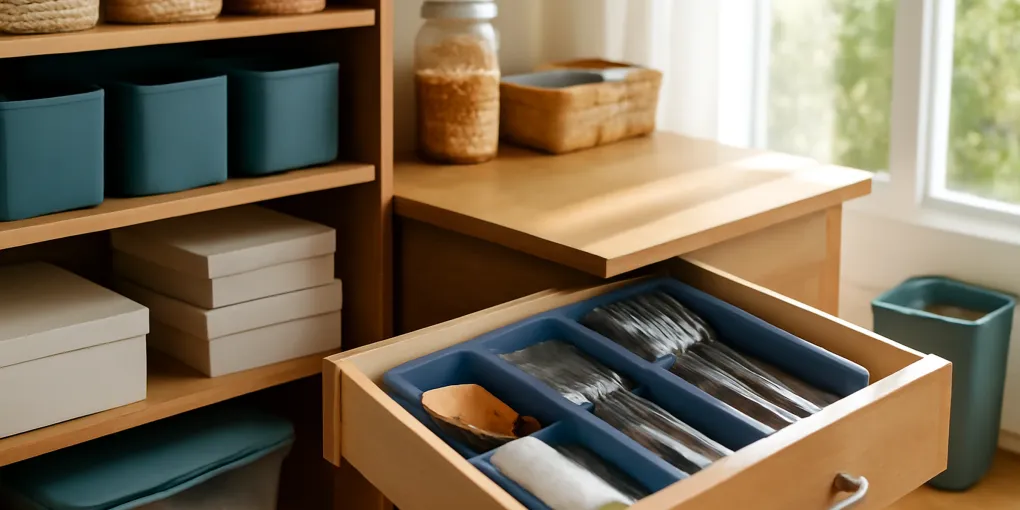
DrawerStore solves that by using vertical layering. Instead of laying every category side by side, it creates angled, labeled tiers. Forks sit in one stacked channel, spoons in another, knives in another, and smaller spoons in a shorter section. The layout compresses the footprint while still giving each category a defined home.
That matters because drawer clutter is often a boundary problem. When forks and spoons share an open tray, they migrate. When cooking tools lie across cutlery, everything catches. A compact tray gives daily flatware a firm boundary and lets the remaining drawer area serve a separate purpose. If you are organizing a deeper drawer instead of a shallow cutlery drawer, pair this review with our guide to the best drawer dividers for deep kitchen drawers.
Design and build
The design is the reason to buy DrawerStore. The angled slots are more space-efficient than a flat tray, and the category labels reduce the learning curve. Once the drawer is loaded, the organizer looks intentionally compact rather than improvised. The plastic body also keeps the price and weight low compared with bamboo, and it should be easy to lift out for occasional cleaning.
The tradeoff is that the design depends on fit. A tiered tray asks the drawer to provide enough vertical clearance above the stacked handles. Many modern drawers have enough height, but older kitchens, shallow top drawers, or drawers with a low face frame can be tight. Flatware shape matters too. Thin, simple handles stack more cleanly than heavy rounded handles, wide decorative handles, or unusually long knives.
The plastic construction is practical rather than premium. It is not trying to look like a custom insert. If you want a warm, built-in look, bamboo wins. If you want maximum width savings for a low price, the plastic tiered format makes sense.
Everyday use
The biggest daily advantage is that the drawer stops feeling full before it is actually full. A conventional tray often turns the drawer into a single-purpose flatware drawer. DrawerStore compresses the flatware zone, so a narrow drawer can still hold a second small category beside it. That can be a genuine improvement in a small kitchen where every drawer has multiple jobs.
It also gives flatware a return path. The labels and channels tell people where things belong. That sounds basic, but visible affordances are what keep organizers working after the first week. A fork has a fork lane. A knife has a knife lane. You do not need a complicated family rule.
Retrieval is good once you learn the pattern. The front of each category is easy to grab, and the angled stack keeps handles presented upward rather than buried flat. For one or two adults, the system can become automatic quickly. For guests, kids, or anyone unfamiliar with the layout, a flat tray is more obvious.
Where it can fail
DrawerStore fails when it is asked to organize too much. If the drawer contains a twelve-place flatware set, steak knives, serving spoons, chopsticks, baby spoons, reusable straws, corn holders, and random packets, the tiered tray will not fix the inventory problem. It may even make overload more annoying because stacked compartments are less forgiving when overfilled.
It also fails in drawers that are too shallow. A flat tray only needs enough height for the tray walls and flatware. DrawerStore needs enough height for the tray plus angled handles plus normal drawer clearance. Measuring only width and depth is not enough.
Cleaning is another modest drawback. A flat tray lets you see crumbs immediately. A tiered organizer can hide crumbs in channels until you lift it out. The fix is simple: empty it and rinse or wipe it occasionally. Households with kids, toast crumbs, and snack utensils may prefer a tray with wider open compartments.
DrawerStore vs alternatives
An expandable bamboo tray is better when the drawer is wide enough and visual clarity matters more than space compression. Bamboo trays show every category at once, feel more substantial, and can look closer to a built-in drawer insert. They are also better when you want to mix flatware with longer serving pieces in one large tray. Shopping option: See current Amazon options for expandable bamboo cutlery trays.
Modular bins are more flexible for mixed kitchen categories. If you need one tray for measuring spoons, another for bag clips, another for peelers, and a long bin for a thermometer, modular pieces make more sense than a dedicated cutlery organizer. Shopping option: See current Amazon options for modular kitchen drawer organizer bins.
Deep drawer peg systems are for a different drawer. They help base drawers that hold bowls, lids, food containers, small pots, or stacks that need vertical boundaries. They are not a substitute for a cutlery tray, and DrawerStore is not a substitute for a peg system. Shopping option: See current Amazon options for deep drawer peg divider systems.
Fit checks that matter
For this DrawerStore review, the useful question is whether the angled tiers make real utensils easier to grab without wasting drawer height or hiding rarely used pieces.
| Dimension | Weight | DrawerStore score | Rationale |
|---|---|---|---|
| Fit and safety | 8.4/10 | The tiered layout addresses a measurable small-drawer constraint: width. | |
| Verifiable details | 7.8/10 | Product claims can be checked against dimensions and materials, but performance depends on the drawer and flatware shape. | |
| Value and capacity | 8.8/10 | The typical price is low compared with expandable bamboo trays, and the recovered space can be meaningful. | |
| Daily friction | 8.2/10 | The design aligns with small-kitchen complaints, though some households prefer flat-tray visibility. | |
| Listing clarity | 8.6/10 | The main limits are clear: height clearance, handle thickness, capacity, and reduced visibility. | |
| Composite | 100% | 8.3/10 | Strong specialist score for narrow cutlery drawers; lower as a general-purpose drawer organizer. |
A score above 8 does not mean every kitchen should buy it. It means the product has a coherent job, a fair price, and predictable limits. DrawerStore is strongest when the drawer is narrow and the flatware set is normal-sized. It drops quickly when the drawer is shallow, the inventory is overloaded, or the household needs a mixed-tool organizer.
Organization protocol
Start by editing the flatware, not by loading the organizer. Remove duplicate takeout utensils, odd unmatched pieces, extra serving items, and anything that is used less than weekly. A compact cutlery tray should hold the daily set, not the entire history of your kitchen.
Next, assign any reclaimed side space before you fill it. Good side-space categories include kitchen shears, a can opener, chopsticks, a small wrap cutter, or one narrow bin for measuring spoons. Bad side-space categories include coupons, batteries, tape, spare hardware, and miscellaneous objects that simply moved from the old junk drawer.
Load the most common pieces in the easiest-to-grab positions. If your household uses teaspoons constantly, do not bury them behind specialty knives. If children unload the dishwasher, show them the labels and test whether they can return each category without help.
After two weeks, open the drawer and look for migration. Are teaspoons appearing in the tablespoon lane? Are knives stacked too high? Is the side space becoming a junk strip? Adjust the system while the failure pattern is small.
FAQ
Is the Joseph Joseph DrawerStore worth it for a small kitchen?
Yes, if drawer width is your main constraint and your flatware set is edited. The compact tiered layout can reclaim side space that a flat tray would consume. It is not worth buying as a workaround for too much flatware or a drawer that is too shallow.
Does the Joseph Joseph DrawerStore fit every cutlery drawer?
No. You need to measure inside width, depth, and height. Height is especially important because the organizer stacks handles at an angle. A drawer can be wide enough but still too shallow for comfortable use.
What is the biggest drawback of a tiered cutlery tray?
Visibility. A flat tray shows every piece at a glance, while a tiered tray hides part of the stack. Most adults adapt quickly, but guests, kids, or anyone who dislikes labels may prefer a conventional tray.
What should I compare before choosing DrawerStore over a bamboo tray?
Compare usable drawer width, drawer height, number of place settings, flatware handle thickness, cleaning access, and whether you need room for serving utensils. DrawerStore is the compact choice; bamboo is usually easier when the drawer has enough width.
Final verdict
The Joseph Joseph DrawerStore compact cutlery organizer works when it is treated as a small-space cutlery specialist. It is clever, affordable, and genuinely space-saving in the right drawer. The tiered layout gives everyday flatware a smaller footprint, which can make a cramped kitchen drawer feel usable again.
The product is less impressive when buyers expect it to behave like a universal drawer system. It will not solve excess inventory, shallow drawer clearance, oversized flatware, or mixed utensil chaos. Measure carefully, edit first, and buy it for the specific problem it solves: too much flatware width in too little drawer.