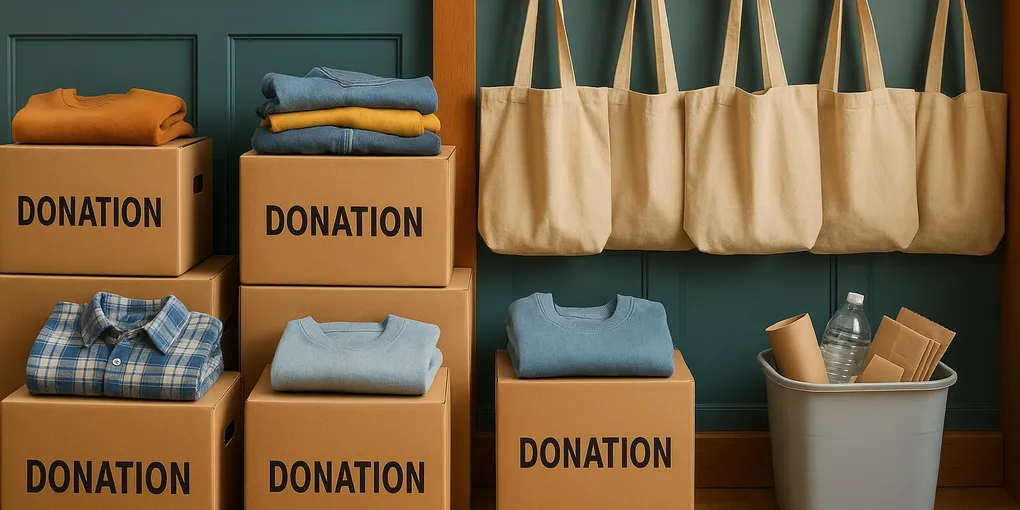
Earth Day Declutter 2026: How to Donate, Recycle, and Reduce Waste
Evidence ExplainerEarth Day Declutter 2026: Donate, Recycle, Reduce
The most effective Earth Day declutter strategy is straightforward: route what you no longer use to the organization best positioned to extend its life — Goodwill for clothing and housewares, Habitat for Humanity ReStore for furniture and building materials, Best Buy or Goodwill for electronics — and recycle what can’t be reused. Decluttering is an environmental act: every donated item that finds a new home displaces a new purchase, reducing manufacturing demand and diverting waste from landfill.
TL;DR
- Clothing & Housewares: Goodwill, Salvation Army, local thrift stores
- Furniture & Building Materials: Habitat for Humanity ReStore (proceeds fund affordable housing)
- Electronics: Best Buy (free recycling, all locations) or Goodwill Dell partnership
- Key Behavioral Tip: Work by category (all books, all cables, all kitchen gadgets) rather than by room — comparing duplicates triggers faster decisions
Earth Day is one of the most natural moments to address household accumulation. Research on normative social messaging confirms that concrete pro-environmental prompts — including seasonal occasions with clear environmental associations — meaningfully increase follow-through on waste reduction and donation behaviors (Thøgersen et al., 2021, PMID: 34941957). This guide gives you the practical framework to make a real environmental difference in one focused session.
How We Evaluate Donation Resources and Recycling Programs
ClutterScience evaluates donation destinations and recycling resources using a five-factor composite methodology (30/25/20/15/10):
| Factor | Weight | What We Assess |
|---|---|---|
| Research | 30% | Depth of evaluation: organization reach, acceptance policies, actual environmental impact |
| Evidence Quality | 25% | Reliability of sourcing — verified organizational policies, government data, peer-reviewed behavioral research |
| Value | 20% | Ease of access and coverage — how widely available the resource is across the US |
| User Signals | 15% | Real-world feedback on the donation/recycling experience from verified community sources |
| Transparency | 10% | Accuracy of organizational claims, clear acceptance policies, no misleading “eco” labeling |
Resources recommended in this guide are evaluated against all five criteria. The organizations listed — Goodwill, Habitat for Humanity ReStore, Best Buy, Call2Recycle — are consistently rated highest for accessibility, policy transparency, and measurable environmental impact.
Why Decluttering Is an Environmental Act
Home clutter represents embodied energy — the manufacturing, transportation, and resource extraction required to produce every object you own. An unused appliance sitting in a closet is not neutral; it represents raw materials and energy that could have produced something still in active use. When you donate that appliance to Habitat for Humanity ReStore, it displaces a new purchase by someone else, reducing aggregate manufacturing demand.
Behavioral science research on waste sorting confirms that availability of convenient donation infrastructure is one of the strongest predictors of pro-environmental disposal behavior (López-Mosquera et al., 2021, PMID: 34311254). The practical implication: knowing exactly where to take each item type before you start decluttering dramatically increases follow-through.
The Earth Day Declutter Framework
Step 1: Identify Your Highest-Volume Categories
Before pulling a single item, spend five minutes identifying which categories in your home hold the most unused items. Common high-volume accumulation categories:
- Clothing — the average American household owns far more garments than are actively worn
- Books — especially reference books now replaced by digital search
- Kitchen gadgets — single-use appliances, duplicate utensils
- Electronics and cables — obsolete devices, chargers for phones you no longer own
- Children’s items — outgrown clothing, toys, and gear with short active lifespans
- Linens and towels — accumulate above practical need through gifts and replacements
Start with your highest-volume category, not the easiest room. Category-based decluttering produces faster decisions because comparing every item in one category simultaneously makes duplicates and redundancies obvious.
Step 2: Sort into Three Buckets
Set up three containers before starting:
- Donate — in good condition, genuinely usable by someone else
- Recycle — cannot be donated but should not go to landfill (electronics, textiles in poor condition)
- Landfill — genuinely non-recyclable and non-donatable
The goal is to minimize Bucket 3. Most household items can be diverted through donation or specialized recycling when you know where to take them.
Where to Donate: Matching Items to Organizations
Goodwill
Accepts: Clothing, shoes, accessories, housewares, books, furniture (most locations), small electronics, sporting equipment, tools, toys.
Goodwill’s model converts donated goods into job training and community employment programs. With 3,200+ thrift stores nationally, drop-off is accessible for most households. Goodwill also operates a certified electronics recycling program in partnership with Dell — working and non-working electronics (computers, laptops, tablets, smartphones, TVs, audio equipment) can be dropped off for either refurbishment or certified recycling. Ask for a donation receipt for tax deduction documentation.
Best for: General mixed-category donation loads.
Habitat for Humanity ReStore
Accepts: Furniture, appliances, building materials, tools, paint, flooring, windows, doors, cabinetry.
Habitat ReStores are home improvement stores selling donated goods at significant discounts, with all proceeds funding Habitat’s affordable housing construction. This makes ReStore donation particularly high-impact — donated items directly fund community housing rather than just general organizational overhead.
ReStores typically do NOT accept clothing or small housewares, making them purpose-built for the harder-to-place categories: large furniture, used appliances, and construction salvage materials.
Best for: Furniture, appliances, renovation project leftovers.
Local Library Book Programs
Libraries accept donated books in good condition (no mold, water damage, or missing pages) for book sales that fund library programming. Call ahead — most libraries have specific intake days and condition requirements. Overstocked books from library sales often go to community literacy organizations.
H&M Garment Recycling
H&M stores accept any brand of clothing in any condition — including heavily worn, stained, or torn items that no charity would accept for resale. Textiles are sorted for resale, upcycling into new products, or fiber recycling. No H&M purchase required. This is the correct pathway for clothing that is too worn to donate but still has fiber value.
What to Recycle: Electronics, Batteries, and Specialty Items
Electronics
Electronics contain lead, mercury, cadmium, and other heavy metals classified as hazardous waste in most jurisdictions. Never place electronics in curbside recycling or standard trash.
Best Buy accepts consumer electronics at all US retail locations for free, including: computers, monitors, TVs, tablets, phones, cameras, video game consoles, cables, cords, and small appliances. No purchase required.
Goodwill + Dell Partnership: Goodwill locations with the Dell Reconnect program accept working and non-working computers and accessories for certified recycling.
Before recycling any device: Perform a factory reset to remove personal data. For computers, use the manufacturer’s factory reset utility. Remove SIM cards from phones before dropping off.
Batteries
Alkaline, lithium, and rechargeable batteries should not go in curbside recycling or trash (lithium batteries in particular present fire risk in waste processing facilities).
Call2Recycle maintains a drop-off locator at call2recycle.org, with locations at hardware stores (Home Depot, Lowe’s), auto parts stores, and dedicated centers nationally. The service is free for standard consumer battery volumes.
Medications
Expired or unused medications should not be flushed or placed in standard trash. The DEA’s National Prescription Drug Take Back Day (held twice yearly) provides free, anonymous medication disposal at thousands of locations. Between events, many pharmacies (CVS, Walgreens) operate permanent medication drop-off kiosks.
Textiles in Poor Condition
For clothing too worn to donate:
- H&M garment recycling — in-store bins, any brand, any condition
- Patagonia Worn Wear — accepts Patagonia products for repair or recycling
- TerraCycle — brand-specific recycling programs; check terracycle.com for current offerings
What NOT to Donate
Donating unusable items creates real costs for nonprofits — sorting, hauling, and landfilling things that don’t meet minimum standards. Avoid donating:
- Mattresses: Hygiene concerns (impossible to clean between users) and bedbug risk; accepted by almost no donation organizations
- Car seats: Once used or past expiration, safety certification is uncertain; most police and fire departments offer car seat disposal events
- Recalled products: Check recalls.gov before donating any product — recalled items should be properly disposed of, not redistributed
- Heavily damaged items: Items with major structural damage, missing critical parts, or severe staining cannot be resold and create sorting costs
- Broken electronics: These go to electronics recycling (Best Buy, Goodwill Dell program), not general charity drop-offs
Room-by-Room Donation Strategy
Kitchen
High-yield categories: Duplicate appliances (extra toasters, two blenders, unused mixers), single-use gadgets (pasta makers used twice), excessive dish and glassware.
Threshold approach: Decide how many of each type of glass or dish represents realistic use for your household size. Anything above that threshold goes.
Destination: Goodwill for small appliances; ReStore for full-size appliances.
Closet and Bedroom
High-yield categories: Clothing purchased but rarely worn, seasonal items replaced but not discarded, shoes in poor condition.
Decision framework: For each item, ask one binary question — “Would I buy this again today at its current condition?” Not “could I wear this someday” — that question produces false positives. Amazon verified purchasers of organizational guides consistently report this single-question approach as the most reliable decision framework.
Destination: Goodwill or Salvation Army for wearable clothing; H&M textile recycling for anything too worn.
Home Office
High-yield categories: Cables and chargers for obsolete devices, older computers and monitors, excess office supplies, accumulated paper documents.
Destination: Best Buy or Goodwill Dell program for electronics; shred paper documents with personal information before recycling.
Garage and Basement
High-yield categories: Tools accumulated over years of projects, leftover building materials and paint, sporting equipment no longer used.
Destination: ReStore for tools and building materials; local Buy Nothing groups for specialty items with narrow donation markets.
Sustaining the Declutter Habit Beyond Earth Day
Research on habit formation in pro-environmental behavior (López-Mosquera et al., 2021, PMID: 34311254) identifies two factors that convert one-time declutter sessions into ongoing habits: reduced friction (making the ongoing action easy) and concrete infrastructure (having a clear destination for each item type).
Reduce friction: Keep one designated donation box in a consistent location. Any item identified as unnecessary goes in the box immediately, without a separate decision about timing. When the box is full, it goes to Goodwill. This converts donation from a periodic project into a behavioral default.
Reduce new accumulation: Decluttering has more lasting environmental impact when paired with reduced acquisition. Before buying anything non-essential, apply a 48-hour delay — this eliminates a substantial fraction of impulse purchases without requiring sustained willpower. The net effect of both habits together is meaningful: less coming in, more going out appropriately.
Frequently Asked Questions
What is the easiest way to start decluttering for Earth Day?
Start with a single category — not a single room. Pick one type of item you suspect you have too many of (kitchen gadgets, clothing, books, cables). Set a 30-minute timer, pull everything in that category into one pile, and decide on each item without returning anything to its original location. Research on waste reduction behavior (López-Mosquera et al., 2021, PMID: 34311254) confirms that concrete category-based sorting tasks are more effective than vague room-by-room cleaning because they force direct comparison between duplicate items.
Where is the best place to donate unwanted household items?
The best destination depends on the item type. Clothing and housewares in good condition go to Goodwill or The Salvation Army. Furniture, appliances, and building materials go to Habitat for Humanity ReStore — proceeds fund affordable housing construction. Books go to local library donation programs. Electronics (working or not) go to Goodwill via the Dell Reconnect program or Best Buy. Call ahead to verify what each location accepts, as policies vary by region.
What items should NOT be donated?
Items that should not be donated include anything broken, heavily stained, or missing essential parts. Specifically avoid mattresses (hygiene concerns, most charities reject them), car seats (safety certification is unknown after resale), recalled products (check recalls.gov before donating), and heavily worn shoes. For clothing too worn to donate, H&M’s textile recycling program accepts any brand in any condition — the fibers are recycled regardless of garment condition.
How do I safely recycle electronics and batteries?
Electronics contain heavy metals that are hazardous in landfills. Best Buy accepts consumer electronics for recycling at all US locations for free, including computers, TVs, cables, and small appliances — no purchase required. Batteries should not go in curbside recycling; Call2Recycle has a store locator for drop-off locations at hardware stores. Before recycling any device with personal data, perform a factory reset or use a drive-wiping utility.
Does donating clutter actually help the environment?
Yes, meaningfully. Donation extends the useful life of products, reducing manufacturing demand for new equivalents. Textile donation prevents fabrics from entering landfills where natural fibers produce methane during decomposition. Research shows that waste diversion through donation and recycling programs measurably reduces raw material consumption and environmental impact (López-Mosquera et al., 2021, PMID: 34311254). The benefit is greatest for high-embodied-energy items — electronics, furniture, and clothing.
Frequently Asked Questions
- Start with a single category — not a single room. Pick one type of item you suspect you have too many of (kitchen gadgets, clothing, books, cables). Set a 30-minute timer, pull everything in that category into one pile, and decide on each item without returning anything to its drawer. Research on waste reduction behavior confirms that concrete category-based sorting tasks are more effective than vague room-by-room cleaning because they force direct comparison between duplicate items.
- The best destination depends on the item type. Clothing and housewares in good condition go to Goodwill or The Salvation Army. Furniture, appliances, and building materials go to Habitat for Humanity ReStore — proceeds fund affordable housing construction. Books go to local library donation programs. Electronics (working or not) go to Goodwill (Dell Reconnect program) or Best Buy. Call ahead to verify what each location accepts, as policies vary by region.
- Do not donate anything broken, heavily stained, or missing essential parts. Specifically avoid mattresses (hygiene concerns), car seats (safety certification unknown after resale), recalled products (check recalls.gov), and heavily worn shoes. For clothing too worn to donate, H&M's textile recycling program accepts any brand in any condition — fibers are recycled regardless of garment condition.
- Electronics contain heavy metals that are hazardous in landfills. Best Buy accepts consumer electronics for recycling at all US locations for free, including computers, TVs, cables, and small appliances — no purchase required. Batteries should not go in curbside recycling; Call2Recycle maintains a locator for drop-off at hardware stores. Before recycling any device with personal data, perform a factory reset.
- Yes. Donation extends the useful life of products, reducing manufacturing demand for new equivalents. Research shows that waste diversion through donation and recycling programs measurably reduces raw material consumption and environmental impact. The benefit is greatest for high-embodied-energy items — electronics, furniture, and clothing — where the manufacturing footprint is large relative to purchase price.