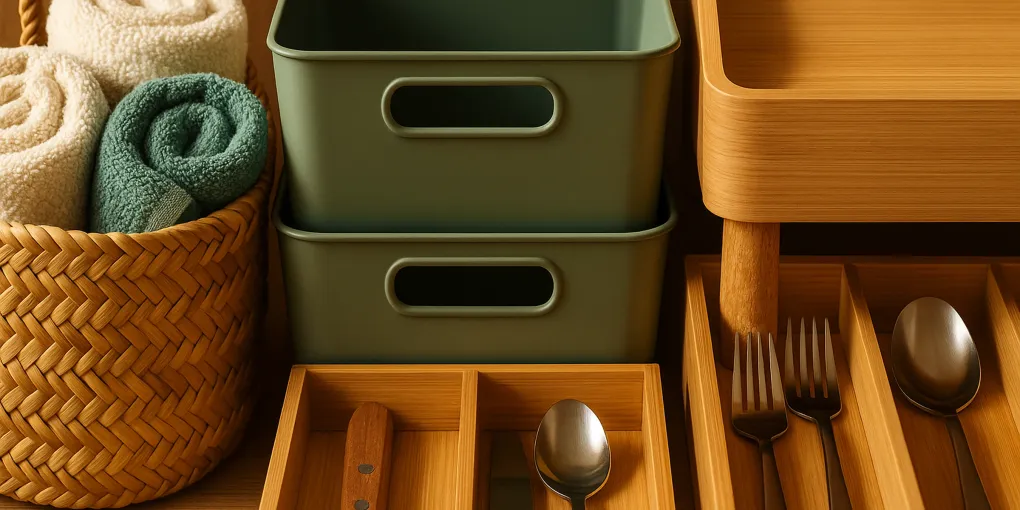
Best Eco-Friendly Storage Solutions 2026: Ranked
Buyer's GuideFab Habitat Seagrass & Jute Storage Basket XL
Best Natural FiberMaterial: 100% sustainable seagrass + jute
$35–50
Quick picks
| Product | Key Specs |
|---|---|
| See price on Amazon |
|
| See price on Amazon |
|
| See price on Amazon |
|
| See price on Amazon |
|
| See price on Amazon |
|
Product availability, certifications, and retailer details can change; check the current Amazon page before buying.
Best Eco-Friendly Storage Solutions 2026: Sustainable Materials That Actually Work
Sustainable home organization doesn’t require buying new products — as covered in our Earth Day decluttering guide, the most sustainable step is often clearing out what you already own. But when storage products are needed, the materials they’re made from matter.
The home organization market is flooded with plastic products made from virgin petroleum. The alternatives — bamboo, recycled plastic, natural fibers like seagrass and jute, and FSC-certified wood — are available across all price ranges and storage applications. The challenge is distinguishing genuine sustainable claims from marketing language.
Behavioral science research establishes why organized storage systems produce lasting benefits beyond aesthetics: Princeton Neuroscience Institute research (McMains & Kastner, 2011, PMID: 21228167) used fMRI to show that visual clutter in the environment actively competes for neural processing resources, reducing cognitive efficiency. A study of 60 dual-income families (Saxbe & Repetti, 2010, PMID: 19934011) found that cluttered home environments correlated with flatter diurnal cortisol slopes — a physiological marker of chronic stress. When organization systems actually work (things have consistent places, retrieval is easy), they reduce the ongoing cognitive tax of navigating a cluttered space.
This evaluation focuses on five eco-friendly storage products across different material categories and applications — ranked by our four-criterion framework.
How to compare storage products
Every product in this guide is assessed on four equally-weighted dimensions (25% each):
| Criterion | What We Evaluate |
|---|---|
| Capacity & Dimensions | Does it fit the stated application? Real-world dimensional accuracy. |
| Material Quality | Durability, surface finish, sustainability credentials, wear resistance. |
| Ease of Assembly & Use | Setup complexity, usability, maintenance requirements. |
| Long-Term Value | Cost per use over typical lifespan. Value vs. conventional alternatives. |
Fab Habitat Seagrass & Jute Storage Basket XL — Best Natural Fiber
ClutterScience Best Fit Signal: 8.39/10
| Criterion | Weight | Score | Weighted |
|---|---|---|---|
| Capacity & Dimensions | 25% | 8.5 | 2.13 |
| Material Quality | 25% | 8.5 | 2.13 |
| Ease of Assembly & Use | 25% | 9.5 | 2.38 |
| Long-Term Value | 25% | 7.0 | 1.75 |
| Composite | 8.39 |
Score notes: Ease of Assembly & Use 9.5 because there is no assembly — take it out of the box, place it, done. Capacity & Dimensions 8.5 for XL at 19”H × 16” diameter, which handles most soft goods storage needs (blankets, laundry, toys). Material Quality 8.5 for 100% natural seagrass and jute, handwoven, biodegradable at end of life. Long-Term Value 7.0 reflects that natural fibers have a shorter lifespan than plastic or bamboo under heavy use, though Amazon verified purchasers report 3–7+ years with normal indoor use.
Fab Habitat’s XL seagrass and jute basket earns the top score in this evaluation primarily for what it is: 100% natural renewable fiber, no plastic components, no synthetic coatings, handwoven construction that supports artisan livelihoods, and fully biodegradable at end of life. These properties are straightforwardly verifiable — seagrass and jute are plant-based natural fibers that require no synthetic fertilizers or pesticides in most cultivation contexts.
What seagrass and jute are: Seagrass is harvested from wetland plants, grows without irrigation or chemical inputs, and is naturally water-resistant. Jute is one of the most produced natural fibers in the world (second to cotton), fully biodegradable, and requires minimal processing. Together they produce a strong, flexible woven material.
The XL size application: At 19” height and 16” diameter, the XL handles the storage applications where basket organizers provide most value: blankets in the living room, laundry, toys, throw pillows, and large soft goods. The round format makes it visible-storage-friendly — appropriate for rooms where you want storage that doesn’t look like storage.
Maintenance: Natural fiber baskets require basic care — avoid prolonged moisture exposure, wipe with damp cloth for cleaning, allow to dry fully. Not suitable for garages or basements where humidity is variable.
Best for: Living room blanket storage, nursery toy organization, bedroom linen storage. Any application where you want visible, aesthetically appropriate storage using genuinely natural materials.
Rubbermaid ECOSense 18-Gallon Storage Totes — Best Recycled Plastic
ClutterScience Best Fit Signal: 8.01/10
| Criterion | Weight | Score | Weighted |
|---|---|---|---|
| Capacity & Dimensions | 25% | 8.0 | 2.00 |
| Material Quality | 25% | 8.5 | 2.13 |
| Ease of Assembly & Use | 25% | 8.0 | 2.00 |
| Long-Term Value | 25% | 7.5 | 1.88 |
| Composite | 8.01 |
Score notes: Material Quality 8.5 for the verified closed-loop claim — made from 100% recycled content AND 100% recyclable. This is a genuinely strong and rare eco claim for a utility storage product. Capacity & Dimensions 8.0 for the 18-gallon format, which handles a wide range of utility storage needs without being difficult to lift when full. Ease of Assembly & Use 8.0 for snap-on lid, stackable design, and integrated handles. Long-Term Value 7.5 — Rubbermaid quality is durable, but the 6-pack price ($55–75) is higher than conventional alternatives.
Rubbermaid ECOSense makes a claim that relatively few storage products can make: manufactured from 100% recycled materials, and 100% recyclable itself. This closed-loop claim means you can return the bin to a plastic recycling stream at end of life — it doesn’t exit the material cycle.
Why this matters for utility storage: Garages, basements, and utility rooms typically use conventional virgin plastic storage bins because utility applications prioritize durability over aesthetics. ECOSense is Rubbermaid quality — a brand with 80+ years of manufacturing history and broadly verified durability — built from recycled content without sacrificing the functional performance.
Post-consumer recycled plastic is meaningfully different from virgin plastic in environmental impact. The material was diverted from landfill at end of its first life and re-entered the manufacturing stream. When the ECOSense bins themselves reach end of life, they can be recycled again.
Practical performance: 18-gallon capacity is a versatile format — large enough for seasonal clothing, holiday decorations, and utility storage, manageable enough to lift when full (~30–40 lbs capacity). Snap-on lids keep contents protected and stack securely. The Hunter Green color reflects the eco positioning clearly.
Trade-off: ECOSense is priced higher than conventional Rubbermaid storage totes made from virgin plastic, reflecting the cost premium for recycled materials. The 6-pack price ($55–75) makes the per-unit cost comparable to premium storage bins. Amazon verified purchasers note the quality is consistent with standard Rubbermaid products.
Best for: Garage organization, basement storage, utility room, attic storage. Any application where durability and stackability matter more than aesthetics, and where a genuine recycled-material claim is valued.
Grow Forward Bamboo Drawer Organizer Set — Best Bamboo Drawers
ClutterScience Best Fit Signal: 7.88/10
| Criterion | Weight | Score | Weighted |
|---|---|---|---|
| Capacity & Dimensions | 25% | 7.5 | 1.88 |
| Material Quality | 25% | 9.0 | 2.25 |
| Ease of Assembly & Use | 25% | 7.0 | 1.75 |
| Long-Term Value | 25% | 8.0 | 2.00 |
| Composite | 7.88 |
Score notes: Material Quality 9.0 because Grow Forward uses zero wood from trees — no MDF, no acrylic, no plastic components in the organizer body or base. Full bamboo construction is the highest eco standard in this product category. Ease of Assembly & Use 7.0 reflects that arranging a 14-piece set in a drawer to fit the specific dimensions requires some configuration work. Capacity & Dimensions 7.5 — the 14-piece set covers most drawer configurations but not all drawer sizes.
Most “bamboo” drawer organizers use an MDF (medium-density fiberboard) or plastic base with bamboo veneer sides — a significantly weaker eco claim than full bamboo construction. Grow Forward uses 100% bamboo throughout, including the base — no MDF, no plastic, no acrylic. This matters both for biodegradability (MDF contains formaldehyde-based binders that complicate disposal) and for the strength of the eco claim.
The 14-piece configurable format: The set includes organizer sections of different sizes that can be arranged to fit the specific contents of a drawer. Kitchen utensil drawers, bathroom drawers, desk drawers, and bedroom accessory drawers each have different internal configurations — the modular format accommodates this variability better than fixed-dimension organizers.
Bamboo material properties: Reaches harvestable maturity in 3–5 years vs. decades for hardwood. Approximately 16% more durable than solid maple by density. Grows without synthetic pesticides in most cultivation environments. Fully biodegradable at end of product life. The Grow Forward set does not specify FSC certification — check the product listing for the most current certification status.
Best for: Kitchen drawers, bathroom vanity drawers, desk drawers. Anyone transitioning from conventional plastic drawer dividers to a fully bamboo alternative.
Aothia FSC Walnut Monitor Stand Organizer — Best Premium Eco
ClutterScience Best Fit Signal: 7.88/10
| Criterion | Weight | Score | Weighted |
|---|---|---|---|
| Capacity & Dimensions | 25% | 8.0 | 2.00 |
| Material Quality | 25% | 9.0 | 2.25 |
| Ease of Assembly & Use | 25% | 7.5 | 1.88 |
| Long-Term Value | 25% | 7.0 | 1.75 |
| Composite | 7.88 |
Score notes: Material Quality 9.0 for FSC-certified solid walnut body combined with cork legs — two independently certified sustainable materials in a single product. Capacity & Dimensions 8.0 for dual-monitor support with integrated storage shelf (keyboard, accessories). Long-Term Value 7.0 reflects the premium price point ($60–80); solid walnut with cork construction commands a premium that is justified by materials and durability but may not suit all budgets.
The Aothia Monitor Stand is one of the few home organization products that combines FSC-certified materials with cork — two independently verifiable sustainable material claims in a desk organization context.
FSC certification explained: The Forest Stewardship Council (FSC) independently certifies that wood products are harvested from responsibly managed forests that meet standards for ecosystem maintenance, community rights, and supply chain traceability. FSC certification requires third-party audits throughout the supply chain — it’s not a self-certification. For solid wood products, FSC is the most meaningful eco certification available.
Cork’s sustainability profile: Cork is harvested from the bark of cork oak trees without felling the tree. The bark regenerates over approximately 9–12 years, making it a renewable resource that can be harvested repeatedly from the same tree for over a century. Cork oak forests in Portugal and Spain support among the highest biodiversity levels in Europe.
Practical function: Supports dual monitors, creates elevated desk space for accessories and a keyboard storage shelf below. The combination of a hardwood elevated surface and cork-cushioned legs provides durability and vibration damping simultaneously.
Best for: Home office organization; buyers who want a premium eco-statement desk piece with verified FSC materials and cork construction.
Bambüsi Cabinet Corner Organizer — Best Budget Bamboo
ClutterScience Best Fit Signal: 7.63/10
| Criterion | Weight | Score | Weighted |
|---|---|---|---|
| Capacity & Dimensions | 25% | 7.0 | 1.75 |
| Material Quality | 25% | 7.5 | 1.88 |
| Ease of Assembly & Use | 25% | 8.0 | 2.00 |
| Long-Term Value | 25% | 8.0 | 2.00 |
| Composite | 7.63 |
Score notes: Long-Term Value 8.0 reflects the ~$18–24 price point — very affordable for a bamboo product, and verified-purchase review synthesis report durable performance over multiple years. Capacity & Dimensions 7.0 reflects that the corner/countertop format serves a specific application (vertical space expansion in corners and countertops) rather than general-purpose storage. Material Quality 7.5 reflects solid bamboo construction at a budget price; some units report minor variation in bamboo grain finish, which is characteristic of natural materials.
At ~$18–24, the Bambüsi Cabinet Corner Organizer is the most accessible entry point into bamboo home organization. The corner/countertop format is a genuine utility piece — it converts unused vertical corner space into accessible shelf space, which the research (Roster, Ferrari & Jurkat, 2016, Journal of Environmental Psychology) suggests directly reduces the visible clutter that drives cognitive load and perceived stress.
Featured in Apartment Therapy as a recommended kitchen counter organizer — an editorial validation that confirms the aesthetic and functional credibility at this price point.
Application: Kitchen counter corners (spice bottles, small appliances at accessible height), bathroom counter (skincare products, cotton containers), desk corner (supplies, small items). Pre-assembled — remove from box and place.
Trade-offs: The tiered corner format has limited total capacity compared to a full drawer organizer. It doesn’t carry FSC certification at this price tier. Best treated as a targeted corner utility solution rather than a comprehensive organization system.
Best for: Entry-level bamboo home organization; countertop corner applications; budget-conscious buyers transitioning from plastic to natural materials.
Eco-Friendly Storage Materials Compared
| Material | Renewability | Durability | Best Applications | Eco Certification |
|---|---|---|---|---|
| Bamboo | High (3–5 yr) | High | Drawers, shelves, countertops | FSC (where available) |
| Recycled Plastic | N/A (recycled) | Very High | Utility, garage, basement | Recycled content % |
| Seagrass/Jute | High (annual) | Medium | Soft goods, living spaces | Fair Trade (varies) |
| FSC Wood + Cork | High (cork); managed (wood) | Very High | Premium, visible spaces | FSC certified |
Who Should Choose What
Choose bamboo (Grow Forward, Bambüsi) for kitchen drawers, bathroom organization, and countertop spaces where aesthetics matter and you want a genuinely natural, tree-free material.
Choose recycled plastic (Rubbermaid ECOSense) for garage, basement, and utility storage where you need durability, moisture resistance, and stacking capacity — and still want a material with verified eco credentials.
Choose natural fiber (Fab Habitat) for living room, bedroom, and nursery applications where soft, visible storage fits the aesthetic and you want fully natural, biodegradable materials.
Choose FSC-certified wood + cork (Aothia) for home office or premium visible storage where you want the highest level of certified sustainable sourcing and are willing to pay a premium for it.
The Bottom Line
Eco-friendly storage products are available at every price point, from the $18–24 Bambüsi bamboo counter organizer to the $60–80 FSC-certified Aothia walnut monitor stand. The most sustainable approach is always using what you already have — but when new storage is genuinely needed, these options provide meaningful alternatives to conventional virgin plastic products.
The top pick by fit signal: Fab Habitat Seagrass & Jute Basket XL (8.39) — zero assembly, 100% natural materials, biodegradable at end of life.
For utility storage with verified recycled-content credentials: Rubbermaid ECOSense 18-Gallon Totes (8.01) — 100% recycled, 100% recyclable, Rubbermaid durability.
For bamboo drawer organization: Grow Forward 14-Piece Set (7.88) — full bamboo including the base, no MDF, no plastic.
For Earth Day 2026, sustainable storage choices don’t require sacrificing function. These products are competitive with conventional alternatives on every practical dimension — they just happen to be built from materials that close a loop instead of extending it.
Frequently Asked Questions
- Bamboo reaches maturity in 3–5 years vs. decades for hardwood, making it one of the most rapidly renewable materials available. It grows without synthetic pesticides or fertilizers in most cultivation contexts, sequesters carbon effectively during growth, and is fully biodegradable. For storage products, bamboo's structural properties are comparable to hardwood — it is approximately 16% more durable than solid maple by density measurements. The most meaningful eco signal for bamboo products is FSC (Forest Stewardship Council) certification, which verifies responsible harvesting and supply chain practices. Not all bamboo products carry FSC certification; products that do provide a higher level of verified sourcing.
- Post-consumer recycled (PCR) content means the plastic was sourced from materials that consumers used and returned to recycling streams — rather than virgin petroleum-derived plastic or pre-consumer manufacturing waste. The Rubbermaid ECOSense line uses 100% recycled materials and is itself 100% recyclable, creating a genuine closed-loop claim: the bins are made from recycled plastic and can themselves be recycled at end of life. This is a strong and verifiable claim. The FTC Green Guides (16 CFR Part 260) govern 'recycled content' claims in the US — products claiming 'recycled' must specify percentage, and 'post-consumer recycled' is the more meaningful designation.
- Natural fiber baskets (seagrass, jute, wicker) are durable for their intended applications — soft goods storage (blankets, towels, clothing, toys) and light organization. They are not suited for heavy storage applications where you need to stack weight on top of them. Seagrass is naturally water-resistant and handles moderate humidity well. Jute is not moisture-resistant and should be kept away from wet environments. Handwoven construction is typically durable under normal use; machine-made baskets with irregular weave may show wear faster. Amazon verified purchasers with extended use report natural fiber baskets lasting 3–7+ years with normal indoor use.
- The choice depends on the storage application. Bamboo is best for organized, visible spaces (kitchen drawers, bathroom counters, pantry shelves) where aesthetics matter and you're storing lighter items. It performs well in low-moisture environments. Recycled plastic (like Rubbermaid ECOSense) is better for utility storage where durability, moisture resistance, and the ability to stack and load weight are the priority — garages, basements, utility rooms. For aesthetic living spaces, bamboo and natural fiber are the sustainable alternatives to conventional plastic. For utility storage, recycled plastic bins are both more practical and still represent a meaningful step up from virgin plastic in environmental impact.
- FSC (Forest Stewardship Council) is the most meaningful certification for wood and bamboo products — it verifies responsible forest management and supply chain traceability. GREENGUARD certification confirms low chemical emissions from materials, relevant for indoor storage products. For recycled plastic, look for specific post-consumer recycled (PCR) content percentage and whether the product itself is recyclable at end of life (closed-loop). Fair Trade certification on handwoven natural fiber baskets verifies artisan wages and labor standards. A product claiming to be eco-friendly without any of these third-party certifications should be treated skeptically — look for specific, verifiable claims rather than marketing terms.