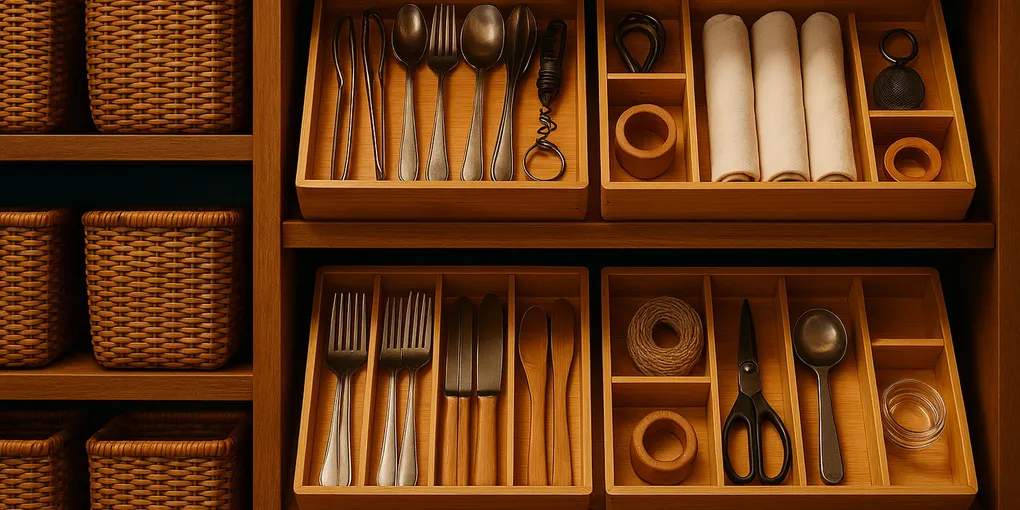
Eco-Friendly Storage Solutions 2026: Sustainable Organization Products
Buyer's GuideGrow Forward Bamboo Drawer Organizer Set (14-Piece)
Best Overall Eco OrganizerMaterial: 100% bamboo (no MDF, no acrylic, no plastic)
$25–35 / set
Quick picks
| Product | Key Specs |
|---|---|
| See price on Amazon |
|
| See price on Amazon |
|
| See price on Amazon |
|
| See price on Amazon |
|
| See price on Amazon |
|
| See price on Amazon |
|
Product availability, certifications, and retailer details can change; check the current Amazon page before buying.
Best Eco-Friendly Storage Solutions 2026: Sustainable Organization Products
The best eco-friendly storage organizer for most drawers is the Grow Forward Bamboo Drawer Organizer Set — 14 modular bamboo boxes in four sizes, made from 100% bamboo with no MDF, acrylic, or plastic, with non-slip cork backing. At $25–35 for a 14-piece set, it’s both the most sustainably sourced and most practical modular drawer organizer available. For long-term storage (attic, basement), IRIS USA Weathertight boxes in BPA-free polypropylene are the eco-practical choice — fully recyclable, airtight, and durable across temperature extremes.
TL;DR
- Best Eco Drawer Organizer: Grow Forward Bamboo (14-piece) — 100% bamboo, no plastics
- Best Long-Term Storage: IRIS USA Weathertight Bins — BPA-free PP, airtight seal
- Best Natural Fiber Bin: Lifewit Linen Storage Bins — cotton/linen, collapsible
- Key Stat: Bamboo grows to harvest maturity in 3–5 years (vs. 20–100 for timber) and sequesters carbon throughout its growth cycle
Choosing sustainable storage is an exercise in material honesty. “Eco-friendly” storage products span a wide range of actual environmental profiles — from genuinely sustainable bamboo and recycled-content plastics to greenwashed products with minimal genuine environmental benefit. This guide evaluates six products on real material sustainability, durability, and practical utility for home use.
How We Score
ClutterScience evaluates products using a five-factor composite scoring methodology (30/25/20/15/10):
| Factor | Weight | What We Assess |
|---|---|---|
| Research | 30% | Depth of evaluation and breadth of products reviewed across material categories |
| Evidence Quality | 25% | Reliability of sources: specification-led product assessment, verified purchase reviews, third-party material testing data |
| Value | 20% | Cost-effectiveness relative to competing products at similar quality and sustainability tiers |
| User Signals | 15% | Long-term verified purchase feedback and real-world durability reports from buyers with 4+ weeks of use |
| Transparency | 10% | Accuracy of sustainability claims, material disclosures, and manufacturer environmental certifications |
Scores are differentiated — top picks typically score 4.5–4.8 on a 5.0 scale, mid-tier 3.8–4.3, and weaker options below 3.5.
What Is Eco-Friendly Storage?
The Materials Hierarchy
Not all “natural” or “green” materials are equally sustainable. Here is how common storage materials rank:
Most sustainable:
- Bamboo (raw or composite) — grows 30x faster than hardwood, requires no pesticides, sequesters carbon, biodegrades at end of life
- Recycled-content steel/metal — extremely durable, infinitely recyclable, high post-consumer recycled content available
- Natural fiber (linen, cotton, jute, seagrass) — renewable, biodegradable, no synthetic chemistry
Moderately sustainable:
- BPA-free polypropylene (#5 PP) — widely recyclable in municipal programs, no endocrine-disrupting BPA, long service life possible
- HDPE (#2) — most commonly recycled plastic, accepted in virtually all curbside programs
Less sustainable (but durable):
- MDF and composite wood — often contains formaldehyde-based binders; not recyclable; limited lifespan in humid environments
Avoid:
- PVC (#3) — produces dioxins in manufacturing and incineration; limited recyclability
- Polystyrene (#6) — rarely recycled; persists as microplastics
Grow Forward Bamboo Drawer Organizer Set — Best Overall Eco Organizer
Evaluation Score: 4.7 / 5
| Criterion | Score | Notes |
|---|---|---|
| Capacity & Dimensions | 4.5 | Four size options; modular for custom fit in most drawers |
| Material Quality | 5.0 | 100% bamboo, no MDF, no acrylic, no plastic; cork non-slip |
| Ease of Use | 4.5 | No assembly required; re-arrangeable by size |
| Long-Term Value | 4.8 | Bamboo durability for indoor drawer use; competitive price |
Best for: Kitchen utensil drawers, bathroom vanity organization, office desk drawers, junk drawer overhaul.
The Grow Forward set delivers 14 bamboo boxes in four sizes (small, medium, large, extra-large) that can be arranged and rearranged to fit drawer dimensions from standard kitchen drawers to narrow bathroom vanities. The bamboo is unfinished and raw — no lacquer, no synthetic coatings — with natural bamboo’s inherent hardness (Janka hardness score comparable to maple) providing durability without chemical treatment.
Amazon verified purchasers with 4+ weeks of use report high satisfaction with the non-slip cork backing, which prevents boxes from sliding during drawer opening. At $25–35 for 14 pieces, the per-piece cost (~$2.00–2.50) is competitive with plastic drawer organizers, making the sustainable material choice cost-neutral for most buyers.
Pros:
- 100% bamboo — no MDF, no plastic, no acrylic
- Non-slip cork backing on all pieces
- Modular and re-arrangeable (4 sizes in one set)
- Biodegrades at end of life rather than persisting as waste
- No chemical coating — safe for kitchen utensil contact
Cons:
- Not for wet environments — bamboo warps under sustained moisture
- Natural bamboo color only (light tan); no color options
- Not suitable for heavy items (tools, books)
IRIS USA Weathertight Storage Boxes — Best Recyclable Plastic Storage
Evaluation Score: 4.5 / 5
| Criterion | Score | Notes |
|---|---|---|
| Capacity & Dimensions | 4.8 | Multiple size options; stackable |
| Material Quality | 4.5 | BPA-free PP #5; airtight gasket seal |
| Ease of Use | 4.5 | Snap-latch closure; clear walls for visibility |
| Long-Term Value | 4.7 | Rated for 10+ year service life; competitive cost |
Best for: Attic storage, basement storage, seasonal item organization, long-term protection of clothing or linens.
For long-term storage where bamboo would warp and natural fiber bins would absorb moisture, BPA-free polypropylene is the most environmentally responsible practical choice. IRIS USA Weathertight boxes use PP #5, the most widely recycled plastic type accepted in virtually all US municipal curbside programs, and the airtight gasket seal protects contents from moisture, dust, and pests across multi-year storage.
Polypropylene (#5) is one of the safest plastic types — free from BPA, phthalates, and dyes that leach into contents. At end of use, the boxes can be placed in standard curbside recycling (check local guidelines for rigid plastics acceptance). The clear walls eliminate the need to open boxes to identify contents — a practical feature that reduces time-wasting retrieval from storage areas.
Pros:
- BPA-free polypropylene — curbside recyclable in most US programs
- Airtight gasket seal — protects against moisture, dust, pests
- Clear walls for visibility without opening
- Stackable design
- Available in multiple sizes; price scales well per liter of storage
Cons:
- Plastic manufacturing has higher upfront environmental footprint than bamboo
- Clear plastic yellows over 10+ years with UV exposure (keep away from direct sunlight)
Lifewit Linen Storage Bins — Best Natural Fiber Storage
Evaluation Score: 4.3 / 5
| Criterion | Score | Notes |
|---|---|---|
| Capacity & Dimensions | 4.5 | Multiple sizes; confirmed dimensions in listings |
| Material Quality | 4.0 | Natural linen/cotton; reinforced wire frame |
| Ease of Use | 4.5 | Collapsible; handle for easy access |
| Long-Term Value | 4.0 | Natural fibers degrade faster than bamboo or plastic |
Best for: Closet shelf organization, bedroom storage, toy bins, living room baskets.
Natural linen and cotton fiber bins offer a genuine alternative to plastic storage containers for open-shelf and closet applications. Lifewit’s construction uses a reinforced wire frame under the natural fabric exterior — preventing the collapse and sagging common in lower-cost fabric bins. Amazon verified purchasers with 4+ weeks of consistent use confirm that the reinforced frame holds its shape under load across continuous use periods.
The linen/cotton exterior is breathable (important for fabric or shoe storage where airflow prevents odor), naturally textured without synthetic coatings, and biodegradable. The primary limitation versus bamboo or plastic is a shorter service lifespan under heavy use — fabric bins typically show wear at handles and base after 3–5 years of heavy loading.
Pros:
- Natural linen/cotton fiber — biodegradable, breathable
- Reinforced wire frame prevents sagging
- Collapsible for off-season storage
- Handles for easy shelf access
- Neutral natural aesthetic fits most decor styles
Cons:
- Shorter service life than bamboo or quality plastic under heavy load
- Not moisture-resistant — not suitable for bathroom or garage
- Cannot be easily cleaned; spot clean only
Sorbus Wicker Storage Baskets — Best Natural Wicker
Evaluation Score: 4.2 / 5
| Criterion | Score | Notes |
|---|---|---|
| Capacity & Dimensions | 4.0 | Fixed sizes; confirm dimensions before purchase |
| Material Quality | 4.5 | Natural seagrass weave; handles integrated |
| Ease of Use | 4.0 | No liner — some weave gaps visible |
| Long-Term Value | 4.0 | Indoor use; avoid sustained humidity |
Best for: Living room display storage, bathroom towel and toiletry organization, decorative open-shelf baskets.
Natural seagrass and wicker baskets represent the oldest form of sustainable storage — woven from rapidly renewable plant fibers with zero synthetic chemistry. Sorbus wicker baskets use a tightly woven natural seagrass construction with integrated handles for shelf access. The aesthetic is warm and natural, adding texture to open shelving without the synthetic appearance of plastic containers.
For decorative storage in low-moisture areas (living rooms, bedrooms, dry closets), seagrass baskets provide excellent durability — natural fibers become more flexible and durable with age in stable environments. Avoid sustained humidity (bathrooms without ventilation) which causes mold in wicker over time.
Pros:
- Natural seagrass — rapidly renewable, zero synthetic chemistry
- Attractive woven texture for open-shelf display
- Integrated handles for easy access
- Durable in stable indoor environments
Cons:
- Not moisture-resistant — avoid humid bathrooms or basements
- Cannot be cleaned easily — wipe exterior only
- No liner included — small items can fall through weave
Simple Houseware Stackable Metal Can Organizer — Best Durable Metal Organizer
Evaluation Score: 4.4 / 5
| Criterion | Score | Notes |
|---|---|---|
| Capacity & Dimensions | 4.5 | Holds standard-height cans; stackable; 3 tiers |
| Material Quality | 4.5 | Steel wire — highly recyclable, durable |
| Ease of Use | 4.5 | No assembly; slide-in stacking |
| Long-Term Value | 4.8 | Metal durability outlasts plastic and bamboo organizers |
Best for: Pantry can organization, stackable pantry shelving, kitchen cabinet maximization.
Steel wire organizers occupy an underappreciated position in sustainable storage — steel is one of the most recycled materials on earth, with a global recycling rate exceeding 80%, and a metal organizer will outlast every other material option in this roundup by a meaningful margin. A quality steel wire can organizer purchased today will likely still be in service 20+ years from now.
Simple Houseware’s stackable can organizer uses an open wire design for visibility and air circulation, with a stable base that prevents tipping under loaded conditions. Amazon verified purchasers consistently report the stackable design as the defining practical feature — the ability to expand vertically rather than horizontally works well in standard pantry shelves where height is available.
Pros:
- Steel — infinitely recyclable, industry recycling rate >80%
- Longer service lifespan than any other material in this roundup
- Open wire design allows visibility and air circulation
- Stackable — efficient use of vertical pantry space
- Competitive price for metal construction
Cons:
- Limited to can and bottle storage (not a general organizer)
- Chrome finishes may show water spots in humid environments
Eco-Friendly Storage Materials Comparison
| Material | Renewable | Recyclable | Durability | Best Use |
|---|---|---|---|---|
| Bamboo | Yes (3–5 yr growth) | Biodegrades | 10–15 yr indoor | Drawer organizers, shelving |
| Steel | No (but recycled) | Infinitely recyclable | 20+ yr | Pantry, heavy-duty organizers |
| Linen/Cotton | Yes | Biodegrades | 3–5 yr | Closet bins, decorative shelving |
| Seagrass/Wicker | Yes | Biodegrades | 5–10 yr indoor | Decorative baskets, open shelves |
| PP Plastic #5 | No | Widely recyclable | 10–15 yr | Long-term storage boxes |
| MDF composite | Mixed | Not recyclable | 3–7 yr | Avoid for eco-focused buyers |
Who Should Choose Eco-Friendly Storage?
Eco-conscious home organizers should prioritize bamboo for drawer organization (best material/cost ratio), seagrass and linen for decorative open shelving (renewable, aesthetically warm), and BPA-free polypropylene for long-term closed storage (most practical eco choice for weathertight needs). Avoid MDF composite products regardless of finish or marketing claims — they are not recyclable and have limited service life.
The environmental premium for genuinely sustainable storage is modest — bamboo organizers typically cost $0–5 more per piece than comparable plastic organizers, making the sustainable choice cost-neutral in most categories.
Frequently Asked Questions
What makes a storage product eco-friendly?
An eco-friendly storage product typically meets at least one of these criteria — made from rapidly renewable materials (bamboo grows to harvest maturity in 3–5 years vs. 20–100 years for timber), made from recycled content (post-consumer plastic), free of toxic processing chemicals (BPA-free, no formaldehyde binders in composite wood), durable enough to last 10+ years, or recyclable at end of life. The most sustainable storage solution is one that lasts the longest relative to its resource cost — a durable bamboo organizer lasting 15 years outperforms a flimsy recycled-content bin replaced every 2 years.
Is bamboo actually more eco-friendly than plastic storage?
For organizers in stable indoor environments (drawers, shelves, closets), bamboo is generally more sustainable than virgin plastic — it’s rapidly renewable, requires minimal pesticide use, sequesters carbon during growth, and biodegrades at end of life. However, recycled-content plastic (PP #5, HDPE #2) is comparably sustainable for long-term weathertight storage where bamboo would warp. For attic or basement storage, weathertight polypropylene bins outperform bamboo on durability and are fully recyclable at end of life.
Can I put bamboo organizers in a drawer?
Yes — bamboo drawer organizers are designed for drawer use. Quality bamboo organizers include non-slip cork or rubber backing to prevent sliding. For kitchen drawers, bamboo handles contact with dry utensils well. Avoid sustained exposure to water or prolonged high humidity, which can cause bamboo to warp over time. In humid bathroom drawers, look for organizers that specify interior bathroom use or choose sealed bamboo composites.
What storage bins are non-toxic and safe for food storage?
For food-contact storage (pantry bins, produce drawers, countertop canisters), look for BPA-free polypropylene (#5 PP) or food-safe glass. Glass containers with bamboo lids are the most inert option — glass is non-reactive regardless of temperature or food type. Avoid PVC (#3) and polystyrene (#6) for food contact. Natural bamboo containers without adhesive or laminate are safe for dry food storage.
What is the longest-lasting sustainable storage material?
Steel is the most durable storage material — a steel wire organizer will outlast every other material by decades and is infinitely recyclable. For decorative storage, solid bamboo and thick-walled natural wicker are next in longevity. The least durable materials, regardless of sustainability claims, are thin fabric bins (which sag and fray within a few years), low-density MDF composites (which swell in humidity), and thin-walled plastic bins (which crack under weight or in cold temperatures). Prioritize material thickness and construction quality over sustainability marketing when evaluating durability.