OXO Good Grips Divided Bathroom Caddy
Best daily reset caddyBest for: Daily shower and counter items that need one portable home
Quick picks
| Product | Key Specs | Pros / Cons |
|---|---|---|
| See price on Amazon |
|
|
| See price on Amazon |
|
|
| See price on Amazon |
|
|
Product availability, certifications, and retailer details can change; check the current Amazon page before buying.
Quick product shortlist
Use this shortlist to choose a product style before you measure. The links are named product or brand searches so you can compare current dimensions, finishes, prices, and return terms before buying.
- Best daily reset caddy: OXO Good Grips Divided Bathroom Caddy (Search Amazon for OXO Good Grips bathroom caddy) for daily shower and counter items that need one portable home. Watch-out: large bottles may need a taller caddy.
- Best under-sink bins: mDesign Stackable Bathroom Bins (Search Amazon for mDesign stackable bathroom bins) for backup soap, dental supplies, and small toiletries under the sink. Watch-out: measure pipe clearance before stacking.
- Best no-drill wall storage: Command Bath Shower Caddy (Search Amazon for Command bath shower caddy) for renters who need shower storage without drilling. Watch-out: adhesive needs smooth clean tile.
Why Bathroom Decluttering Deserves Its Own System
Quick picks
These are the products referenced in the guide; check dimensions, material, and installation limits before ordering.
- mDesign Plastic Under Sink Storage Organizer with Handles (2-Pack): See current price on Amazon
- iDesign Clarity Bathroom Vanity Drawer Organizer Set (7-Piece): See current price on Amazon
- Umbra Trigg Floating Shelves Wall Décor (Set of 2): See current price on Amazon The bathroom is a uniquely high-accumulation space. Unlike most rooms, where clutter builds from items that belong there, bathroom clutter compounds from three simultaneous sources: product expiration (creating a rotating backlog of items to evaluate), gift accumulation (bath products are a common gift category), and the small size of the space (even modest accumulation creates a visually cluttered environment).
Environmental psychology research identifies small, enclosed spaces as particularly sensitive to the effects of visual clutter. In a bathroom of thirty to fifty square feet, three extra bottles on the counter and an overcrowded medicine cabinet create a meaningfully more stressful environment than the same volume of clutter in a larger room. The psychological benefit of a decluttered bathroom — the clean, clear, spa-like space — is achievable in most homes because the volume of items that needs to go is usually smaller than it appears.
This guide provides a complete, zone-by-zone bathroom decluttering approach designed to be completed in two to three hours for an average bathroom.
Before You Start: Prepare Your Tools
The bathroom declutter requires minimal setup but benefits from having the right tools in place:
- Two trash bags: One for discard, one for recyclables
- A donation box: For unopened, unexpired products you won’t use
- Cleaning supplies: Surface cleaner and paper towels — you’ll wipe down every surface as you go
- A good light source: Medicine cabinet interiors and under-sink spaces are often poorly lit; a flashlight or phone light helps you see what you’re dealing with
- Optional: Rubber gloves for handling expired products and old medications
The bathroom declutter rule: If you can’t remember the last time you used it, it goes. This rule works for the bathroom more reliably than “twelve-month rule” estimates because bathroom products are typically used frequently if they’re part of an active routine. An item you’re uncertain about has effectively already been replaced in your routine.
Zone 1: Medicine Cabinet
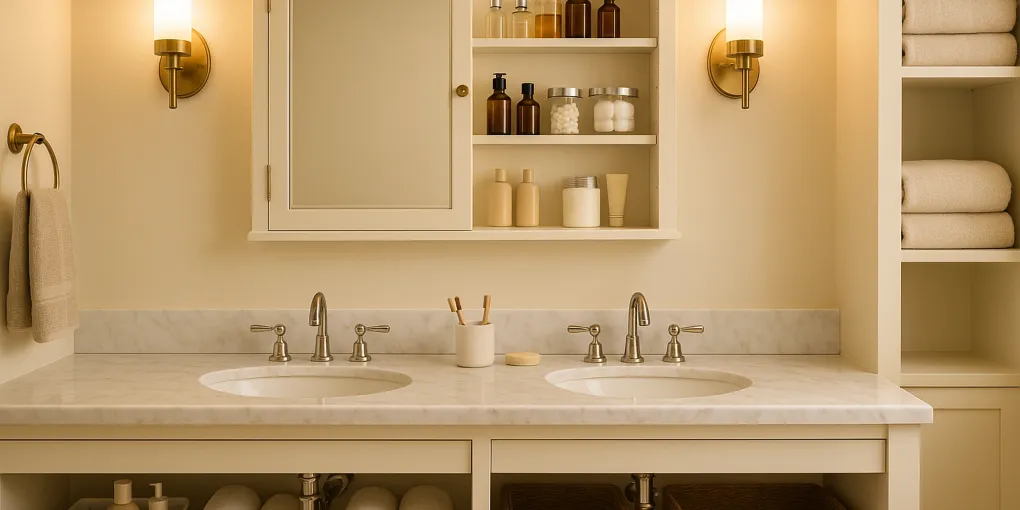
The medicine cabinet is ground zero for expired bathroom clutter. Most medicine cabinets contain at least some expired medications, outdated first aid supplies, and long-abandoned skincare products from previous routines.
The medicine cabinet declutter process:
- Remove everything — set on the bathroom counter or a nearby table
- Check every medication for expiration date and discard all expired items using safe disposal methods (see FAQ above)
- Check first aid supplies: expired bandages, dried-out antiseptics, and ancient hydrogen peroxide should go
- Check skincare and personal care products: look for open containers past their use-by window and products from skincare routines you no longer follow
- Wipe down the cabinet interior — medicine cabinets rarely get wiped inside during regular cleaning
- Return only items you actively use
What belongs in a medicine cabinet:
The medicine cabinet is best used for items you need quick, daily access to: current medications, daily skincare in active use, shaving supplies, contact lens products, and dental care items. It is not a storage space for backup supplies, products you might use someday, or items that “just need a temporary spot.”
Medicine cabinet capacity rule: If items don’t fit without stacking or overcrowding, the volume is too large for the space. Either add a secondary storage location or reduce the number of items further.
Zone 2: Under the Sink
The under-sink cabinet is the bathroom’s highest-volume storage area and typically its most chaotic. The irregular cabinet shape (plumbing takes up central space) creates dead zones that accumulate forgotten items.
Common under-sink clutter categories:
- Backup products in excess of a two-month supply (three spare shampoos is an accumulation problem, not a preparedness strategy)
- Cleaning products that have migrated from their intended storage location
- Hair tools with tangled cords
- Products purchased speculatively and never used
- Old prescription medications that were discontinued
Under-sink declutter process:
- Remove everything completely — under-sink spaces reveal themselves only when fully emptied
- Check for moisture or mold (plumbing leaks make under-sink spaces damp; address leaks before reorganizing)
- Apply the same expiration and “last used” evaluation as the medicine cabinet
- Limit backup supplies to a one-month rolling supply maximum
- Return items in category groupings, using baskets or bins to work around the plumbing obstacle
After decluttering, under-sink space is best organized with pull-out bins or stackable baskets that allow access to items at the back without reaching over items at the front. For specific product recommendations, see our guide to best bathroom organizers.
Zone 3: Countertop
Bathroom countertops accumulate daily-use products that have no designated cabinet home. A clear bathroom counter — like a clear kitchen counter — is both functionally superior and psychologically calming.
The bathroom counter rule: Only items used every single day earn counter space. Everything else has a cabinet.
Common counter items and their right home:
- Daily moisturizer and skincare: fine on the counter if used every day; in a medicine cabinet drawer otherwise
- Electric toothbrush: acceptable on the counter if used daily
- Hair tools (flat iron, hair dryer): stored under-sink or in a drawer; not on the counter except while in use
- Decorative items: one small plant or one intentional decorative object maximum — additional decor creates visual clutter in a small space
- Soap dispenser: a single pump dispenser replaces loose bars and bottles
- Candles, jewelry, miscellaneous: everything accumulated here gets a proper home or goes
The soap dish situation deserves specific attention: a single quality pump dispenser for hand soap and a bar soap holder (if you prefer bar soap for the shower) is the entire soap infrastructure the counter needs. Multiple half-empty bottles and backup bars create visual chaos disproportionate to their practical function.
Zone 4: Linen Closet or Bathroom Shelving
Bathroom linen storage — whether a dedicated closet or built-in shelving — accumulates towels, washcloths, and toiletry backups that can grow to occupy far more space than needed.
Towel count audit: Count your towels. For a household of two, two bath towels per person (one in use, one clean backup), two hand towels, and two washcloths per person is a complete, sufficient supply. Guest towels in a dedicated set are appropriate. If you have significantly more than this — twelve bath towels for two people — the surplus contributes storage congestion without providing real utility.
Towel donation: Worn, frayed, or stained towels that you’re reluctant to put out for guests can often be donated to local animal shelters, which accept used towels for animal bedding.
Toiletry backup inventory: Establish a “par level” for each backup product — one spare shampoo, one spare conditioner, one spare body wash — and stop buying replacements until the backup is in use. This prevents the bathroom from filling with products purchased ahead of need.
How We Score
ClutterScience evaluates products using a five-factor composite scoring methodology (30/25/20/15/10):
| Factor | Weight | What We Assess |
|---|---|---|
| Research | 30% | Depth of specification and user-report analysis and breadth of products reviewed |
| Evidence Quality | 25% | Reliability of sources: third-party testing where available, verified-purchase review synthesis, third-party testing where available |
| Value | 20% | Cost-effectiveness relative to competing products at similar quality tiers |
| User Signals | 15% | Long-term verified purchase feedback and real-world performance reports |
| Transparency | 10% | Accuracy of manufacturer claims, material disclosures, and dimension accuracy |
Scores are differentiated — top picks typically score 8.5–9.5, mid-tier 7.0–8.4, and weak options below 7.0.
Recommended Products
mDesign Plastic Under Sink Storage Organizer with Handles (2-Pack)
After decluttering, the under-sink space requires organization tools that work around the plumbing obstruction at the cabinet center. These pull-out baskets sit on either side of the plumbing, provide handles for easy access to items at the back, and stack to use the full cabinet height. The open mesh sides allow visibility of contents without removing items.
| Criterion | Weight | Score |
|---|---|---|
| Capacity & Dimensions | 30% | 8.7/10 |
| Material Quality | 25% | 8.3/10 |
| Ease of Assembly & Use | 20% | 9.5/10 |
| Long-Term Value | 25% | 8.8/10 |
| Composite Score | 8.8/10 |
Among the most-reviewed under-sink bathroom organizers on Amazon. Verified purchasers consistently note how much more space appears after the combination of decluttering and installing these pull-out baskets. A post-declutter essential.
iDesign Clarity Bathroom Vanity Drawer Organizer Set (7-Piece)
Bathroom drawer organization is frequently the last step of a bathroom declutter, and it has disproportionate impact on daily routine efficiency. These clear acrylic organizer trays create category-specific zones within bathroom drawers for makeup, skincare tools, dental care, and accessories. The clear material allows instant visual inventory — you can see what you have and where it is without opening or rummaging.
| Criterion | Weight | Score |
|---|---|---|
| Capacity & Dimensions | 30% | 8.4/10 |
| Material Quality | 25% | 8.9/10 |
| Ease of Assembly & Use | 20% | 9.4/10 |
| Long-Term Value | 25% | 9.0/10 |
| Composite Score | 8.9/10 |
The acrylic construction is more durable than plastic alternatives and maintains clarity over time. Multiple verified purchasers note that this set, installed after a declutter, permanently transformed their bathroom morning routine. Best for vanity drawers with makeup, skincare, or grooming supplies.
Umbra Trigg Floating Shelves Wall Décor (Set of 2)
For bathrooms with limited cabinet space, wall-mounted shelving provides additional storage without consuming counter or floor space. These triangular floating shelves provide display and storage space for intentional bathroom items — a small plant, a single candle, daily skincare — while keeping the counter clear.
| Criterion | Weight | Score |
|---|---|---|
| Capacity & Dimensions | 30% | 7.5/10 |
| Material Quality | 25% | 8.6/10 |
| Ease of Assembly & Use | 20% | 7.8/10 |
| Long-Term Value | 25% | 8.5/10 |
| Composite Score | 8.0/10 |
Lower capacity score reflects their intentionally minimal design — these are for curated display, not bulk storage. Best for bathrooms where the declutter has been thorough and the need is for a small amount of intentional counter-alternative storage.
Step-by-Step Expired Product Disposal Guide
Prescription medications: Use DEA Take Back Day programs (twice yearly) or year-round drop-off at participating pharmacies. This is always the preferred option.
Over-the-counter medications: If no take-back location is available, mix with coffee grounds or cat litter in a sealed bag and place in household trash. Remove personal information from the label.
Sunscreen: Expired sunscreen loses SPF effectiveness and should be discarded. Most municipalities accept it in household trash.
Personal care products: Empty containers (shampoo, conditioner, lotion) go in recycling where accepted. Products themselves go in household trash. Do not pour large quantities of product down the drain.
Aerosol products: Completely empty aerosol cans are recyclable in most municipalities. Partially full aerosol cans are considered hazardous waste in many areas — check local household hazardous waste disposal guidelines.
Maintaining a Decluttered Bathroom
Behavioral science research on habit formation (Clear, Atomic Habits, 2018) identifies the bathroom as an excellent anchor for daily habit routines because it’s entered at predictable times with predictable behavioral patterns. The same principle works for maintenance: a brief weekly bathroom reset takes under five minutes and prevents re-accumulation.
Weekly reset (5 minutes):
- Return any items that migrated to the counter to their designated homes
- Discard any empty containers rather than leaving them on the shelf
- Wipe counters and the medicine cabinet shelf
Monthly check (10 minutes):
- Open the medicine cabinet and under-sink cabinet and confirm organization is intact
- Discard any products that have been opened and unused for more than thirty days
Semi-annual full review:
- Repeat the full medicine cabinet expiration audit every six months
- Coincide with spring cleaning and fall clothing rotation for an easy schedule anchor
For a comprehensive approach to small bathroom organization systems after decluttering, see our guide to how to organize a small bathroom.
Summary
A bathroom declutter produces results that are immediately visible and lasting. The core process — medicine cabinet, under-sink, counter, linen storage — takes two to three hours and eliminates the visual and functional clutter that makes bathrooms feel chaotic.
The behavioral key to long-term success is the one-in-one-out purchasing rule applied to bathroom products. Every new product in means one going out. With this rule in place, the decluttered state becomes self-sustaining rather than requiring repeated full declutters. Start today with the medicine cabinet — it takes thirty minutes and produces an immediate visible result.
Frequently Asked Questions
- The FDA recommends using designated drug take-back programs as the first choice for medication disposal — many pharmacies, police stations, and hospitals operate drop-off locations. For medications without a take-back option, the FDA recommends mixing them (not crushing) with an undesirable substance like coffee grounds or cat litter in a sealed bag before placing in household trash. A small number of medications are authorized for flushing when no take-back option is available — the FDA maintains an updated flush list at fda.gov. Never dispose of medications by pouring them down the sink.
- Unopened products typically remain safe for two to three years from manufacture. Once opened, general guidelines are: facial moisturizers and serums (six to twelve months), mascara (three months), foundation and concealer (twelve months), lipstick (twelve to eighteen months), sunscreen (one year from opening or per expiration date), shampoo and conditioner (one to two years), and prescription medications (per the labeled date). Products that have changed color, smell, or texture should be discarded regardless of date.
- Bathroom re-accumulation is driven primarily by product purchases that exceed usage rate. The most effective prevention is a one-in-one-out purchasing rule: when you buy a new shampoo or skincare product, the current bottle must be finished or discarded before the new one joins the rotation. Keeping a small donation box in the bathroom linen closet for unopened products you've decided not to use also prevents accumulation of 'samples and gifts I should probably use.'
- Always declutter first. Buying bathroom organizers — drawer inserts, under-sink bins, shelf organizers — before decluttering means purchasing storage for items you may not keep. The most common bathroom organization mistake is filling up organizers with products that should have been discarded. Declutter to the actual volume of items you're keeping, then purchase organizers that fit that volume.