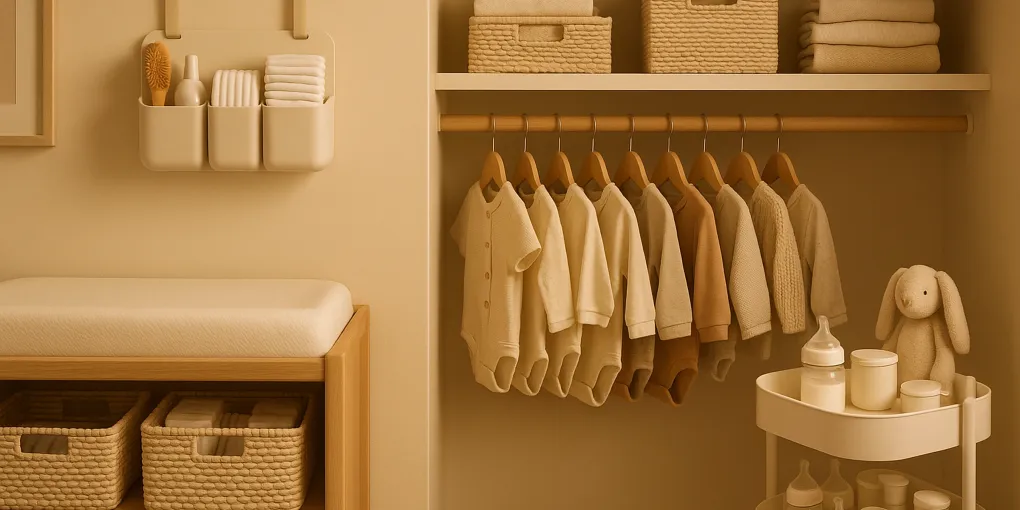
How to Organize a Baby Nursery 2026
Buyer's GuideQuick picks
Munchkin Diaper Caddy Organizer
Baby Deedee Nursery Closet Organizer Dividers (Set of 7)
Sorbus Freestanding Closet Organizer with Shelves and Hanging Rods
Why Nursery Organization Matters More Than New Parents Realize
Quick picks
These are the products referenced in the guide; check dimensions, material, and installation limits before ordering.
-
- Munchkin Diaper Caddy Organizer: See current price on Amazon
-
- Baby Deedee Nursery Closet Organizer Dividers (Set of 7): See current price on Amazon
-
- Sorbus Freestanding Closet Organizer with Shelves and Hanging Rods: See current price on Amazon The nursery is one of the most operationally demanding rooms in a home. In the first weeks with a newborn, the changing table will be used 10–12 times per day. Middle-of-the-night feedings require navigating a darkened room for bottles, burp cloths, and pacifiers. Bath time involves coordinating multiple products across multiple body areas for a person who cannot hold still. Every organizational inefficiency — a wipe container that’s hard to open one-handed, a diaper cream that’s in a different spot than yesterday, a onesie that takes 30 seconds to locate in a disorganized drawer — compounds across hundreds of daily interactions.
Behavioral research on new parent stress consistently identifies environmental friction as a significant contributor to caregiver exhaustion. A study in the Journal of Environmental Psychology found that women who described their home environments as “cluttered” or “disorganized” showed elevated cortisol levels throughout the day compared to women in orderly environments. For new parents already managing sleep deprivation, every small organizational win matters.
The principles that make nursery organization effective are borrowed from industrial workflow design: co-location (items used together are stored together), proximity hierarchy (most-used items are closest to point of use), and one-motion retrieval (anything needed during caregiving tasks should be retrievable with a single motion, not a search). Applied to a nursery, these principles transform the changing station from a chaotic surface into an efficient workstation, and the middle-of-the-night feeding from a fumbling ordeal into a calm routine.
This guide walks through nursery organization zone by zone: the changing station, the sleep area, the feeding zone, the clothing storage system, and the general supply organization. For broader baby product organization needs, see our guide to best nursery organizers.
Step 1: Map Your Nursery Zones Before Buying Storage
The single most effective nursery organization strategy is zone design — designating specific areas of the room for specific caregiving functions before purchasing any storage. Without zone design, items tend to migrate toward the changing table (the most-used surface) until it becomes a cluttered catch-all that’s actually less functional than a bare table would be.
The five nursery zones:
Zone 1 — Diaper Changing Station: This is the highest-frequency caregiving zone. Everything needed for a diaper change — diapers, wipes, creams, and a change of clothes — must be within arm’s reach of the person doing the changing, without requiring them to move away from the baby on the table. Typically centered on a changing table or dresser top with a changing pad.
Zone 2 — Sleep Area: The crib or bassinet zone should be clear of non-sleep items. The organization goal for this zone is access to sleep-associated items (sleep sacks, white noise machine, swaddle blankets) without clutter that could compromise safe sleep practices. Storage in this zone should be adjacent, not on or in the crib.
Zone 3 — Feeding Station: Whether you’re breastfeeding, bottle-feeding, or both, a dedicated feeding station with an accessible storage system dramatically improves the experience. This zone needs a comfortable chair, good lighting, and storage for all feeding-related supplies within arm’s reach.
Zone 4 — Clothing Storage: The dresser and closet form the clothing storage zone. Organization here is about size-based rotation and category sorting that allows you to dress the baby quickly while sleep-deprived.
Zone 5 — General Supplies and Health: First aid items, extra bath supplies, medications, and backup inventory live in a lower-frequency access zone — often the top shelf of a closet or a dedicated cabinet that doesn’t need to be accessed daily.
Draw a rough floor plan of your nursery and assign each piece of furniture to one of these five zones. This clarity prevents the functional zones from overlapping and competing for space.
Step 2: Optimize the Diaper Changing Station
The changing station deserves the most organizational attention of any nursery zone because it’s used most frequently and under the most challenging conditions (one hand on a wiggling baby, potential for messes requiring immediate access to multiple products).
Essential changing station organization:
Within immediate arm’s reach (countertop or top shelf of changer):
- Diapers: Stack 10–15 diapers in a holder or open-top caddy. Restocking should take under 30 seconds.
- Wipes: An open-top wipe dispenser (not the original packaging) allows one-handed retrieval. This single change reduces friction enormously.
- Diaper cream: One tube or jar, cap-side-up, within immediate reach. Not three tubes — one.
- Small garbage receptacle: A simple open bin (with a lid that opens automatically or with a foot pedal) directly adjacent to the changing area.
Within easy reach but not on the changing surface (a shelf above or a caddy on the side):
- Change of clothing: 2–3 folded outfits in the current size, ready to go.
- Extra burp cloths: A small stack, accessible with one hand.
- Gentle spray or lotion for skin concerns.
Out of the way (lower shelf or drawer below):
- Backup diapers (1–2 week supply)
- Backup wipes
- Additional size clothing for the next size up
Critical rule: Nothing that doesn’t belong to the changing station should live on or immediately adjacent to the changing surface. The changing table is not a mail-sorting station or a gift-card holder. Ruthlessly maintain its function.
Step 3: Set Up the Clothing Storage System
Baby clothing organization has a unique challenge: sizes change every 2–3 months for the first year, requiring a regular rotation that can overwhelm an unprepared system. The solution is a two-tier storage approach: active storage for the current size, and rotation storage for upcoming sizes.
Active dresser organization:
Divide dresser drawers by clothing type, not by outfit. Suggested drawer assignments:
- Drawer 1: Onesies (long-sleeve and short-sleeve, current size)
- Drawer 2: Pants, leggings, and shorts (current size)
- Drawer 3: Pajamas and sleep sacks
- Drawer 4: Socks, hats, mittens, and accessories
The file folding method (items folded and stored on their edges, visible from above when the drawer is opened) works exceptionally well for baby clothing because all items are visible at once, nothing gets buried, and the drawer never becomes disorganized from pulling items out at the bottom of a stack.
Closet organization:
Use the closet for hanging items (nicer outfits, dresses, rompers) and overflow categories. Add a hanging closet divider to create sections by clothing size. Add a second hanging rod at a lower height to double the usable hanging space in the closet.
Size rotation storage:
Store all future-size clothing in labeled bins: “3–6M,” “6–9M,” “9–12M,” and so on. These bins should live on the top shelf of the nursery closet or in a storage area outside the nursery. When the baby approaches the next size (typically when current-size items start looking snug), pull the next bin, pre-wash and sort the contents, and swap into the active drawers.
See our guide to best baby clothes organizers for drawer divider and closet organizer recommendations.
Step 4: Organize the Feeding Station
Feeding a newborn is a frequent, time-consuming activity — and a disorganized feeding station adds unnecessary stress to an experience that deserves to be as calm and comfortable as possible.
For bottle feeding:
Keep all bottle-related items in one dedicated area of the kitchen (preferred) or nursery: bottles, nipples, bottle brush, drying rack, and formula or breast milk storage. A turntable organizer in a cabinet keeps all items accessible without needing to move things to reach what’s in the back.
For middle-of-the-night feeds, set up a small nursery feeding caddy or nightstand organizer with everything needed for one feeding: a bottle or burp cloth, pacifier, and a small water bottle for the caregiver. This eliminates trips to the kitchen in the dark.
For breastfeeding:
The nursing chair area needs storage for: burp cloths, nursing pads, nipple cream, water for the caregiver, phone or remote control (for long nursing sessions), and a small snack. A nursing caddy that attaches to the chair arm or a small side table with a storage tray keeps these items organized and accessible.
Pumping supplies:
If pumping, designate a specific cabinet or section of the kitchen for all pump parts. Parts used daily should be at counter height; instruction materials and accessories can be stored higher. A dish drying rack specifically for pump parts prevents them from ending up scattered across the general kitchen counter.
Step 5: Create a General Supply and Health Zone
The remaining nursery supplies — bath items, health and first aid, backup inventory, keepsakes, and seasonal items — need a storage home that keeps them accessible but out of the daily workflow.
Health and first aid: Group all health-related items (thermometer, nasal aspirator, gripe water, infant Tylenol when appropriate, bandages) into a single labeled container. This container should be immediately identifiable and accessible in a moment of need, but stored away from the daily-use items that surround it so it doesn’t get buried.
Bath supplies: If bath items are stored in the nursery rather than the bathroom, keep a dedicated waterproof caddy or bin for all bath products. This container can travel to the bathroom for bath time and return to the nursery for storage.
Backup inventory: New parents often receive substantial quantities of diapers, wipes, and other supplies. Rather than storing all of it in the nursery (which creates visual clutter and competes with functional organization), store bulk backup supply in a separate closet or storage area, and create a simple restocking system: when the nursery supply drops below a threshold (e.g., fewer than one week of diapers), restock from the backup supply.
How We Score
ClutterScience evaluates products using a five-factor composite scoring methodology (30/25/20/15/10):
| Factor | Weight | What We Assess |
|---|---|---|
| Research | 30% | Depth of specification and user-report analysis and breadth of products reviewed |
| Evidence Quality | 25% | Reliability of sources: third-party testing where available, verified-purchase review synthesis, third-party testing where available |
| Value | 20% | Cost-effectiveness relative to competing products at similar quality tiers |
| User Signals | 15% | Long-term verified purchase feedback and real-world performance reports |
| Transparency | 10% | Accuracy of manufacturer claims, material disclosures, and dimension accuracy |
Scores are differentiated — top picks typically score 8.5–9.5, mid-tier 7.0–8.4, and weak options below 7.0.
Product Recommendations
1. Munchkin Diaper Caddy Organizer
ASIN: B07CZ47VTP | See current price on Amazon
This portable diaper caddy organizer is the hub of an efficient changing station. Multiple compartments accommodate diapers, wipes, creams, and accessories with everything visible at a glance. The portable design allows it to move from changing table to living room to travel bag. Wipe-clean interior makes maintenance simple. The structured walls keep contents organized even when the caddy is only partially full.
| Criterion | Weight | Score |
|---|---|---|
| Capacity & Dimensions | 30% | 8.5/10 |
| Material Quality | 25% | 8.8/10 |
| Ease of Assembly & Use | 20% | 9.5/10 |
| Long-Term Value | 25% | 8.2/10 |
| Composite Score | 8.7/10 |
2. Baby Deedee Nursery Closet Organizer Dividers (Set of 7)
ASIN: B01N5PRMD4 | See current price on Amazon
These closet rod dividers create size-labeled sections in the nursery closet that allow the whole clothing rotation system to work visually. Each divider is labeled with a size range (Newborn through 24 months) and slides onto any standard closet rod. When rotating sizes, you can see immediately which section is active and which is upcoming. Simple, inexpensive, and genuinely impactful for the morning chaos of finding an outfit quickly.
| Criterion | Weight | Score |
|---|---|---|
| Capacity & Dimensions | 30% | 7.5/10 |
| Material Quality | 25% | 8.0/10 |
| Ease of Assembly & Use | 20% | 9.8/10 |
| Long-Term Value | 25% | 9.0/10 |
| Composite Score | 8.5/10 |
3. Sorbus Freestanding Closet Organizer with Shelves and Hanging Rods
ASIN: B074WFPZQX | See current price on Amazon
For nurseries where the built-in closet doesn’t have adequate shelving, this freestanding closet organizer provides a complete storage system: hanging rods at two heights, multiple shelving levels, and a compact footprint that fits in most standard closets. The combination of hanging space and shelving accommodates both clothing and general supply storage in one piece. Assembly is straightforward and the unit is stable under typical nursery loads.
| Criterion | Weight | Score |
|---|---|---|
| Capacity & Dimensions | 30% | 9.0/10 |
| Material Quality | 25% | 7.8/10 |
| Ease of Assembly & Use | 20% | 7.5/10 |
| Long-Term Value | 25% | 8.5/10 |
| Composite Score | 8.3/10 |
Maintenance: Keeping the Nursery Organized Through the First Year
Baby development moves faster than almost any other organizational variable in a home. An organizational system built for a newborn will be wrong for a 6-month-old, partially wrong for a 12-month-old, and significantly wrong for an 18-month-old. Building in regular maintenance cycles is essential.
Weekly maintenance (10 minutes):
- Restock the changing station from backup supply
- Return any items to their correct zone
- Process laundry back into the correct drawers using the file-fold method
- Check that the next clothing size bin is accessible (baby growth can be sudden)
Monthly maintenance (20–30 minutes):
- Check whether the current clothing size is still fitting; if the baby is filling out current sizes, pull the next-size bin and pre-wash contents
- Assess whether any zone organization needs adjustment based on current use patterns
- Restock backup supply from bulk storage
Major transitions (every 2–3 months in the first year):
- Conduct a mini clothing audit: remove all items the baby has outgrown, sort them into keep/donate/pass-along
- Reassess zone organization as the baby’s developmental stage changes caregiving needs
- Update the feeding station to reflect any changes in feeding method or schedule
The 6-month nursery reassessment: At around 6 months, many nurseries need a significant reorganization to accommodate an increasingly mobile and interactive baby. The flat-on-the-changing-table phase transitions to a rolling, sitting, grabbing phase that changes how the changing station needs to work. The exclusively-feeding phase transitions to a first-foods phase that adds a whole new supply category. Plan for a deliberate reassessment at this milestone rather than reacting to gradual system degradation.
The investment in thoughtful nursery organization pays dividends throughout the first year — not only in reduced daily friction, but in the cumulative caregiver wellbeing that comes from a functional, calm environment for one of the most demanding parenting seasons.
Related Articles
- How to Organize a Kids Room by Age
- How to Organize a Kids Playroom
- Best Baby Clothes Organizers
Frequently Asked Questions
- Most organizational experts recommend beginning nursery setup between weeks 28 and 32 of pregnancy — early enough to avoid the exhaustion of the third trimester, but late enough that you've received most shower gifts and have a realistic picture of what you'll need to store. If you're adopting or have a shorter preparation timeline, prioritizing the diaper changing station and sleep area first allows you to be functional before all storage is fully optimized.
- More than you expect, and in more categories than you might anticipate. Beyond clothing and diapers, a nursery needs to accommodate feeding supplies, bath supplies, health and first aid items, books, sleep aids, and comfort items. A functional nursery organization plan includes a dresser with at least 4–6 drawers, a closet system with both hanging and shelf storage, a changing table with built-in storage, and a dedicated feeding station.
- Sort all pre-washed baby clothing by size (Newborn, 0-3M, 3-6M, 6-9M, 9-12M) and store each size group in a clearly labeled bin or with a labeled divider. Keep the current expected size and one size up accessible in the dresser or closet. Store future sizes in labeled bins, ideally on a high shelf or in a separate storage area, to avoid the common confusion of accidentally using a 9-month outfit on a newborn.
- Keep a 1–2 week active supply at the changing station, organized by immediate accessibility: diapers stacked within arm's reach, wipes in an open container or wipe dispenser, creams and ointments in a caddy or small tray. Store bulk backup supply on a nearby shelf or in a separate closet. Rotate bulk into active supply weekly to keep the changing station from becoming cluttered with excess inventory.