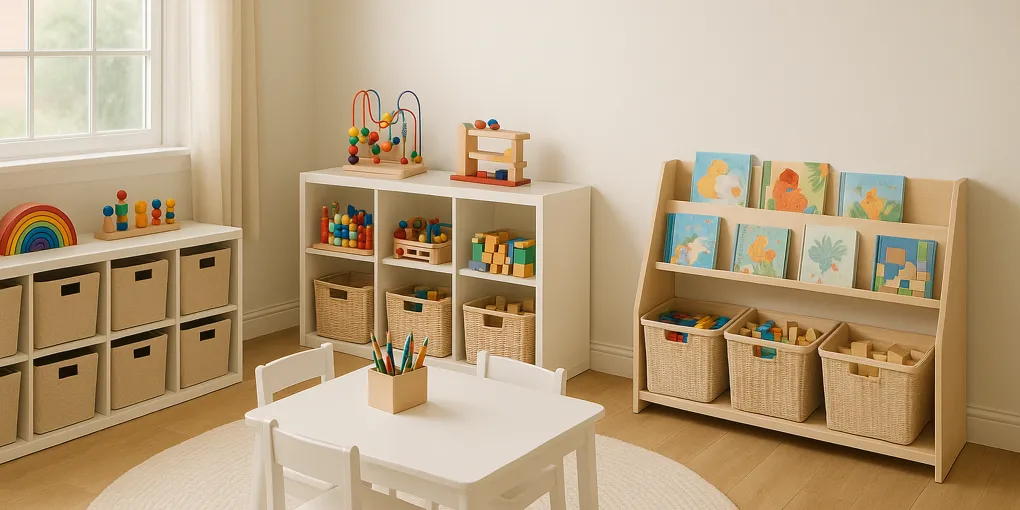
How to Organize a Playroom with Activity Zones 2026
Buyer's GuideIKEA TROFAST Frame and Bins
Best zone systemBest for: Blocks, vehicles, figures, and rotating toy categories
Quick picks
| Product | Key Specs | Pros / Cons |
|---|---|---|
| See price on Amazon |
|
|
| See price on Amazon |
|
|
| See price on Amazon |
|
|
Product availability, certifications, and retailer details can change; check the current Amazon page before buying.
Quick product shortlist
Use this shortlist to choose a product style before you measure. The links are named product or brand searches so you can compare current dimensions, finishes, prices, and return terms before buying.
- Best zone system: IKEA TROFAST Frame and Bins (Search Amazon for IKEA TROFAST frame bins playroom) for blocks, vehicles, figures, and rotating toy categories. Watch-out: needs labels and floor space.
- Best soft catch-all: 3 Sprouts Toy Chest (Search Amazon for 3 Sprouts toy chest) for stuffed animals or large soft toys. Watch-out: one huge bin should not hold tiny pieces.
- Best visual labels: Avery Picture Labels (Search Amazon for picture labels toy bins Avery) for pre-readers and shared playrooms. Watch-out: labels must match the bins children actually use.
The Science Behind Activity Zone Design for Children’s Playrooms
Quick picks
These are the products referenced in the guide; check dimensions, material, and installation limits before ordering.
-
- Step2 Art Master Activity Desk with Stool: See current price on Amazon
-
- SONGMICS 9-Cube Storage Organizer with Fabric Bins: See current price on Amazon
-
- P’kolino Bookcase with Bins — Kids Bookshelf: See current price on Amazon The standard approach to playroom organization — shelves along the walls, bins on every surface — misses a fundamental insight from environmental psychology: children’s behavior is powerfully shaped by how their environment is structured, not just what it contains. A room organized by activity zone doesn’t just look more orderly; it produces qualitatively different play behavior.
Research on children’s learning environments, originally conducted in early childhood educational settings and translated to home contexts by developmental psychologists, consistently shows that defined activity zones increase the duration and depth of children’s play engagement. When children enter a space with a clearly defined reading corner, they’re more likely to read — and to read for longer — than when they enter an undifferentiated room where books are on a shelf alongside everything else. The zone serves as a behavioral invitation: it signals what kind of activity belongs here and creates an environmental context for that activity.
This principle, known in behavioral architecture as activity affordance, explains why even very young children tend to gravitate toward specific areas for specific play types when given a well-designed environment. The art corner invites drawing. The building corner invites construction. The reading nook invites quiet engagement. The environment does behavioral work that adult direction and reminders cannot.
Zone design also dramatically simplifies cleanup by creating categorical clarity. Instead of “toys go away,” the cleanup instruction becomes “art supplies go to the art area, blocks go to the building area.” The zone system transforms cleanup from a vague directive into a series of specific, completable actions — a cognitive load reduction that benefits both children and the adults supervising them.
This guide walks through the process of identifying, designing, stocking, and maintaining playroom activity zones for children of all ages. For a general playroom organization overview, see our guide on how to organize a playroom. For age-specific organization approaches, see how to organize a kids room by age.
Step 1: Assess Your Room and Identify Natural Zone Locations
Before assigning zones, you need an accurate understanding of the physical space you’re working with. Zones don’t exist in isolation — they need to be sited in locations that support their function and minimize conflict with adjacent zones.
Walk the room with fresh eyes and assess:
Natural light locations: The reading zone and art zone benefit most from natural light — position these near windows if possible. Building zones and dramatic play zones are less light-sensitive.
Wall availability: Zones that use wall-mounted storage (art supply rails, pegboards, hanging organizers) need a clear wall section. Measure available wall space before committing to wall-dependent organization systems.
Electrical outlets: If any zone will include a light source, a white noise machine, or an electronic learning device, it needs to be adjacent to an outlet.
Traffic flow: The highest-energy zone (often gross motor play or building/construction) should be sited away from the primary room entrance and away from the reading zone, to avoid zone interference.
Floor space vs. vertical space: Zones like building and dramatic play primarily use floor space. Zones like reading and art can be organized primarily vertically (bookshelves, wall-mounted supply storage). In smaller rooms, prioritizing floor space for active zones and vertical space for passive zones maximizes usability.
Draft a simple zone map. This doesn’t need to be architectural — a sketch on paper with approximate zone boundaries is sufficient. Assign each proposed zone to a section of the room and identify what storage furniture it will need before any purchasing decisions.
Common zone pairings that work well adjacent to each other: reading + quiet games; art + crafts; building + vehicles (both floor-based construction play). Common zone conflicts to avoid: gross motor play adjacent to reading; art adjacent to dramatic play (costume and prop mixing with art supplies creates persistent organizational confusion).
Step 2: Design Each Zone with Appropriate Storage
Each activity zone has different storage needs based on the items it contains, the age of children using it, and the typical cleanup pattern of that play type.
Art and Crafts Zone: Art zones require the most organizational structure of any playroom zone because they contain the most item types and the most potential for supply mixing. The organizational goal is one-hand, one-item retrieval: scissors in one container, markers in another, paper in a flat tray, paints in a sealed caddy.
A child-height table with a washable surface is the anchor of the art zone. Storage should be immediately adjacent — ideally a rolling cart or wall-mounted rail with bins that can be pulled to the table surface. Clear containers are particularly valuable in the art zone so children can identify what’s inside without opening every container. Organize by supply type, not by project type. Paper goes in one place regardless of what it’s used for; markers go in one place regardless of which project they’re used in.
Building and Construction Zone: Building zones (LEGO, DUPLO, Magna-Tiles, wooden blocks, K’Nex) need floor space for building and open-bin storage for pieces. The primary organizational challenge is piece mixing — different building systems need distinct storage so pieces don’t get combined and made unusable. Use one large bin per system, or a divided organizer for smaller sets. A building mat (a large padded surface that defines the building area and catches small pieces) reduces floor scatter significantly.
Reading and Quiet Zone: A comfortable seat, good lighting, and book storage within arm’s reach define this zone. Forward-facing bookshelves (where book covers face outward) are the most effective display for younger readers — the visual covers function as invitations in ways that spine-out shelving doesn’t. For older children, standard shelving organized by series, genre, or author works well and accommodates more books per linear foot.
Dramatic Play and Dress-Up Zone: Costumes, props, and accessories need hanging storage for costumes (a low clothing rod or hooks at child height) and open-bin storage for small props and accessories. Categorizing props by theme (kitchen, princess/prince, superhero, doctor) rather than mixing everything in one bin makes dramatic play more generative — children can set up a themed play scenario more easily when the relevant props are grouped.
Step 3: Acquire Zone-Appropriate Storage Products
With your zone map and storage requirements defined, you can purchase targeted storage rather than generic bins that may not fit the specific needs of each zone.
General principles for playroom zone storage:
Choose storage that’s proportional to the zone — a massive cube organizer for a small reading corner overwhelms the space; a single small bin for an art zone with 15 supply types doesn’t provide enough organization.
Standardize within zones where possible. If you’re using fabric bins for the building zone, use the same fabric bin in the same color family throughout that zone. Visual consistency within a zone makes the cleanup target clear.
Use color-coding across zones judiciously. Assigning a distinct color to each zone (green for building, blue for reading, red for art) and using that color for the primary storage containers in each zone creates an automatic visual sorting system for children.
For shared multi-sibling playrooms, consider adding name labels or silhouette labels to personal item storage — younger children’s toys that older siblings shouldn’t mix with, or older children’s items that need to be kept away from younger siblings.
Maintain zone boundaries through the furniture itself. A bookshelf perpendicular to the wall creates a physical zone boundary. A rug defines a zone’s floor footprint. These physical cues are more effective than tape on the floor or written rules — children respond to three-dimensional environmental structure, not two-dimensional instruction.
Step 4: Label Every Storage Location
In a multi-zone playroom, labeling is particularly important because children need to navigate across zones to return items and need clear signals about where each item belongs. A labeling system that’s visible, consistent, and age-appropriate is the connective tissue that holds the zone system together.
Age-appropriate labeling:
For mixed-age playrooms, use photo + word labels on all storage. The photo communicates category to pre-readers; the word communicates category to readers; the combination works for everyone simultaneously and avoids the need for two separate labeling systems.
Zone labels — a label or sign that identifies each zone by name — help reinforce the zone concept with children. “The Building Corner” or “Art Zone” posted at eye level gives the zone an identity that children can reference and feel ownership of.
Labeling placement: Attach labels to the front of bins and containers at the child’s eye level. Labels on the top of bins are invisible when bins are in use; labels on the back of shelving units are invisible from the usual approach direction.
For detailed guidance on creating a labeling system, see our dedicated guide on how to label storage containers and bins.
Step 5: Establish Zone-Based Cleanup Routines
Zone design is only fully realized when cleanup routines reinforce zone integrity. A cleanup routine that returns items to their zones — not just off the floor — is what maintains the behavioral invitation effect of the zone system over time.
The zone sweep method:
Rather than doing a general “clean up” sweep of the room, teach children to do a zone-by-zone cleanup sequence: starting in one zone, returning all items to their correct storage, then moving to the next zone. For younger children, a visual cleanup checklist showing each zone (with a photo of what it looks like clean) makes the sweep routine concrete and completable.
One-zone-at-a-time for younger children. Asking a 4-year-old to “clean up the whole playroom” creates a task with no clear boundary. Asking a 4-year-old to “put the blocks in the block bin” is specific, completable, and immediately verifiable. Start with the building zone, declare victory, then move to the next zone.
Zone maintenance vs. full reset: Daily cleanup should return items to their correct zones but doesn’t need to achieve full organizational perfection. Weekly or bi-weekly, do a full zone reset: verify that each bin and container holds what it’s labeled for, that no zone creep has occurred, and that the storage systems within each zone are fully functional.
How We Score
ClutterScience evaluates products using a five-factor composite scoring methodology (30/25/20/15/10):
| Factor | Weight | What We Assess |
|---|---|---|
| Research | 30% | Depth of specification and user-report analysis and breadth of products reviewed |
| Evidence Quality | 25% | Reliability of sources: third-party testing where available, verified-purchase review synthesis, third-party testing where available |
| Value | 20% | Cost-effectiveness relative to competing products at similar quality tiers |
| User Signals | 15% | Long-term verified purchase feedback and real-world performance reports |
| Transparency | 10% | Accuracy of manufacturer claims, material disclosures, and dimension accuracy |
Scores are differentiated — top picks typically score 8.5–9.5, mid-tier 7.0–8.4, and weak options below 7.0.
Product Recommendations
1. Step2 Art Master Activity Desk with Stool
This purpose-built art zone desk includes built-in storage for art supplies — a paper roll holder, side bins, and a storage compartment. The washable tabletop surface, foot storage, and complete self-contained design make it the ideal anchor for a playroom art zone without requiring additional storage furniture. The compact footprint fits in most playrooms without dominating the space. Adjustable stool accommodates a wide age range.
| Criterion | Weight | Score |
|---|---|---|
| Capacity & Dimensions | 30% | 8.0/10 |
| Material Quality | 25% | 8.5/10 |
| Ease of Assembly & Use | 20% | 8.2/10 |
| Long-Term Value | 25% | 8.8/10 |
| Composite Score | 8.4/10 |
2. SONGMICS 9-Cube Storage Organizer with Fabric Bins
The versatile 9-cube unit is the backbone of multi-zone storage. Nine individual cubes create enough cells to assign 2–3 cubes per zone, with distinct fabric bin colors per zone for immediate visual sorting. The modular system can be configured as a low horizontal unit (doubles as a room divider between zones) or a tall vertical unit (fits along a single wall). Fabric bins are washable; the wood-composite frame is stable under heavy toy loads.
| Criterion | Weight | Score |
|---|---|---|
| Capacity & Dimensions | 30% | 9.3/10 |
| Material Quality | 25% | 8.0/10 |
| Ease of Assembly & Use | 20% | 7.8/10 |
| Long-Term Value | 25% | 8.8/10 |
| Composite Score | 8.5/10 |
3. P’kolino Bookcase with Bins — Kids Bookshelf
Designed specifically for children’s reading zones, this bookshelf combines forward-facing display shelves (for picture books whose covers should be visible) with standard shelves (for chapter books and series collections) and lower bins for books-in-progress or reading accessories. The combination format grows with the child’s reading stage without requiring a furniture swap. Child-safe construction, wall-mount anchor hardware included, attractive in room settings.
| Criterion | Weight | Score |
|---|---|---|
| Capacity & Dimensions | 30% | 7.8/10 |
| Material Quality | 25% | 8.5/10 |
| Ease of Assembly & Use | 20% | 8.0/10 |
| Long-Term Value | 25% | 9.0/10 |
| Composite Score | 8.3/10 |
Maintenance: Keeping Playroom Zones Functional Over Time
The zone system requires active maintenance because children’s play interests evolve, toy collections grow, and developmental stages change which zones get the most use.
Monthly zone assessment (15 minutes):
Walk through each zone with the specific question: “Is this zone working the way it was designed to?” Look for zone creep (items from other zones accumulating in this zone), storage overflow (bins so full that cleanup is impossible), and abandoned zones (areas that are never used because the child has moved past that play stage). Address each finding with a targeted adjustment rather than a full system redesign.
Seasonal zone evolution:
Major toy holidays (birthdays, winter holidays) bring new items that may expand existing categories or introduce new ones. Before major gift-giving seasons, do a full zone audit and remove items that have been outgrown, unused for 3+ months, or damaged. This creates capacity for new items within the existing zone structure.
Zone redesign triggers:
Some transitions warrant a full zone redesign rather than incremental maintenance: a child moving from picture books to chapter books (changes the reading zone storage needs significantly), a child transitioning from large-motor construction play to fine motor craft-intensive play, or a sibling aging into the playroom who has different developmental needs.
The 10-minute daily zone reset:
End each day with a brief zone sweep — everything off the floor and back in its zone. This daily habit, established consistently, prevents the slow drift toward organizational entropy that plagues many playrooms. Use a visual timer and make it a family activity rather than a solo chore; research on household maintenance habits shows that shared routines are significantly more sustainable than individual obligations.
With consistent zone maintenance and periodic zone reassessment, a well-designed playroom zone system can serve a family’s children from toddlerhood through late elementary school — adapting to development while maintaining the organizational clarity that makes the space genuinely functional.
Frequently Asked Questions
- Most well-designed playrooms include 3–5 distinct zones, depending on room size and the ages and interests of the children using the space. Common zones include art/crafts, building and construction, reading/quiet play, pretend/dramatic play, and active/gross motor play. Fewer than 3 zones often means categories are too broadly combined to be functional; more than 6 zones typically creates zone confusion and makes cleanup routines harder to enforce.
- Multi-zone organization works in rooms as small as 10×10 feet, though the scale of each zone will be modest. The key is defining zones with storage furniture rather than requiring dedicated floor space for each — a bookshelf and a rug define a reading zone; a low table and an art supply caddy define a crafts zone. Even a 100-square-foot room can accommodate 3–4 functional zones when storage is well-chosen.
- Zone integrity is maintained through storage design, not policing. When each zone's storage is purpose-built for that zone's items — art supplies in a caddy at the art table, building pieces in bins at the building zone — items are most naturally returned to their zone-specific storage. Cleanup routines that specify 'put it where it belongs, not just off the floor' reinforce zone integrity. For older children, zone maps or signs help; for younger children, color-coded bins by zone create a visual sorting system.
- Many families use rugs to define zones in a room with hard flooring — a reading rug under the bookshelf area, a building mat in the construction zone. Rugs serve both as visual zone boundaries and as comfortable play surfaces. Avoid wall-to-wall carpet in playrooms if possible; hard floors are easier to clean, and zone rugs can be washed or replaced individually as they wear.