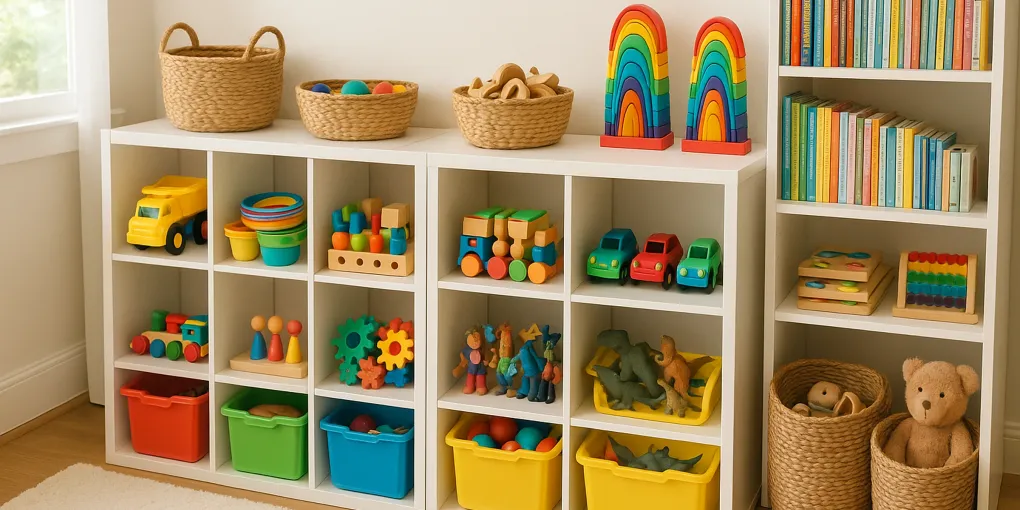
How to Organize Kids Toys: A Room-by-Room Guide 2026
Buyer's GuideQuick picks
IRIS USA 4-Cube Storage Organizer with Bins
Humble Crew Superset Toy Storage Organizer with 12 Bins
Sterilite 18-Gallon Storage Tote with Lid (6-Pack)
Stop Fighting the Toy Chaos: A Science-Based Room-by-Room Guide
Quick picks
These are the products referenced in the guide; check dimensions, material, and installation limits before ordering.
-
- IRIS USA 4-Cube Storage Organizer with Bins: Check current options on Amazon
-
- Humble Crew Superset Toy Storage Organizer with 12 Bins: Check current options on Amazon
-
- Sterilite 18-Gallon Storage Tote with Lid (6-Pack): Check current options on Amazon Walk into any home with young children and you’ll likely encounter the same scene: toys on the floor, bins overflowing, and a cleanup battle that happens every single evening. The frustration is real — but the root cause is almost never the children. It’s the organizational system.
Behavioral science research on children’s environments consistently shows that children respond to environmental design far more than to instructions or reminders. A study published in Environment and Behavior found that children in environments with clear visual organization cues tidied up spontaneously at significantly higher rates than children in identical rooms without those cues. The takeaway is powerful: if your children aren’t putting toys away, the system is probably the problem — not the children.
This matters because the organizational barriers that seem small to adults loom large for kids. A lid that requires two hands to lift. A bin that’s labeled in text a 3-year-old can’t read. A shelf that’s 6 inches too high to reach. Each of these friction points reduces the probability that a child will return an item to its correct home. Reduce the friction, and the behavior changes almost automatically.
The second major insight from organizational psychology is choice overload. Research by psychologist Barry Schwartz demonstrates that when humans face too many options, decision quality and action both decline. For children surrounded by 200 toys, picking one toy to play with — or finding where one toy belongs — becomes genuinely overwhelming. Toy rotation systems, which reduce the available toyscape to a manageable set, dramatically improve both play quality and cleanup follow-through.
This guide uses both of those principles — reducing friction and managing choice — to build a room-by-room toy organization system that works in real homes with real children. We’ll cover the playroom, bedrooms, living areas, and transition zones, with specific storage products and maintenance routines for each.
For broader playroom planning, see our guide to how to organize a playroom. For age-specific systems, see how to organize a kids room by age.
Step 1: Complete a Full Toy Audit Before Buying Any Storage
Before purchasing a single bin or shelf, you need an accurate picture of what you’re actually storing. Most households discover during a toy audit that they’re attempting to organize significantly more toys than their children actually use — and that much of the perceived chaos comes from volume, not from a lack of storage.
How to conduct a toy audit:
Collect every toy from every room in the house into one central location. Yes, this means pulling toys from under beds, from the back of closets, from the car, from the mudroom floor. The temporary chaos is necessary for an accurate count.
Once collected, sort everything into five piles:
- Actively loved: Items the child asks for, plays with regularly, and would notice if missing
- Occasionally used: Items that get play during certain seasons, moods, or visits from specific friends
- Developmental stage mismatch: Toys the child has outgrown or isn’t yet developmentally ready for
- Broken or incomplete: Anything missing pieces, damaged, or no longer functional
- Duplicate or excessive volume: The fourteenth stuffed animal, the third set of stacking cups
Your target is to actively keep categories 1 and 2, place category 2 extras in rotation storage, and remove categories 3, 4, and 5 entirely. Most families find they can reduce total toy volume by 40–60% without any child noticing or objecting — particularly when the removal is done while children are asleep or out of the house.
Document before you discard. Take a photo of donation bins before dropping them off. Parents often second-guess decisions days later; having a photo confirmation that items were truly excess reduces this anxiety significantly.
Count what remains. This number tells you what storage capacity you actually need. A common mistake is purchasing storage first, then filling it — which tends to expand toy volume to match available space. Instead: reduce first, then right-size your storage to match what you’re keeping.
After the audit, group remaining toys into categories that will inform your storage system. Common categories include: building and construction, vehicles and transportation, figures and dolls, arts and crafts, games and puzzles, books, outdoor toys, and dress-up. The specific categories will vary by your child’s age and interests — what matters is that the categories are intuitive enough that a child can correctly sort a new item on their own.
Step 2: Design a Room-by-Room Toy Assignment System
One of the most effective strategies for managing toy volume across a family home is location assignment — the principle that different categories of toys live in different rooms, and toys are expected to stay in their assigned location. This reduces the spread of toys throughout the home while making cleanup expectations clear.
Playroom or dedicated toy room: This is your primary high-capacity storage zone. Building sets, large vehicle collections, art supplies, dress-up bins, and active play items all belong here. Because this space is purpose-built for play, you can use open shelving systems and large bins without sacrificing aesthetics. Storage cubes — 12-inch cubes that fit standard storage bins — are the workhorse of playroom organization and can hold everything from LEGO sets to board game collections.
Children’s bedrooms: Bedrooms should hold a smaller curated selection of each child’s most-loved items — the toys they want accessible for quiet independent play, for morning play before the rest of the household wakes, and for nighttime wind-down activities. Books belong in bedrooms. Loveys and comfort items belong in bedrooms. Limit bedroom toy storage to one or two pieces of furniture (a bookshelf and one small bin system) to prevent bedroom overflow.
Living and family rooms: If your household uses living room space for family play, designate a specific piece of furniture for toy storage — an ottoman with a storage lid, a built-in cabinet, or a decorative basket — and enforce that all toys must fit within that footprint. This single-container rule prevents living room creep. When the container is full, something must leave before anything new enters.
Transition zones (mudroom, entry, car): Outdoor toys, sports equipment, and items that travel between school and home need a dedicated landing zone in the mudroom or entryway. A set of labeled cubbies or a hanging organizer on the back of the mudroom door keeps these items from migrating into living spaces.
See our comprehensive guide on best toy storage solutions for specific product recommendations organized by room type and capacity.
Step 3: Implement a Toy Rotation System
Toy rotation is the single highest-impact intervention for households overwhelmed by toy volume. The principle is simple: only a subset of toys is accessible at any given time, while the remainder are stored out of reach. Every few weeks, the accessible set rotates with the stored set, making toys feel fresh and novel without any new purchases.
Building your rotation:
Divide your “occasionally used” and even some “actively loved” categories into two or three equal groups. Each group should represent a balanced mix of toy types — some building, some pretend play, some art, some physical activity — so that each rotation offers a complete play environment.
Store inactive rotation groups in sealed bins (with lids, since children won’t be accessing these independently) on high shelves, in a storage closet, or in an out-of-the-way corner of the basement or garage. Clear bins are helpful here so you can identify contents without opening each one.
Rotation timing:
Most families do well with 3–4 week rotation cycles. Some use predictable triggers instead of time: the first weekend of each month, the start of each school week, or major holidays. Children who are aware of the rotation system often look forward to “new toy day” with genuine excitement — even though the toys aren’t actually new.
Label rotation bins clearly. Mark each bin with a rotation number and a brief contents list. This eliminates the frustration of sorting through multiple bins to find a specific item.
What not to rotate: Keep off the rotation list: the child’s most beloved comfort items (specific stuffed animals, special blankets), outdoor toys that are used seasonally rather than in rotation cycles, books (which benefit from permanent accessibility), and any toy currently in active daily use.
Step 4: Set Up Accessible, Labeled Storage in Each Zone
With your toy categories, room assignments, and rotation plan established, you’re ready to select and set up the actual storage. The non-negotiable principle here is accessibility: every piece of storage must allow the child to independently return items without adult assistance.
Storage height matters enormously. For children under age 6, all primary toy storage should be at or below the child’s shoulder height. For children 6–10, storage can extend to eye level. Anything above eye level becomes de facto adult-only storage — which is fine for rotation bins, but not appropriate for items the child is expected to maintain independently.
Open bins outperform closed containers for daily-access toy storage in children. This is consistent across behavioral research on children’s environments: lids create a friction barrier that significantly reduces independent cleanup follow-through. Reserve closed containers for small-piece sets (LEGO, puzzles, craft supplies) that require containment to prevent piece loss.
Labeling systems by age:
- Ages 1–3: Photo labels only. Photograph each category of toys and affix the photo to the front of the bin.
- Ages 3–6: Photo + word labels. The visual cue helps non-readers while the word label supports emerging literacy.
- Ages 6+: Word labels are sufficient, though color-coding by category adds a quick visual navigation layer.
Cube storage systems (like the IKEA KALLAX or similar cube organizers) are the gold standard for playroom organization because the fixed-size cubes impose natural limits on each category — when the cube is full, the category is full. This built-in constraint prevents individual categories from expanding indefinitely.
For the garage or outdoor storage of large play equipment, see our guide on best garage storage solutions.
Step 5: Establish Daily and Weekly Maintenance Routines
An organizational system without a maintenance routine degrades within days in a household with active children. The cleanup routine is as important as the storage setup — and like the storage setup, it needs to be designed with behavioral science in mind.
Daily cleanup: Aim for one full toy cleanup per day, ideally at a consistent time (before dinner, before bath, before bed). Consistency is critical — behavioral research on habit formation shows that same-time-same-place cues dramatically accelerate the formation of automatic routines. A timed cleanup (5-minute tidy with a visual timer) transforms what feels like an open-ended chore into a defined, completable task.
Weekly reset: Once per week, do a 10-minute reset of storage systems — return any items that have migrated to wrong bins, consolidate partially-full rotation bins, check for items that need to transition to donation or discard.
Monthly rotation check: Every 3–4 weeks, execute the toy rotation. This is also a good time to check whether the current categorical assignments are still working or whether children’s interests have shifted enough to warrant a system adjustment.
Toy storage buying criteria
Use these factors to compare options before ordering:
| Factor | Weight | What to check |
|---|---|---|
| Research | 30% | Depth of specification and user-report analysis and breadth of products reviewed |
| Evidence Quality | 25% | Reliability of specs, product documentation, and repeated owner-reported fit patterns |
| Value | 20% | Cost-effectiveness relative to competing products at similar quality tiers |
| User Signals | 15% | Long-term owner feedback and fit-related complaints |
| Transparency | 10% | Accuracy of manufacturer claims, material disclosures, and dimension accuracy |
Scores are differentiated — top picks typically score 8.5–9.5, mid-tier 7.0–8.4, and weak options below 7.0.
Product Recommendations
1. IRIS USA 4-Cube Storage Organizer with Bins
Check current options for IRIS USA 4-Cube Storage Organizer with Bins
This 4-cube storage unit paired with fabric bins is the foundation of a functional playroom toy organization system. The cube structure imposes natural category limits, the bins pull out easily for small hands, and the overall system scales by adding additional units as the child grows. Available in multiple finishes to suit different room aesthetics. The fabric bins are washable, which matters in households with young children.
| Criterion | Weight | Score |
|---|---|---|
| Capacity & Dimensions | 30% | 8.8/10 |
| Material Quality | 25% | 8.2/10 |
| Ease of Assembly & Use | 20% | 8.5/10 |
| Long-Term Value | 25% | 9.0/10 |
| Composite Score | 8.6/10 |
2. Humble Crew Superset Toy Storage Organizer with 12 Bins
Check current options for Humble Crew Superset Toy Storage Organizer with 12 Bins
Designed specifically for children’s rooms, this multi-bin organizer features a full array of colorful removable bins in multiple sizes — ideal for households with varied toy types across multiple categories. The color-coded bins serve as a pre-labeling system for younger children who respond to color cues. The frame is sturdy and holds significant weight; the bins are lightweight enough for toddlers to manage independently. Top surface provides display space for larger items.
| Criterion | Weight | Score |
|---|---|---|
| Capacity & Dimensions | 30% | 9.2/10 |
| Material Quality | 25% | 7.8/10 |
| Ease of Assembly & Use | 20% | 9.0/10 |
| Long-Term Value | 25% | 8.0/10 |
| Composite Score | 8.5/10 |
3. Sterilite 18-Gallon Storage Tote with Lid (6-Pack)
Check current options for Sterilite 18-Gallon Storage Tote with Lid (6-Pack)
For toy rotation storage — the bins that hold inactive toy sets between rotations — these Sterilite totes are the practical workhorses. Stackable, durable, with secure-latching lids that keep contents contained during storage. The semi-transparent walls allow you to identify contents without opening. A set of six gives you enough containers to divide toys into three rotation groups with one spare. These live in storage areas, not in the playroom itself.
| Criterion | Weight | Score |
|---|---|---|
| Capacity & Dimensions | 30% | 9.0/10 |
| Material Quality | 25% | 8.5/10 |
| Ease of Assembly & Use | 20% | 7.5/10 |
| Long-Term Value | 25% | 9.2/10 |
| Composite Score | 8.6/10 |
Maintenance: Keeping the System Working Long-Term
The most common failure mode for children’s toy organization systems is neglect of the maintenance routine — particularly the rotation cycle. Here’s how to build a system that sustains itself:
Set calendar reminders for rotation. A recurring monthly reminder eliminates the need to remember the cycle. Many parents schedule toy rotation for the first Sunday of each month; others tie it to school breaks, when children are home and can participate in choosing what gets rotated.
Involve children in maintenance. Research on children’s organizational habits consistently shows that participation increases ownership, and ownership increases follow-through. Let your child be the one who opens the rotation bin and “discovers” the toys inside. Let them help decide what goes into storage during the rotation.
Reassess category assignments twice per year. Children’s play interests evolve rapidly, and a category system built for a 4-year-old will feel wrong to a 7-year-old. Every six months, walk through the storage system with fresh eyes: are the categories still intuitive? Are the bin sizes right for the current volume of each category? Is any category consistently overflowing while others stay mostly empty?
Add a “limbo bin” for homeless items. Despite a well-designed system, toys will occasionally end up without a clear category home — incomplete sets, one-off items received as gifts, transitional pieces between two categories. A dedicated limbo bin gives these items a temporary home while you decide whether they warrant their own category, fit within an existing one, or should be discarded. Process the limbo bin during monthly rotation cycles.
Build in an annual full audit. Each year, repeat the comprehensive toy audit from Step 1. Children grow, interests shift, toys break or are outgrown, and storage needs change. An annual reset — particularly timed to fall (before holiday toy influx) — keeps the system calibrated to your actual household.
Consistent application of this system reduces toy-related conflict, improves children’s independent cleanup behavior, and creates a home environment where toys genuinely have a place — which is the precondition for a place genuinely having its things.
Frequently Asked Questions
- Behavioral research on attention and play quality suggests that having fewer toys available at once leads to longer, more focused, and more creative play sessions. Most child development experts recommend having no more than 20–30 items accessible at one time for younger children, with additional toys stored in rotation. This isn't about deprivation — it's about reducing choice overload, which research shows diminishes engagement in both children and adults.
- Developmental research suggests children can begin participating in toy cleanup as early as 18 months when the system is simple enough — a single bin, a clear location, a visual cue. The key is proportionality: the organizational system needs to match the child's cognitive and physical development. A 2-year-old can drop toys into an open bin. A 5-year-old can sort by category. A 9-year-old can maintain a labeled shelf system independently.
- Research consistently favors open bins for children's toy storage, particularly for children under age 8. Closed containers add a behavioral barrier — each lid that must be removed is one more step between a child and the cleanup task. Open bins with clear visual labels allow children to identify storage locations immediately and return items without adult assistance. Closed containers are appropriate for small pieces that pose choking hazards, or for rotation storage.
- Implement what organizational researchers call a 'one in, one out' policy — every new toy that enters the home should prompt the exit of an existing toy through donation, gifting to a younger child, or discard. Additionally, use the holiday and birthday season as a natural rotation trigger: box up current toys before gifts arrive, store them for 2–3 months, then rotate back. This approach maintains a manageable volume while keeping toys feeling fresh.