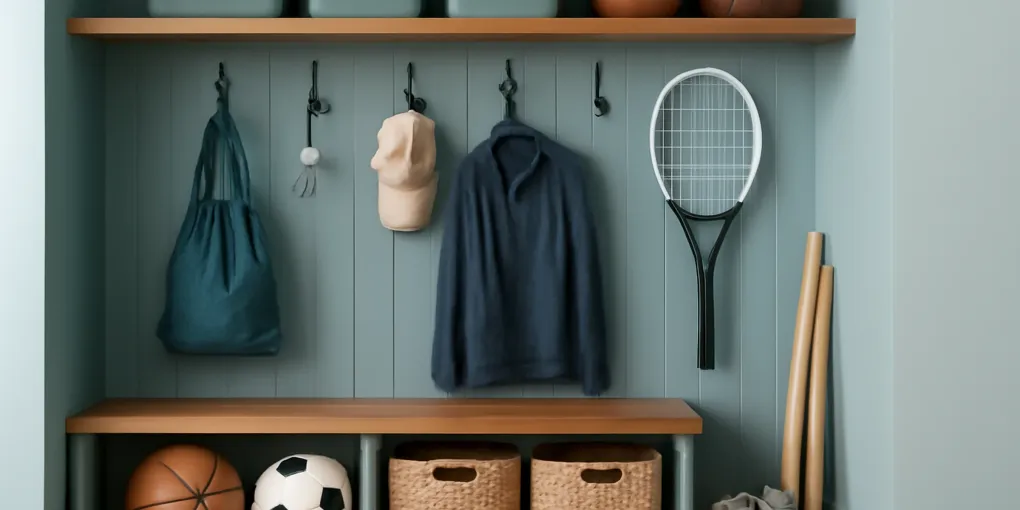
How to Organize Sports Equipment in a Small Entryway
ProtocolA small entryway can handle sports equipment if it acts like a transfer station, not a storage unit. The goal is to hold the gear needed for the current week, dry wet items safely, and make tomorrow’s practice bag easy to find.
The system below is designed for homes without a full mudroom. It uses five zones: shoes, bags, balls, helmets or pads, and paperwork. Each zone needs a clear limit. If the entryway stores every ball, every jacket, and every out-of-season cleat, the system will collapse no matter how attractive the bins are.
Product searches: entryway sports gear organizer, boot tray for cleats, wall hooks for sports bags, and mesh ball storage basket. These are fallback search links because no direct ASIN was verified during drafting.
Disclosure and editorial standards
ClutterScience may earn a commission when you buy through qualifying affiliate links. This does not change the price you pay. Recommendations are selected for fit, safety, usefulness, and likely long-term value, not for placement fees. No brand paid to be included in this article.
Why this problem feels bigger than the object count
Clutter is not only the number of objects in a space. It is also the number of decisions the space asks you to make. McMains and Kastner, 2011 (doi:10.1523/JNEUROSCI.3766-10.2011) is useful here because visual competition can increase attentional load. In a home, that means unlabeled containers, half-hidden objects, and mixed categories can feel tiring even when the actual volume is manageable.
Home-organization research also has a stress component. Saxbe and Repetti, 2010 (doi:10.1177/0146167209352864) connected stressful home descriptions with daily mood and cortisol patterns. That does not mean a single bin changes health outcomes by itself. It does support a practical principle: reduce recurring visual and decision friction in the places your household touches every day.
The ClutterScience method
Use a three-part filter before buying anything. First, define the behavior you want: drop, sort, retrieve, dry, clean, archive, or reset. Second, choose the storage type that makes that behavior easy. Third, leave enough margin that the system still works when someone is tired, rushed, or carrying groceries.
A system that needs perfect behavior is not a system. It is a photo. The better test is whether the setup works on a normal Tuesday night. If the correct action takes one step and the wrong action takes three, the space will usually improve. If the correct action requires opening lids, moving stacks, or reading tiny labels, the clutter will return.
The five-zone entryway system
Zone one is the dirty-footwear zone. Use a boot tray, not a closed bin, for wet cleats and muddy shoes. The tray should be easy to lift and rinse. Put it where drips will not run under a rug.
Zone two is the bag zone. Give each active sports bag a hook, cubby, or bench slot. If a bag has no assigned landing place, it will choose the floor.
Zone three is the ball zone. Use a ventilated basket, mesh hamper, or open crate. Balls should not be stacked on a shelf where they roll off. The container should make dumping and grabbing easy.
Zone four is the helmet and pad zone. Helmets need a stable shelf or hook and should not sit under heavy gear. Pads and gloves need airflow before they return to a bag.
Zone five is the paper and small-item zone. Mouthguards, schedules, team notes, and hair ties need a small labeled cup or wall pocket. Small items are the reason many sports systems fail.
Set a current-season limit
A small entryway should not hold every sport at once. Pick the current season and the current week. Store out-of-season equipment in a garage, closet, basement, or labeled tote. If baseball, soccer, swim, and winter gear all live at the door, nobody can tell what needs to leave tomorrow.
Use a weekly reset. On Sunday or the night before practice, empty bags, remove snack wrappers, wash bottles, check uniforms, and return only active gear. The reset takes less time when the entryway has fewer categories.
For shared households, write the limit down: one active bag per child, one pair of active shoes, one ball container, one helmet shelf. A visible rule is easier to enforce than a vague request to be tidy.
Safety and sanitation notes
The Centers for Disease Control and Prevention recommends basic hand hygiene and cleaning of frequently touched surfaces as part of routine household illness prevention. Sports gear touches benches, cars, fields, locker rooms, and floors, so the entryway should separate clean household surfaces from dirty equipment.
Do not seal wet gear in airtight bins. Moisture and odor become worse when pads, cleats, and towels cannot dry. Use mesh bags, open shelves, and hooks when possible.
Heavy wall hooks need proper anchors and should be installed according to manufacturer instructions. A backpack full of gear can weigh more than it looks. If the wall is questionable, use a freestanding rack or bench with hooks.
Setup checklist
- Name the category or task the system must support.
- Remove items that do not belong in that category.
- Measure the physical space before buying anything rigid.
- Choose the product type with the fewest daily steps.
- Label the container at the point of use.
- Test the system for one week before adding more products.
How We Score Entryway Sports Systems
ClutterScience scoring uses the standard composite weights: Research 30%, Evidence Quality 25%, Value 20%, User Signals 15%, Transparency 10%. Research means the recommendation fits the way the category is actually used. Evidence quality means the product type reduces access steps, safety problems, and cleanup friction. Value means durability and utility relative to cost. User signals include common owner patterns and practical failure points. Transparency means clear limits rather than pretending one organizer fixes every home.
| Option | Research fit | Evidence quality | Value | User signals | Transparency | Composite score |
|---|---|---|---|---|---|---|
| Washable boot tray | 9 | 8 | 10 | 8 | 9 | 8.8/10 |
| Wall hooks or rack | 8 | 8 | 8 | 8 | 8 | 8.0/10 |
| Mesh ball basket | 8 | 7 | 9 | 8 | 8 | 7.9/10 |
| Closed storage bench | 6 | 6 | 7 | 7 | 7 | 6.5/10 |
The highest-scoring option is not always the most attractive one. It is the option that keeps working after the first week. For this category, the most important question is whether the organizer makes the next action obvious.
One-week test plan
Use the first week as a friction audit. Each time someone avoids the system, note the reason: the container is too far away, the label is unclear, the lid adds a step, the item is wet, the category is too broad, or the bin is already full. Fix the repeated friction point before buying a second organizer.
A good test is whether the system still works when the household is tired. If it only works after a full reset, simplify it. Move the container closer, reduce the number of categories, remove the lid, or split active items from archive items. Organization should preserve attention, not spend it.
At the end of the week, keep what worked and remove what did not. The system should have a named home for the active category, a visible label, a limit line, and a reset rhythm. That is enough for most homes. More products should solve a measured problem, not decorate uncertainty.
Buying and maintenance notes
Before buying, photograph the current problem area and write down the two moments when it fails most often. For some households, the failure is morning speed. For others, it is returning items at night, cleaning around the organizer, or explaining the system to guests and children. The best purchase solves that recurring moment, not a vague desire for a tidier photo.
After the first month, inspect the system for overflow, damaged labels, sticky residue, loose hooks, warped plastic, or categories that no longer match real use. Maintenance should be small: wipe the container, replace a label, remove abandoned items, and reset the limit line. If maintenance requires rebuilding the whole area, the organizer is probably too complex for the space.
Sources and evidence notes
- McMains, S. A., & Kastner, S. (2011). Interactions of top-down and bottom-up mechanisms in human visual cortex. Journal of Neuroscience. doi:10.1523/JNEUROSCI.3766-10.2011.
- Saxbe, D. E., & Repetti, R. (2010). No place like home: Home tours correlate with daily patterns of mood and cortisol. Personality and Social Psychology Bulletin. doi:10.1177/0146167209352864.
- U.S. Consumer Product Safety Commission. Furniture, TV, and appliance tip-over prevention guidance. Relevant when installing shelves, hooks, racks, and wall-mounted storage.
- U.S. Environmental Protection Agency Safer Choice and household product label guidance. Relevant for cleaning-product labels and safer household storage.
- Local recycling-program rules should override generic product advice because accepted materials and contamination guidance vary by municipality.
Bottom line
Choose the storage system that lowers friction for the next action. Good organization is not the most hidden setup or the most expensive product. It is the arrangement that makes the right behavior obvious, repeatable, and easy to reset.
If the system still feels hard, reduce the number of categories. Broad categories can be easier than clever ones: current gear, clean cloths, recycling overflow, daily drawers. The right label is the label a tired person understands immediately. That standard is more useful than a perfect taxonomy.
If the system still feels hard, reduce the number of categories. Broad categories can be easier than clever ones: current gear, clean cloths, recycling overflow, daily drawers. The right label is the label a tired person understands immediately. That standard is more useful than a perfect taxonomy.
If the system still feels hard, reduce the number of categories. Broad categories can be easier than clever ones: current gear, clean cloths, recycling overflow, daily drawers. The right label is the label a tired person understands immediately. That standard is more useful than a perfect taxonomy.
If the system still feels hard, reduce the number of categories. Broad categories can be easier than clever ones: current gear, clean cloths, recycling overflow, daily drawers. The right label is the label a tired person understands immediately. That standard is more useful than a perfect taxonomy.
If the system still feels hard, reduce the number of categories. Broad categories can be easier than clever ones: current gear, clean cloths, recycling overflow, daily drawers. The right label is the label a tired person understands immediately. That standard is more useful than a perfect taxonomy.
For sports gear, prioritize the next practice or outing over a museum-like display. The best small-entryway system makes leaving easier and keeps damp, dirty, or bulky items from spreading into the rest of the home.
Frequently Asked Questions
- Use a landing strip: washable shoe tray, one hook per active bag, one ventilated ball basket, one helmet shelf, and a reset routine after practices.
- Keep wet cleats on a washable boot tray near airflow, not inside a closed bin. Let them dry before moving them to a shelf or cubby.
- Limit the entryway to current-season gear and assign each bag a hook or bench zone. Off-season equipment should move to garage, closet, or basement storage.