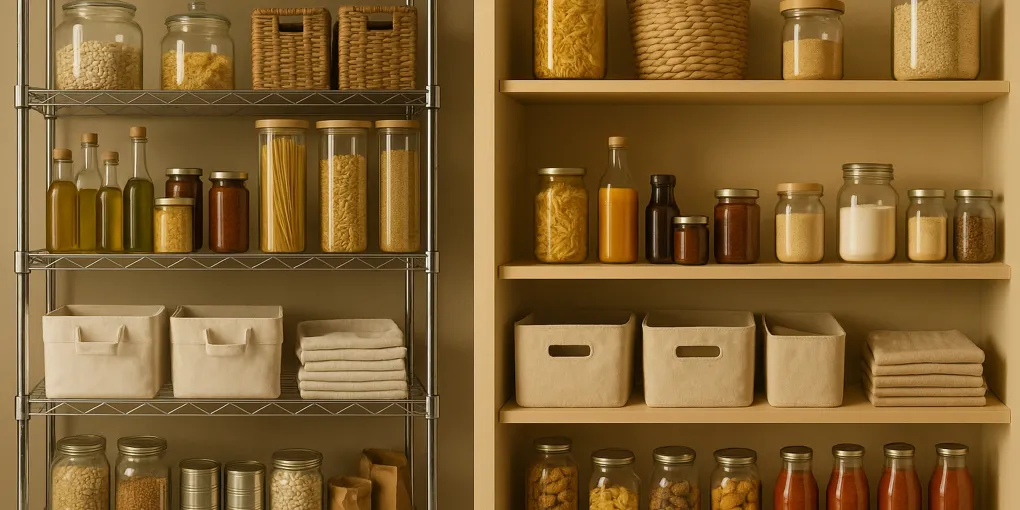
Wire Shelving vs Solid Shelving: Which Is Better? 2026
Buyer's GuideQuick picks
Product option
Quick picks
These are the products referenced in the guide; check dimensions, material, and installation limits before ordering.
- Recommended product: Check current options on Amazon
- Recommended product: Check current options on Amazon
- Recommended product: Check current options on Amazon
- Recommended product: Check current options on Amazon
Wire Shelving vs Solid Shelving: The Core Trade-Off
Walk into any home improvement store and you’ll face both options almost immediately: the gleaming chrome grid of wire shelving systems and the smooth, flat surface of solid shelf boards. Both hold items. Both attach to walls or freestand. But they perform differently across a wide range of real-world scenarios, and choosing the wrong type for a given space can mean years of minor frustrations—or worse, a structural failure.
The behavioral science angle here involves what researchers call affordance perception—the way a surface’s appearance shapes how people interact with it. Studies in environmental design show that open, grid-like surfaces (like wire shelving) communicate “utilitarian storage” to users, encouraging functional over decorative organization. Solid shelves signal “display” contexts, which influences what people choose to place on them and how carefully they arrange items. Neither signal is right or wrong—but it explains why wire shelves in a living room often look out of place even when they’re technically functional, while solid shelves in a garage workshop can feel overly precious.
Understanding this tension between utility and aesthetics is key to making the right choice. Wire shelving systems excel in spaces that are closed off from daily view—closets, garages, utility rooms, pantries—where function outweighs appearance. Solid shelving earns its place in visible, social spaces where the shelf is part of the room’s visual language.
Wire Shelving: What It Is and When It Wins
Wire shelving is constructed from steel rods welded or bent into a grid pattern, typically coated in epoxy, chrome, or vinyl. The standard gauge for residential use runs from 3/8-inch to 1/2-inch rod diameter. Heavy-duty commercial wire shelving uses thicker rod stock and can support substantially higher loads.
The defining advantage of wire shelving is airflow. The open grid allows air to circulate freely around stored items—critical in closets where clothing needs to breathe, in pantries where produce benefits from ventilation, and in garages where moisture accumulation causes rust and rot. This single characteristic makes wire shelving the default choice for professional closet organizers in humid climates.
Wire shelving is also remarkably adjustable. Systems like ClosetMaid and Rubbermaid FastTrack use wall-mounted brackets with adjustable clip placements, allowing shelf height changes in minutes without tools. This adjustability is a major long-term advantage: as your storage needs evolve—more hanging space, less folded storage, added shoe racks—wire systems reconfigure easily.
For garages and utility areas, wire shelving’s open design also improves visibility. You can see what’s stored on lower shelves when standing above the unit, without bending down to check each shelf individually. Items stored in the back of a shelf are visible through the grid, which reduces the “out of sight, out of mind” effect that drives pantry waste and garage hoarding.
Weight capacity is another strength. A standard 48-inch wire shelf from a quality manufacturer handles 200–350 lbs distributed across its surface. Heavy-duty commercial units rated for 600–1,500 lbs are available for garage and workshop use at reasonable prices.
The main limitations: wire shelving is unforgiving with small items that fall through the grid, it’s visually cold and industrial in appearance, and the vinyl coating can chip in high-contact areas over time, eventually leading to rust on non-galvanized models.
Solid Shelving: What It Is and When It Wins
Solid shelving encompasses MDF boards, plywood, particleboard, solid hardwood, melamine-coated panels, and veneer-faced boards. Each material has different structural properties, but all share the flat, uninterrupted surface that defines solid shelving.
The primary advantage is surface versatility. Solid shelves hold every item without instability: small bottles, thin books, individual spice jars, folded linens, framed photos. Nothing falls through or tips on a flat surface. This makes solid shelving the only practical choice for kitchen cabinets, bathroom shelves, and anywhere small items are stored in quantity.
Solid shelves are also aesthetically flexible. A properly cut and finished wood shelf is beautiful in a living room, a bedroom, or a home office. Wire shelving cannot compete on visual warmth, texture, or the ability to be painted, stained, or refinished to match surrounding decor.
For closets with folded clothing, solid shelving provides a more satisfying storage experience. Folded items stack more stably on flat surfaces, shirts and sweaters don’t snag on grid edges, and the shelf reads as a deliberate storage surface rather than an industrial fixture. Many homeowners who convert builder-grade wire closets to solid shelving report immediately improved satisfaction with the space—a documented phenomenon in residential satisfaction research.
Solid shelves attached to wall standards are also remarkably strong when properly anchored. Three-quarter-inch plywood on properly spaced brackets holds 50 lbs per linear foot without deflection—suitable for books, tool collections, and heavy equipment.
The main weaknesses: solid shelves don’t breathe, require more precise installation, are heavier to work with, and are significantly more susceptible to moisture damage in high-humidity environments. MDF in particular is vulnerable to water damage and swelling, making it a poor choice for basements, garages, and bathrooms without careful sealing.
Head-to-Head Comparison
| Feature | Wire Shelving | Solid Shelving |
|---|---|---|
| Cost | $15–$80 per unit | $20–$150 per unit |
| Airflow | Excellent | None |
| Small item stability | Poor (grid gaps) | Excellent |
| Aesthetics | Industrial/utilitarian | Warm, design-flexible |
| Weight capacity | 200–1,500 lbs | 50–300 lbs (board dependent) |
| Best for | Closets, garages, pantries | Living rooms, kitchens, offices |
| Moisture resistance | Good (galvanized/vinyl coat) | Variable (poor for MDF) |
| Adjustability | Easy (bracket systems) | Moderate (requires remounting) |
When to Choose Wire Shelving
Choose wire shelving for any closed or utility-forward space where function is the primary criterion. Reach-in closets, walk-in closets, garage storage walls, utility room shelving, basement storage, and pantries all benefit from wire shelving’s airflow and adjustability.
Wire shelving is the right call when you’re working with a budget. A complete ClosetMaid system for a standard reach-in closet—one hanging rod, two upper shelves—typically runs $40–$80 in materials and can be installed in a weekend. An equivalent solid-shelf system built from melamine panels and standards costs two to three times as much for materials alone.
In rental situations where wall damage must be minimized, wire shelving’s bracket system often creates smaller, more repairable wall penetrations than the multiple anchor points required for solid floating shelves.
Wire is also the right choice in spaces shared by multiple family members with evolving needs. A teenager’s closet that needs to transition from toy storage to hanging clothes to desk space benefits from an adjustable wire system that can be reconfigured without new materials or professional installation. Our best closet organization systems guide covers the top wire system options in detail.
When to Choose Solid Shelving
Choose solid shelving when the shelf will be visible and part of the room’s design. Living room built-ins, bedroom floating shelves, kitchen cabinet interiors, and bathroom vanity shelves all call for solid surfaces that can be finished to match the space.
Solid shelving is essential when small items are the primary load. Spice racks, bathroom vanities, desk supply shelves, and art supply walls all require the flat, stable surface that solid boards provide. Wire simply isn’t functional for these applications without full liner coverage—which is essentially just turning wire into pseudo-solid at extra cost.
If resale value is a concern, solid shelving—particularly well-executed built-ins or clean floating shelf installations—adds perceived home value in ways that wire shelving systems don’t. Buyers walking through a home with solid wood shelving in the closets and built-ins in the living room respond more positively than they do to equivalent wire systems, even when the functional storage capacity is similar.
For book storage, solid shelves are clearly superior. Wire shelving doesn’t provide adequate support for the concentrated linear weight of books, and the grid texture damages book spines over time. A solid shelf properly sized and anchored is the only appropriate solution for a meaningful book collection. See our best bedroom shelf organizers article for solid shelf options optimized for bedroom libraries and display storage.
Shelving material buying criteria
Use these factors to compare options before ordering:
| Factor | Weight | What to check |
|---|---|---|
| Research | 30% | Depth of specification and user-report analysis and breadth of products reviewed |
| Evidence Quality | 25% | Reliability of specs, product documentation, and repeated owner-reported fit patterns |
| Value | 20% | Cost-effectiveness relative to competing products at similar quality tiers |
| User Signals | 15% | Long-term owner feedback and fit-related complaints |
| Transparency | 10% | Accuracy of manufacturer claims, material disclosures, and dimension accuracy |
Scores are differentiated — top picks typically score 8.5–9.5, mid-tier 7.0–8.4, and weak options below 7.0.
Product Recommendations
Best Wire Shelving
ClosetMaid SuperSlide Heavy Duty Closet Organizer Kit $65–$90. The benchmark for wire closet shelving systems. The SuperSlide system uses a wall-mounted rail and adjustable shelf brackets that allow repositioning in minutes. Epoxy-coated steel resists chipping better than vinyl alternatives. The included hardware covers standard 5-foot closet configurations with room for customization.
| Criterion | Weight | Score |
|---|---|---|
| Capacity & Dimensions | 30% | 9.0/10 |
| Material Quality | 25% | 8.8/10 |
| Ease of Assembly & Use | 20% | 8.5/10 |
| Long-Term Value | 25% | 9.0/10 |
| Composite Score | 8.9/10 |
Check current options on Amazon
Honey-Can-Do 5-Tier Heavy Duty Wire Shelving Unit $45–$65. A freestanding wire shelving unit ideal for garages, basements, and utility rooms. NSF-certified for food storage. Chrome-plated shelves hold 350 lbs per shelf. Height-adjustable in 1-inch increments and fully tool-free assembly in under 20 minutes.
| Criterion | Weight | Score |
|---|---|---|
| Capacity & Dimensions | 30% | 9.2/10 |
| Material Quality | 25% | 8.5/10 |
| Ease of Assembly & Use | 20% | 9.0/10 |
| Long-Term Value | 25% | 8.8/10 |
| Composite Score | 8.9/10 |
Check current options on Amazon
Best Solid Shelving
BAYKA Floating Shelves Wall Mounted (Set of 3) $35–$50. These melamine-coated MDF floating shelves offer a clean, minimal aesthetic at a compelling price. Hardware includes wall anchors sized for both stud and drywall mounting. The concealed bracket system makes these look like thick slabs of wood on the wall. Best suited for bedroom, living room, and office display use.
| Criterion | Weight | Score |
|---|---|---|
| Capacity & Dimensions | 30% | 7.8/10 |
| Material Quality | 25% | 7.5/10 |
| Ease of Assembly & Use | 20% | 8.0/10 |
| Long-Term Value | 25% | 7.5/10 |
| Composite Score | 7.7/10 |
Check current options on Amazon
ClosetMaid 7194 Impressions Deluxe Hardwood Closet Organizer $120–$180. Where wire shelving systems prioritize function, this ClosetMaid Impressions kit prioritizes aesthetics without sacrificing adjustability. Hardwood veneer panels and solid wood rods deliver a custom-closet look at a fraction of built-in costs. The 5-foot kit includes a double hang section, single hang, and two shelves with enough hardware for a complete master closet transformation.
| Criterion | Weight | Score |
|---|---|---|
| Capacity & Dimensions | 30% | 8.8/10 |
| Material Quality | 25% | 9.0/10 |
| Ease of Assembly & Use | 20% | 7.5/10 |
| Long-Term Value | 25% | 8.8/10 |
| Composite Score | 8.6/10 |
Check current options on Amazon
The Verdict
Wire shelving and solid shelving aren’t in direct competition—they’re optimized for different environments and different use cases.
Wire shelving belongs in closets, garages, pantries, utility rooms, and any space that needs airflow, adjustability, and cost efficiency. Its utilitarian appearance is a fair trade for ventilation, weight capacity, and the ability to reconfigure without major effort.
Solid shelving belongs in visible rooms, kitchen interiors, bathroom vanities, and anywhere aesthetics contribute meaningfully to daily satisfaction. The investment in solid shelving pays off in rooms you spend time in, where the quality of the environment affects your mood and motivation.
For most homes, the right answer is to use both: wire shelving systems in closets and the garage, solid floating or bracket shelves in living spaces and bedrooms. Mixing the two in the same space rarely works well—pick one type per zone and execute it consistently.
When in doubt, start with wire. It’s faster, cheaper, more reversible, and does the core job of holding things better than most homeowners expect. Upgrade to solid where the aesthetics genuinely matter to you.
Frequently Asked Questions
- Wire shelving made from heavy-gauge steel often supports more weight per linear foot than solid MDF shelving. However, solid wood or plywood shelves outperform both on weight distribution for heavy, concentrated loads. Solid metal brackets with particleboard are typically the weakest option.
- Wire shelving works well in pantries for canned goods, bottles, and boxed items. The open grid can cause small items to tip, wobble, or fall through gaps, which is its main limitation. Shelf liners solve this problem and cost very little.
- MDF and particleboard shelves are susceptible to moisture damage and can harbor mold in humid closets. Solid hardwood and plywood are more resistant. Proper ventilation and avoiding moisture buildup matters more than shelf material for long-term performance.
- Wire shelving systems (like ClosetMaid) are generally faster to install because they use wall brackets and clips rather than full cabinet construction. Solid floating shelves require precise leveling and stud-finding but can be done without a full system.
- Wire shelving is excellent for garages. The open construction allows air circulation that prevents moisture buildup, and galvanized steel versions resist rust. Heavy-duty wire shelving units can hold 500–2,000 lbs total, making them practical for tools and equipment.