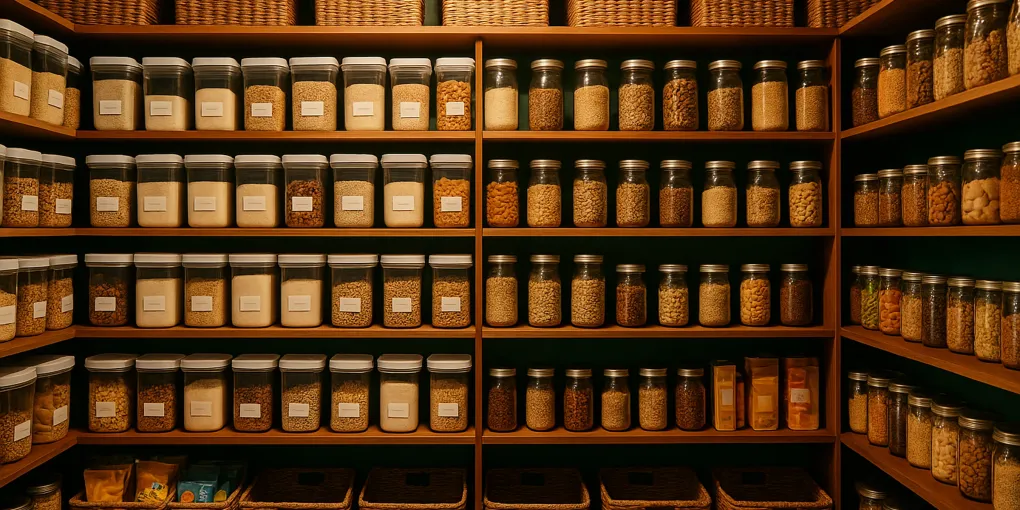
The Complete Guide to Kitchen Storage: Organization Systems That Actually Work (2026)
Buyer's GuideiDesign Linus Clear Pantry Bins
Best visible pantry/refrigerator binBest fit: Useful when duplicate buying and forgotten food are the problem. Choose sizes around shelf depth and package height.
Quick picks
| Product | Key Specs |
|---|---|
| See price on Amazon |
|
| See price on Amazon |
|
| See price on Amazon |
|
| See price on Amazon |
|
| See price on Amazon |
|
Product availability, certifications, and retailer details can change; check the current Amazon page before buying.
Product-Led Quick Picks
Kitchen storage works when each product solves a specific zone problem: visible pantry inventory, vertical bakeware retrieval, drawer categories, under-sink containment, or movable prep overflow. Do not buy a matching-bin set before measuring the zone.
Use the links below as named-product searches, then confirm the current dimensions, included hardware, return terms, and seller details before ordering.
For the adjacent setup decision, see our how to declutter a kitchen.
- Best visible pantry/refrigerator bin: Search Amazon for iDesign Linus clear pantry bins. Useful when duplicate buying and forgotten food are the problem. Choose sizes around shelf depth and package height.
- Best flat-pan cabinet fix: Search Amazon for YouCopia StoreMore bakeware racks. A strong first product for sheet pans, cutting boards, muffin tins, and cooling racks that are currently stacked.
- Best deep-cabinet upgrade: Search Amazon for Rev-A-Shelf pull-out cabinet organizers. Best when the back of a lower cabinet is wasted and installation is acceptable.
- Best mixed drawer reset: Search Amazon for OXO Good Grips expandable drawer organizers. Use for utensils and small tools when drawer categories need broad, visible lanes.
- Best movable small-kitchen surface: Search Amazon for drop-leaf rolling kitchen carts. Consider when counter space is the bottleneck and there is a clear parking path.
What to compare before buying
- One product per failed kitchen zone.
- Exact shelf, drawer, cabinet, or walkway measurements.
- Visibility for food inventory and daily tools.
- Install effort versus renter constraints.
- Cleaning access around spills, crumbs, and plumbing.
Table of Contents
- Why Kitchens Are Uniquely Hard to Organize
- The Behavioral Science of Kitchen Organization
- The Declutter-First Principle
- Zone-by-Zone Kitchen Organization Guide
- Refrigerator Organization Systems
- Freezer Organization
- Pantry and Cabinet Organization
- Drawer Organization
- Counter and Open Shelf Organization
- Organizer Material Guide: Bamboo vs. Metal vs. Plastic
- Stackable vs. Slide-Out Organizers: Choosing the Right System
- Kitchen Islands and Work Surface Solutions
- Specialty Storage: Wine, Recipes, and Baby Equipment
- Top Organization Products by Zone
- Frequently Asked Questions
Why Kitchens Are Uniquely Hard to Organize {#why-kitchens-are-uniquely-hard}
Every other room in a house is organized around one or two primary functions. The kitchen is organized around six or more: food storage (dry goods, refrigerated, frozen), food preparation, cooking, cleanup, appliance storage, and in many homes, casual dining. Each function has different spatial requirements, different access frequency patterns, and different organizational logic.
The kitchen also has the highest item turnover of any room. Items come in (grocery shopping), get consumed, and are replaced — continuously. Static organization systems break down quickly because the inventory they’re organizing is constantly changing. An organization system that worked perfectly before a Costco run doesn’t work afterward.
The third challenge is shared use. A single-user kitchen can be organized to one person’s mental model. A kitchen used by multiple household members requires organizational logic legible to everyone — clear enough to use without explanation, consistent enough to maintain without effort.
Effective kitchen storage addresses all three challenges: functional zoning, inventory-adaptive systems (especially for refrigerator and pantry), and visible, self-explanatory organization that multiple users can maintain.
The Behavioral Science of Kitchen Organization {#behavioral-science}
The most useful insight from behavioral science research on kitchen environments: what you can see, you use; what you can’t see, you waste.
A systematic review of 38 food placement studies (Shaw et al., 2020, Nutrition Reviews, DOI: 10.1093/nutrit/nuaa024) found consistent evidence that more prominently placed food items — at eye level, front-of-shelf, or at the first point of encounter — are selected at dramatically higher rates than identical items stored out of sight.
This isn’t about willpower. It’s about the brain’s accessibility bias — a well-documented tendency to act on what’s immediately available rather than what’s optimal. Research on food consumption patterns shows that items at the front of the refrigerator are eaten far more often than items pushed to the back, regardless of food category.
The practical implication: organizing your kitchen is organizing your choices. Where you put food determines what you eat. Where you put equipment determines what you cook. Clear storage, visible labels, and accessible front-positioning of priority items aren’t aesthetic choices — they’re behavioral design.
A related finding from Vohs et al., 2013 (Psychological Science, DOI: 10.1177/0956797613480186): participants in an orderly room were twice as likely to choose an apple over a candy bar as participants in a disorderly room. Physical environment activates cognitive frameworks around self-regulation. An organized kitchen isn’t just about finding things faster — it changes what choices feel natural.
The cortisol data is also relevant. Saxbe & Repetti, 2010 (Personality & Social Psychology Bulletin) found that women in homes they described as cluttered or “unfinished” showed flatter diurnal cortisol slopes — a hormonal profile associated with fatigue and burnout. Visual kitchen clutter is a chronic low-level stressor with measurable physiological consequences.
The Declutter-First Principle {#declutter-first-principle}
The most common mistake in kitchen organization: buying storage solutions before decluttering. New bins and organizers on top of excessive or poorly curated items produce organized clutter, not functional storage.
The right sequence:
1. Full empty-out, zone by zone. Remove everything from one zone (one cabinet, one drawer, the entire pantry). Every item out of the cabinet at once.
2. Categorize everything. Three piles: Keep, Donate/Discard, Relocate (items that belong in a different zone or room). Be ruthless about rarely-used items — the mandoline slicer used twice in three years, the novelty gadget that never integrated into actual cooking, the duplicated utensils that accumulated from multiple moves.
3. Measure before buying. Interior dimensions of cabinets, drawers, and shelves before purchasing any organizers. This is the step most people skip, and it causes the most regret — bins that don’t fit, shelf risers too tall for the clearance available, pull-out organizers sized for the wrong cabinet width.
4. Assign categories to zones. Kitchen organization logic is frequency-based: things used daily belong within arm’s reach of where they’re used; things used weekly belong in accessible secondary storage; things used monthly or less can tolerate deeper cabinet real estate.
5. Then buy organizers. Now you know exactly what dimensions you need, what volumes you’re organizing, and what specific problems you’re solving.
This sequence sounds slower than buying a set of bins and sorting into them, but it produces results that last. The bins-first approach typically requires redoing the organization within six months when the system proves incompatible with actual use patterns.
Zone-by-Zone Kitchen Organization Guide {#zone-by-zone-guide}
Effective kitchen organization divides the kitchen into functional zones based on task proximity, not just storage availability.
The Core Zones
The Prep Zone — the counter area adjacent to your cutting board, knife block, and most-used prep tools. Everything needed for daily meal preparation should live within this zone: cutting boards, knives (in a block or drawer organizer), mixing bowls, measuring cups, frequently used spices and oils. This zone has the highest access frequency in the kitchen and should be the most ergonomically optimized.
The Cooking Zone — the area around the stove and oven. Pots, pans, and cooking utensils (spatulas, ladles, tongs) belong here. Pull-out organizers in the base cabinet adjacent to the stove are transformatively useful for heavy cookware — the common alternative (stacking pots with lids balanced precariously) is both impractical and hazardous.
The Storage Zone — pantry, cabinet shelves, and the refrigerator. This is the inventory zone: dry goods, canned items, refrigerated foods, and frozen items. This zone requires the most systematic organization because its contents change constantly.
The Cleanup Zone — sink, dishwasher, and drying area. Dish storage should be near the dishwasher to minimize unloading distance. Cleaning supplies belong under the sink.
The Appliance Zone — counter space and cabinet storage for small appliances. Appliances used daily (coffee maker, toaster) stay on the counter. Appliances used weekly go in accessible cabinet storage. Appliances used monthly or less go in deep cabinet storage — or get donated if use frequency doesn’t justify the space cost.
Refrigerator Organization Systems {#refrigerator-organization}
The refrigerator is where behavioral science insights about food visibility have the most direct impact on household outcomes. A disorganized refrigerator — items pushed to the back, leftovers forgotten behind tall containers, produce wilting in a drawer that’s never opened — produces measurable food waste, duplicated grocery purchases, and a daily friction that degrades the kitchen experience.
The most effective refrigerator organization system has four components:
Zone assignment by category: Dedicated zones for produce, dairy, deli, leftovers, condiments, and beverages. Consistent zones mean household members know where to look and return items correctly.
Clear bins for category grouping: Clear bins group items of the same category, keep them contained within their zone, and make everything visible without moving items. The research imperative (Shaw et al., 2020) applies directly: if you can’t see it, you won’t eat it.
FIFO for perishables: New items behind existing items. This requires accessible fronting — items shouldn’t be stacked three deep — which clear bins enforce naturally.
Accessible lazy susans for condiments and jars: Condiment bottles and tall jars on a rotating platform prevent the back-of-shelf burial problem and allow retrieval without knocking over adjacent items.
The common outcome of a properly organized refrigerator (based on user community reports across Amazon verified purchase reviews): reduced food waste, reduced duplicate grocery purchases, and meaningfully reduced time spent “searching” — which is really time spent moving items to find what’s behind them.
Full article: How to Organize Your Refrigerator | Best Refrigerator Organizers
Freezer Organization {#freezer-organization}
Freezers are systematically underutilized. The typical household freezer contains a mix of ice-crusted items of unknown vintage, overlapping bags that resist stacking, and opaque containers whose contents were never labeled. The result: functional capacity far below physical capacity, and regular food waste from items that expire unnoticed.
The principles for freezer organization parallel refrigerator organization but with additional constraints: freezer items stack stiffly, are often opaque, and are pulled infrequently enough that un-labeled items become genuinely mysterious within months.
The freezer organization standard: Zone assignment (proteins, vegetables, prepared meals, ice cream/desserts), clear bins where possible, and a mandatory labeling system. Masking tape + permanent marker is sufficient. A label that reads “chicken thighs — Oct 2025” contains more information than a Ziploc bag with no label and an ice crust that obscures the contents.
Chest freezers require the most disciplined zone system — items at the bottom can go months without being surfaced. Vertical dividers and mesh bin inserts create accessible zones.
Full article: Best Freezer Organizers | How to Organize Your Freezer
Pantry and Cabinet Organization {#pantry-and-cabinet-organization}
Pantry organization is where the full behavioral science insight about decision-making applies most directly. An organized pantry with visible, accessible items changes what gets cooked — because ingredients you can see are ingredients you think to use.
The structural challenge in pantry organization: most pantry shelves are designed for a static display model that doesn’t account for the reality of multiple products with multiple heights, irregular shapes, and constantly varying inventory. The solution is modular sub-zoning within each shelf:
Category-based zones: Baking supplies, canned goods, pasta/grains, snacks, oils and vinegars, and spices as separate zones on dedicated shelf areas. Clear bins per category keep items from migrating.
Tiered shelf risers for depth visibility: Standard pantry shelves are deep enough that front items block rear items. A two-level shelf riser creates a visible “stadium seating” arrangement where items at the back remain visible.
The open-shelf vs. closed-cabinet decision is more than aesthetic. Research on food choices confirms that visible food exerts a pull on behavior — use this strategically. Open shelves work for aesthetically pleasing, frequently-used, or intentional-consumption items (whole grain cereals, fruit, nuts). Closed cabinets work for items you want to moderate consumption of or items that you want out of visual clutter.
Full article: Open Shelving vs. Closed Cabinets: Which Works Better? | How to Declutter Your Kitchen
Drawer Organization {#drawer-organization}
Kitchen drawers are organizational failure points in almost every household — a category driven by the fact that drawers are an easy “dump zone” for small items without obvious storage locations.
The two-drawer system covers most household kitchens: a utensil drawer (cooking utensils, spatulas, tongs, ladles — ideally near the stove) and a prep tools drawer (measuring cups, measuring spoons, peeler, can opener — near the prep zone). Everything else that accumulates in kitchen drawers — takeout menus, batteries, rubber bands, the unknown drawer items every household accumulates — belongs in either a designated junk drawer (with its own organization) or relocated out of the kitchen entirely.
Drawer organizers divide the drawer into fixed zones that prevent items from migrating. Bamboo organizers expand to fit various drawer widths and have a premium feel. Adjustable plastic dividers are more flexible for irregular drawer contents.
The junk drawer is its own organizational challenge — the principle is the same (categorize, dedicate zones, purge regularly) but the tolerance for the “miscellaneous” category is higher.
Full articles: Best Kitchen Drawer Organizers | How to Organize Your Junk Drawer
Counter and Open Shelf Organization {#counter-and-open-shelf}
The kitchen counter is the most visible and most contested space in the kitchen. It’s the default landing zone for new items, takeout containers, mail, and everything that doesn’t have a designated location elsewhere.
The organizing principle for counters: every item on a kitchen counter should earn that real estate. Earn it through daily use or through intentional display value. Anything used less than daily — including small appliances — should have a cabinet home.
The behavioral science evidence (Wansink et al., 2016) is direct: food visible on counters predicts consumption. This is useful for fruits and healthy snacks (leave them visible), and important to consider for items you want to moderate.
Open shelf organization requires additional discipline: the visual nature of open shelves means disorganization is immediately visible. The most successful open shelf systems use consistent container sizes and materials (matching glass jars for pantry staples, for example), restrict each shelf to one or two functional categories, and include a maintenance habit (a 5-minute weekly reset).
Organizer Material Guide: Bamboo vs. Metal vs. Plastic {#organizer-material-guide}
The material choice for kitchen organizers involves tradeoffs in durability, aesthetics, cost, and specific-use fit.
Bamboo organizers offer a warm, natural aesthetic, good structural strength for drawer dividers and countertop bins, and environmental sustainability credentials. They work best in dry environments — prolonged moisture contact causes warping and mold. Not ideal for inside refrigerators or for organizers that will be regularly washed. Strong for: drawer organizers, countertop holders, pantry containers.
Metal organizers (steel, stainless, coated wire) excel in high-moisture or high-temperature environments — under-sink, inside refrigerator drawers, near the stove. Wire systems allow airflow (important for produce). Durability is excellent; stainless won’t rust under normal kitchen conditions. Coated wire can chip, especially on drawer-track systems. Strong for: refrigerator bins, produce storage, under-counter pull-out systems.
Plastic organizers are the most versatile and affordable category. Clear plastic bins are the standard for refrigerator and freezer organization where visibility is paramount. BPA-free polypropylene is the appropriate material for food contact. Durability varies significantly by thickness — thin-walled bins from budget manufacturers deform and crack within 6–12 months of regular use; quality thick-walled bins last 3–5+ years. Strong for: refrigerator bins, pantry containers, bathroom (by extension) — anywhere clear visibility is the primary need.
The stacking consideration: Bamboo and thick plastic both support stacking. Metal wire typically does not stack cleanly. For pantry and cabinet applications where vertical efficiency matters, stacking compatibility is a key evaluation criterion.
Full comparison: Bamboo vs. Metal Organizers: Which Works Better?
Stackable vs. Slide-Out Organizers: Choosing the Right System {#stackable-vs-slide-out}
Two organizational approaches dominate kitchen cabinet optimization, and they solve different problems:
Stackable organizers solve the vertical space problem. Kitchen cabinets typically have 12–16 inches of clearance per shelf, and the standard single layer of items uses only the bottom 4–6 inches. Stackable risers and tiered organizers multiply the usable surface area within that clearance.
Stackable organizers don’t require installation, are portable, can be repositioned as storage needs change, and work in pantries, upper cabinets, and refrigerators. Cost: $15–60 per set. Primary limitation: they don’t solve the depth-access problem in deep base cabinets.
Slide-out organizers (pull-out shelves, cabinet slides) solve the depth-access problem. Standard kitchen base cabinets are 24 inches deep. The comfortable reach zone standing at a cabinet is about 12–14 inches. The back 10 inches is effectively dead storage for most users — items there are out of reach without crouching or moving front items. Pull-out organizers convert the full depth into accessible territory.
Slide-outs require installation (30–60 minutes per cabinet), must be sized to the specific cabinet opening, and cost $30–150 per unit. They’re most impactful in base cabinets used for heavy items (pots, pans, appliances, bulk pantry staples) where depth-access is the functional bottleneck.
The choice rule: If your problem is unused vertical space between shelves, use stackable organizers. If your problem is inaccessible items at the back of deep base cabinets, use slide-out organizers. Most kitchens benefit from both.
Full comparison: Stackable vs. Slide-Out Organizers: Which Works Better?
Kitchen Islands and Work Surface Solutions {#kitchen-islands}
A rolling kitchen island cart is the highest-ROI kitchen upgrade for homes with insufficient counter space or under-organized storage. For $100–400, a well-chosen cart adds 4–8 square feet of work surface plus integrated storage — at a fraction of the cost of a kitchen renovation.
What to evaluate in kitchen islands:
- Work surface height: Standard kitchen counter height is 36 inches. Island carts that match this height integrate ergonomically with existing prep work; shorter carts require bending.
- Storage configuration: Assess what storage gap you’re solving. Shelves for appliances and cookware? Drawers for utensils? A wine rack? Choose a cart whose integrated storage matches your actual need.
- Mobility: Rolling casters with locks allow repositioning for cleaning and for kitchen configurations where the island needs to move for traffic flow. Verify lock quality — cheap casters drift.
- Counter material: Butcher block is warm and functional (and can be used directly as a cutting surface); stainless is hygienic and heat-resistant; tile or solid surface is durable but adds weight.
Full article: Best Kitchen Island Carts
Specialty Storage: Wine, Recipes, and Baby Equipment {#specialty-storage}
Wine Storage
Wine storage in the kitchen creates a specific organizational and environmental challenge: wine needs consistent temperature (ideally 55–65°F), low vibration, and darkness — conditions that most kitchen environments don’t provide naturally. For serious wine collections, a dedicated wine fridge or cellar is appropriate.
For everyday table wine and casual storage (bottles consumed within weeks of purchase), kitchen wine racks provide accessible countertop or wall-mounted storage. Freestanding racks with good weight distribution and stable bases are the functional choice.
Full article: Best Wine Rack Storage Solutions
Recipe and Cookbook Organization
Cookbook and recipe management is increasingly digital, but physical cookbook collections remain common. Cookbook organization on open shelves follows the standard frequency-based logic: most-used cookbooks at eye level, reference or occasional cookbooks below. Recipe card organization — for those who maintain physical recipe collections — benefits from indexed binders or boxes with alphabetical or category tabs.
Full article: Best Recipe and Cookbook Organizers
Baby Bottle Organization
Households with infants face a specific kitchen organization challenge: baby bottles, nipples, caps, cleaning brushes, and drying racks create significant counter and cabinet clutter, and the sterilization requirements make regular washing and organized storage essential.
Dedicated bottle drying racks that fold flat when not in use, countertop organizers that keep components grouped and accessible, and drawer organizers sized for bottle components are the standard solutions.
Full article: Best Baby Bottle Organizers
Top Organization Products by Zone {#top-products}
The following products are selected based on the ClutterScience 4-criterion evaluation framework (Capacity & Dimensions, Material Quality, Ease of Assembly & Use, Long-Term Value), synthesizing specification-led assessment methodology and verified Amazon purchase reviews.
Best Refrigerator Organizer Set: mDesign Stackable Bins
Best for: Full-fridge organization with zone-based bin system Price: ~$25–35 (set of 4, two sizes)
mDesign’s clear polypropylene bins are the standard-bearer in refrigerator organization. The two-size format (two large, two small) allows zone coverage across produce, dairy, snacks, and deli. The stackable design enables vertical optimization on taller refrigerator shelves. BPA-free, top-rack dishwasher safe, 8,000+ verified purchase reviews at 4.4 stars (April 2026).
4-Criterion Score:
| Criterion | Score |
|---|---|
| Capacity & Dimensions | 8/10 |
| Material Quality | 8/10 |
| Ease of Assembly & Use | 10/10 |
| Long-Term Value | 8/10 |
| Composite | 8.5/10 |
Score notes: No installation required earns maximum Ease score. Slightly lower Capacity score reflects 4-bin count — full-fridge organization typically requires 2 sets. Material Quality 8/10: thick-walled construction holds shape under load but lacks handles (requires sliding on glass shelves). Long-Term Value 8/10 reflects 18+ month durability based on verified community reports.
See full article: Best Refrigerator Organizers
Best Drawer Organizer: SpaceAid Bamboo Drawer Dividers
Best for: Kitchen utensil drawers, prep tool drawers Price: ~$16–24 (set of 5 expandable dividers)
SpaceAid’s bamboo dividers expand to fit drawers from 10” to 21” wide and are the top-rated bamboo drawer organizer on Amazon (4.6 stars, 3,000+ reviews). The spring-tension mounting requires no tools and no adhesive — press to fit, release to reposition.
4-Criterion Score:
| Criterion | Score |
|---|---|
| Capacity & Dimensions | 9/10 |
| Material Quality | 9/10 |
| Ease of Assembly & Use | 9/10 |
| Long-Term Value | 9/10 |
| Composite | 9.0/10 |
Score notes: Adjustable expansion system earns Capacity 9/10 — fits nearly all standard kitchen drawer widths without measuring or cutting. Bamboo construction is durable and aesthetically superior to plastic alternatives at similar price points. Ease 9/10 — tool-free tension installation. Long-Term Value 9/10 — bamboo organizers in this price range consistently last 3+ years under daily use based on community reports.
Best Under-Counter Pull-Out: Rev-A-Shelf Pull-Out Drawer
Best for: Base cabinet depth-access solution for heavy pots, pans, appliances Price: ~$80–150 (single pull-out)
Rev-A-Shelf is the established brand in kitchen pull-out organizers, used by professional kitchen designers. Full-extension ball-bearing slides ensure smooth operation even fully loaded. Proper installation in a standard face-frame cabinet takes approximately 45 minutes.
4-Criterion Score:
| Criterion | Score |
|---|---|
| Capacity & Dimensions | 9/10 |
| Material Quality | 9/10 |
| Ease of Assembly & Use | 7/10 |
| Long-Term Value | 9/10 |
| Composite | 8.7/10 |
Score notes: Installation requirement lowers Ease score — not appropriate for renters or those avoiding drilling. Excellent Capacity and Material Quality scores reflect the full-depth-access mechanism and commercial-grade slide hardware. Long-Term Value 9/10 based on multi-year durability in installed kitchen environments.
See full article: Best Under-Counter Organizers
Explore All Kitchen Storage Articles
This guide organizes all 15 kitchen storage articles on ClutterScience. Use these links for zone-specific deep dives:
Zone Guides (How-To): How to Declutter Your Kitchen · How to Organize Your Refrigerator · How to Organize Your Freezer · How to Organize Your Junk Drawer
Product Roundups (Best-Of): Best Refrigerator Organizers · Best Freezer Organizers · Best Kitchen Drawer Organizers · Best Under-Counter Organizers · Best Kitchen Island Carts · Best Wine Rack Storage Solutions · Best Baby Bottle Organizers · Best Recipe and Cookbook Organizers
Comparisons: Bamboo vs. Metal Organizers · Open Shelving vs. Closed Cabinets · Stackable vs. Slide-Out Organizers
ClutterScience evaluations draw on behavioral science research, specification-led product assessment methodology, and Amazon verified purchase community data. Affiliate relationships do not influence editorial rankings — the most effective product for the use case receives the top recommendation regardless of commission rate.
Kitchen Storage Product FAQ
What kitchen organizer should I buy first?
Buy for the first failed zone, not the whole kitchen. Clear pantry bins help forgotten food, YouCopia-style racks help stacked bakeware, and OXO-style inserts help mixed drawers.
Are pull-out cabinet organizers worth the installation?
They are worth considering in deep lower cabinets where the back half is wasted. Freestanding bins or racks are better when you rent or need a reversible setup.
Should a small kitchen use a rolling cart?
Use a rolling cart only if it has a clear parking place and does not block appliance doors or walkways. Otherwise, shelf risers, drawer organizers, or wall storage usually solve more with less floor space.
Frequently Asked Questions
- Start with a full empty-out of one zone — countertops, one drawer, or one cabinet. Remove everything. Categorize what you have (keep, donate/discard, relocate). Then measure the empty space precisely before buying any organizers. Buying containers before measuring is the single most common decluttering mistake. The goal of the first session is a complete picture of what you have and where it belongs — not perfect organization. Momentum comes from completing one zone fully before moving to another.
- Clear stackable bins or containers — whether for the refrigerator, pantry, or cabinets — consistently deliver the highest ROI across kitchen zones. Behavioral science research on food environments (Shaw et al., 2020, Nutrition Reviews) confirms that visible food gets eaten; invisible food gets wasted. Clear containers that show contents without opening eliminate the "I didn't know it was there" cycle that wastes food and money. After clear bins, drawer organizers (bamboo or plastic) and cabinet pull-outs typically follow in impact.
- Three principles for small kitchens. First, use vertical space — stackable bins, tiered shelf risers, and over-door organizers convert unused air space into functional storage. Second, apply the countertop standard — if you use it less than once per week, it should be stored, not displayed. Third, eliminate duplicates and rarely-used items aggressively. Most kitchen clutter is underused items that belong to a previous version of your cooking habits. A small kitchen with 60% of what you own well-organized beats a larger kitchen in disarray.
- A full kitchen audit once per year is a practical cadence for most households — usually after the holiday season when extra items have accumulated. Smaller zone-specific reorganizations (pantry, refrigerator, freezer) should happen every 3–6 months or when you notice consistent friction (spending more than 10 seconds locating an item, forgetting food exists, regular duplicate purchases). The goal is not a perfect static system — it's a dynamic system that adapts as your habits change.
- FIFO stands for "first in, first out" — the restaurant inventory management principle adapted for home kitchens. When restocking pantry or refrigerator, new items go behind existing items so older items are consumed first. This eliminates the expired-item problem in pantries and the forgotten-leftovers problem in refrigerators. Implementing FIFO requires visible, accessible storage (clear bins, pull-out shelves) rather than stacking where new items pile on top and old items are buried.
- Yes, with conditions. A rolling kitchen island cart adds 4–8 square feet of counter and storage space for $100–400, which is far cheaper than a kitchen renovation. The key conditions for worthwhile purchase are floor clearance (enough space to roll without blocking traffic paths), a work surface height matching your counter height (standard 36 inches), and built-in storage that addresses your specific gap (shelves for appliances, drawers for utensils, wine rack if applicable). Rolling carts that can be repositioned or moved when not needed are especially useful in open-plan kitchens.