Why Open Cubbies Become Dumping Grounds: The Clutter Science of Half-Visible Storage
Evidence ExplainerQuick picks
Cube Storage Fabric Bins
★ Top pick Best containment fix- Best For: Loose categories such as toys, winter gear, and pet supplies
- Caveat: Opaque bins need labels or they become mystery boxes
Clip-On Basket Label Holders
Best visibility fix- Best For: Turning cubby bins into named categories
- Caveat: Check whether clips fit fabric, wicker, or plastic bin rims
Open cubbies promise easy access. That is why they show up in mudrooms, playrooms, closets, dorm rooms, and entryways. But the same openness that makes them convenient can also make them a dumping ground.
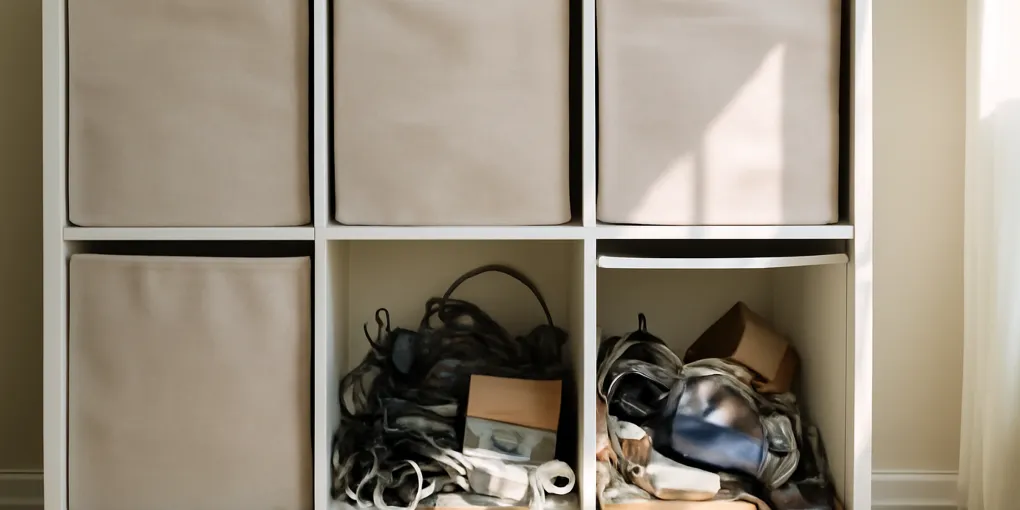
The problem is half-visible storage. A cubby is visible enough to receive whatever is in your hands, but often not defined enough to tell you what belongs there. Without a category boundary, one square becomes a soft archive for gloves, library books, toys, chargers, returns, hats, dog leashes, and the object someone did not want to decide about.
The fix is not always more bins. The fix is matching the cubby to the category: open cubbies for items with shape and obvious identity, bins for loose groups, labels for shared systems, and empty space for items that are actively moving through the home.
For a related entryway system, see our family drop zone protocol. Cubbies work better when they are part of a named drop zone rather than the only storage rule.
Quick picks for cubby fixes
- Best containment fix: Search Amazon for cube storage fabric bins. Use these for loose categories that collapse into a pile.
- Best visibility fix: Search Amazon for clip-on basket label holders. Use labels when several people use the same shelf.
- Best display-only alternative: Search Amazon for cube shelf dividers. Use dividers only when the cubby holds upright books, files, or flat items that need separation.
The visibility trap
Open cubbies are not fully open storage and not fully concealed storage. They sit in the middle. You can see the mess from across the room, but you often cannot see the contents clearly enough to retrieve one item without pulling the whole pile forward.
That creates a visual attention problem. In crowded scenes, objects compete for attention; McMains and Kastner (2011, DOI: 10.1523/JNEUROSCI.3766-10.2011) describe how multiple objects compete in visual cortex. A cubby packed with mixed objects turns one storage square into a mini crowded scene. Your eye sees clutter, but not a useful next action.
Opaque bins can improve the room view, but they add a memory problem. If the bin is not labeled or assigned to one category, it becomes easier to ignore. Clear bins can improve visibility, but they may keep visual noise on display. The best choice depends on whether the household problem is seeing too much or forgetting what is inside.
The category boundary problem
A good cubby category has a clear membership rule. “Library books” works. “Dog walking” works. “School papers to sign” works. “Stuff for later” fails because nearly anything can enter.
Open cubbies become dumping grounds when the category boundary is broad, emotional, or temporary. A cubby labeled “returns” can work for a week. A cubby silently used for returns, donations, gifts, and mail will overflow because every item has a different next step.
Use this test: if a visitor could put the item back correctly after hearing a two-word category name, the cubby is defined well enough. If the visitor would need a story, the cubby needs a bin, label, split, or new location.
When open cubbies work well
Open cubbies are excellent for items that are bulky, visible, and returned often. Examples include:
- Backpacks assigned by person.
- A single pair of daily shoes.
- Library books due this week.
- A folded throw blanket.
- A current sports bag.
- One activity kit in a handled bin.
These items have shape and identity. You do not need to rummage through them. The cubby acts as a parking space.
Open cubbies work poorly for tiny mixed objects, clothing piles, loose papers, sentimental overflow, and items with unresolved decisions. Those categories need a container, a deadline, or a different process.
When to add bins
Add a bin when the cubby holds small items that scatter or when the category needs to move as a group. Fabric cube bins are useful for mittens, pet supplies, toy sets, craft kits, and seasonal accessories. Woven baskets can work in visible living spaces, but measure carefully because many cube shelves have tight openings.
The bin should match the reset behavior. A toy bin can be open because a child needs to toss pieces in quickly. A document bin should be more structured because papers need orientation and dates. A winter-gear bin needs a washable or breathable surface because damp gloves should not be sealed into a deep opaque container.
If you add bins, add labels. Otherwise, the shelf may look calmer while becoming harder to use.
When to keep a cubby open
Keep a cubby open when the contents are self-identifying. Books, one backpack, a folded blanket, or one pair of shoes do not need to be hidden. Adding a bin may create an extra step and reduce use.
Open cubbies are also good for active transit categories. A library-book cubby, return-to-car cubby, or school-form cubby should stay visible because the point is movement. The visual cue reminds you to act.
The key is expiration. A transit cubby needs a review rhythm. If the library-book cubby contains last year’s notebooks, it stopped being a transit zone.
Fit checks that matter
For open-cubby fixes, the useful checks are category clarity, child or adult reach, review rhythm, label visibility, and whether each cubby has a short-lived transit job.
For open cubbies, Research emphasizes attention, habit, and category-design evidence. Evidence Quality favors direct observable behavior: does the cubby show the next action, keep one category bounded, and make return easier than dropping the item elsewhere? Value rewards inexpensive fixes such as labels or a few bins before buying a new shelf. User Signals include whether the household can reset the cubby during a normal weekday, not only after a weekend overhaul. Transparency means the cubby visibly communicates its job.
This scoring favors one-category cubbies and labeled bins over decorative cube shelves packed with mixed items.
A five-cubby reset
Use this reset when a cube shelf or mudroom bench has started to absorb everything.
- Photograph the shelf before sorting. The photo shows which cubbies are failing under normal use.
- Empty one cubby at a time. Do not empty the whole room.
- Name the category that would make the cubby useful.
- Remove anything that does not match that category.
- Decide whether the category needs open space, a bin, a label, or a different location.
- Leave one cubby partly empty if the shelf receives temporary items.
The partly empty cubby is not wasted space. It is capacity for real life.
Room-specific examples
In an entryway, a cubby should usually be assigned by person or leaving-the-house action. One child’s backpack cubby can stay open because the object is large and obvious. A glove-and-hat cubby usually needs a bin because the items are small, seasonal, and easy to mix with dog leashes or mail.
In a playroom, cubbies should match cleanup categories a child can recognize. Blocks, cars, costumes, and puzzles are better than learning, imagination, and fun. If puzzle pieces keep migrating, use a lidded case inside the cubby rather than expecting the open square to contain them.
In a closet, cubbies work best for folded items that hold their shape: sweaters, jeans, or one stack of workout clothes. They work poorly for slippery scarves, mixed accessories, or off-season clothing that should be sealed from dust. Use a bin when the category cannot stand or stack neatly on its own.
Open-cubby clutter questions
What should not go in open cubbies?
Avoid loose papers, tiny mixed objects, damp clothing, sentimental items awaiting decisions, and categories that need privacy or dust protection. These turn cubbies into visible clutter quickly.
Are cube bins better than baskets?
Cube bins are better when the shelf opening is square and tight. Baskets are better when the shelf is visible in a living area and the basket dimensions still allow easy sliding.
How do I organize kids’ cubbies?
Assign by activity or person, not by vague item type. “Soccer,” “library,” and “school morning” are easier to maintain than “misc toys” or “extras.”
Why does one empty cubby help?
An empty or flexible cubby gives incoming items a temporary landing place. Without that buffer, temporary items invade permanent categories.
Sources
- McMains, S. A., and Kastner, S. (2011). Interactions of top-down and bottom-up mechanisms in human visual cortex. DOI: 10.1523/JNEUROSCI.3766-10.2011.
- Wood, W., and Neal, D. T. (2007). A new look at habits and the habit-goal interface. DOI: 10.1146/annurev.psych.58.110405.085617.
- American Academy of Pediatrics. Preventing furniture and TV tip-overs: https://www.healthychildren.org/English/safety-prevention/at-home/Pages/Preventing-Furniture-and-TV-Tip-Overs.aspx. Anchor tall cube shelves and avoid loading heavy items high.
Frequently Asked Questions
- Open cubbies get messy when they are used for undefined categories. They are visible enough to invite quick drops but not structured enough to guide where items should return.
- Bins are not always necessary, but they help when a cubby holds small, soft, or mixed items. Use open cubbies for books or display items and bins for loose categories.
- One cubby should usually hold one category or one small activity kit. If a cubby needs a long explanation, split it or move part of the category elsewhere.
- Small consistent labels usually reduce visual confusion because they make each bin's purpose obvious. Oversized decorative labels can add visual noise if they compete with the shelf.