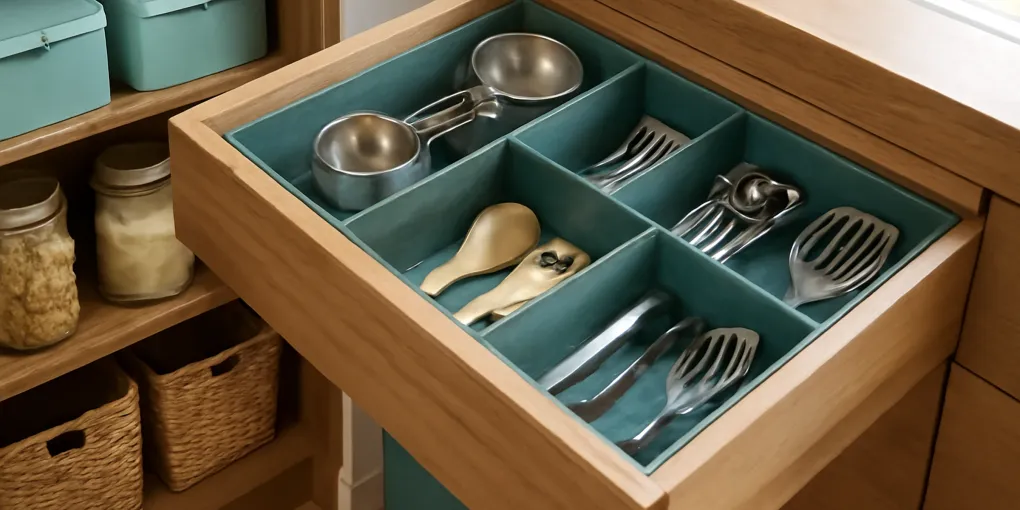
Best Drawer Dividers for Measuring Cups and Utensils: Stop the Kitchen Tool Tangle
Buyer's GuideBambüsi spring-loaded bamboo drawer dividers
Best adjustable lane systemBest For: Wide drawers that need custom lanes for measuring cups, spatulas, and whisks
Quick picks
| Product | Key Specs | Pros / Cons |
|---|---|---|
| See price on Amazon |
|
|
| See price on Amazon |
|
|
| See price on Amazon |
|
|
Product availability, certifications, and retailer details can change; check the current Amazon page before buying.
A kitchen drawer divider succeeds when you can grab a measuring spoon without excavating a whisk, citrus zester, chip clip, and three duplicate spatulas. It fails when it creates pretty compartments that are too short, too shallow, or too full for the tools you actually use.
This guide is for the messy utility drawer near the stove or prep counter. If your larger issue is countertop appliance cords, see our small-appliance cord management guide. If under-sink tools are mixing with chemicals, use the under-sink cleaning product separation protocol first. Cooking tools need a food-safe, easy-clean drawer, not just a decorative tray.
Quick product shortlist
- Best adjustable lanes: Search Amazon for Bambüsi bamboo drawer dividers when measuring cups, whisks, and spatulas need custom widths.
- Best everyday tray: Search Amazon for OXO expandable utensil organizers when a standard drawer needs shallow fixed zones.
- Best modular insert: Search Amazon for YouCopia DrawerFit organizers when odd tools need movable compartments.
Do not buy the organizer until you have measured the drawer interior and counted the bulky tools that cause the tangle.
The measuring-cup problem
Measuring cups are awkward because they nest, swing by their handles, and often travel with spoons, funnels, scrapers, and bag clips. A narrow silverware tray is usually wrong. The cup stack needs a long lane with enough width for handles. Measuring spoons can sit in a small compartment, but cups need room to be lifted without snagging.
The drawer should support the cooking sequence. Flour scoop, measuring spoon, spatula, and peeler should not all cross the same pile. If a tool is used weekly, give it a lane. If it is used twice a year, move it to a secondary bin.
Best for wide drawers: Bambüsi-style adjustable bamboo dividers
Spring-loaded bamboo dividers work best when the drawer is wide and shallow enough to create two to five long lanes. Put measuring cups in one lane, spatulas and wooden spoons in another, peelers and small prep tools in a shorter insert, and specialty tools at the back.
Check drawer construction first. Thin drawer walls, bowed sides, or very shallow boxes may not hold spring pressure well. The divider should fit snugly without forcing the drawer box outward. Add small nonslip pads if the dividers creep when the drawer opens.
Best for standard drawers: expandable utensil tray
An expandable tray is easier when the drawer already matches standard utensil dimensions. It gives spoons, spatulas, peelers, and small tools predictable homes. It also lifts out for cleaning, which matters because kitchen drawers collect crumbs, flour dust, and sticky residue.
The limitation is shape. A fixed tray may waste the back corners and can be too short for long tongs or balloon whisks. If those tools are the real clutter, choose long dividers instead of a tray with many small slots.
Best for odd tools: modular inserts
Modular inserts help when the drawer contains a strange mix: measuring spoons, corn holders, peelers, pastry brush, thermometer, jar opener, and scraper. Movable compartments let you build around the actual tools instead of accepting the tray maker’s idea of a kitchen.
Use modular pieces for small and medium tools. Very long utensils still need a lane. Do not solve a 60-tool drawer by adding 60 little compartments. First remove duplicates, damaged tools, and gadgets you no longer use.
Food-zone cleaning checklist
Kitchen drawer organizers need to be easy to empty and clean. The FDA’s food-safety guidance emphasizes clean food-contact surfaces and avoiding cross-contamination. Even though a drawer divider is not a cutting board, it sits in a food-prep zone. Crumbs, flour, and residue should not become permanent drawer layers.
- Choose smooth surfaces over fuzzy liners.
- Avoid unfinished crevices that trap crumbs.
- Keep raw-meat tools, grill tools, and cleaning brushes out of the daily utensil drawer.
- Lift and wipe the organizer monthly, or sooner after spills.
- Replace cracked plastic or splintered wood that cannot be cleaned well.
Practical score
| Factor | Weight | What matters |
|---|---|---|
| Tool fit | 30% | Measuring cups, spoons, and long utensils lift out without snagging. |
| Adjustability | 25% | Compartments can match the drawer and tool mix. |
| Cleanability | 20% | The organizer can be removed or wiped without trapped crumbs. |
| Drawer clearance | 15% | Tools do not block the drawer from closing. |
| Duplicate control | 10% | The system discourages keeping four versions of the same tool. |
Drawer layouts that work
For a narrow drawer, skip the big expandable tray and create two long lanes. Put measuring cups and spoons in the front lane, then spatulas or wooden spoons behind them only if the drawer is deep enough. A narrow drawer fails when every compartment is short and every handle points a different direction.
For a wide shallow drawer, use dividers to create job-based lanes: measuring, stirring, cutting and peeling, serving, and specialty. Keep the most-used lane closest to the side where your hand naturally enters. If you bake often, measuring cups and spoons deserve the front. If weeknight cooking is mostly skillet meals, spatulas and tongs may deserve the front.
For a deep drawer, use height carefully. Deep drawers invite stacking, but stacking measuring cups under whisks brings back the tangle. Use tall dividers only if the tools remain visible from above. If the drawer is deep enough for bins, choose bins with low fronts so small tools do not disappear.
What to move out before installing dividers
A divider cannot fix an overstuffed tool collection. Remove takeout chopsticks, sauce packets, birthday candles, mystery appliance parts, duplicates you never reach for, and specialty tools that belong with the appliance they serve. Grill tools, meat thermometers used only outdoors, and raw-meat prep tools should not sit loose with everyday measuring tools.
Next, remove broken or unpleasant tools. A cracked measuring cup, bent peeler, melted spatula, or whisk with loose wires adds search friction every time the drawer opens. Keep the versions you reach for first. The drawer should make the best tool easiest to grab, not preserve every backup.
How to place measuring tools
Nested measuring cups should sit handles in the same direction, with the largest cup underneath and the smallest visible. If the set is on a ring that tangles, consider removing the ring and giving the cups one lane. Measuring spoons can stay on a ring if the ring does not snag. Otherwise, a shallow cup or small compartment is faster.
Keep dry measuring tools away from sticky prep tools when possible. Honey spoons, pastry brushes, and oil-covered silicone brushes leave residue that migrates. If those tools share the drawer, put them in a washable small bin rather than directly against wood dividers.
Buying details people miss
Measure inside dimensions, not cabinet face dimensions. Drawer boxes often lose space to slides, rounded corners, and rear stops. Also measure tool height with the tallest spatula or cup stack in place. A drawer that closes when empty may jam when a divider lifts the tools by half an inch.
Check whether the organizer has nonslip feet or needs a liner. A tray that slides to the back will frustrate everyone and make small tools disappear underneath. If you choose bamboo, inspect for smooth edges. If you choose plastic, check that corners are rounded enough to wipe clean.
Look at the drawer pull angle too. Heavy tools can roll forward if the drawer opens quickly, so the front lane should hold stable items rather than loose peelers and thermometer probes. If children help unload the dishwasher, choose broad obvious lanes instead of a delicate layout that only one adult understands.
When one drawer is not enough
Some kitchens need two utensil zones. Keep daily cooking tools near the stove and measuring tools near the prep surface or baking ingredients. Serving pieces, grilling tools, holiday cutters, and appliance-specific blades can live elsewhere. Splitting by work zone is better than forcing every tool into the most convenient drawer.
The test is simple: can you name what belongs in the drawer in one sentence? Daily measuring and stirring tools is a usable rule. Everything that might be useful while cooking is too broad. A divider system works when the boundary is clear enough for anyone to put tools back without guessing.
Measuring-cup drawer FAQ
Should measuring cups hang instead of going in a drawer?
Hanging works if the cups are near the prep zone and do not clatter into cabinet doors. In many kitchens, a long drawer lane is calmer and keeps the set together.
Are bamboo dividers better than plastic trays?
Neither is automatically better. Bamboo dividers are better for custom lanes and long tools. Plastic or composite trays are often easier to wash after sticky spills. Choose for the drawer and cleaning routine.
What should leave the utensil drawer first?
Remove duplicates, damaged tools, rare holiday gadgets, takeout packets, and non-cooking items. The divider should organize active tools, not defend a crowded drawer.
Sources and safety notes
- FDA kitchen food-safety basics: https://www.fda.gov/food/buy-store-serve-safe-food/safe-food-handling
- FDA kitchen setup and cleaning guidance: https://www.fda.gov/food/buy-store-serve-safe-food/food-safety-your-kitchen
Frequently Asked Questions
- Long adjustable lanes usually work better than tiny square compartments because cup handles and nested sets need length.
- Store daily tools by job first: measuring, stirring, peeling, serving. Size matters only after each job has a clear lane.
- Leave enough space for each lane to close without tools climbing over the divider. If the drawer needs shaking, it is too full.