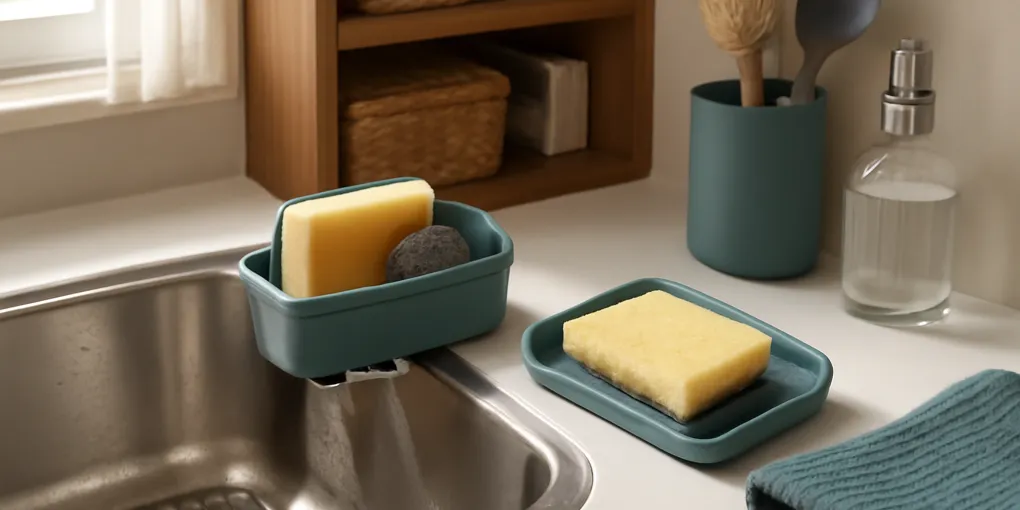
Best Sponge Holders That Drain: Keep Sink Tools Dry Without Crowding the Counter
Buyer's GuideOXO Good Grips Stainless Steel Sink Caddy
Best divided caddyBest For: Households that need sponge, brush, and scraper separation beside the faucet
Quick picks
| Product | Key Specs | Pros / Cons |
|---|---|---|
| See price on Amazon |
|
|
| See price on Amazon |
|
|
| See price on Amazon |
|
|
Product availability, certifications, and retailer details can change; check the current Amazon page before buying.
A good sponge holder is not just a place to hide the sponge. It is a small drainage system. The right holder keeps the sponge exposed to air, separates brushes from scrub pads, and gives dirty water a path away from the counter. The wrong holder turns one wet sponge into a slippery tray of residue.
If your sink cabinet is the bigger issue, start with our under-sink storage safety protocol. If the odor starts below the sink instead of at the basin, see why damp cleaning cloths smell under the sink. This guide is for the active sink-side tools you touch every day.
Quick product shortlist
- Best divided caddy: Search Amazon for OXO stainless sink caddy when a sponge, bottle brush, and scraper need separate spots.
- Best in-sink rail option: Search Amazon for iDesign Gia suction sink center when drips should fall straight into the basin.
- Best premium caddy: Search Amazon for simplehuman KT1166 sink caddy when you want a neater counter-side setup with removable parts.
Choose by drainage path first, capacity second, and looks third. A pretty ceramic cup that traps water under the sponge is not a drying system.
What actually matters in a draining sponge holder
The first requirement is open contact. A sponge pressed flat against a dish or cup dries slowly because one side stays wet. Look for rails, perforations, open wire, or a standing slot that lets air reach both faces.
The second requirement is a clear drip route. In-sink holders let water fall into the basin. Countertop caddies need a removable tray or a spout that can be rinsed. Shallow trays should have a lip or slope that keeps drips from running toward grout lines, wood trim, or the backsplash seam. If water pools under the sponge, the holder becomes another item to scrub.
The third requirement is tool separation. Brushes, chain-mail scrubbers, bottle nipples, dish wands, and steel-wool pads should not all sit in one wet clump. A divided caddy prevents the sponge from wrapping around other tools and holding moisture.
Best for most kitchens: divided stainless sink caddy
A divided caddy such as the OXO-style stainless sink caddy works when the sink area handles several tools. It gives the sponge one zone, a brush another zone, and usually leaves enough airflow around both. This is the most forgiving choice for households that cook often and wash a mix of pans, bottles, and plates.
Check the base before buying. Some caddies use a removable plastic tray; others rely on open drainage. If the caddy sits on the counter, the tray should slide out easily. If it hangs over the sink, make sure it does not block the faucet, sprayer hose, or garbage-disposal switch.
Use this style if your current problem is a pile of tools on the back ledge. Skip it if your sink ledge is narrow or if a larger caddy will crowd food-prep space.
Best small-space option: suction sink holder
A suction holder is the cleanest answer when it sticks. It keeps the sponge inside the sink wall and lets water drip where it already belongs. The footprint is tiny, and the counter stays clear.
The catch is surface fit. Suction cups perform best on smooth, flat, clean surfaces. They are weaker on stone-textured sinks, curved corners, wet soap film, and old porcelain. Before relying on one, clean the sink wall, press the cups firmly, and load only the tools the holder is designed to carry.
Use a suction holder for one sponge and maybe one small scrubber. Do not treat it as a heavy brush rack unless the listing and reviews support that load.
Best visible-counter option: premium counter caddy
A simplehuman-style counter caddy can make sense when the sink wall will not hold suction or when the sponge needs to stay beside a tall faucet. The advantage is stability and better visual control. The tradeoff is that the counter now owns the drainage problem.
Look for removable inserts, wide drainage openings, and a tray that can be cleaned without disassembling the whole product. Stainless panels look calm, but the hidden underside still needs access. If you cannot rinse the place where water collects, the caddy will age badly.
This option is best for people who will clean the caddy weekly and want the sink tools to look intentional in an open kitchen.
Fit checklist before you buy
- Measure the sink ledge depth and faucet swing.
- Count the tools that need to dry at the same time.
- Decide whether drips should go into the basin or a removable tray.
- Check whether suction cups match your sink surface.
- Avoid closed cups, deep dishes, and holders that hide the bottom of the sponge.
Match the holder to your sink layout
A single-basin stainless sink usually works well with an in-sink suction or rail holder because the sponge can drip into the basin without stealing prep space. The holder should sit high enough that it does not get flooded when a pan is soaking, but low enough that water does not run down the outside wall.
A divided sink often needs more care. If the holder sits on the divider, check whether large pots still fit and whether the sponge gets splashed by food debris from both sides. If the divider is narrow, a counter caddy with a removable tray may be less annoying than a holder that falls during cleanup.
An undermount sink with a stone counter usually favors a compact countertop caddy. Suction cups may not have a flat vertical surface, and adhesive products can be a poor fit for stone or sealed surfaces. In that case, choose the smallest caddy that holds the daily sponge and brush, then keep backup scrubbers somewhere else.
A farmhouse or apron-front sink often has less back-ledge space than it appears in photos. Measure the ledge depth behind the faucet before buying a wide caddy. Many product returns happen because the caddy fits the sponge but not the faucet, backsplash, or sprayer hose.
What to avoid
Avoid closed ceramic cups for active sponges unless they have raised ribs and real drainage. They look calm on the counter, but the sponge sits in a damp pocket. Avoid oversized sink caddies that become a storage garage for bottle brushes, old scrub pads, drain stoppers, and mystery attachments. The active holder should hold what dries today, not everything that has ever cleaned a dish.
Also avoid adhesive holders if your lease, sink finish, or cleaning routine makes removal risky. A low-cost suction holder is easier to test. If it fails, move to a counter caddy rather than adding stronger adhesive to a wet zone.
How to keep the holder from becoming the new mess
Give the sponge one home and make it stand or lean, not lie flat. Rinse food debris from the holder at the end of dishwashing. Once a week, remove every tool, wash the holder, and let it dry completely before reloading it.
Food-safety guidance from the USDA and university extensions emphasizes cleaning and sanitizing kitchen surfaces and tools because wet food residue supports microbial growth. The organizing lesson is practical: a sponge holder has to make rinsing and drying easier, not just move the sponge out of sight.
Setup test after it arrives
Before throwing away the packaging, run a two-day sink test. Put the holder in the exact spot where it will live. Load only the sponge, brush, and scrubber you expect to keep there. Wash a normal dinner load, then check three things the next morning: whether the sponge is still wet on the bottom, whether the tray or sink wall has standing residue, and whether any tool blocks the faucet or sprayer.
If the holder fails this test, do not solve it by adding a second holder. Move to the next style. A suction rail that falls needs a counter caddy. A counter caddy that leaves a wet ring needs a better removable tray or an in-sink option. A divided caddy that overflows needs fewer active tools, not a bigger container.
The best sponge holder is the one your household can clean without ceremony after normal dishwashing. If cleaning it requires a brush, toothpick, and five minutes of disassembly, it will probably become sink clutter within a month.
Sponge-holder FAQ
Should the sponge holder go inside the sink?
Usually yes if the holder sticks securely and does not block washing. Drips go into the basin, and the counter stays drier. Use a counter caddy when the sink wall will not support suction or a rail.
Can I put a dish brush and sponge in the same holder?
Yes, but choose a divided caddy. The brush should stand upright or lean separately so the sponge is not wrapped around wet bristles.
Are ceramic sponge dishes a bad idea?
They can look nice, but most flat dishes keep one side of the sponge wet. If you use one, choose a ridged or perforated version and clean it often.
Sources and safety notes
- CDC, kitchen and food-safety cleaning steps: https://www.cdc.gov/food-safety/prevention/index.html
- Utah State University Extension, sanitizing kitchen surfaces: https://extension.usu.edu/preserve-the-harvest/research/sanitizing-kitchen-surfaces
Frequently Asked Questions
- An open holder that drains into the sink or has a removable drip tray usually dries faster than a closed cup or flat dish. The sponge still needs air on multiple sides.
- A suction holder is better when it sticks reliably and lets water drip into the sink. A countertop caddy is better when the sink wall is curved, textured, or crowded.
- Rinse visible residue daily and wash the holder weekly, or sooner if it holds food debris, soap film, or standing water.