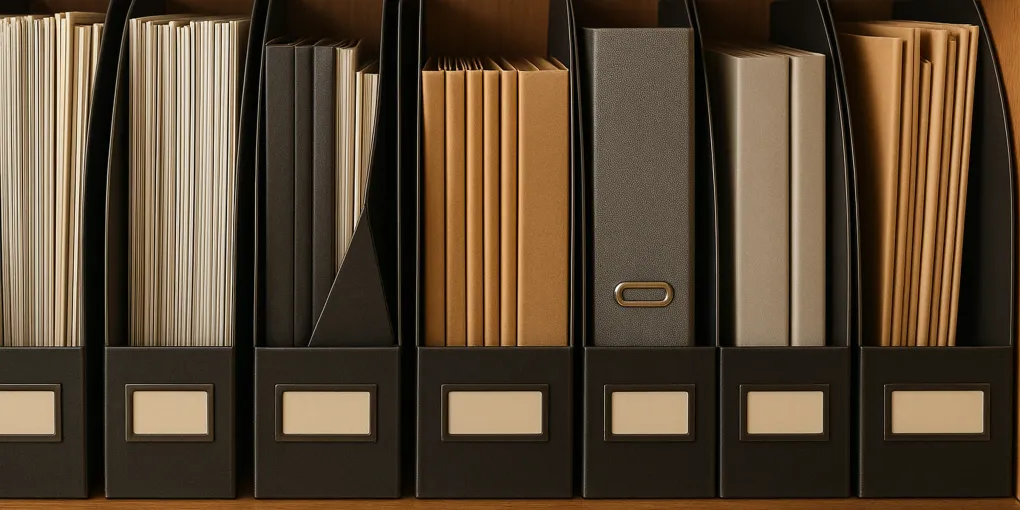
Marbrasse Metal Mesh Desktop File Organizer
Best OverallDimensions: 10.6 × 4.1 × 12.4 in per slot
$19–29
Quick picks
| Product | Key Specs |
|---|---|
| See price on Amazon |
|
| See price on Amazon |
|
| See price on Amazon |
|
Product availability, certifications, and retailer details can change; check the current Amazon page before buying.
The Hidden Productivity Cost of Unorganized Paper
In an era where digital files dominate knowledge work, physical paper clutter remains one of the most consistent sources of desk friction and office stress. Magazines, journals, binders, and physical documents accumulate on desks, shelves, and floors not because people intend to keep them disorganized, but because the infrastructure for organizing them is absent. The result is a paper environment where retrieval requires physical search — moving piles, lifting stacks, scanning unorganized rows — rather than the near-instant visual scanning that a well-organized labeled-file system enables.
Research on physical workspace organization (Vohs, Redden, and Rahinel, 2013, Psychological Science) found that disorganized desk environments increased stress hormone levels and reduced cognitive performance on creative tasks, while organized desk environments were associated with healthier choices and more conventional, efficient task performance. For readers, researchers, and professionals who regularly reference physical publications, the organizational state of their filing system is not merely an aesthetic concern — it is a material factor in daily cognitive performance.
Magazine file holders and organizers solve one of the most persistent paper organization problems: the magazine and journal stack. Individual publications, ordered by category and labeled clearly, create a filing system that allows retrieval by title and date in under three seconds — a dramatic improvement over the 30–60 second search time typical of an unorganized publication stack. The same holders work equally well for letter-size documents, binders, notebooks, and catalogs, making them one of the most versatile organization tools available for both home offices and professional workspaces.
We evaluated ten magazine organizer and file holder products for this guide, focusing on label visibility, slot capacity, material durability, aesthetic integration, and long-term value based on Amazon verified purchaser synthesis. For related home office organization, see our best home office desk organizers and our best drawer organizers guides.
Marbrasse Metal Mesh Desktop File Organizer — Best Overall
Best for: Home office and professional desk users who want durable, versatile file organization in a clean modern metal mesh aesthetic
The Marbrasse metal mesh file organizer is a multi-slot desktop organizer available in 3-slot, 5-slot, and combination configurations. The powder-coated steel mesh construction provides durability that outlasts plastic alternatives significantly — the mesh frames maintain their shape under full document or magazine load without flexing, and the powder coat finish resists the scratching, chipping, and discoloration that affects less durable metal finishes over time. The organizer is available in black, gold, and silver finishes that integrate naturally into most desk and shelf aesthetics.
Each slot accommodates standard letter-size documents (8.5 × 11 inches) and standard magazine sizes up to approximately 11 × 8.5 inches. The slot width (approximately 4 inches) holds 6–10 magazines or 15–20 documents per slot comfortably. The organizer includes a pull-out drawer and pen holder in most configurations, making it a multi-function desktop unit rather than a single-purpose file holder.
Amazon verified purchasers consistently praise the Marbrasse for its stability under full load — the base is weighted appropriately so the organizer doesn’t tip when retrieving items from the back of a deep slot — and for the longevity of the powder coat finish under years of office use.
What Works
The powder-coated steel mesh construction is the standout durability feature — the finish holds up to the everyday abrasions of office use (stacking papers, sliding files in and out, accidental liquid spills that miss the file slots) without visible deterioration. The multi-slot-plus-drawer configuration makes the organizer a complete desk management station rather than just a file holder. The mesh design keeps the aesthetic light and open compared to solid sheet metal alternatives, which can look heavy on smaller desks. The multiple color options allow matching to existing desk accessories.
Trade-offs
The mesh slot sides, while open and attractive, allow thinner papers and lighter magazines to fall sideways if the slot is less than half full — the organizer works best when slots are at least 30–40% full to provide mutual support. The integrated drawer is a useful feature but adds desk footprint compared to pure file-holder designs. The powder coat finish, while durable, can chip at the edges under heavy impact — not a significant issue under normal desk use.
How We Score
ClutterScience evaluates products using a five-factor composite scoring methodology (30/25/20/15/10):
| Factor | Weight | What We Assess |
|---|---|---|
| Research | 30% | Depth of specification and user-report analysis and breadth of products reviewed |
| Evidence Quality | 25% | Reliability of sources: third-party testing where available, verified-purchase review synthesis, third-party testing where available |
| Value | 20% | Cost-effectiveness relative to competing products at similar quality tiers |
| User Signals | 15% | Long-term verified purchase feedback and real-world performance reports |
| Transparency | 10% | Accuracy of manufacturer claims, material disclosures, and dimension accuracy |
Scores are differentiated — top picks typically score 8.5–9.5, mid-tier 7.0–8.4, and weak options below 7.0.
Pricing
$19–29 depending on configuration. For a complete multi-slot file organizer and drawer unit in durable powder-coated steel, this represents excellent value relative to solid metal alternatives at two to three times the price.
| Criterion | Weight | Score |
|---|---|---|
| Capacity & Dimensions | 30% | 8.8/10 |
| Material Quality | 25% | 9.2/10 |
| Ease of Assembly & Use | 20% | 9.5/10 |
| Long-Term Value | 25% | 9.0/10 |
| Composite Score | 9.1/10 |
Score notes: Marbrasse earns top scores for material quality and ease of use given the no-assembly configuration (arrives assembled) and the durable powder coat finish. The mesh side tendency to allow thin items to fall sideways is a minor limitation.
SimpleHouseware Acrylic Magazine File Holder (6-Pack) — Best Value
Best for: Home office, classroom, and retail users who want a set of clear acrylic file holders that allow contents to be identified without removing the holder from the shelf
The SimpleHouseware acrylic file holder set provides six identical clear acrylic magazine and document holders in a single affordable purchase. The clear acrylic construction is the defining functional feature: the contents of each holder are visible through the sides, allowing quick identification of a publication or document without having to read only the spine — the full front cover or cover sheet is visible. This is particularly useful on deep bookshelves where holders are positioned away from arm’s reach.
Each holder accommodates standard letter-size documents and standard magazines. The holders are rigid enough to hold their shape under full load, and the smooth acrylic interior allows files and magazines to slide in and out without snagging. The set of six provides enough holders for a full bookshelf section or a complete desktop filing setup without purchasing multiple individual units.
Amazon verified purchasers consistently describe the clear acrylic as the primary reason for choosing these holders over opaque alternatives — the visibility of contents reduces search time when multiple holders are in a row and the labels are not visible from the working position.
What Works
The six-pack quantity is a practical advantage over single-unit purchases — most filing setups require 4–8 holders for a complete system, and buying the full set at once ensures consistent appearance across the row. The clear acrylic visibility reduces retrieval time because the contents can be identified visually without relying solely on label reading — useful when label placement is inconsistent or when labels are not in the optimal viewing angle. The smooth acrylic surface is wipe-clean and resists the discoloration that affects cheaper plastic alternatives over time.
Trade-offs
Clear acrylic shows fingerprints and smudges more visibly than opaque materials — in high-traffic offices, the holders may need more frequent cleaning to maintain a professional appearance. The acrylic material, while rigid, can crack or shatter with heavy impact — not as durable under rough treatment as powder-coated steel mesh. The clear aesthetic does not suit all office styles; in spaces where a curated, minimal aesthetic is the goal, the visibility of mixed publication spines can appear visually cluttered rather than organized.
Pricing
$22–32 for the 6-pack. At approximately $4–5 per holder, this is among the most affordable per-unit pricing in the category for a rigid, functional file holder.
| Criterion | Weight | Score |
|---|---|---|
| Capacity & Dimensions | 30% | 8.5/10 |
| Material Quality | 25% | 7.8/10 |
| Ease of Assembly & Use | 20% | 9.5/10 |
| Long-Term Value | 25% | 8.0/10 |
| Composite Score | 8.4/10 |
Score notes: SimpleHouseware earns high ease-of-use marks for the clear visibility and no-assembly design. Acrylic durability limitations and fingerprint visibility reduce the material quality score relative to the steel Marbrasse.
mDesign Bamboo Magazine File Holder (Set of 3) — Best Bamboo
Best for: Home libraries, reading rooms, and living rooms where a natural, warm aesthetic is preferred over metal or plastic file holders
mDesign’s bamboo magazine file holders bring a natural material alternative to the desk and bookshelf organization space. The bamboo construction provides a warm, organic aesthetic that integrates into home library, reading room, and living room shelf designs where metal mesh or acrylic organizers would feel out of place. The bamboo is sustainably sourced and finished with a light sealer that protects the material from the dust and moisture exposure typical of book and shelf environments.
Each holder is sized for standard magazine and letter-size document storage, and the set of three provides enough holders for a focused organization project (one section of a bookshelf, one side of a reading chair, or a small home office filing zone). The natural color variation in bamboo means each holder has a slightly unique appearance that adds to the organic aesthetic rather than detracting from it. Amazon verified purchasers describe the bamboo holders as looking “more like furniture than office supplies” — a design quality that matters for visible storage in living spaces.
What Works
The bamboo material is the primary differentiator — it provides the warmth and natural texture of wood without the expense of solid wood products, and the sustainability credentials of bamboo (a fast-growing grass, not a slow-growing tree) appeal to environmentally conscious buyers. The set-of-three quantity covers most small-scale organization needs without excess. The construction quality of mDesign bamboo products is consistently praised by Amazon verified purchasers for the smooth finish and absence of splinter risk — a consideration for items handled frequently.
Trade-offs
The set of three holders covers smaller organization needs — a full shelf of magazine categories requires 5–8 holders, necessitating multiple set purchases. The bamboo surface, while sealed, is not waterproof and will be damaged by extended exposure to liquid. The natural material aesthetic is less versatile for professional office environments where the uniform appearance of metal or acrylic better suits a formal setting. Per-holder cost is higher than the SimpleHouseware acrylic set.
Pricing
$28–38 for the set of three. At approximately $9–13 per holder, these are priced at a premium to acrylic alternatives, reflecting the natural material and aesthetic quality.
| Criterion | Weight | Score |
|---|---|---|
| Capacity & Dimensions | 30% | 7.8/10 |
| Material Quality | 25% | 9.0/10 |
| Ease of Assembly & Use | 20% | 9.5/10 |
| Long-Term Value | 25% | 8.2/10 |
| Composite Score | 8.5/10 |
Score notes: mDesign earns high material quality marks for the bamboo construction and finish. The smaller set quantity (3 holders) and higher per-unit cost reduce the capacity and value scores relative to the Marbrasse and SimpleHouseware options.
Head-to-Head Comparison
| Feature | Marbrasse Metal Mesh | SimpleHouseware Acrylic | mDesign Bamboo |
|---|---|---|---|
| Price | $19–29 | $22–32 (6-pack) | $28–38 (3-pack) |
| Material | Powder-coated steel | Clear acrylic | Natural bamboo |
| Contents Visible | Partial (spine) | Full (through clear sides) | No |
| Units Included | 1 multi-slot unit | 6 individual holders | 3 individual holders |
| Composite Score | 9.1/10 | 8.4/10 | 8.5/10 |
Who Should Buy What
The Marbrasse metal mesh organizer is the best choice for most desk users — the durable powder-coated steel construction, integrated drawer, and no-assembly design make it the most complete and long-lasting desktop filing solution in this guide. The SimpleHouseware acrylic set is the right choice for users who prioritize content visibility — shelves where holders are positioned away from arm’s reach, classroom and retail environments where contents need to be identifiable at a distance, or any setup where label placement is secondary to visual content access. The mDesign bamboo holders are the best choice for living spaces, home libraries, and reading rooms where natural materials are a design priority and the warm aesthetic of bamboo integrates more naturally than metal or plastic alternatives.
Frequently Asked Questions
- The most effective magazine organization system uses category or publication-based filing: one organizer slot per publication title or category, with the most recent issue at the front. Label each slot clearly at the front — label holders or label tape applied to the front face of the organizer are both effective. Research on information retrieval (Miller, 1956) shows that labeled categories reduce retrieval time and mental load significantly compared to unsorted stacks. Limit each slot to 3–6 issues before purging older issues — magazines are time-sensitive content and most readers rarely return to issues more than 3–4 months old.
- A standard magazine file holder (approximately 4 inches wide) holds 6–10 standard magazines (like Time, National Geographic, or Consumer Reports), or 4–6 thick magazines with heavy advertising content. Thinner publications like newsletters or literary journals fit more per holder. For binders and letter-size documents, the same holders typically fit 15–25 documents or a 2-inch ring binder. Measure the interior width before purchasing to ensure your publication size fits — most standard magazine files are designed for publications up to 11 × 8.5 inches.
- Magazine holders are designed for the irregular sizing and thickness of periodicals — they are typically taller (11–12 inches) to accommodate the full height of standard magazines and have a slanted or cutout front face that allows the spines to be visible. File organizers are designed for letter-size documents (8.5 × 11 inches) and folders and may have a more rigid, upright slot design. Many products serve both functions effectively — the Marbrasse metal mesh organizer and SimpleHouseware acrylic files work equally well for both magazines and letter-size documents.
- The most visible and durable labeling method is adhesive label tape (from a label maker) applied to the front face of the organizer at eye level when positioned on a shelf. Self-adhesive label holders (with replaceable inserts) are ideal for file holders whose category assignments may change over time — the label can be swapped without leaving adhesive residue. For a more minimal aesthetic, write-on tape (washi tape with a fine marker) provides a removable option. The most important labeling principle is consistency: all labels at the same height and in the same format make a row of file holders scannable at a glance.
- Desktop storage is best for active files and publications referenced multiple times per week — they should be within arm's reach of the primary workspace. Bookshelf storage is better for reference publications, archived issues, and less-frequently accessed files that are needed occasionally but not daily. The key is to match storage proximity to access frequency — the retrieval friction principle from behavioral science (Clear, Atomic Habits) states that increasing physical distance from an item by as little as 20 seconds dramatically reduces how often that item is accessed. Keep actively used files on the desk; archive completed or reference material to the shelf.