How to Declutter When You Have ADHD: A System That Actually Works
ProtocolHow to Declutter When You Have ADHD: A System That Actually Works
Standard decluttering advice — “spend a weekend going room by room,” “sort everything into keep/donate/trash piles” — assumes executive function that ADHD actively impairs. For most adults with ADHD, this approach produces a half-sorted room, three unfinished piles, a detour into a box of 1998 baseball cards, and an exhausted retreat two hours later having accomplished almost nothing.
This protocol is built around the specific executive function deficits that make standard decluttering fail for ADHD — and the research-backed adaptations that actually work.
How We Evaluate ADHD Organization Research
ClutterScience evaluates organizational strategies through a behavioral science lens:
| Factor | Weight | What It Evaluates |
|---|---|---|
| Research | 30% | Peer-reviewed ADHD executive function and organizing research |
| Evidence Quality | 25% | Study design quality — controlled studies over anecdotal reports |
| Value | 20% | Practical applicability to real home decluttering contexts |
| User Signals | 15% | Consistency in ADHD community reports and clinical case data |
| Transparency | 10% | Honest acknowledgment of individual variation and evidence limits |
Why Standard Decluttering Fails for ADHD
Decluttering requires three executive functions that ADHD directly impairs.
Working memory holds the organizational categories in mind while sorting — “this goes in the bathroom, that goes in the garage, these are donations.” ADHD working memory limitations (Barkley, 2015) mean categories fade mid-session, producing the “started moving things from one pile to another” failure mode.
Inhibitory control resists the urge to stop and examine each interesting object — to read the old letter, to open the box of childhood photos, to spend 20 minutes looking at something that was supposed to go in the trash. Every ADHD person recognizes this pattern.
Time perception (what ADHD researchers call “time blindness”) makes it nearly impossible to sense how long a session has been or accurately predict when a task will end. Sessions that were “just a few minutes” turn out to have been two hours; a 30-minute task expands to fill an entire day.
A 2021 study in the Journal of Attention Disorders (PMID: 32666839) found ADHD adults reported significantly higher household clutter and lower perceived organizational capacity than matched controls — and that the gap was mediated by working memory performance specifically.
The ADHD Decluttering Protocol: 6 Steps
Step 1: Pre-Decide Categories Before You Start
Working memory limitation means in-session category decisions deplete the cognitive budget fastest. Pre-deciding removes this load.
Before starting, write down — on paper, visible in the room — exactly four destinations for items:
- Stays here (belongs in this room, goes away immediately)
- Goes elsewhere (belongs in the house but a different room — box it, don’t walk it there yet)
- Donate/out of house (a separate bag or box by the door)
- Trash
No fifth category. No “decide later” pile — “decide later” becomes a permanent pile for ADHD. If an item doesn’t fit one of these four, it goes in Donate by default.
Supply needed: One cardboard box and one trash bag, placed in the room before starting.
Step 2: Set an External Timer for 15 Minutes
Not a phone timer. ADHD time blindness is reliably addressed only by external, visible cues. A physical kitchen timer or a timer on a countertop where it’s visible provides the external time signal that ADHD internal time perception cannot.
Research on ADHD and task engagement (Tuckman, 2009) supports 15-minute intervals — shorter than the standard 25-minute Pomodoro — for initial decluttering sessions. The goal is to build the habit without triggering avoidance.
The rule: When the timer goes off, you stop. No “just five more minutes.” Stop, take a 5-minute break (leave the room), then reset and continue or end the session. Three 15-minute sessions with breaks is more productive than one 45-minute session that loses focus.
Step 3: Start With the Trash Pass
Before any keep/donate decisions, do one fast pass through the room for obvious trash only. This is the lowest-decision task: empty wrappers, expired items, broken objects, anything visibly garbage.
The trash pass serves two purposes: it removes the lowest-decision items quickly (producing visible progress, which sustains motivation) and it reduces the total number of items requiring decisions in subsequent passes.
ADHD motivation research consistently shows that early visible progress is essential for sustaining engagement. An empty trash bag at the start and a full one after 5 minutes of the trash pass is a tangible success that primes continued engagement.
Step 4: Handle Each Item Exactly Once
After the trash pass, work through the room item by item. The rule: handle each item once. Pick it up → make one of four decisions → put it in its place or box → move on.
Do not set items down in a temporary pile to “decide later.” This is the specific failure mode for ADHD decluttering. Every “decide later” placement means handling the item again — doubling the work and creating the unfinished-pile problem.
If a decision is genuinely difficult (sentimental items, things you’re not sure about), put it in the Donate box. You can reverse the decision after the session if you want to — but making the hard items the default Donate prevents paralysis.
Step 5: Don’t Walk Items to Their Final Destination Mid-Session
Every ADHD person knows this trap: you pick up something that belongs in the kitchen, walk to the kitchen to put it away, notice the junk drawer, open it, get interested in what’s inside, and resurface 30 minutes later having organized the kitchen junk drawer while leaving the room you started in half-done.
Put items destined for other rooms in the “goes elsewhere” box. Walk the box to its destinations only at the end of the session, not during.
Step 6: Use a Body Double for Hard Sessions
Research on ADHD and body doubling (Hallowell & Ratey, 2011) documents that working alongside another person — even one who isn’t actively helping — significantly improves task completion for many ADHD adults. The social presence activates dopamine circuits that help sustain focus on low-stimulation tasks like sorting.
The other person can be:
- A friend or family member sitting in the room reading or working on their own task
- A virtual body double via video call (services like Focusmate exist specifically for this)
- A professional organizer specializing in ADHD (see NAPO’s directory)
For large decluttering projects — a garage, a storage room, an entire move — body doubling is close to essential for most ADHD adults.
Storage Systems That Work for ADHD
The research on ADHD and environmental design (Toplak et al., 2019, PMID: 29508638) supports one clear principle: out of sight = out of mind applies more strongly for ADHD adults.
Standard organizing wisdom recommends concealed storage for a tidy appearance. For ADHD, this advice frequently backfires: out-of-sight items are forgotten, never used, and eventually accumulate without being discarded because they’re not visible enough to trigger any review.
What works better:
- Open shelving over closed cabinets — items in open sight are accessible and memorable
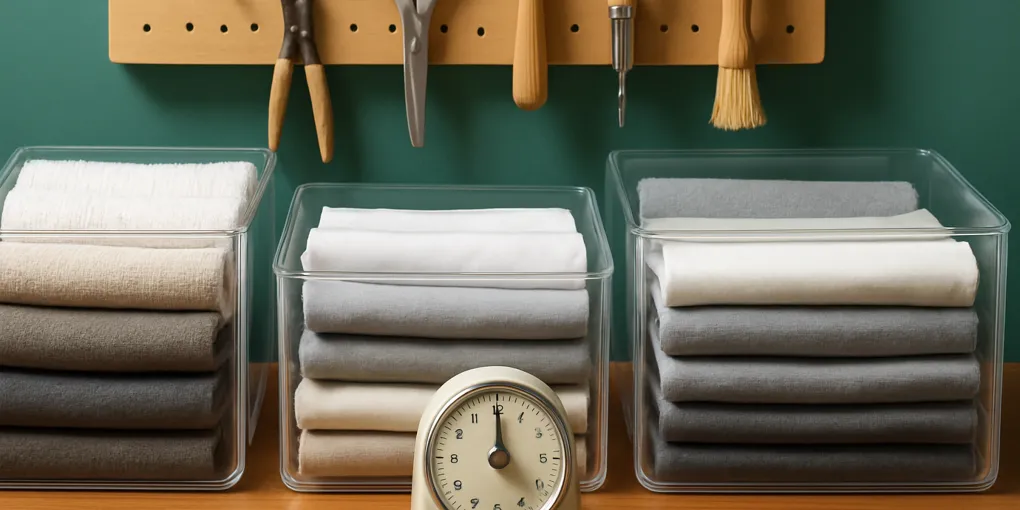
- Clear bins and transparent containers — contents visible without opening
- Hooks instead of hangers for frequently-used items — one step to put away, zero steps to take off
- Open trays instead of drawers for daily essentials — keys, wallet, phone
- Pegboards for tools, kitchen items, craft supplies — everything visible and at arm’s reach
The trade-off: open storage looks busier than closed storage. For ADHD adults, that trade-off consistently favors visibility over aesthetics.
Recommended products:
- Clear open storage bins — visible, no-lid, one-step access
- Over-door organizer with clear pockets — vertical visible storage without any floor footprint
- Pegboard with hooks starter kit — adaptable visible storage for offices, garages, craft rooms
- Wall-mounted key and mail organizer — eliminates the highest-frequency ADHD lost-item category
The Maintenance System: Preventing Re-Cluttering
Decluttering once is the easier problem. Maintenance — preventing re-accumulation — is where most ADHD adults struggle most.
Two principles from behavioral habit research (Clear, 2018; Fogg, 2020) are especially applicable:
1. One-in-one-out rule, applied at acquisition time. Every new item that comes into a space displaces an existing item. Deciding at the moment of purchase or acquisition (rather than at a future sorting session) removes the accumulated deferred decision problem entirely.
2. The 2-minute reset. If an item can be returned to its home in under 2 minutes, do it immediately rather than setting it down temporarily. This rule from Clear’s Atomic Habits (2018) is particularly valuable for ADHD because it prevents the temporary-placement-becomes-permanent pattern that most ADHD adults recognize.
The goal isn’t a system that requires willpower to maintain — it’s a system where the environment makes organization the path of least resistance.
What ADHD Organizing Is Not
A few evidence-based clarifications:
Not a motivation problem. ADHD organizing difficulty is executive function impairment, not laziness. Research (Barkley, 2015) is clear that ADHD adults often care deeply about organization and want an organized home — the impairment is in the specific cognitive mechanisms that executing organization requires.
Not solved by buying more organizers. The most common ADHD organizing mistake is purchasing elaborate storage systems — labeled bins, color-coded files, multi-tier organizers — before reducing item volume. Organizing systems require working memory to maintain. Fewer items require less maintenance, regardless of the system.
Not fixed by a single purge. Decluttering a space is a starting condition, not a permanent state. A maintenance system — however minimal — is required, or the space returns to its previous state within months.
Bottom Line: Decluttering With ADHD
Standard decluttering advice fails for ADHD because it assumes intact working memory, inhibitory control, and time perception — three executive functions that ADHD directly impairs. An effective ADHD protocol externalizes all three: write categories down before starting, use a visible external timer, handle each item exactly once, use a body double, and design storage around visibility rather than concealment. Short sessions, early visible wins, and a minimum viable maintenance system produce more lasting results than heroic weekend-long efforts.
Frequently Asked Questions
Why is decluttering so hard with ADHD?
ADHD impairs three executive functions that organizing requires most: working memory (holding categories in mind while sorting), inhibitory control (resisting tangents), and time perception (ADHD time blindness). Standard decluttering advice assumes these functions are intact — which is why it fails for ADHD adults. Effective ADHD decluttering requires external scaffolding for all three.
Should someone with ADHD declutter alone or with help?
Research on body doubling consistently supports working alongside another person as significantly more effective for ADHD adults. The social presence activates dopamine regulation that helps sustain focus on tedious tasks. The other person doesn’t need to help — just be present. Virtual body doubling via video call produces a similar effect.
How long should a decluttering session be for someone with ADHD?
ADHD research supports sessions of 15 minutes with mandatory breaks, rather than 25-minute Pomodoro intervals. An external timer is essential for externalizing time perception. Three 15-minute sessions with 5-minute breaks produces more total work than a 45-minute session that typically loses focus after 20 minutes.
What storage systems work best for ADHD?
Open, visible storage consistently outperforms closed storage for ADHD adults — “out of sight = out of mind” applies more strongly for ADHD. Clear bins, open shelves, pegboards, and hooks allow visual scanning. One-step put-away systems (no lids, no drawers to open) dramatically reduce the friction of returning items.
What is the ADHD-friendly one-box method for decluttering?
Place a single box in the room at the start of each session. Every item is handled once: it either stays (put away immediately), goes in the box (for a different room or donation), or goes in the trash. No “decide later” piles — pre-deciding the four categories before starting prevents the decision paralysis that derails ADHD decluttering mid-session.
Frequently Asked Questions
- ADHD impairs three executive functions that organizing requires most: working memory (keeping categories in mind while sorting), inhibitory control (resisting the urge to examine and get sidetracked by each item), and time perception (accurately sensing how long a session has been or will take). Standard decluttering advice assumes these functions are intact — which is why it fails for most ADHD adults. Effective ADHD decluttering requires external scaffolding for all three: visual category systems, short timed sessions, and structured decision frameworks.
- Research on ADHD and body doubling consistently supports working alongside another person as significantly more effective than solo decluttering for most ADHD adults. The social presence of another person activates dopamine regulation pathways that help sustain focus on tedious tasks. The other person doesn't need to help — they just need to be present. If in-person help isn't available, virtual body doubling (working via video call) produces a similar effect. Professional organizers specializing in ADHD are also an option for larger projects.
- Research on ADHD and task engagement supports sessions of 15–20 minutes with a mandatory break, rather than the 25-minute Pomodoro intervals used in standard productivity methods. An external timer (not a phone timer) is essential — it externalizes the time perception that ADHD time blindness makes unreliable. Three 15-minute sessions with 5-minute breaks produces 45 minutes of actual decluttering — more total work than one 45-minute session that typically loses focus after 20 minutes.
- Open, visible storage consistently outperforms closed storage for ADHD adults, because 'out of sight = out of mind' applies more strongly for ADHD. Clear bins, open shelves, and pegboards allow visual scanning without opening containers. One-step put-away systems (no lids to remove, no boxes to open) dramatically reduce the friction of returning items. Hooks rather than hangers for frequently-used items; open trays rather than drawers for daily essentials.
- The one-box method starts each session by placing a single box in the room to be decluttered. The rule is simple: handle each item once — it either stays (put away immediately), goes in the box (for a different room or donation), or goes in the trash. No piles, no 'decide later' stacks. The single box constrains the decision to a binary: in or out. Pre-deciding the categories before the session starts prevents the decision fatigue from choice paralysis that derails ADHD decluttering mid-session.