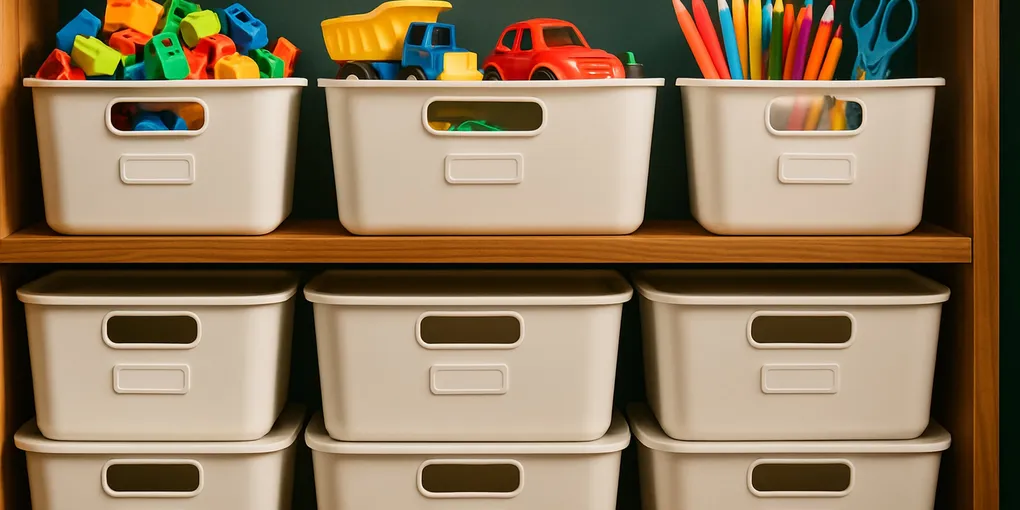
Toy Rotation System Guide: The Science-Backed Method for Better Play
ProtocolToy Rotation System Guide
Most homes with young children have far more toys than children actually play with. Research supports what most parents have observed: a child with fifty toys accessible will spend less time engaged with any single toy than a child with five. The problem is not the quantity of toys — it’s the simultaneous availability.
A toy rotation system is a simple organizational structure that solves this by controlling what is accessible at any given time. Behavioral science explains exactly why it works and provides evidence-based guidance for setting it up.
TL;DR
- Keep 4–8 toys accessible at once; store the rest
- Rotate every 2–4 weeks — stored toys feel new when reintroduced
- Use opaque labeled bins for out-of-sight storage
- Never rotate comfort objects (loveys, security blankets)
- The system reduces toy overwhelm for parents and improves focus and creativity for children
How We Evaluate Research on Toy Rotation
ClutterScience reviews behavioral science and environmental psychology evidence using a five-factor composite approach:
| Factor | Weight | What It Measures |
|---|---|---|
| Research Quality | 30% | Study design rigor; peer-reviewed publication and replication across populations |
| Evidence Depth | 25% | Mechanistic grounding; how directly the evidence links toy quantity to play outcomes |
| Practical Utility | 20% | Actionability of findings for real household setup and rotation scheduling |
| Population Coverage | 15% | Whether findings replicate across diverse age groups and household types |
| Transparency | 10% | Honest characterization of causal limitations and individual variation |
Why Toy Rotation Works: The Behavioral Science
Finding 1: Fewer Options Produce Higher-Quality Play
The foundational evidence comes from a controlled study by Dauch, Imwalle, Ocasio, and Metz at the University of Toledo (2018, DOI: 10.1016/j.infbeh.2017.11.005). The researchers observed 36 toddlers (18–30 months) in free-play sessions with either 4 or 16 toys available.
Toddlers with 4 toys showed:
- Fewer total toy transitions (less “toy hopping”)
- Longer individual play duration with each toy
- Greater variety in how they used each toy — more creative, imaginative, and functional play
The finding challenges the intuitive assumption that more toys equals more stimulation equals better development. The data showed the opposite: abundance of options shortened play duration per toy and reduced play sophistication.
Finding 2: Choice Overload Reduces Engagement
Iyengar and Lepper’s foundational choice overload research (2000, PMID: 11138768, DOI: 10.1037/0022-3514.79.6.995) demonstrated across multiple studies that larger option sets reduce both the motivation to engage and post-selection satisfaction. Participants given 6 jam varieties were ten times more likely to make a purchase than those given 24 varieties, and reported higher satisfaction with their choices.
The parallel in a child’s play space: a room with 30 accessible toys presents a choice environment that behavioral science predicts will reduce engagement, increase toy-switching behavior, and decrease the depth of play with any single item. Toy rotation applies choice architecture principles — making the decision environment manageable — to the play space.
Finding 3: Clutter Affects the Whole Family
Saxbe and Repetti (2010, PMID: 19934011) found that cluttered home environments correlated with flatter diurnal cortisol profiles — a pattern associated with chronic stress — in adult home occupants. Toy clutter concentrated in shared family living spaces contributes to this physiological burden for parents and other household members.
The toy rotation system addresses this not only by improving child play quality, but by reducing the visible toy volume in shared spaces — which carries documented stress-reduction benefits for adults.
Finding 4: Play Quality Supports Development
The American Academy of Pediatrics (Yogman et al., 2018, DOI: 10.1542/peds.2018-2058) identifies child-initiated, open-ended play as essential for executive function development, self-regulation, language development, and social-emotional growth. The research emphasizes play depth over play volume — which aligns directly with what toy rotation produces.
Research on sustained attention in preschoolers (Cahill et al., 2025, DOI: 10.1007/s10643-025-01985-w) showed that child-initiated choice during play produced the longest attention spans, outperforming adult-directed play. Toy rotation supports this by making child-initiated selection tractable — with 5 accessible options, children can make genuine ownership decisions; with 30, choice paralysis reduces meaningful selection.
How to Set Up a Toy Rotation System: Step-by-Step Protocol
Step 1: Full Inventory and Sort
Collect every toy in the house into one location. Discard broken items, toys with missing pieces that make them non-functional, and items the child has clearly aged out of. Set aside items in good condition that are appropriate to donate.
Sort what remains into categories:
- Building / Construction (blocks, Duplo, magnetic tiles)
- Imaginative Play (play kitchen items, dolls, action figures, vehicles)
- Sensory / Creative (art supplies, playdough, sensory bins)
- Cognitive / Puzzle (puzzles, board games, shape sorters)
- Physical / Active (balls, climbing items, outdoor equipment)
- Books (separate rotation optional, or integrate)
Step 2: Define Your Rotation Set Size
Based on the research guidance:
- Toddlers (18 months–3 years): 4–6 items per active set
- Preschool (3–5 years): 6–8 items per active set
- Early school age (5–7 years): 8–10 items, with more self-directed selection
Each active set should have at least one item from 2–3 different categories — this supports developmental breadth. A set that is all building items reduces imaginative and creative play opportunities.
Step 3: Create 3–4 Rotation Sets
Divide your sorted inventory into 3–4 balanced sets. Write down the contents of each set — a simple list by category. This inventory helps you rebuild sets accurately when rotating and prevents the “what was in box 2?” problem.
Each set should feel balanced across the categories you identified. If one set has significantly more items from a popular category, the child will notice the pattern and the novelty effect weakens.
Comfort objects (loveys, security blankets, specific stuffed animals the child sleeps with) are never rotated. These serve attachment and emotional regulation functions distinct from play toys. They remain permanently available.
Step 4: Set Up Storage
Storage rules that support the system:
- Use opaque bins, not transparent. Out-of-sight maintains the novelty effect; visible stored toys tempt requests and reduce the felt scarcity of the active set.
- Lidded bins stack — maximize closet or storage shelf space vertically.
- Label by set number (Set 1, Set 2, Set 3) and category summary on the outside. Do not label with specific item names — too much information reduces surprise on reintroduction.
- Store at adult height, not at a location the child can easily access. The point is that the stored sets are genuinely inaccessible to the child during active rotation periods.
Storage containers that work well for full toy rotation sets include large lidded storage bins (60–70 quart capacity handles a full toddler rotation set comfortably). For smaller item categories, a series of medium lidded bins on a single closet shelf manages the system cleanly.
Recommended approach:
- Large lidded bin (60–70 quart): Sterilite 66-Qt Latch Storage Tote — sturdy, stackable, latches shut
- Medium labeled bins: IRIS USA 32-Qt Storage Bin with Lid — good for smaller item categories
Step 5: Set Up the Active Play Zone
The active set lives in the designated play area — accessible, visible, at the child’s level. How you present the active set affects engagement:
- Fewer better-organized options outperform organized chaos. A shelf with 5 toys clearly placed invites exploration; a bin with 8 toys mixed together reduces each item’s accessibility.
- Open shelving (even a basic bookshelf with front-facing options) works better than toy chests and deep bins for toddlers and preschoolers — children can see and access items independently.
- Allow the child to make active choices within the set — this child-initiated selection is what produces the sustained attention benefits in the AAP research.
Step 6: Rotate on Signal, Not Just Schedule
Two approaches to rotation timing work in practice:
Calendar rotation (simpler): Rotate every 2–3 weeks on a fixed day — Sunday morning, the first of each month. This creates a routine that children can anticipate, which adds motivational structure.
Engagement-triggered rotation (more responsive): Watch for observable signals that the current set has run its course: the child ignores most toys in the set for 2–3 consecutive days, requests items from another set by name, or play sessions have become noticeably shorter and less imaginative. These are reliable behavioral signals that the set’s novelty is exhausted.
How to rotate: Collect the active set, box it, retrieve the next stored set. Reintroduce rotated toys matter-of-factly — “look what we have today.” Most children respond with genuine excitement even for familiar toys. The absence interval is sufficient to trigger the novelty response.
Common Implementation Issues
“My child asks for toys that aren’t in the active set.” This is normal and typically resolves within 1–2 weeks as the child habituates to the active set. Acknowledge the preference (“yes, that toy is resting right now”), redirect to an active set item, and hold the boundary. If the same item is requested daily for more than a week, it may belong in the permanent-access category rather than rotation.
“I have too many toys to sort.” The system requires a one-time inventory effort that most families estimate at 2–3 hours. The ongoing maintenance (biweekly rotation) takes 10–15 minutes. If the initial sort feels unmanageable, work in one category per session — building first, then imaginative play, etc. — rather than attempting the full inventory in one session.
“My older and younger children want different things.” Manage separate rotation sets for different age groups if age gaps are significant (2+ years). Older children can often participate in selecting their own rotation sets, which adds buy-in and the child-initiated selection benefit.
Frequently Asked Questions
What is a toy rotation system?
A toy rotation system divides a child’s full toy collection into smaller sets — typically 4–8 toys per active set for toddlers — and cycles between sets every 2–4 weeks. Only the active set is accessible in the play space. Research by Dauch et al. (2018) demonstrated that toddlers play significantly longer and more creatively when fewer toys are available at once.
How many toys should be out at a time?
Research supports 4–6 accessible toys for toddlers (18–30 months) and 6–8 for preschoolers (3–5 years). The Dauch et al. study compared 4 vs. 16 toys and consistently found higher-quality play — longer duration, more creative use — in the 4-toy condition.
How often should you rotate toys?
Practitioner guidance based on behavioral observation supports 2–4 weeks as the practical sweet spot. Many families find that rotation triggered by observable engagement decline — when children noticeably ignore the active set — works better than a fixed calendar schedule.
Do kids notice when toys are rotated?
Yes, and this is the mechanism. The brain’s novelty response treats a rotated toy that has been absent for 2–4 weeks as genuinely new or newly interesting. Re-encountering a toy after a gap reactivates play schemas at an earlier, more exploratory stage.
What storage containers work best for toy rotation?
Opaque lidded bins outperform transparent for maintaining the out-of-sight effect that preserves novelty. Stackable options maximize closet or storage shelf space. Label the outside with contents by category rather than specific items, so you can make flexible swaps.
Frequently Asked Questions
- A toy rotation system divides a child's full toy collection into smaller sets — typically 4–8 toys per active set for toddlers and preschoolers — and cycles between sets on a regular interval (usually every 2–4 weeks). Only the active set is accessible in the play space at any time; the rest is stored out of sight. Research by Dauch et al. (2018, DOI: 10.1016/j.infbeh.2017.11.005) demonstrated that toddlers play significantly longer with each toy and in more creative ways when fewer toys are available at once.
- Research supports 4–6 accessible toys for toddlers (18–30 months), and 6–8 for preschool-aged children (3–5 years). The Dauch et al. study compared 4 vs. 16 toys and found consistently higher-quality play in the 4-toy condition. Most practitioners working from this evidence recommend staying under 10 accessible items at once, including books, puzzles, and art supplies that are in active use.
- No controlled study establishes a precise optimal rotation interval, but practitioner experience grounded in behavioral observation supports 2–4 weeks as a practical sweet spot. Shorter than 2 weeks and the novelty effect on reintroduction is reduced. Longer than 4 weeks can lead to boredom with the active set. Many families find that rotation triggered by observable engagement decline — when children start noticeably ignoring the active set — works better than a fixed calendar schedule.
- Yes, and this is the mechanism. The brain's novelty response treats a rotated toy that has been absent for 2–4 weeks as genuinely new or newly interesting, even though the child has played with it before. This is not a trick — it reflects how memory-retrieval cues work: re-encountering a toy after a gap reactivates play schemas at an earlier, more exploratory stage. Amazon verified purchasers of popular toy rotation bins consistently report that children show greater excitement about returning toys than about newly purchased ones.
- Opaque bins with lids work better than transparent for maintaining the out-of-sight, out-of-mind effect that preserves novelty. Stackable options maximize closet or storage shelf space. Label the outside with contents by category (building, imaginative play, art) rather than specific items, so you can make flexible swaps. Popular verified-purchase options on Amazon include Sterilite 66-quart storage bins for full toy rotation sets and smaller lidded bins for smaller item categories.