How to Get Kids to Keep Their Room Organized 2026
Buyer's Guide3 Sprouts Kids Storage Bin
Best open toy binBest for: Young kids who need fast toss-and-go cleanup
Quick picks
| Product | Key Specs | Pros / Cons |
|---|---|---|
| See price on Amazon |
|
|
| See price on Amazon |
|
|
| See price on Amazon |
|
|
Product availability, certifications, and retailer details can change; check the current Amazon page before buying.
Quick product shortlist
Use this shortlist to choose a product style before you measure. The links are named product or brand searches so you can compare current dimensions, finishes, prices, and return terms before buying.
- Best open toy bin: 3 Sprouts Kids Storage Bin (Search Amazon for 3 Sprouts kids storage bin) for young kids who need fast toss-and-go cleanup. Watch-out: large bins need category limits.
- Best zone system: IKEA TROFAST Storage Combination (Search Amazon for IKEA TROFAST storage combination) for playrooms and bedrooms with blocks, art, and small toys. Watch-out: bins need labels or pictures.
- Best picture labels: Mabels Labels Kids Labels (Search Amazon for Mabels Labels kids organization labels) for pre-readers or shared sibling rooms. Watch-out: too many labels become noise.
Why Kids’ Room Organization Requires a Different Approach
Quick picks
These are the products referenced in the guide; check dimensions, material, and installation limits before ordering.
- Fhiny Montessori Toy Storage Organizer with 12 Bins: See current price on Amazon
- SONGMICS Kids Bookcase with 3 Storage Cubes: See current price on Amazon
- Tot Tutors Kids’ Toy Storage Organizer with 9 Plastic Bins: See current price on Amazon Adult organizational strategies fail in children’s rooms because they’re built on adult cognitive capabilities: the ability to categorize abstractly, to consider future states (“this will be easier later”), and to delay gratification (putting away toys now because of the benefit of a clear floor later). Children develop these capabilities gradually across childhood and adolescence — applying adult-standard systems to a seven-year-old produces systems the child cannot successfully maintain, followed by parental frustration and the conclusion that “my kid just isn’t organized.”
Behavioral science research on child development (Piaget’s cognitive stages; executive function research by Zelazo & Müller, 2002) establishes that successful children’s organization systems must be designed for the child’s current cognitive and motor stage, not for the child parents hope they will be.
The most important principle in this entire guide: the organizational system must be easier to use correctly than to ignore. If putting toys away in their designated location requires three steps and “just leaving them on the floor” requires zero steps, the floor wins every time. Good children’s organization design removes friction from the correct behavior until it becomes the path of least resistance.
This guide provides age-differentiated strategies, behavioral techniques, and specific product recommendations for 2026.
Step 1: Declutter Before Organizing
Before building any organization system, declutter the room to a volume the child can realistically manage. An overwhelming volume of toys is not an organization problem — it’s a volume problem. No system successfully organizes more items than the child can reasonably maintain.
The room volume assessment:
Walk through the room and ask: if everything in here were put away in its designated location right now, would the room be clear? If the answer is no — if “fully put away” still means a crowded, visually busy space — the volume needs reduction before any system will work.
Child-involved decluttering:
Involve the child in the declutter process, using age-appropriate framing:
- For ages 3-5: “Let’s find toys that another child would love to play with.”
- For ages 6-10: “Let’s make room for the things you love most by finding homes for toys you’ve grown out of.”
- For ages 11+: “Let’s make a plan for what stays and what goes — you get to decide.”
The “maybe box” technique works well for children who feel anxious about letting things go: items that are difficult to decide on go in a labeled box for 30 days. If the child hasn’t missed or asked for items in the box, they go. This technique, borrowed from adult decluttering practice, respects the child’s attachment while providing a trial separation period.
For specific toy storage solutions after decluttering, see our guide to best toy storage solutions.
Step 2: Design Age-Appropriate Systems
Ages 2-4: The One-Step System
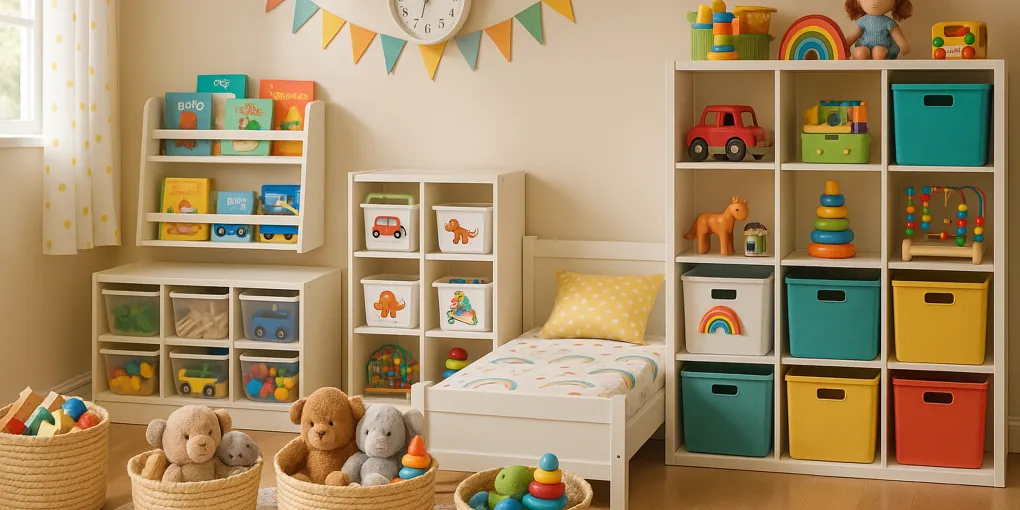
Children at this age need a single-step cleanup action: “put it in the bin.” Use large, open-top containers — one for soft toys, one for building blocks, one for vehicles. Label containers with pictures (photographs of the toys that belong there), not words. No sorting within categories; the entire category goes in the designated container.
System design principles for toddlers:
- Containers should be accessible: at floor level or on the lowest shelf
- Open tops only — lids create friction that toddlers cannot manage consistently
- No more than three to four containers — cognitive load of more categories exceeds capacity at this age
- “Cleanup songs” (the Barney cleanup song has genuinely research-supported effectiveness as a behavioral cue) create an environmental trigger for the cleanup action
Ages 5-8: The Picture-Label System
Children in early elementary school can sort by category and understand simple organizational logic. Use labeled bins with both pictures and words. Categories can be more specific: Legos separate from general building blocks; crayons separate from markers; board games separate from card games.
System design for early elementary:
- Labeled bins at child height
- Homework and school supplies in a designated spot near the desk (not shared with toys)
- A simple visual checklist for the bedtime routine: “toys away, floor clear, clothes in hamper” with checkboxes the child controls
- Natural consequence framing rather than punishment: items left on the floor go in a “Saturday box” (retrievable at the weekend), not confiscated
Ages 9-12: The Zone System
Older children are capable of maintaining a zone-based organizational system similar to adult approaches. Their room should have defined zones: a desk and homework zone, a clothing zone, a reading zone, and a play/hobby zone. Within each zone, a category-based system that the child helped design.
Critical design principle for tweens: Their buy-in is essential. Systems designed by parents for tweens are resisted; systems designed collaboratively with tweens are maintained. Have the tween participate in choosing containers, deciding on categories, and placing items. The extra time required for this collaborative design pays dividends in consistent maintenance.
Step 3: Apply Behavioral Science Principles
Reduce Friction on the Correct Behavior
Every barrier between a child and the correct action (putting something away) reduces the probability of the action occurring. Design the system to minimize friction:
- Hampers with wide openings rather than narrow slots — wider openings = more successful throws = habit reinforcement
- Open-top bins rather than lidded containers where appropriate
- Bins stored at the child’s height, not requiring reaching or climbing
- Hooks at the child’s level for bags, jackets, and frequently hung items
Research on friction reduction (Thaler & Sunstein, Nudge, 2008) demonstrates that small changes to the physical environment have effects on behavior that rival explicit instructions or rewards. Designing the room so that putting things away is easy is more effective than any amount of reminding.
Use Visual Cues and Environmental Anchors
Visual cues serve as prompts that trigger the cleanup behavior without requiring parental reminders. These include:
- Picture-labeled bins that visually show what belongs inside
- A bedtime routine chart on the wall near the bedroom door (the “before you leave” trigger)
- A clear visual distinction between clean and cluttered states — a visible baseline of what “put away” looks like
Behavioral researcher B.J. Fogg’s Tiny Habits framework (Fogg, Tiny Habits, 2019) identifies “anchors” — existing routine behaviors — as the most reliable triggers for new habits. Attaching cleanup to an existing anchor (after dinner, before screens, at bedtime) creates a habit loop that becomes automatic over time.
Use Reinforcement, Not Punishment
Behavioral psychology research on children’s motivation (Deci & Ryan’s self-determination theory, 1985) consistently shows that intrinsic motivation — doing something because it feels good or aligns with one’s self-concept — produces more durable behavior than extrinsic motivation alone (rewards, punishments). The most effective approach combines positive reinforcement with identity-based language.
Effective reinforcement approaches:
- Specific verbal praise: “You put all the Legos away — I love how you keep your building area organized”
- Completion charts with visual progress tracking (sticker charts are behaviorally effective for ages 3-10)
- Age-appropriate earned privileges tied to room maintenance (not punishments for non-maintenance)
- Framing: “You’re someone who keeps your space organized” builds identity around the behavior
How We Score
ClutterScience evaluates products using a five-factor composite scoring methodology (30/25/20/15/10):
| Factor | Weight | What We Assess |
|---|---|---|
| Research | 30% | Depth of specification and user-report analysis and breadth of products reviewed |
| Evidence Quality | 25% | Reliability of sources: third-party testing where available, verified-purchase review synthesis, third-party testing where available |
| Value | 20% | Cost-effectiveness relative to competing products at similar quality tiers |
| User Signals | 15% | Long-term verified purchase feedback and real-world performance reports |
| Transparency | 10% | Accuracy of manufacturer claims, material disclosures, and dimension accuracy |
Scores are differentiated — top picks typically score 8.5–9.5, mid-tier 7.0–8.4, and weak options below 7.0.
Recommended Products
Fhiny Montessori Toy Storage Organizer with 12 Bins
This combination shelf-and-bin storage unit places labeled open bins at multiple heights, making it appropriate for children from toddler through early elementary age. The modular design allows bins to be rearranged as storage needs evolve. Open fronts allow children to see and grab items without searching through a closed container, and the non-tip design provides safety for active children.
| Criterion | Weight | Score |
|---|---|---|
| Capacity & Dimensions | 30% | 9.0/10 |
| Material Quality | 25% | 8.2/10 |
| Ease of Assembly & Use | 20% | 8.0/10 |
| Long-Term Value | 25% | 8.8/10 |
| Composite Score | 8.6/10 |
One of the most-reviewed children’s toy organization products on Amazon. Verified parents consistently note that children actually use this system because the open-bin design eliminates the friction of lid removal. The unit earns its floor space by handling the largest volume of items in the room.
SONGMICS Kids Bookcase with 3 Storage Cubes
A combination bookcase and cube storage unit provides both book display and categorized bin storage in a single footprint — appropriate for children who are reading independently (ages 5+). The shelf section keeps current books visible and accessible; the storage cube section holds categorized bins for art supplies, Legos, or game pieces. Anti-tip hardware included.
| Criterion | Weight | Score |
|---|---|---|
| Capacity & Dimensions | 30% | 8.5/10 |
| Material Quality | 25% | 8.6/10 |
| Ease of Assembly & Use | 20% | 7.8/10 |
| Long-Term Value | 25% | 8.9/10 |
| Composite Score | 8.5/10 |
The combination of book display and bin storage makes this a good single-unit solution for reducing the total number of furniture pieces in a children’s room. Assembly requires adult effort, but the finished unit is sturdy and well-reviewed for durability.
Tot Tutors Kids’ Toy Storage Organizer with 9 Plastic Bins
A nine-bin organizer provides enough category capacity for the most common toy collection while remaining manageable for children ages 3 and up. The mix of bin sizes (large for bulky items, small for pieces and accessories) suits the typical range of toy types in a young child’s room. Bins remove completely for easy transport and cleanup.
| Criterion | Weight | Score |
|---|---|---|
| Capacity & Dimensions | 30% | 8.8/10 |
| Material Quality | 25% | 7.8/10 |
| Ease of Assembly & Use | 20% | 9.2/10 |
| Long-Term Value | 25% | 8.0/10 |
| Composite Score | 8.4/10 |
Lower material quality score reflects that the plastic construction, while adequate, doesn’t match the durability of wood alternatives. However, the extremely low price point and high functional performance make this one of the best value options for younger children whose organizational needs will change significantly as they grow.
The Daily Cleanup Routine
The most powerful organizational tool in a child’s room is a consistent daily cleanup routine — a brief, predictable maintenance habit that prevents accumulation from reaching the threshold of overwhelm.
The bedtime reset (10-15 minutes):
- Toys to their designated bins (items on the floor)
- Books to the bookshelf
- Clothes to the hamper (worn items) or hung/folded (items worn once)
- Desk cleared (school items to their designated spots)
- Visual confirmation: “Is there a clear path to the bed and desk?”
This routine, applied nightly, maintains the organizational system established in the steps above. Skipping it for two to three consecutive days allows accumulation to reach a threshold where the child (and often the parent) finds cleanup daunting rather than simple.
The anchor: Connect the cleanup routine to an existing nightly ritual — before bath time, after dinner, before the bedtime story. The existing ritual serves as the environmental cue that triggers the cleanup without requiring a reminder. Within two to three weeks, the cleanup routine begins to occur automatically in response to the anchor event.
For a comprehensive maintenance strategy beyond the children’s room, see our guide to how to maintain home organization long-term.
Common Mistakes Parents Make
Designing the system for yourself, not the child: The most aesthetically pleasing organization system is not always the one a child can maintain. Beautiful wicker baskets with unlabeled category sorting requirements look wonderful in parenting content but fail in practice with young children. Design for function at the child’s stage.
Expecting adult standards from children: A room maintained to an adult standard of tidiness by a six-year-old is not a realistic daily expectation. Setting standards appropriate to the child’s age — clear floor, items in their general categories — prevents the demoralization that comes from consistently falling short of impossible standards.
Doing it for them instead of with them: Cleaning up a child’s room for them while they’re absent teaches nothing and removes the ownership that drives maintenance. Cleaning up alongside the child — as a shared activity, especially for younger children — builds the routine and the skill simultaneously.
Too many toys: No organizational system compensates for a volume of toys that exceeds the child’s capacity to manage. Regular decluttering — ideally before birthdays and holidays when new items will arrive — is the structural maintenance that makes all other organization possible.
Summary
Getting kids to maintain an organized room is achievable with age-appropriate systems, friction reduction, and consistent daily routine. The system must fit the child’s developmental stage; the bins must be easier to use than the floor; and the daily cleanup routine must be anchored to an existing ritual.
The behavioral science is clear: organization is a skill that develops with practice, consistent environmental support, and identity-based reinforcement. Children who grow up with systems they can manage become adults who maintain organized spaces naturally — an investment in organizational habit that lasts a lifetime.
Frequently Asked Questions
- Children as young as two to three years old can participate in basic cleanup routines with parental guidance and age-appropriate systems. At this age, cleanup means putting toys into large bins — a single action with an obvious outcome. By ages four to five, children can sort by category into labeled containers. By ages six to eight, children can maintain a simple organizational system independently with daily parental reminders. By ages nine to twelve, children are capable of full room maintenance with decreasing supervision. The key is age-appropriate expectations and systems designed for the child's current skill level.
- Refusal is most often a response to overwhelm — 'clean your room' as an instruction leaves children without a clear action path. Behavioral research on task design shows that breaking requests into specific, small actions dramatically increases compliance: 'put the Legos in the blue bin' produces action where 'clean up' produces paralysis. Involvement in creating the organizational system also increases buy-in significantly — children maintain systems they helped design far more consistently than systems imposed on them.
- Young children attach strongly to possessions as part of developmental identity formation — researchers describe this as the 'endowment effect' in development. Effective strategies include: involving the child in the decision about what goes (giving control reduces resistance), framing donation as giving toys to children who need them (altruistic framing), using a 'maybe box' where ambiguous items go for 30 days before a final decision, and never removing items secretly — secrecy destroys trust and increases future hoarding behavior. Patience with the process produces better long-term results than forced removal.
- This depends on the child's age and the volume of toys. For children under five, one or two large open bins work better than complex categorized systems — the motor skill required to sort accurately exceeds the developmental stage. For children five and older, a hybrid approach works best: categories within containers (Legos in one bin, art supplies in another) labeled with pictures and words. Complete categorization of every individual toy is counterproductive at any age — it creates a system too complex to maintain.