How to Organize Your Freezer for Maximum Space 2026
Buyer's GuideQuick picks
Polar Whale Freezer Organizer Bins (Set of 4)
Rubbermaid Brilliance Freezer-Safe Food Storage Containers
Weston Vacuum Sealer Machine
Quick picks
These are the products referenced in the guide; check dimensions, material, and installation limits before ordering.
- Recommended product: Check current options on Amazon
- Standardizing frozen meal and portion storage: Check current options on Amazon
- Recommended product: Check current options on Amazon
The Hidden Cost of a Disorganized Freezer
A disorganized freezer is a slow money leak that most households never quantify. Meat bought during a sale gets buried under a glacier of mystery containers. Frozen vegetables purchased with good intentions calcify into unrecognizable lumps at the bottom. Meals prepped on a productive Sunday get covered by subsequent grocery runs and forgotten until they are so frost-burned they need to be discarded. The average household wastes hundreds of dollars per year in frozen food this way.
The problem is compounded by the design of most freezers. Chest freezers in particular are optimized for maximum volume, not accessibility. Without intentional organization, they function as a cold pit where things go in but retrieval requires excavation. Upright freezers are slightly better for visibility but still default to chaos without a deliberate zone system.
Environmental design principles apply to freezer organization just as they do to the rest of the kitchen. The key insight from behavioral research is that people consistently choose the path of least resistance. If retrieving a frozen meal requires moving fifteen items, most people will choose something else — and the frozen meal will sit there until it is no longer worth eating. The solution is to build a system where the things you use most often require the fewest steps to access.
This guide covers the complete process for organizing both chest and upright freezers, including how to establish category zones, which products keep the system intact, and how to build a rotation habit that eliminates waste. For broader kitchen organization context, see our guides on how to organize kitchen cabinets and how to organize your refrigerator.
Step 1: Complete Inventory and Audit
Before any organizational system can be imposed on a freezer, you need to know what is actually in it. This sounds straightforward but is often eye-opening. Most households discover items that have been in the freezer for two or three years, items they forgot they had, and multiple duplicates of the same category.
Remove everything from the freezer and place it on the counter. Work quickly — frozen items can sit at room temperature for 20 to 30 minutes without significant thaw, which is enough time to complete an audit. Have a bag ready for disposal and a notepad for inventory.
For each item, check for: (1) the freeze date, if labeled; (2) visible freezer burn, indicated by grayish-white patches and dry, desiccated surfaces; (3) whether it is still identifiable. If you cannot tell what it is, it goes. If it has been in there more than 12 months and is a cooked dish, it goes. If the packaging is torn or damaged, it goes.
Sort surviving items into categories as you go: proteins (beef, chicken, pork, fish), vegetables, fruits, prepared meals, baked goods and bread, ice cream and desserts, and a miscellaneous category for items that do not fit elsewhere. This categorization becomes the foundation of your zone system.
While the freezer is empty, wipe down interior walls and the bottom with a damp cloth. If there is frost buildup of more than a quarter inch, this is the time to defrost. Run the defrost cycle or let the frost melt, then dry thoroughly before restocking.
Step 2: Design Your Zone System
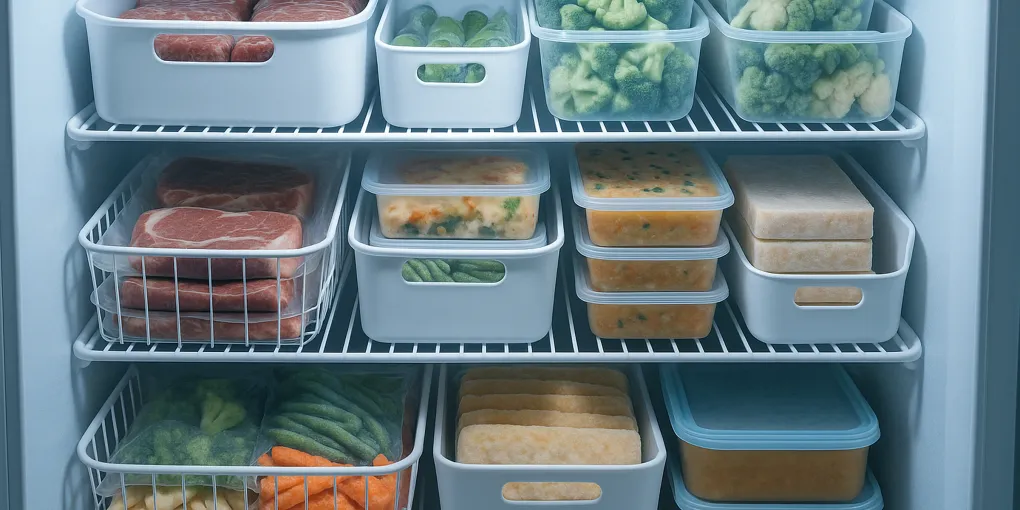
Effective freezer organization is fundamentally about zones — dedicated spatial areas for each category that remain consistent regardless of what is in them at any given time. The number of zones you need depends on your household’s freezer habits, but most households function well with five to seven categories.
For upright freezers, zones are created shelf by shelf. Assign each shelf a category. The most-used items should occupy the shelves at eye level or just below — typically the second and third shelves from the top. Less frequently accessed categories (holiday baking supplies, bulk proteins bought quarterly) live at the top and bottom. A common zone layout for an upright: top shelf for overflow and long-term storage; eye-level shelves for prepared meals and frequently used proteins; middle shelves for vegetables and fruits; bottom drawer (if applicable) for ice cream and bread.
For chest freezers, zones are created using dividers and bins because there is no shelf structure to work with. The most critical principle for chest freezers is that no category should be loose — everything must be contained. Loose items inevitably settle to the bottom and require excavation. Use large bins or tote organizers for each category, labeled clearly on their front face. Common zone layout for a chest freezer: proteins bin, vegetables bin, prepared meals bin, baked goods bin, and a front-access zone for the items you need most often.
Temperature zones also matter in freezers. The back and bottom of a chest freezer are coldest. Long-term storage items — whole turkeys, bulk proteins, items you will not access for months — belong there. Frequently accessed items should be front and center.
Write down your zone map and tape it to the inside of the freezer lid or door. This external reminder is not just for you — it is for every member of your household. When the system is explicit and visible, follow-through improves dramatically.
Step 3: Standardize Your Containers
One of the biggest contributors to freezer chaos is inconsistent packaging. Items arrive in bags, boxes, plastic trays, foil pans, and countless other formats that refuse to stack neatly or fit together efficiently. Standardizing your containers is the single most impactful step you can take for long-term freezer organization.
Square and rectangular containers are the most space-efficient because they tile without gaps, unlike round containers. For liquid-based foods (soups, stews, sauces), either use rectangular containers or freeze in freezer bags laid flat — once frozen flat, bags stack like books and take up a fraction of the space that containers do.
Invest in a set of freezer-safe containers in two or three sizes. One quart is ideal for single meals, soups, and portion-sized proteins. Two quart handles bulk items and family-sized portions. Gallon-sized freezer bags or containers handle large batches. Having consistent container sizes means everything stacks neatly and bins can hold a predictable quantity.
Label everything before it goes in. A label with permanent marker directly on a piece of freezer tape is sufficient: item name, date frozen, and quantity. More elaborate labeling systems exist, but the basic three fields are what matters. If you meal prep regularly, a label template with spaces for name, date, and servings makes the process faster and more consistent.
The investment in consistent containers pays for itself quickly in reduced food waste, easier meal planning, and the simple satisfaction of being able to find what you need in under ten seconds.
Step 4: Load Using the FIFO System
FIFO — First In, First Out — is the commercial kitchen principle of always using the oldest stock first. It is the single most effective habit for preventing freezer waste, and the organizational system you build should make FIFO the default behavior, not a choice that requires willpower.
For upright freezers, FIFO works naturally when items are stacked front-to-back rather than left-to-right. New items go to the back of each shelf; older items are pulled forward. When stocking after a grocery run, the habit of always restocking from the back takes about 30 seconds to implement but saves significant waste over time.
For chest freezers with bins, FIFO requires a bit more intentionality. Load new items into the back of each bin and retrieve from the front. Some households use two-bin rotation within each category: one bin currently in use, one restocking bin behind it. When the front bin empties, it gets replaced by the back bin and a new restocking bin is loaded.
The behavioral science point here is important: the goal is to build a system where the right behavior is the easy behavior. If FIFO requires extra steps, it will not happen consistently. When the system is designed so that the natural action of grabbing something from the front automatically gives you the oldest item, FIFO becomes the path of least resistance.
Step 5: Establish a Monthly Freezer Check
Unlike the refrigerator, which benefits from a weekly scan, the freezer operates on a slower timeline. A monthly check is sufficient for most households. On a regular schedule — the first Saturday of each month is a common anchor — spend five minutes scanning the freezer contents.
During the monthly check: identify anything approaching the quality limit for its category; rotate any items that have migrated out of their zones back to their proper bins; check that bin labels are still readable and attached; and confirm that the temperature is set correctly (0°F or below).
Pair the monthly check with meal planning for the following two weeks. Review what proteins and prepared meals are available before deciding what to buy. This habit reduces duplicate purchasing, accelerates consumption of items approaching their quality limit, and keeps the freezer lean and functional.
Quarterly, conduct a more thorough audit — similar to the initial inventory, but less extensive since the system should be functioning. Pull each bin, check for anything that needs to be consumed soon, and wipe down the interior.
Freezer organizer buying criteria
Use these factors to compare options before ordering:
| Factor | Weight | What to check |
|---|---|---|
| Research | 30% | Depth of specification and user-report analysis and breadth of products reviewed |
| Evidence Quality | 25% | Reliability of specs, product documentation, and repeated owner-reported fit patterns |
| Value | 20% | Cost-effectiveness relative to competing products at similar quality tiers |
| User Signals | 15% | Long-term owner feedback and fit-related complaints |
| Transparency | 10% | Accuracy of manufacturer claims, material disclosures, and dimension accuracy |
Scores are differentiated — top picks typically score 8.5–9.5, mid-tier 7.0–8.4, and weak options below 7.0.
Product Recommendations
For freezer organization, these products deliver the best results:
Polar Whale Freezer Organizer Bins (Set of 4)
Best for: Chest freezer zone separation and upright freezer shelf organization $32–38. Owner reviews often praise the durable construction and the stackable design that works equally well in chest and upright freezers. The ventilated sides prevent moisture buildup.
| Criterion | Weight | Score |
|---|---|---|
| Capacity & Dimensions | 30% | 9.0/10 |
| Material Quality | 25% | 8.8/10 |
| Ease of Assembly & Use | 20% | 9.1/10 |
| Long-Term Value | 25% | 8.9/10 |
| Composite Score | 8.9/10 |
Check current options on Amazon
Rubbermaid Brilliance Freezer-Safe Food Storage Containers
Best for: Standardizing frozen meal and portion storage $28–35 for a set. Purchasers highlight the airtight seal that prevents freezer burn far better than standard containers, and the clear sides that allow identification without reading the label.
| Criterion | Weight | Score |
|---|---|---|
| Capacity & Dimensions | 30% | 8.7/10 |
| Material Quality | 25% | 9.2/10 |
| Ease of Assembly & Use | 20% | 8.9/10 |
| Long-Term Value | 25% | 9.0/10 |
| Composite Score | 8.9/10 |
Check current options on Amazon
Weston Vacuum Sealer Machine
Best for: Long-term protein storage and eliminating freezer burn $68–90. Verified buyers report that vacuum-sealed meats stay in excellent quality for 12 to 24 months compared to 3 to 6 months for standard packaging. The investment pays back quickly in reduced food waste.
| Criterion | Weight | Score |
|---|---|---|
| Capacity & Dimensions | 30% | 7.8/10 |
| Material Quality | 25% | 8.8/10 |
| Ease of Assembly & Use | 20% | 8.2/10 |
| Long-Term Value | 25% | 9.3/10 |
| Composite Score | 8.5/10 |
Check current options on Amazon
Maintenance: Keeping Your Freezer Organized
The most important maintenance principle for freezer organization is this: the system only works if restocking follows the same logic as the initial setup. The most common breakdown point is the grocery run. Items get loaded into the freezer quickly, without attention to zones or FIFO rotation, and within a few weeks the system has deteriorated.
The solution is to build restocking into the grocery routine rather than treating it as a separate task. When you return from shopping, spend two minutes at the freezer before anything else goes in. This is the moment to check what needs to move forward for consumption and to load new items into the correct zones at the back of each bin.
If multiple household members use the freezer, a simple shared inventory list — on the refrigerator door or in a shared notes app — prevents the duplicate purchasing problem. When someone takes the last chicken breast, they note it. When someone adds a new item, they note it. This two-minute habit saves money and prevents the frustration of discovering an empty bin when you planned to cook.
Annual defrosting for manual-defrost models should be scheduled in advance. Most households find that late winter is a natural time for a freezer clean-out — before spring holidays bring additional food, and after the holiday-season stock has been largely consumed. Mark it on a calendar and treat it as a reset opportunity rather than a chore.
Frequently Asked Questions
- Chest freezers benefit most from vertical dividers and labeled bins that create distinct category zones. Without bins, items pile on top of each other and the bottom layers become inaccessible. Use one bin per category — meats, vegetables, meals, bread — and always use FIFO rotation.
- Most meats stay safe indefinitely at 0°F but lose quality after 3–12 months depending on cut. Cooked meals and leftovers maintain best quality for 2–3 months. Vegetables and fruits last 8–12 months. Label everything with the freeze date to track this accurately.
- If your freezer has more than a quarter inch of frost buildup, yes — defrost before organizing. Frost buildup reduces usable space and forces the compressor to work harder, raising energy costs. Manual defrost should happen roughly once a year.
- Rigid square or rectangular containers are the most space-efficient because they stack and tile without gaps. Freezer-safe bags laid flat and stacked like files are excellent for liquids and soups. Avoid containers not rated for freezer temperatures — they crack and allow freezer burn.
- Freezer burn occurs when food is exposed to air. Use airtight containers, press air out of freezer bags before sealing, and double-wrap meats. Vacuum sealing is the most effective method and extends freezer life significantly for meats and fish.