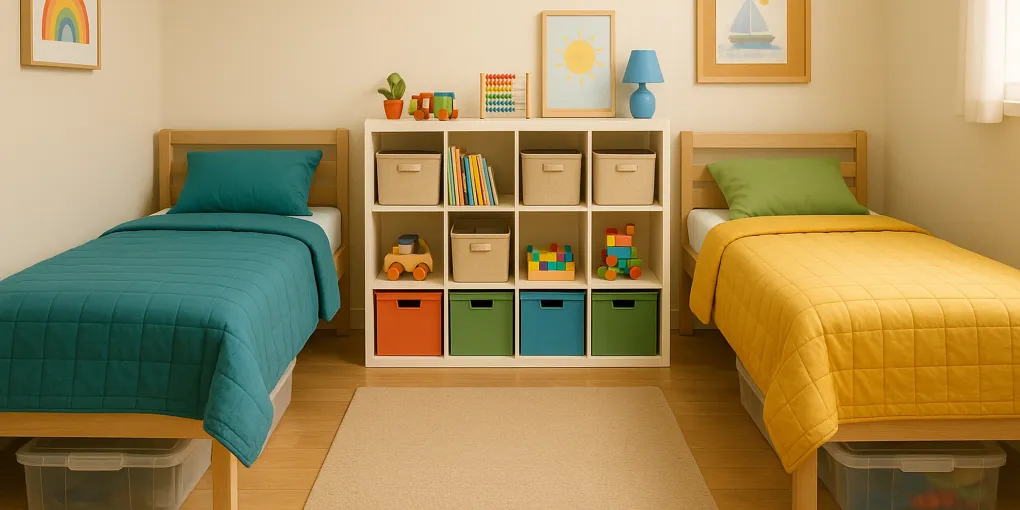
How to Organize a Shared Kids' Bedroom: A Step-by-Step Guide
ProtocolHow We Evaluate Shared Bedroom Organization Systems
ClutterScience assesses organization guidance using a five-factor composite methodology (30/25/20/15/10):
| Factor | Weight | What It Measures |
|---|---|---|
| Research | 30% | Grounding in behavioral science research on shared environments, child development, and habit formation |
| Evidence Quality | 25% | Quality of cited sources: peer-reviewed research, verified community data, documented practitioner methods |
| Value | 20% | Practical applicability using widely available, budget-friendly storage products |
| User Signals | 15% | Real-world feedback from families using zone-based shared bedroom systems |
| Transparency | 10% | Honest acknowledgment of limitations, individual variation, and age-specific constraints |
The Shared Bedroom Organization Problem Is a Design Problem, Not a Conflict Problem
Two children sharing a bedroom creates a category of organizational challenge that doesn’t exist in single-occupant rooms: the ownership ambiguity problem. When it’s unclear which items belong to which child, where shared items should be returned, or what constitutes “your side,” the room becomes a source of daily conflict rather than a functional shared space.
Behavioral science research on shared environments consistently points to the same root cause: conflict over shared spaces is driven by unclear boundaries and ambiguous ownership signals, not by personality incompatibility or intentional bad behavior (Keltner & Lerner, 2010). Children whose bedroom has clear zones, dedicated personal storage, and obvious shared-storage positions report significantly lower conflict frequency than children in the same physical space without those design elements.
This guide addresses the shared bedroom organization problem as a design problem: six steps to build a system where each child’s belongings have an unambiguous home, shared items have a clear location, and both children can maintain the system independently.
For general bedroom storage products, see our guide to best bedroom storage organizers. For kids’ closet-specific organization, see best kids’ closet organizers.
Step 1: Conduct a Two-Child Toy and Belongings Audit
Before arranging any furniture or purchasing any storage, conduct an audit of every item in the room. This serves two functions: it establishes what actually needs to be stored (often 30–50% less than currently exists), and it forces a categorization decision that is far easier to make before storage is designed than after.
Categorize every item into four groups:
- Child A personal items — belongs solely to Child A; would cause conflict if Child B used or relocated it without permission
- Child B personal items — same as above for Child B
- Genuinely shared items — both children use, neither owns exclusively; including books read by both, art supplies, board games, building sets, outdoor toys
- Outgrown or excess — items that neither child actively uses, or duplicates; candidates for donation, gifting to younger relatives, or storage outside the bedroom
The categorization step is typically uncomfortable when conducted jointly with the children present, because ambiguous items become subjects of real-time negotiation. Do the initial sort without the children present — adult categorization is faster and more accurate at identifying what is genuinely used vs. stored out of habit. Present the result to the children afterward for input on genuinely ambiguous items.
Target: reduce total bedroom item volume by at least 25% before designing storage.
A common shared-bedroom failure mode is attempting to store two children’s full possession inventory in a space designed for one. The math doesn’t work. Selective reduction before storage design is not optional — it is the prerequisite that determines whether any organizational system holds.
After the audit, you know exactly what storage capacity is required: total personal items per child (which drives dedicated storage sizing) and total shared items (which drives shared storage sizing).
Step 2: Design Clear Ownership Zones
An ownership zone is a physical area of the room where each child’s personal items live exclusively. The zone does not need to be perfectly equal in size — it needs to be unambiguous. Children respond to clear visual and physical boundaries more than to stated rules; a zone delineated by furniture, a rug, or even a strip of colored tape on the floor provides a persistent environmental signal that stating “that’s your side” does not.
Zone design strategies by room layout:
Two-side division (most common): Split the room down a natural axis — often the center of the room, or aligned with the window. Child A occupies one side (bed, dresser, shelves, closet half); Child B occupies the other. Each side has identical or equivalent furniture pieces to minimize perception of inequality. The middle of the room — floor space between the two zones — is shared territory.
Bunk bed configuration: When bunk beds are the layout, zones become vertical rather than horizontal. The lower bunk child has floor-level access to a dresser and under-bed drawers on their side; the upper bunk child uses a shelf attached to the bunk frame for small items and a dresser on the same side, slightly offset to avoid blocking headroom. Wall-mounted shelves above the upper bunk provide equivalent storage to the lower bunk’s floor access.
L-shape or irregular rooms: Place each child’s bed in a distinct corner, and extend the zone outward from there using bookshelves as zone dividers. The bookshelf-as-divider is particularly effective: it provides storage for both zones while physically demarcating the boundary between them.
Visual zone markers: Beyond furniture arrangement, reinforce zones with color-coded details: a small rug in each child’s assigned color, wall hooks in matching colors for backpacks and coats, and storage labels in each child’s color. These visual signals communicate “this side is yours” without requiring adult explanation or enforcement.
Step 3: Set Up Personal Storage for Each Child
Each child needs dedicated, private storage for their personal items — storage that is clearly theirs and does not require negotiation with the other child to access. The specific products depend on room size and layout, but the functional requirements are consistent.
Core personal storage components per child:
Dresser or chest of drawers: Each child needs their own dresser for clothing — sharing a dresser almost always creates conflict over drawer assignments that shifts over time. If floor space is tight, a narrow 3-drawer chest placed beside the bed works as a nightstand and clothing storage combined. See our guide to best bedroom dresser organizers for drawer insert options.
Recommended: mDesign Soft Fabric Closet Storage Organizer Bin — for shelf sections within each child’s closet zone.
Under-bed storage (one set per child, color-coded): Under-bed storage is the highest-ROI storage real estate in a shared bedroom: it holds significant volume in a footprint that doesn’t compete with floor space. Assign one set of under-bed containers to each child in a distinct color or with distinct labels. The color assignment makes the ownership unambiguous without any explanation needed.
Recommended: Iris USA Under Bed Storage with Wheels — clear-sided containers on wheels allow visual inventory and easy retrieval.
Personal shelf section: If a shared bookshelf is the room’s primary shelving, assign specific shelves to each child. The lower shelves go to the younger child (easier access), upper shelves to the older child. Use a color-coded label or a small marker at the shelf edge to make the assignment permanently clear.
Closet half or section: Divide a shared closet evenly or proportionally based on each child’s clothing volume. Install a second closet rod for the child with more hanging items if the standard single rod is insufficient. Over-door organizers on each child’s designated closet door side add pockets for accessories, shoes, or small toys without consuming shelf space.
Recommended: SimpleHouseware Over-Door 24-Pocket Organizer — one per child, assigned to each closet door.
Step 4: Create a Clear Shared Storage System
Shared items — books read by both children, art supplies, board games, puzzles, building sets — need storage that is clearly accessible to both children and equally “neither child’s responsibility to manage alone.” Shared storage is more complex to maintain than personal storage because it requires both children to share accountability for returns.
Shared storage design principles:
Centrally located, not zone-adjacent: Place shared storage in the genuinely shared space of the room — not within either child’s zone. A shared bookshelf in the center of the room, or a cube storage unit against the wall between the two zones, signals shared ownership by its neutral location.
Open bins with visual labels: For shared storage to hold over time, it needs to require minimal decision-making for returns. Open bins with clear labels (picture-based labels for pre-readers; word labels for readers) eliminate the “where does this go?” friction. Each category has one bin; each bin has one label; returning an item is a match task rather than a decision.
Recommended: IKEA Kallax-style Cube Organizer — a 2x4 or 4x4 cube unit holds multiple labeled bins for shared categories in an accessible format.
Category bins for shared toys: Group shared items into clear categories: Building Sets, Art Supplies, Board Games, Books, Outdoor Toys. Each category gets its own bin or shelf section with a label. Children who cannot yet read respond well to picture labels printed and laminated — images of a puzzle, a LEGO brick, crayons — affixed to each bin front.
Rules for shared returns: Establish and post one rule for shared storage: “return it before you start something new.” This limits the number of shared items simultaneously out of their bins, preventing the pile-up that occurs when multiple open projects coexist. Frame it as a system rule, not a child rule — “the system works this way” rather than “you must do this.”
Step 5: Build a Daily and Weekly Reset Routine
Even well-designed shared bedroom systems require consistent maintenance. The most common failure mode for shared spaces is successful initial setup followed by gradual entropy — small deviations from the system that compound over days until the room returns to disorder.
Daily reset (5 minutes, done together): At a consistent time — before dinner, after bath, or at a fixed homework-transition point — both children do a simultaneous 5-minute room sweep. Personal items return to personal zones; shared items return to shared bins. The simultaneous format prevents the “why do I have to clean up their stuff too?” objection: both children are doing it at the same time, which is the defining feature of shared responsibility.
Behavioral research on cooperative household routines (Grolnick & Slowiaczek, 1994) found that children who share household tasks simultaneously (rather than in sequence) develop higher compliance and stronger perception of fairness than children who perform the same tasks independently. The routine signals shared accountability through shared execution.
Weekly deeper reset: Once a week — Sunday evening works well to reset for the school week — do a brief audit of both zones and shared storage. Items that have migrated to the wrong zone return home. Items that are genuinely no longer used are candidates for the “outgrown or excess” category. Shared bins that are overflowing trigger a quick sort of whether any items have become personal-zone items or candidates for removal.
Seasonal clear-out: Four times per year (aligned with school year transitions and seasonal clothing swaps), do a mini-version of the Step 1 audit: identify what each child has outgrown or no longer uses and remove it before it becomes background clutter. A shared bedroom has half the floor space per child of a solo bedroom — the same volume tolerance doesn’t apply.
Step 6: Adapt the System as Children Grow
Shared bedroom organizational systems have a built-in challenge that single-occupant systems don’t: both children are changing simultaneously, often at different rates. A system calibrated for a 6-year-old and a 9-year-old will be partially inappropriate within 12–18 months as the younger child’s developmental stage changes.
Age-appropriate adaptation triggers:
Pre-readers to readers (typically ages 5–7): Replace picture labels with word labels. Add independent reading lighting at each child’s bed — a clip-on lamp or wall-mounted reading light that allows each child to read without disturbing the other.
Single-activity play to multi-activity: As children move from playing with one toy at a time to coordinating more complex multi-step play (building projects, art projects), increase shared storage capacity for in-progress projects. A dedicated “in progress” section — a shallow open bin or low shelf — allows active multi-day projects to live without occupying floor space.
Growing privacy needs (typically ages 8–11): Older children begin needing more visual privacy in the bedroom. Add a ceiling-mounted curtain track for each child’s bed zone, or a freestanding room divider panel. Designated “quiet time” hours — posted as a shared household schedule — give each child protected individual time in the shared space.
Homework independently at desk (typically ages 7–10): If both children are doing independent homework, a shared desk creates conflict. Either add a second desk (one per child, in their respective zones) or establish alternating desk-use schedules. A pegboard or small desktop organizer assigned to each child’s desk half maintains personal supply ownership at the shared surface. See our guide to best desk drawer organizers for options.
Product Summary
| Item | Purpose | Recommended Link |
|---|---|---|
| Under-bed containers (2 sets, different colors) | Personal storage per child | Shop on Amazon |
| Over-door pocket organizers (2) | Personal closet accessories | Shop on Amazon |
| Cube storage organizer | Shared toy and book storage | Shop on Amazon |
| Fabric storage bins (labeled) | Category bins for shared storage | Shop on Amazon |
| Drawer dividers (per child’s dresser) | Personal clothing organization | Shop on Amazon |
| Label maker or picture labels | Zone and bin labeling | Shop on Amazon |
Bottom Line
A shared kids’ bedroom becomes functional when it is organized as a shared space — not as two individual bedrooms forced into one room. The six-step approach: audit and reduce total volume, design clear ownership zones, establish personal storage for each child, build shared storage with unambiguous labeling, implement a daily reset routine, and adapt the system as children grow.
The root cause of shared-bedroom chaos is almost always ambiguous ownership — items that belong to “the room” rather than to anyone specifically, which means no one is accountable for returning them. Clear zones and clear labels remove the ambiguity. When every item has an unambiguous home, the organization system holds with minimal effort.
For related organization guides, see:
Frequently Asked Questions
- Divide the room into clear ownership zones using visual and physical boundaries — a bookshelf, a curtain track, or simply a designated side of the room. Each child gets their own dedicated storage (dresser, shelves, under-bed containers) for personal items. Shared items like books and art supplies live in central shared storage with clear labels. The key is that each child knows exactly where their things belong and where shared things belong, eliminating the disputes that come from ambiguous ownership.
- Vertical storage maximizes limited floor space: bunk beds with built-in drawers, tall bookshelves with labeled baskets per child, and over-door organizers on each child's closet door. Under-bed storage containers — one set per child in a defined color — give each child private storage that's out of the way. For shared items, open-bin cube shelving units with labeled baskets allow easy return-to-place for children of different ages.
- Privacy in a shared bedroom comes from physical and visual separation, not acoustic isolation. A ceiling-mounted curtain track lets each child draw a curtain around their bed zone for personal space during homework or downtime. A bookshelf placed perpendicular to the wall creates a visual divider. Each child's dresser and storage should face their zone, not the shared space. Simple signals — a 'do not disturb' hook or clip on the curtain — teach negotiation of personal time without requiring physical separation.
- Behavioral research and pediatric guidance generally supports shared bedrooms from age 3 and up when sleep schedules are compatible. The practical threshold is when both children are sleeping through the night consistently, so that one child's waking doesn't disrupt the other. Compatible sleep schedules matter more than age: two children who go to bed at similar times and wake similarly share a bedroom far more successfully than children with 2+ hour gaps in sleep schedule.
- Use a combination of personal and shared storage. Personal toys — items that belong specifically to each child and cause conflict when shared — go in each child's dedicated storage zone (under-bed containers, personal shelves, closet area). Genuinely shared toys — building sets, puzzles, games — go in clearly labeled shared central storage. The organizational principle is the same as for adult shared spaces: reduce ambiguous ownership, and conflict reduces proportionally.