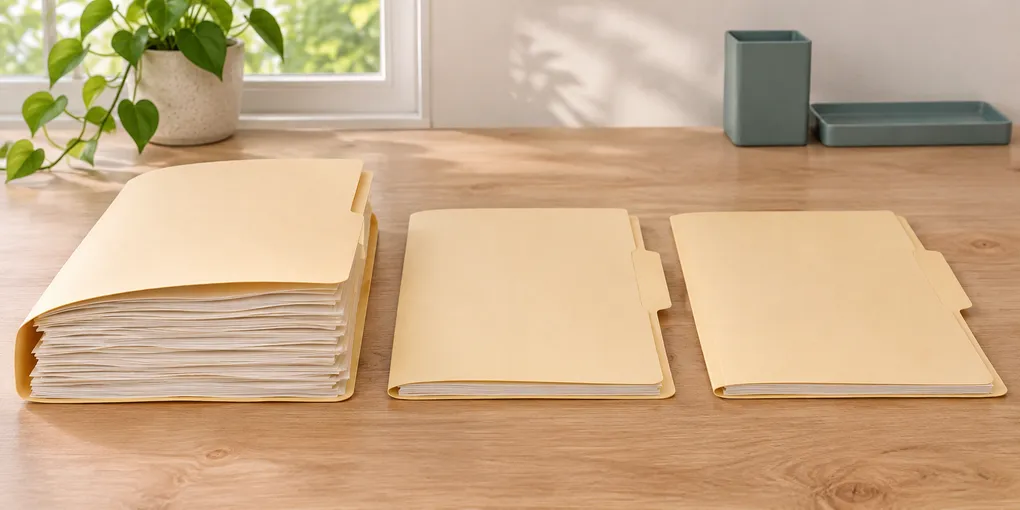
When to Split an Overstuffed Paper Folder: A Simple Capacity Check
ProtocolWhen a folder starts bulging at the edges, the tempting fix is to press the papers flatter and force it shut. Split it instead when the stack is thicker than the folder’s broadest scored width—typically about ¾ inch—or when you can no longer pull out one paper cleanly. Two folders can preserve the same subject while making the next document easier to find.
The National Archives gives a useful capacity cue for scored folders: the stack should be no thicker than the broadest width of the folder, typically three-quarters of an inch. The Library of Congress makes the companion point more simply: folders can hold multiple items, but they should not be overstuffed. Those are practical signals for an ordinary household folder that has become a paper wedge. The National Archives guidance and the Library of Congress storage guide support that limit.
Do the 30-second capacity check
Set the folder on a table and look at it from the open edge. You are checking the papers, not trying to estimate a page count.
| What you see | What it means | Next move |
|---|---|---|
| The paper stack sits within the folder’s broadest scored width | The folder still has working room | Leave it intact and return loose papers to it before they spread |
| The stack reaches or exceeds that width | The folder is at its practical capacity | Split it into two folders before adding more |
| Corners protrude, the cover bows, or tabs catch | Retrieval is already getting harder | Split it now and give each new folder some slack |
Treat the three-quarter-inch cue as a starting point rather than a universal measurement. A thin folder may become frustrating before that point, while a sturdy one may still close near it. The better question is physical: can the folder close without pressing its edges into the papers, and can you remove one item without lifting a thick stack first? If the answer is no, the split will save time on every future search.
Keep the subject; change the divider
A crowded folder can still have the right subject. A folder called “home repairs,” “school papers,” or “car records” may still make sense. Its one container is simply doing too much work.
Keep the original subject at the front of both names, then add one dividing cue you can recognize quickly. Choose the cue from the way you actually look for papers:
- Use a date range when you usually ask, “Was that from this year or before?” For example: “Home repairs — 2024–2025” and “Home repairs — 2026.”
- Use document type when you usually know what kind of paper you need: “Car records — service” and “Car records — purchase.”
- Use current use when one group comes out often: “School papers — current” and “School papers — reference.”
Keep the divider no more detailed than the retrieval problem. Four new categories can turn one crowded folder into four folders you hesitate to file. One clear split is enough when it lets you open the right half of the subject first.
Split the stack without starting a bigger project
Put two empty folders beside the full one. Give them their shared subject name and the divider before you move a single page. That small step prevents a temporary sorting pile from becoming a permanent desk pile.
Work from the front of the old folder to the back. Place each paper in the left or right folder according to the one rule you chose. Put any uncertain paper in a small “decide later” pile rather than creating a third category on the spot. Most folders can be divided in a few minutes because the goal is to restore enough open space for both folders to work.
When you are finished, close each folder once. Papers should sit behind the edges, and each folder should open without springing back against your hand. If either one already feels packed, move the few papers from the “decide later” pile into a separate short task rather than forcing them into a full folder again.
Leave enough room for the next paper
The split only helps if both folders stay easy to use. Put them back in the same general home as the old folder, side by side when possible. Keep the shared subject name first so they remain neighbors rather than drifting into unrelated parts of a drawer or box.
For the next month, use one return rule: when you add a paper, pick between the two folders immediately. If neither is obvious, put it in a temporary inbox rather than stuffing it into whichever folder happens to be open. The next time one of the pair reaches its capacity cue, repeat the same small decision with a new divider.
Keep the capacity check in proportion
This routine suits ordinary household papers. Questions about what to keep, discard, shred, digitize, or preserve—and how to handle rare, fragile, historic, or high-value material—need a separate decision. For an everyday folder that has simply become hard to use, compare the stack with the folder’s width, make one clear split, and leave both halves easy to close.
Sources
Frequently Asked Questions
- A practical limit is the folder's broadest scored width—typically about ¾ inch. Split it sooner if papers protrude, the folder bows, or you cannot retrieve a document without disturbing the whole stack.
- Keep the original subject name, then add one useful divider. A date range, a document type, or an active-versus-reference split is usually enough. The point is to make the next retrieval easier, not to redesign every household file.
- Start by checking whether the contents still answer one clear retrieval question. If two thinner folders with a shared subject name would be faster to open and return, splitting is usually the simpler maintenance move.