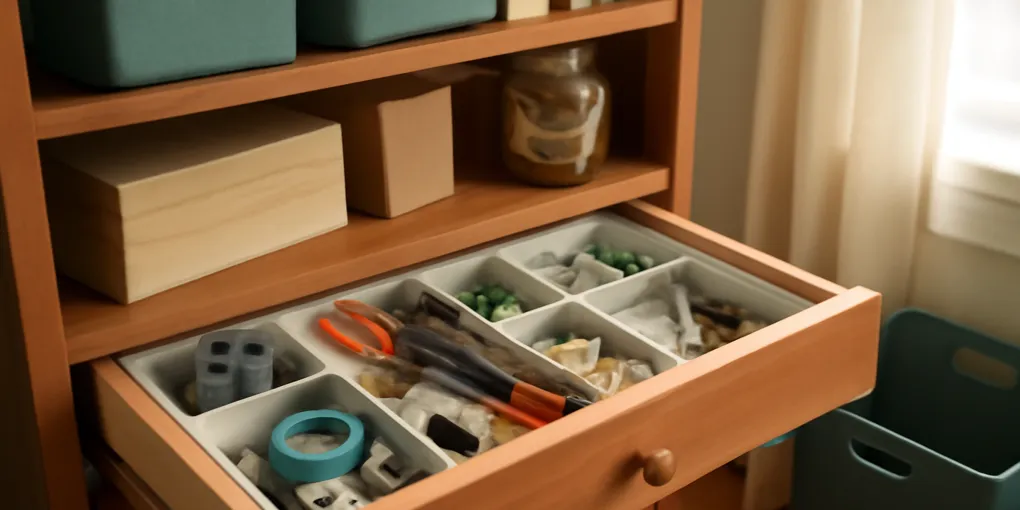
Why Junk Drawers Become Small-Hazard Zones
Evidence ExplainerQuick picks
Small divided drawer organizer tray
★ Top pick Best reset tool- Why consider it: Creates separate lanes for keys, tools, clips, and office supplies so hazards are not mixed with everyday grabs.
Battery storage case with tester
Best for loose cells- Why consider it: Keeps fresh and spent batteries from rolling loose in a drawer with coins, keys, or foil wrappers.
Child-resistant small-item lock box
Best for risky leftovers- Why consider it: Moves medicines, blades, button batteries, and sharp repair parts out of the shared grab drawer.
A junk drawer becomes risky when it mixes two very different jobs: quick access and forgotten storage. The same drawer that holds pens, tape, and keys often collects loose batteries, coins, medication samples, utility blades, screws, safety pins, matches, and mystery hardware. That mix is convenient until someone reaches in quickly, a child explores it, or a loose battery rolls against metal.
This is an evidence explainer, not a call to eliminate every junk drawer. A small everyday drawer can work. The goal is to remove small hazards from the shared grab zone and give safe everyday items clear lanes. The simplest product stack is a small divided drawer organizer tray (search current options on Amazon), a battery storage case (browse battery cases on Amazon), and a child-resistant small-item box for the things that should not be grabbed casually (compare options on Amazon).
If your drawer is mostly ordinary clutter rather than hazard clutter, start with how to organize a junk drawer. If it contains batteries, blades, pills, or small parts within reach of children, use the safety reset below first.
Quick picks for a safer junk drawer
- First step: empty the drawer onto a tray or towel so risky leftovers are visible before you buy anything.
- Best everyday organizer: Search Amazon for small divided drawer organizer trays for keys, clips, tape, pens, and small tools.
- Best battery fix: Search Amazon for battery storage cases with testers if loose cells are rolling around near coins or keys.
- Best hazard move-out: Search Amazon for child-resistant small-item lock boxes for button batteries, blades, matches, and medication leftovers that must stay indoors.
- Skip: deep open bins that mix safe everyday items with sharp, electrical, or swallowable pieces.
Why the drawer turns risky
Junk drawers collect items that lack a better home. That sounds harmless, but the category is defined by uncertainty. If nobody knows where a button battery, half-used key ring, mini screwdriver bit, expired coupon, or loose pill belongs, it lands in the drawer. Over time, the drawer becomes a mixed-risk environment.
The problem is not only clutter volume. It is incompatible access. Pens and tape invite fast, casual reaching. Batteries, blades, and medications require slower, more controlled handling. When both live in the same drawer, the drawer teaches everyone to treat hazards like office supplies.
Small objects also hide at the bottom. A divided tray can make safe items visible, but it should not be used to make hazards look organized. A button battery in a neat little compartment is still a button battery in a shared drawer.
Battery clutter needs its own rule
Loose household batteries deserve a separate system. The National Capital Poison Center and pediatric safety groups warn that button batteries can cause severe injury if swallowed. Even larger batteries should not roll loose with coins, keys, foil, or small tools because metal contact can create short-circuit risk.
Store batteries in original packaging, a battery case, or another container that separates terminals. A battery storage case with tester (search current options on Amazon) is useful if your household keeps mixed AA, AAA, coin, and 9-volt cells. Keep spent batteries in a separate labeled area for recycling or disposal according to local rules.
Do not use the junk drawer as a battery quarantine zone. If a child can reach the drawer, the battery case should move higher, lock away, or live in a controlled utility area.
Blades, pins, and repair leftovers need covers
A junk drawer often becomes the landing zone for leftover repair parts: loose screws, picture-hanging nails, razor blades, utility-knife blades, safety pins, Allen keys, and tiny brackets. These items are easy to underestimate because each one is small. Together, they make the drawer unpleasant and risky to search.
Keep one safe mini tool kit if you actually use it near that drawer. Everything sharp should have a cover, case, or dedicated hardware box. Utility blades and razors do not belong loose in a tray. If a repair item is too sharp or too tiny to grab safely, move it out of the shared drawer.
A child-resistant small-item lock box (search current options on Amazon) can help for risky leftovers that must remain indoors but should not be casual-access items.
Medication and personal-care samples are not drawer filler
Medicine clutter is common in junk drawers because sample packets, travel tubes, and stray blister packs are small. That does not make the drawer a safe storage location. Medications need label visibility, date checks, and storage away from children and pets.
Move medicines, supplements, and first-aid products to a dedicated location with labels intact. Dispose of expired or unneeded medication according to FDA or local take-back guidance. Do not keep unidentified pills, cut blister packs with missing labels, or old packets because they are small enough to ignore.
The four-bin sorting pass
Empty the drawer onto a towel so small parts cannot roll away. Sort everything into four groups:
- Safe everyday items: pens, tape, clips, keys, stamps, scissors with covers.
- Controlled storage: batteries, blades, medicines, sharp hardware, matches, lighters.
- Relocate: items that belong in a toolbox, office, car, entryway, or command center.
- Trash or recycle: expired coupons, broken pieces, mystery keys, dead batteries, and packaging.
Only group one returns to the junk drawer. Group two gets safer storage. Group three goes to its real home immediately. Group four leaves the house according to the right disposal route.
Product fit matrix
| Drawer condition | Best tool | Why |
|---|---|---|
| Safe items are mixed together | Small divided tray | Restores lanes without overbuilding the drawer |
| Loose batteries are present | Battery case with tester | Separates terminals and fresh versus spent cells |
| Blades or tiny hardware appear often | Lidded hardware box | Keeps sharp parts out of casual reach |
| Medicines or button batteries are accessible | Child-resistant lock box | Adds a boundary for high-risk small items |
| Paper piles dominate the drawer | Paper inbox or command center | Moves forms and mail out of the grab zone |
If the drawer is mostly paper, the safer fix may be a paper inbox protocol for home counters rather than more compartments.
Safety and source notes
HealthyChildren guidance on childproofing calls out small objects, medicines, and household hazards as items that should be kept away from children. The National Capital Poison Center’s button-battery guidance explains why coin and button cells deserve special handling. FDA medicine-disposal guidance supports removing expired or unneeded medicines instead of keeping them in casual storage.
This does not mean every adult household needs a locked drawer. It does mean the junk drawer should not be the default home for objects that require warning labels, intact packaging, or controlled access.
FAQ
Can I keep scissors in a junk drawer?
Yes, if they are normal household scissors, close properly, and have a predictable compartment. Do not mix loose utility blades, razor blades, or uncovered craft knives into the same tray.
What is the best organizer for a junk drawer with kids in the house?
Use a divided tray only for safe everyday items. Move batteries, medicines, sharp parts, matches, and small choking-size objects to higher, locked, or otherwise controlled storage.
How often should I inspect the junk drawer?
Do a quick scan monthly or whenever you change batteries, assemble furniture, wrap gifts, or empty pockets. Those moments add the small parts that make the drawer drift from useful to risky.
Sources
- HealthyChildren, Childproofing Your Home — supports keeping small objects, medicines, and household hazards away from children.
- National Capital Poison Center, Button Batteries — supports treating button batteries as a serious ingestion hazard.
- FDA, Disposal of Unused Medicines — supports removing expired or unneeded medicines from casual storage.
Bottom line
A junk drawer can be useful if it holds safe everyday items in visible lanes. It becomes a hazard zone when loose batteries, blades, medicines, and tiny hardware share the same casual-access space. Remove the risky categories first, then organize what remains.