Do Color-Coded Cleaning Cloths Prevent Cross-Contamination at Home?
Evidence ExplainerQuick picks
| Product | Key Specs |
|---|---|
| See price on Amazon |
|
| See price on Amazon |
|
Product availability, certifications, and retailer details can change; check the current Amazon page before buying.
A red cloth does not kill germs. Its useful job is simpler: it can make it harder to wipe a toilet and then carry the same cloth to a kitchen counter. Color is a routing cue, not a disinfectant.
A household color system is worthwhile when several reusable cloths look alike, cleaning jobs span bathrooms and food-preparation areas, or multiple people share chores. It fails when used cloths return to the clean stack, colors change from week to week, or everyone assumes microfiber replaces correct product use.
The EPA distinguishes cleaning with soap and water from disinfection with an EPA-registered product. Its household guidance also says to follow label directions and never mix products or chemicals (EPA cleaning and disinfecting best practices). A cloth system must support those steps rather than distract from them.
What color coding can and cannot do
Color coding can:
- Reserve cloths for toilet and bathroom fixtures.
- Separate kitchen and food-contact work from bathroom work.
- Keep glass cloths away from greasy jobs.
- Show family members where a clean cloth belongs.
- Make a used-cloth mistake more visible.
Color coding cannot:
- Make a dirty cloth clean.
- Neutralize bleach, ammonia, acids, or other cleaners.
- Replace label directions, dilution instructions, or contact time.
- Guarantee that a surface has been disinfected.
- Make one cloth suitable for every surface finish.
The evidence-backed principle is separation plus correct cleaning practice. The specific colors are a household convention.
A practical four-color map
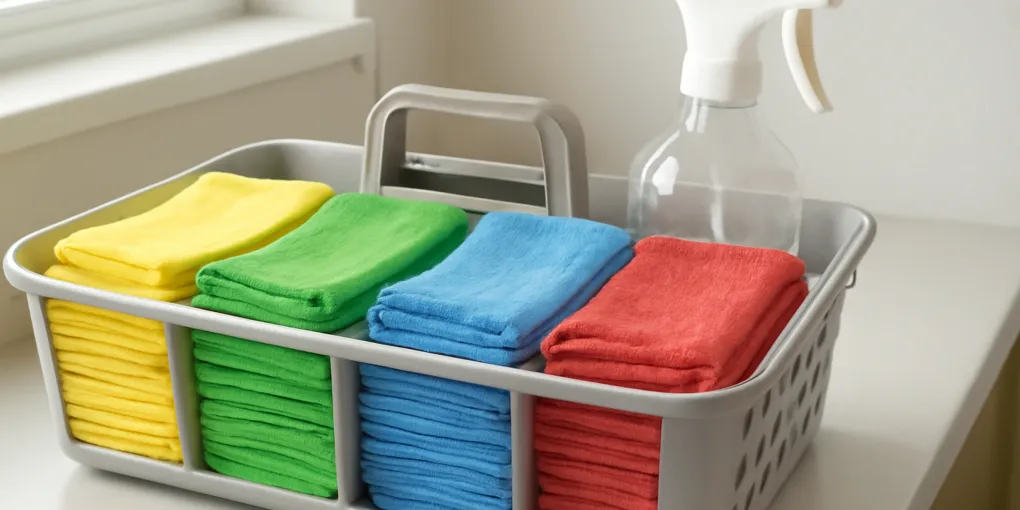
Choose high-contrast colors that remain distinguishable after washing. One workable assignment is:
| Color | Reserved job | Keep away from |
|---|---|---|
| Red | Toilet exterior, seat, flush handle, nearby floor | Kitchen and dining surfaces |
| Green | Kitchen counters, cabinet fronts, appliance exteriors | Toilet work |
| Blue | Mirrors, glass, polished fixtures | Grease and floor soil |
| Yellow | General dusting, doors, switches, living spaces | Toilet and raw-food cleanup |
If a household member has color-vision difficulty, add physical separation: different weave, stitched corner shape, or separate caddy compartment. Do not rely on handwritten tags that disappear in the wash.
Check 4 color microfiber cleaning cloths washable on Amazon. Look for clearly different colors, finished edges, machine-washable care instructions, and enough cloths that one used piece does not force reuse. Avoid packs where four pale shades become nearly identical when wet.
Separate clean, active, and used cloths
Most color systems fail in storage rather than during wiping. Use three states:
- Clean cloths: dry, folded, and separated by assigned use.
- Active cloth: in hand or placed beside the product currently being used.
- Used cloths: moved directly to a ventilated hamper or washable container.
Check ventilated divided cleaning caddy on Amazon. A caddy can hold clean cloths and sealed products, but it should not become a damp-cloth hamper. Moist folded textiles can develop odor and are easy to mistake for clean ones.
Keep cleaning products in their original containers. The EPA warns against mixing products or chemicals, and decanting chemicals into unmarked bottles creates identification and safety problems. Store products according to their directions and away from children and pets.
Use enough folded faces
Fold a cloth into quarters to create multiple working faces. Use one face for a bounded area, then refold to expose a clean face. Replace the cloth when all faces are soiled, after a toilet job, after raw-food contamination, or when the product directions require a fresh applicator.
Do not use the same kitchen cloth to wipe a raw-chicken spill and then continue around the room. Remove visible material safely, follow food-safety cleaning guidance, and launder the cloth after the job.
For disinfecting, read the product label. The surface may need to remain visibly wet for a stated contact time. A nearly dry microfiber cloth that instantly absorbs the product can defeat that requirement.
Match cloth and chemical care directions
Reusable microfiber is not indestructible. Fabric softener can reduce absorbency and leave residue. High heat may damage some fibers. Bleach compatibility varies. Read both the textile care instructions and the cleaning-product directions rather than applying one laundry rule to every cloth.
A safe household routine is:
- Wear gloves when the product directions call for them.
- Do not shake heavily soiled cloths.
- Move used cloths to their laundry route promptly.
- Wash with an appropriate detergent and water temperature for the item.
- Dry completely before returning cloths to clean storage.
- Retire cloths that remain greasy, damaged, or impossible to identify.
If a cloth was used with a strong chemical or on a high-risk mess, do not combine it with other laundry unless the relevant product and textile instructions support that choice.
When disposable material makes more sense
A reusable cloth is not mandatory for every mess. Disposable towels may be the clearer choice for pet waste, bodily fluids, raw-meat packaging leaks, broken glass cleanup, or a chemical spill where reuse would create handling risk. Follow local disposal and product instructions.
The goal is not to maximize cloth reuse. It is to keep contamination routes understandable.
Set up the system in 15 minutes
- Choose three or four high-contrast cloth colors.
- Write the assignment on a card stored inside the cleaning cupboard door.
- Place clean colors in separate compartments.
- Add a distinct ventilated container for used cloths.
- Tell every household member that red never enters the kitchen.
- Check product directions before the first use.
- Review the system after two weeks and change any color people confuse.
Buyer checklist
Buy a cloth set only if it has:
- Clearly distinct colors when dry and wet.
- Machine-washable care instructions.
- Enough pieces to replace a cloth mid-job.
- Edges that will tolerate repeated laundering.
- A size that folds into several usable faces.
Buy a caddy only if it has:
- Separate space for clean textiles and closed products.
- A washable interior.
- Ventilation or an open design.
- A stable handle.
- No temptation to store incompatible chemicals loose together.
Color coding is useful because it makes one safety boundary visible. Its benefit disappears when laundering, storage, or chemical handling ignores that boundary.
Sources
- U.S. EPA, Cleaning and Disinfecting Best Practices During the COVID-19 Pandemic: https://www.epa.gov/coronavirus/cleaning-and-disinfecting-best-practices-during-covid-19-pandemic
- U.S. EPA, Six Steps for Safe and Effective Disinfectant Use: https://www.epa.gov/coronavirus/six-steps-safe-effective-disinfectant-use
Frequently Asked Questions
- The exact colors do not matter. Choose a memorable assignment, such as red for toilet surfaces, blue for glass, green for kitchen, and yellow for general surfaces, then keep it consistent.
- Follow the cloth and cleaning-product care directions. Heavily soiled toilet cloths may warrant separate handling, and cloths exposed to incompatible chemicals should not be mixed casually.
- No. A cloth can remove soil, but disinfection depends on an appropriate registered product, correct dilution where applicable, and the surface staying wet for the product's stated contact time.