How to Organize Basement Storage 2026
Buyer's GuideQuick picks
Iris USA 53-Quart Heavy Duty Storage Tote with Buckle-Down Lid
Edsal Heavy Duty 5-Shelf Steel Shelving Unit
hOmeLabs 4,500 Sq. Ft Energy Star Dehumidifier
Quick picks
These are the products referenced in the guide; check dimensions, material, and installation limits before ordering.
- Recommended product: Check current options on Amazon
- Recommended product: Check current options on Amazon
- Recommended product: Check current options on Amazon
The Basement: From Dumping Ground to Strategic Storage Asset
The American basement has a complicated relationship with home organization. In theory, it represents enormous untapped storage potential — hundreds of square feet of additional space beneath the main living area. In practice, it becomes the repository of everything that does not belong anywhere else, until it is so full and disorganized that retrieving any specific item requires a dedicated half-day expedition.
The pattern is recognizable in millions of homes: a box from the last move that was never unpacked. Tools from a project three years ago left on a shelf, then covered by subsequent projects. Holiday decorations in bags and bins of varying sizes stacked precariously in corners. Exercise equipment that seemed like a good idea purchased between two items no one uses anymore. Sports gear from activities no one has done in a decade. The basement accumulates without intention, and without a system, it never gives back.
The behavioral science of basement disorganization is straightforward. Basements are out of sight and therefore out of mind. The low visibility of basement storage reduces the psychological discomfort that drives people to declutter main living spaces. Items sent to the basement avoid the decision about whether they are worth keeping, which is why basements become accumulation zones rather than strategic storage spaces.
The transformation from dumping ground to functional storage asset requires three things: a ruthless declutter, a zone-based organizational system, and environmental upgrades that address the moisture and accessibility challenges unique to basements. This guide covers all three.
For related large-space organization, see our guides on how to organize an attic for long-term storage and how to organize a garage by zone.
Step 1: Assess Environmental Conditions First
Before moving a single item or installing any shelving, conduct a thorough environmental assessment of your basement. Organizing a basement without addressing its environmental conditions is building a system that will gradually fail.
Moisture: Basement moisture is the most common and most damaging issue. Check for: water staining on walls or floor, efflorescence (white salt deposits on concrete indicating water migration), mold or mildew on walls or stored items, condensation on pipes or walls, and musty odor. Run a hygrometer for 24 hours to measure actual humidity levels — anything consistently above 50% requires active moisture management with a dehumidifier.
Flooding history: Ask neighbors, check the property disclosure, or look for waterline marks on walls. Basements with a history of flooding require specific waterproofing measures before storing anything valuable.
Pests: Inspect for rodent droppings, insect activity, and evidence of entry points. Seal any cracks or gaps. Steel wool packed into larger gaps prevents rodent entry. All stored items in a basement with pest history should be in sealed rigid plastic containers.
Lighting: A dark basement is an unusable basement. Assess whether existing lighting is sufficient or whether additional lights — overhead or battery-powered LED strips along shelving — are needed. The single biggest usability improvement in most basements is better lighting.
Floor and wall condition: Check for cracks, crumbling concrete, and surface damage. Major structural issues should be addressed before the space is used for storage. Minor cosmetic issues do not require repair before organizing.
Addressing environmental issues before organizing saves the cost and frustration of having to dismantle and redo a well-planned storage system after a flood or pest incident.
Step 2: Full Basement Declutter
With the environmental assessment complete, the second step is the most labor-intensive: remove and sort every item currently stored in the basement. This is a multi-hour process for most households, but it is the step that determines whether the final organized basement remains organized for years or reverts to chaos within months.
Bring every item out of its current location — off shelves, out of corners, away from walls. Work systematically from one end of the basement to the other. Spread items into sorting areas: keep, discard, donate/sell, and relocate.
Apply a strict standard for the keep pile. Ask three questions: Is this item in usable condition? Does someone in the household have a realistic future use for it? Does it make sense to store it in the basement specifically? Items that fail any of these three questions belong in another pile.
Give particular scrutiny to: items that have been in the basement since the last move; items stored in cardboard boxes that may have been damaged by moisture; duplicates; items belonging to former hobbies or activities no longer pursued; and items that were stored “temporarily” more than a year ago.
Most households reduce their basement contents by 40 to 60 percent during a thorough declutter. That reduction is the single most important factor in whether the organized system will remain functional. A basement organized to 80% of its capacity stays organized — items are easy to access and return. A basement organized to 100% or beyond its capacity collapses quickly under the daily reality of household use.
Step 3: Create a Zone Map
A zone-based basement organization system divides the available space into dedicated areas for each storage category. Zones make the basement navigable — any household member can find any item by knowing which zone it belongs to, without requiring knowledge of the specific location.
Typical basement zones:
Tools and hardware zone: Workbench area (if applicable), wall-mounted tool storage, hardware bins. This zone is most accessible if it is near the entry point or staircase and needs adequate lighting for detail work.
Seasonal decor zone: Holiday decorations, seasonal table settings, and related items. Labeled by holiday, these containers need to be accessible seasonally but not daily. Medium-depth shelving works well.
Seasonal sports and recreation zone: Ski equipment, camping gear, cycling equipment, and sports items that rotate in and out seasonally. Bulky items benefit from dedicated floor space or high-capacity shelving with adjustable heights.
Household maintenance zone: Cleaning supplies in bulk, spare fixtures, paint and painting supplies, plumbing and electrical basics. This zone should be accessible and clearly organized, since items are retrieved in reactive situations (something breaks).
Archive and memorabilia zone: Important documents in fireproof storage, family memorabilia, photographs (in climate-appropriate containers), and keepsakes. This zone can be in a less accessible location since items are retrieved rarely.
Long-term overflow zone: Seasonal clothing not in active rotation, extra household linens, and items that legitimately have no better home. This should be the smallest zone, not the largest.
Map the zones on paper with approximate square footage for each. Assign physical locations in the basement to each zone based on proximity to stairs, lighting quality, and floor surface condition.
Step 4: Install Shelving and Moisture-Resistant Storage
For basement storage, two product decisions are foundational: the shelving system and the containers. Getting these right means the system will remain functional for years regardless of the normal wear and tear of household storage activity.
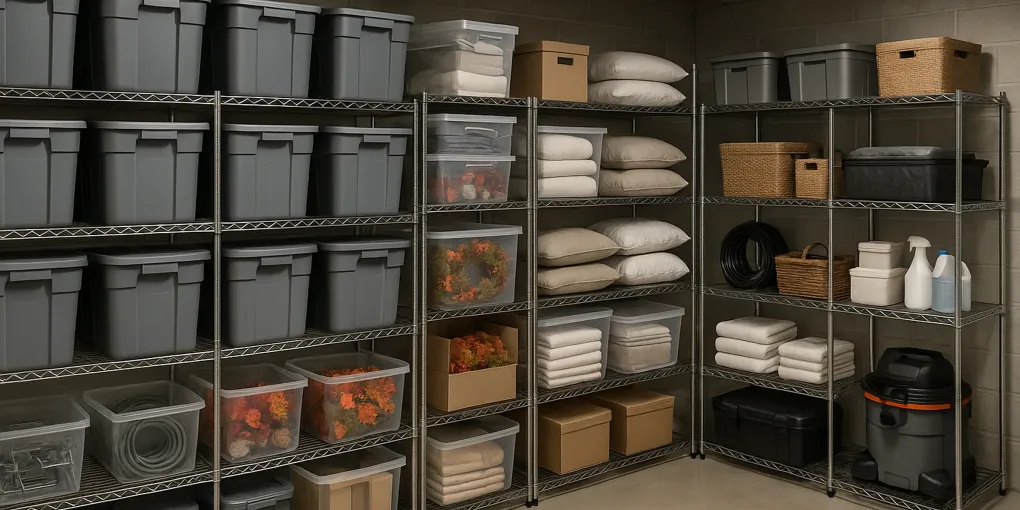
Shelving: Free-standing metal wire shelving or heavy-duty metal shelving units are the best choice for basements. Wire shelving allows airflow around stored items, which reduces moisture accumulation and helps prevent mold. Adjustable shelving that can be reconfigured as needs change is significantly more valuable than fixed shelving. Ensure shelving feet sit on concrete or plywood rather than soil or soft surfaces, and consider leveling feet for uneven concrete floors.
Containers: Sealed plastic totes are mandatory for basement storage. Cardboard degrades rapidly in even moderate humidity. Standard household bins without lids allow moisture and pests access. Heavy-duty plastic totes with snap or latch-close lids, raised slightly off the floor by the shelving system, provide the best protection. Color-coding containers by zone is an effective visual system: red for holiday items, green for sports equipment, blue for household maintenance, for example.
Moisture control: A dedicated basement dehumidifier running during humid months keeps the storage environment within acceptable parameters. Position it centrally, direct the drainage to a floor drain or use the automatic pump function if your model supports it, and empty or service it according to manufacturer recommendations.
Pest barriers: All containers should be sealed. Dryer sheets placed in containers deter some pests. Peppermint oil-soaked cotton balls placed at potential entry points discourage rodents. The primary defense remains sealed containers and regular inspection.
Step 5: Build the Labeling and Inventory System
A basement storage system without labels and an inventory is a system that works for three months and then becomes the basement it replaced. Labels and inventory are the mechanisms that make the system usable for years by anyone in the household, not just the person who organized it.
Label every container on the front face and the top. Use large, bold text that is readable at the distance from which you will typically view the shelving. The minimum label content: zone category, specific contents, and year updated. For seasonal items: add the season. For archive items: add a review date (e.g., “Review in 2028”).
Create a basement inventory document — a spreadsheet or shared note that lists every container, its zone, and its contents. This is the resource that allows any household member to identify which container holds the camping stove without physically searching the basement. Update it whenever a container is added, moved, or significantly changed.
Post a printed zone map near the basement entry. This is the 30-second reference that tells anyone which part of the basement to head toward without needing to search the full inventory. A hand-drawn map on an index card in a plastic sleeve takes ten minutes to create and dramatically improves the baseline usability of the space.
Basement storage buying criteria
Use these factors to compare options before ordering:
| Factor | Weight | What to check |
|---|---|---|
| Research | 30% | Depth of specification and user-report analysis and breadth of products reviewed |
| Evidence Quality | 25% | Reliability of specs, product documentation, and repeated owner-reported fit patterns |
| Value | 20% | Cost-effectiveness relative to competing products at similar quality tiers |
| User Signals | 15% | Long-term owner feedback and fit-related complaints |
| Transparency | 10% | Accuracy of manufacturer claims, material disclosures, and dimension accuracy |
Scores are differentiated — top picks typically score 8.5–9.5, mid-tier 7.0–8.4, and weak options below 7.0.
Product Recommendations
For basement storage organization, these products deliver the best results:
Iris USA 53-Quart Heavy Duty Storage Tote with Buckle-Down Lid
Best for: Primary basement storage containers with moisture and pest protection $18–24 each. Owner reviews highlight the reinforced corners that prevent cracking under heavy stacking loads, and the buckle-down lid that stays sealed even when totes are stacked four to five high.
| Criterion | Weight | Score |
|---|---|---|
| Capacity & Dimensions | 30% | 9.1/10 |
| Material Quality | 25% | 9.0/10 |
| Ease of Assembly & Use | 20% | 8.9/10 |
| Long-Term Value | 25% | 9.2/10 |
| Composite Score | 9.1/10 |
Check current options on Amazon
Edsal Heavy Duty 5-Shelf Steel Shelving Unit
Best for: High-capacity basement shelving that handles heavy loads $65–90. Purchasers note the 4,000 lb total weight capacity, the tool-free assembly that takes about 20 minutes, and the adjustable shelf heights that accommodate containers of different sizes without wasted vertical space.
| Criterion | Weight | Score |
|---|---|---|
| Capacity & Dimensions | 30% | 9.4/10 |
| Material Quality | 25% | 9.2/10 |
| Ease of Assembly & Use | 20% | 8.5/10 |
| Long-Term Value | 25% | 9.3/10 |
| Composite Score | 9.2/10 |
Check current options on Amazon
hOmeLabs 4,500 Sq. Ft Energy Star Dehumidifier
Best for: Basement moisture management during humid months $180–220. Verified buyers report consistent humidity reduction to target levels even in large basement spaces, and the built-in pump feature eliminates the need to manually empty the water tank.
| Criterion | Weight | Score |
|---|---|---|
| Capacity & Dimensions | 30% | 8.7/10 |
| Material Quality | 25% | 8.9/10 |
| Ease of Assembly & Use | 20% | 8.6/10 |
| Long-Term Value | 25% | 9.0/10 |
| Composite Score | 8.8/10 |
Check current options on Amazon
Maintenance: Keeping Your Basement Organized
Basement organization maintenance requires both routine habits and periodic strategic review. The routine habits prevent daily accumulation; the periodic review prevents the gradual drift that turns a well-organized basement back into a storage problem over the span of years.
The single most important routine habit is the entry policy: nothing goes into the basement without a labeled container and an inventory entry. When someone brings an item to the basement — seasonal gear after summer, holiday decorations after Christmas, sports equipment no longer in regular rotation — it goes into its designated zone in a labeled container. Items placed on the floor “just for now” are the primary mechanism by which basement organization collapses.
Annual inspection, timed to coincide with spring or fall, provides the opportunity to check environmental conditions, update the inventory, remove items no longer needed, and confirm that the zone system still matches the household’s current storage needs.
Every three years, conduct a more thorough reassessment: pull a sample of containers from each zone and review contents. Family needs change significantly over three to five years, and a basement that was organized for a specific season of life may need reconfiguration as children grow, hobbies change, and household composition evolves. The basement that gets periodic strategic review remains a functional resource indefinitely rather than reverting to its natural state as a household landfill.
Frequently Asked Questions
- Organizing before decluttering. Most basement organization failures happen because people try to impose order on too much stuff. A basement that holds twice what it should can never be meaningfully organized. Ruthless decluttering before any organizational system is installed is non-negotiable.
- Use sealed plastic totes rather than cardboard boxes. Raise all shelving and storage at least two inches off the floor using shelving with adjustable feet. Use a dehumidifier if humidity regularly exceeds 50%. Check annually for evidence of water intrusion, mold, or condensation.
- Label every container on the front and top with category, specific contents, and the year last updated. For seasonal items, add the season. For items in deep storage, add a discard or review date so the bin gets reviewed rather than sitting indefinitely.
- Basements work well for: seasonal decorations, seasonal sports equipment, camping gear, tools and hardware, household maintenance supplies, rarely accessed memorabilia, extra pantry stock, and archived documents. Items sensitive to moisture, temperature extremes, or pests should be stored elsewhere.
- Vertical space is the answer in small basements. Floor-to-ceiling shelving along walls maximizes capacity while keeping the center of the space clear. High-density shelving with multiple tiers can store several times more than floor stacking in the same footprint.